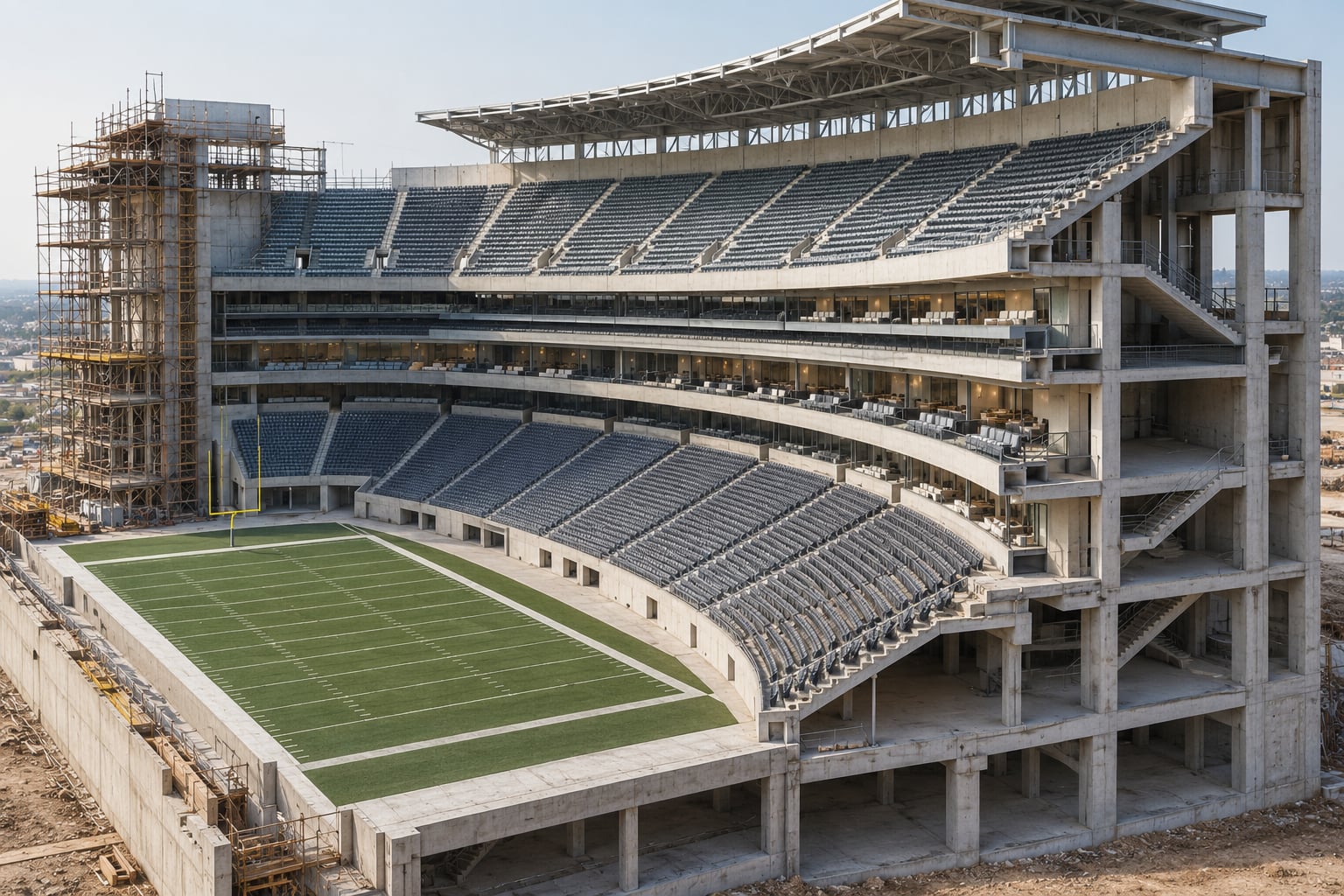
College football stadiums keep getting renovated because athletic departments stopped treating them as concrete bowls with seats. A stadium now has to pay for itself. The buildings that get the biggest upgrades in 2026 are the ones that generate premium seating revenue, host concerts and postseason games, sell recruiting trips, and keep fans comfortable enough to renew. Capacity is a secondary concern, and in a growing number of cases schools are cutting seats outright.
The money confirms it. Roughly 6 billion dollars of college stadium construction was underway in 2025, and about 2.4 billion dollars of projects finished that year, double the 2024 total, with 2026 projected above 3 billion dollars according to HVS, citing Sports Business Journal.
Below is the honest breakdown, including the parts schools would rather you did not read.
Table of Contents
- The short answer: schools are optimizing revenue, not chasing bigger bowls
- Why college football stadiums keep getting renovated at a glance
- Reason 1: Premium seating prints money
- Reason 2: NIL and revenue sharing changed the math
- Reason 3: The venues are old
- Reason 4: The building has to earn its keep 365 days a year
- Reason 5: Fans now expect a finished product
- Reason 6: Recruiting is won in the facility tour
- The twist nobody expects: fewer seats, better seats
- Who actually pays for all of this
- What a renovation actually includes
- Does any of it help the team win?
- When it goes wrong: fan backlash and the Charlotte deal
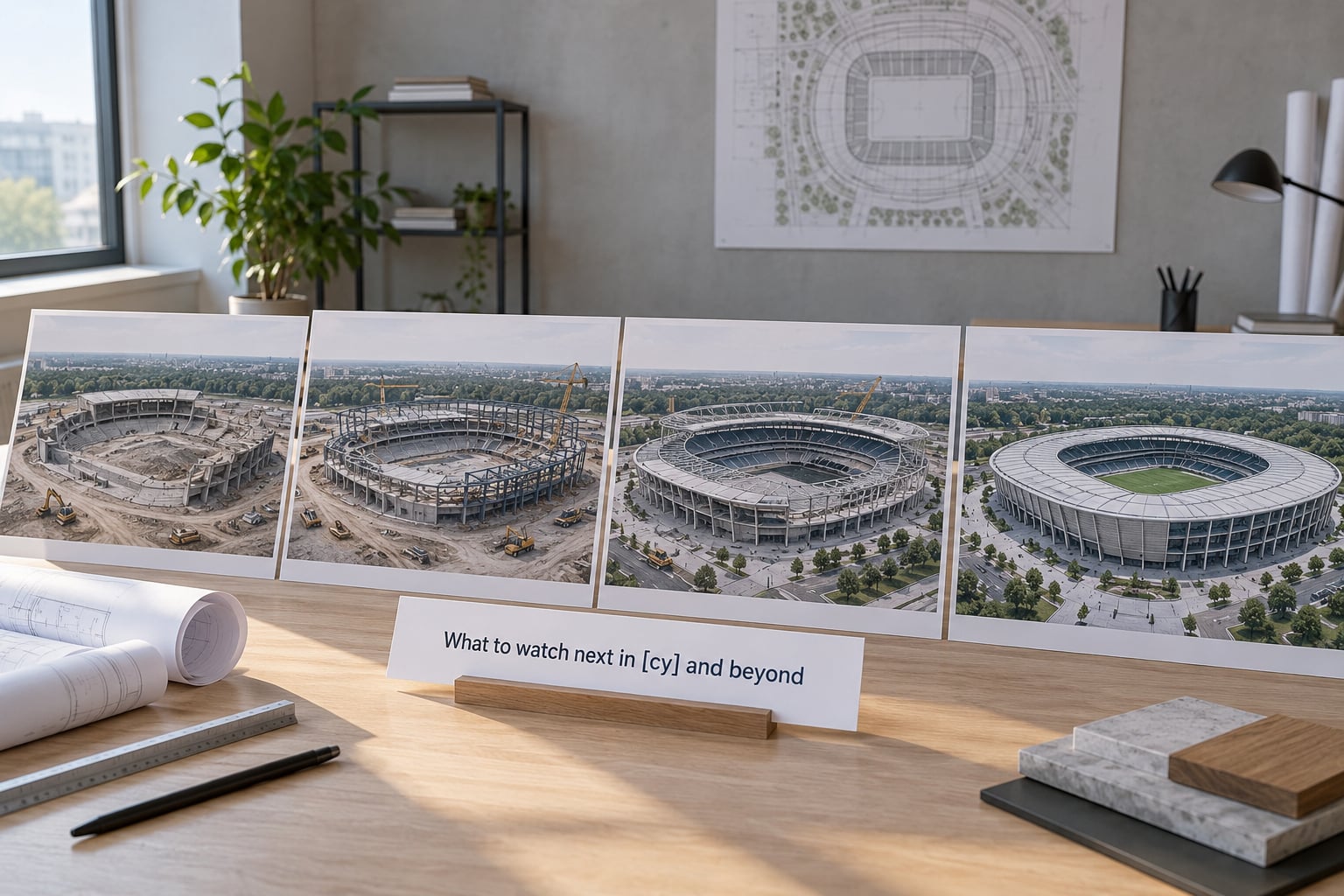
- What to watch next in 2026 and beyond
- Frequently Asked Questions
- What is the most expensive college football stadium ever built?
- Why do college football stadiums have so many luxury suites?
- Why are some colleges cutting their stadium seating capacity?
- Do stadium renovations help a football team win?
- Who pays for college football stadium renovations?
- Are college stadiums built year round now, not just for football?
- The bottom line
The short answer: schools are optimizing revenue, not chasing bigger bowls
Six forces drive nearly every modern college football stadium renovation, and they rarely have anything to do with hosting a bigger bowl game.
- Premium seating pays for everything else. Roughly 12 percent of a stadium’s inventory generates about 46 percent of its ticket revenue, per an Elevate report summarized by NIL Wire.
- NIL and revenue sharing took money out of the facilities line. The same dollar now competes between a suite project and a player payment.
- The buildings are genuinely old. The median power-conference stadium dates to the 1930s. The NFL’s median venue opened in 2001.
- Six to eight home games a year does not cover the bond. Winterizing and mixed-use districts extend the calendar to 365 days.
- Fans punish bad gameday experiences. Wi-Fi, restrooms, concessions and concourse width decide whether people come back.
- Recruiting visits happen in the building. In the transfer portal era, a finished facility is a live pitch.
Everything else in this article is detail on those six. Before going deeper, the table below maps each driver to the evidence behind it and a real project.
Why college football stadiums keep getting renovated at a glance
| Driver | The evidence | Example project |
|---|---|---|
| Premium seating revenue | About 12 percent of seats produce roughly 46 percent of ticket revenue (Elevate) | Beaver Stadium, Penn State |
| NIL and revenue sharing | Schools may pay athletes directly up to 20.5 million dollars starting 2025-26 (HVS) | Clemson Branding Institute content studio |
| Aging infrastructure | Median power-conference stadium age is the 1930s (Elevate) | Beaver Stadium, opened 1959, eight expansions |
| Year-round utilization | About 6 billion dollars of stadium construction underway in 2025 (Elevate) | Liberty Bowl Memorial Stadium, Memphis |
| Fan experience expectations | 80 percent of surveyed power-conference fans want at least one premium option (Elevate) | Ohio Stadium concourse work |
| Recruiting | Transfer portal made facility tours a standard stop on the visit | Ryan Field, Northwestern |
One caveat on the table: most of these figures come from industry research funded by stadium vendors and suites sellers, so treat them as directional rather than audited. The direction is what matters, and everyone in the industry is pointing the same way.
Reason 1: Premium seating prints money
This is the whole ballgame, and the numbers are lopsided enough to be memorable. Premium inventory, meaning suites, club seats, loge boxes, ledge seats and field-level boxes, makes up roughly 12 percent of a stadium’s seats. It produces about 46 percent of ticket revenue.
That gap exists because an upper-deck general admission seat sold at face value and a field-level box sold to a company for ten times the price are both, technically, one seat. Add in hospitality space, which is real estate rather than seating, and the ratio gets even better for the school.
The demographics matter too. Fans aged 22 to 32 will spend about 28 percent more on premium seating than older cohorts, per the same Elevate data, and 80 percent of surveyed power-conference fans said they are interested in at least one premium seating option. Those two findings sit in tension with the loudest criticism of stadium projects, and we will get to that tension later.
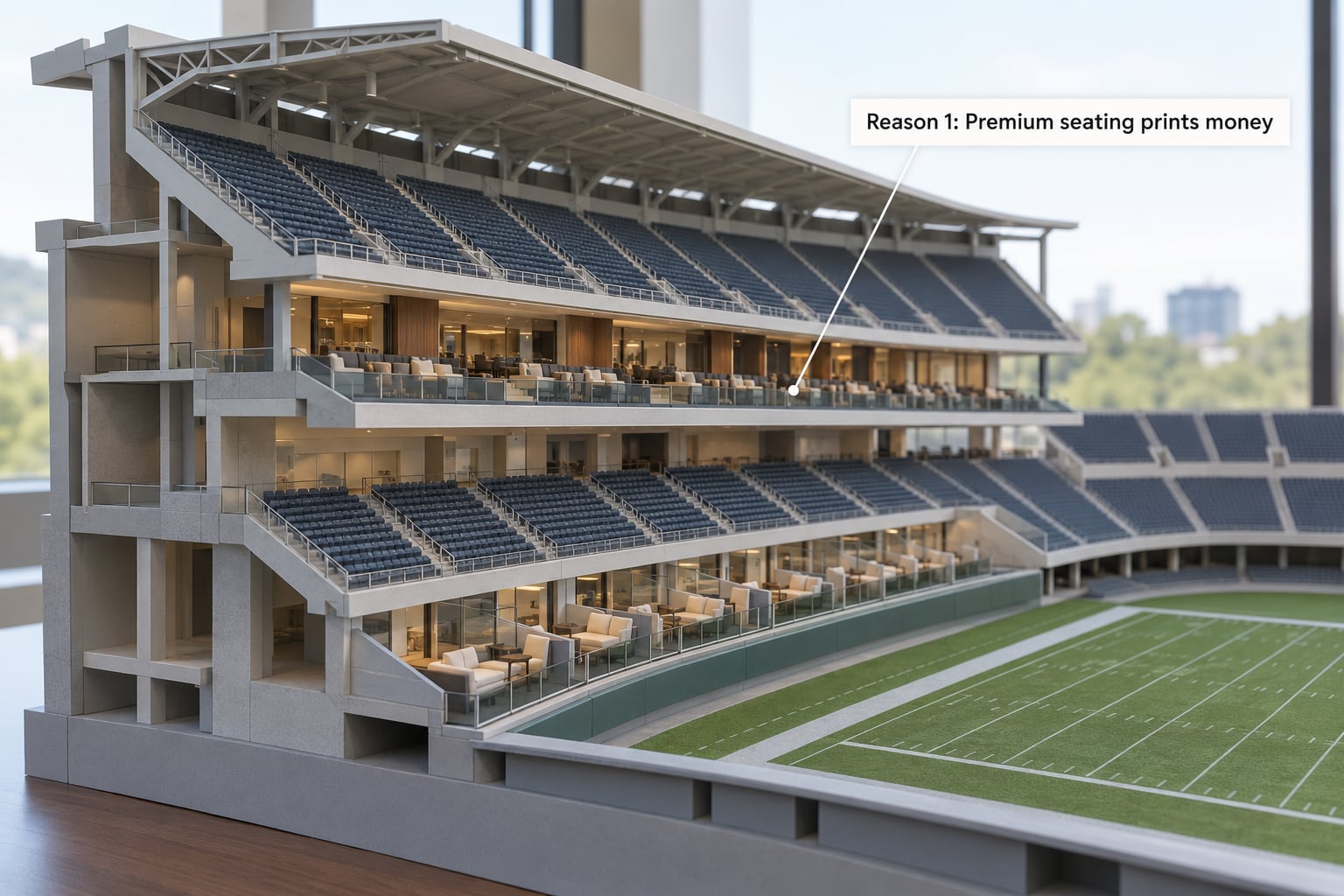
That is why an increasing number of projects start with the same move: take a slab of upper-deck bleachers, cut it into suites and clubs, and sell the revenue stream to donors and local businesses. The concrete bowl stays the same size. The economics underneath it change completely.
Beaver Stadium is the cleanest example of the pattern at scale. Penn State’s project, designed by Populous, has a reported cost of 700 million dollars, and its scope includes executive suites, loge seating, winterizing and code and accessibility upgrades. Archinect, which reported the figure in October 2023, described the project as a mix of revenue generation and keeping an old building compliant.
Northwestern’s Ryan Field went further, at roughly 850 million dollars by HVS’s accounting. Both figures are large enough to sound absurd until you divide them by the number of premium seats being created and the decades a debt can be spread across.
Reason 2: NIL and revenue sharing changed the math
Name, image and likeness money arrived in 2021, direct revenue sharing followed, and in 2025-26 schools can make direct athlete payments of up to 20.5 million dollars per athlete under the House settlement. HVS, citing NIL-NCAA.com, projected roughly 2.25 billion dollars in total NIL and revenue-sharing compensation.
Prior to that, a booster’s discretionary dollar mostly funnelled toward facilities and the program ranked the department. Now the same dollar can go to a starting quarterback. That single change explains most of the urgency behind renovation projects.
The athletic directors have been open about the squeeze. Tilman Fertitta at Houston and Ross Bjork at Ohio State have both said publicly that player compensation pulls money away from facilities. Bjork has talked about the tradeoff directly, and HVS quoted both men on it.
Here is the logic schools use, and it is not silly. If player pay is going up by millions a year regardless of what the department does, the department needs revenue that does not depend on the football team winning, that does not require selling more tickets, and that does not vanish in a losing season. Premium suites, hospitality leases and non-football events are exactly that revenue. They are how the school funds the things that keep athletes and recruits happy.
It also explains a project category that did not exist five years ago: content creation studios. Clemson’s Branding Institute, Kentucky’s downtown studio and Murray State’s NIL studio were built so athletes could produce sponsored content inside campus, close to the athletics facilities rather than in a separate building across town.
Reason 3: The venues are old
Here is the least glamorous reason and probably the most important one. The median stadium in a power conference opened in the 1930s, per Elevate, while the NFL’s median venue dates to 2001. A college stadium can be a quarter-century older on average than its professional counterpart, and the reason is simple: colleges can defer for a very long time.
Deferral works until it doesn’t. Structural steel reaches the end of its service life, original wiring cannot carry the load of modern production lighting and video, and concrete that was poured before current seismic and life-safety standards gets evaluated against those standards anyway. Accessibility requirements are the same story, and unlike a private suite, a code upgrade cannot be negotiated away.
Beaver Stadium opened in 1959 and has been expanded eight times. That history is not a criticism. Every expansion solved a real problem, and collectively they produced a 106,572-seat building with a circulation system nobody would design from scratch in 2023.
Heritage venues add a wrinkle worth naming. The Rose Bowl in Pasadena and Michigan’s Big House are not candidates for the standard loge-and-suite program, because what makes them valuable is the opposite of a modern fan environment. When a school decides to keep a stadium exactly as it is, that is also a deliberate capital decision.
Reason 4: The building has to earn its keep 365 days a year
A stadium that hosts six to eight home games generates a thin return on a very expensive asset. That is the core problem, and it explains the growth of winterizing, a term for adding heating, insulation, plumbing capacity and enclosed concourses so a building can operate in cold months.
Winterizing is expensive and unglamorous. It is also what makes a stadium bookable in November, December and January, which is when the money is. Once a venue is weather-ready, the calendar can include concerts, professional soccer, hockey, lacrosse, high school championships, rodeos, monster truck shows and specialty events like the Savannah Bananas tour.
Memphis makes the case plainly. Ed Scott, the athletic director there, said the Liberty Bowl Memorial Stadium renovations were designed to attract concerts and other revenue-generating events once construction finished, and the project was widely covered in 2026 as a football venue with a second career.
The other half of the strategy is what happens around the building. Entertainment districts, mixed-use developments with hotels, restaurants, offices and retail, turn a stadium from an isolated concrete ring into an anchor that justifies parking garages and public transit. The stadium stops being the reason the trip happens and becomes one stop in it.
Highmark Stadium in Buffalo is a related case with a different ending. It is being replaced rather than renovated, which is the tell that a venue’s location and market can matter more than its bones when the postseason destination no longer works for the program using it.
Reason 5: Fans now expect a finished product
Ask a fan what a good stadium feels like and you will not hear about capacity. You will hear about whether they could get on Wi-Fi, whether they could find a restroom that was not out of paper towels, and whether a twenty dollar hot dog was worth twenty dollars.
That sentiment is well documented in the college football forums. On r/CFB and r/NCAAFBseries, recurring threads about what fans want improved almost always land on the same list: more restrooms, better food, faster lines, reliable wireless service. One of the most repeated lines in those discussions is that not being able to get online is a dealbreaker.
The upgrade packages schools now plan follow that list exactly. Grab-and-go stands with self-checkout replace long concession lines. Mobile ordering lets a fan skip the queue and pick up food near their seat. Concourses get wider so circulation does not gridlock. LED boards replace aging video systems that burned power and failed in rain.
There is an equity problem hiding in here. Every one of those improvements makes the good gameday better and does nothing for the fan in the upper deck on a student budget, which is where the resentment comes from. Forum threads about luxury facilities tend to split into people who loved the new Wi-Fi and people who object to being priced out. Both reactions are rational.
Reason 6: Recruiting is won in the facility tour
Recruiting is the least documented return on a stadium project and probably the one athletic departments believe in most.
The forum consensus, from r/NoStupidQuestions threads on why programs build fancy facilities to HuskerMax debates about Nebraska’s stadium plans, treats recruiting as the hidden payoff. In the transfer portal era, prospects commit in days rather than years, and a recruiting visit is now a full campus itinerary. The practice facility tour that once ended at the weight room now ends in a stadium with a players’ tunnel, a video board and a dining hall.
The argument for it is straightforward. If two programs offer the same coaching staff, the same scheme and the same academic path, the tiebreaker is the building. Fans are skeptical about the return, mostly because facilities do not win games, but the people making the decision for recruits seem to disagree.
The twist nobody expects: fewer seats, better seats
Here is the detail that surprises people who assume bigger is always better: a number of schools are cutting capacity on purpose.
Florida State trimmed seating at Doak Campbell Stadium as part of its premium seating work. Oklahoma has done similar surgery. The trade is straightforward math. Every low-yield general admission seat removed makes room for high-yield premium inventory, and the school’s per-seat revenue goes up even as its headcount goes down.
For most major programs the seat count is not the point. Michigan is not filling 107,000 seats. Alabama, Ohio State and Nebraska are not either. At that scale the game is the ticket, the alumni network and the broadcast product, and the bowl bid, which depends on stadium quality and availability rather than raw capacity.
For smaller programs the calculus flips entirely. Conference USA and Sun Belt venues often cannot fill their seats on a good day, so adding inventory for a big rival helps and adding 10,000 more seats does not. Some mid-major fans argue that smaller, distinctive stadiums are more fun than half-empty expansions, and they have a point.
What is lost in the trade is the cheap seat. When schools convert general admission sections into suites and loge boxes, the entry price for the most committed fans often rises. That is the part of this equation that shows up in every forum thread, and it is the part that is least likely to change.
Who actually pays for all of this
Four pools of money fund stadium projects, and the mix matters more than the total.
Donor naming gifts. The largest single check usually comes with a name on the building. It is the fastest money available and the most public.
Premium seat leases. Companies and wealthy donors pay for suites and boxes on multi-year deals. The revenue lands before construction finishes, which is how a project gets financed at all.
The athletics budget. This is the least glamorous source and the one that surprises people. Penn State’s Beaver Stadium renovation was funded entirely by the athletic department specifically so the school could say no tuition increase was needed, according to Archinect. That framing is a political decision as much as a financial one.
Public money and bonds. State and local funds come in for infrastructure around the venue, and public financing is where the controversy concentrates.
Charlotte’s failed stadium deal is the cautionary case worth knowing. The proposal was named 2024’s worst economic development deal of the year by a local advocacy organization, and the objection was straightforward: the city was being asked to absorb financial risk for a private venue whose upside accrues mostly to the team and its donors. When public money enters the picture, the accountability question arrives with it.
Compare that with the NFL model, where teams routinely fund venues privately and municipalities handle only roads, transit and policing. Colleges cannot always play that game. A university’s stadium sits on land that is publicly owned and often publicly financed, and that structural difference is why the Charlotte-style fight keeps recurring.
What a renovation actually includes
When a school announces a project, the headline number covers a specific list of work. Most projects contain some combination of the following.
- Premium inventory conversion. Upper-deck and end-zone seats rebuilt as suites, club seats, loge boxes and field-level boxes, often with a players’ tunnel attached.
- Winterizing. Heating, insulation, restrooms and enclosed concourses so the venue works outside football season.
- Technology. New LED video boards, sound systems, production infrastructure and high-density wireless networks.
- Concourse and concession rebuilds. Wider circulation, more restrooms, grab-and-go stands, self-checkout and mobile ordering.
- Code and accessibility work. Ramps, seating and sightline upgrades, life safety systems and structural retrofits that are non-negotiable.
- Seat replacement. Old upper decks get new seating, often fewer seats in better positions.
- Player and NIL space. Training facilities and content studios, sometimes inside the stadium bowl itself.
Items one and five are the ones that dictate the price. Item seven is the newest line on the invoice.
Does any of it help the team win?
Honest answer: probably not directly, with one exception.
Athletic Business has covered this question, and the reporting there is more skeptical than the industry trade press. The core finding is that a modern facility program can plausibly be justified on amenities and fan experience, while the on-field returns are much harder to demonstrate.
The exception is recruiting. That is a real, if indirect, competitive effect. Better recruiting classes turn into better rosters, and no one has ever explained how a club with a good training facility loses that argument in a recruiting war.
The second exception is revenue flexibility. A stadium that earns money in December lets a coach keep a director of football when budgets tighten, and that continuity matters more than a single facility feature ever will.
What facilities almost certainly do not do is make a team faster or better-coached. Anyone promising that is selling you something.
When it goes wrong: fan backlash and the Charlotte deal
Not every renovation lands well, and the failures are more useful than the successes.
Cost inflation is the most common source of backlash. Fans routinely react badly to numbers like Oregon State’s Reser Stadium renovation, reported at more than 324.5 million dollars over a 50-year lifespan. The reaction is not about the amount per se. It is the sight of a per-seat cost that will be spread across generations of students who never see a game.
Losing general admission seating is the second reliable flashpoint. Every conversion of cheap bleachers into expensive boxes produces a thread arguing the school is selling its soul to donors, and every one of those threads has a point, because the seat is genuinely gone.
Charlotte is the third, and the sharpest. A stadium and development package that drew a local economic development group’s worst-deal-of-the-year designation failed in part because the risk was socialized and the rewards were not. It is the pattern fans everywhere are watching for.
Construction disruption is the quiet fourth. Projects that take out a tunnel or close a concourse for a season generate years of resentment from people who simply want to watch football. Ohio State’s stadium tunnel renovation is the kind of thing that outlasts the project itself in memory.
What to watch next in 2026 and beyond
Four trends will define the next round of projects.
Billion-dollar projects get normalized. Ryan Field at roughly 850 million dollars and Beaver Stadium at 700 million dollars set a range that is no longer treated as outrageous. Expect more schools in the 500 million to 1 billion dollar band.
More replacement rather than renovation. When a venue’s location no longer works, schools are choosing new builds over endless retrofits. Highmark’s replacement in Buffalo is the model.
Entertainment districts become mandatory scope. Mixed-use development is moving from a nice idea to a line item, because it is the only mechanism that monetizes the land around the venue.
Facilities compete with athlete pay, openly. Expect more public debate in which schools explain what they chose to fund and why, because the alternative conversation is louder.
Conference realignment adds pressure of its own. A school moving to a different league changes its television market, its donor base and its schedule profile, and a stadium project often follows within a few years of the move.
Frequently Asked Questions
What is the most expensive college football stadium ever built?
Cost records depend on whether you count inflation, and the totals are often inflated by scope creep. Among the most expensive recent projects are Northwestern’s Ryan Field at roughly 850 million dollars by HVS’s accounting and Penn State’s Beaver Stadium renovation at a reported 700 million dollars, per Archinect. Older builds, adjusted for inflation, rank even higher.
Why do college football stadiums have so many luxury suites?
Because suites are the best revenue per square foot a stadium can offer. Premium seating is roughly 12 percent of a stadium’s inventory but generates about 46 percent of its ticket revenue, per an Elevate report. Suites also create multi-year lease income that arrives before construction ends, which is what makes the rest of the project financeable.
Why are some colleges cutting their stadium seating capacity?
The trade is deliberate. Removing low-yield general admission seats makes room for high-yield suites, loge boxes and field-level boxes, so revenue per seat rises even as the headcount falls. Florida State and Oklahoma are both examples of schools trimming seating during premium inventory projects. The cost is that the cheap seat disappears.
Do stadium renovations help a football team win?
Not directly. Athletic Business reporting finds the on-field case is difficult to make, and amenities explain most of the spending. The two indirect effects are real though: recruiting, where a finished facility is a live differentiator in the transfer portal era, and revenue stability, which lets a department keep coaches through a losing season.
Who pays for college football stadium renovations?
Usually a mix. Large donor naming gifts and multi-year premium seat leases provide the front-loaded capital. The athletic department covers the rest, as Penn State did for Beaver Stadium specifically to avoid a tuition increase. State and local funds often support surrounding infrastructure, which is where the Charlotte-style public accountability fight comes in.
Are college stadiums built year round now, not just for football?
Increasingly, yes. Winterizing adds heating, plumbing and enclosed concourses so a venue can host concerts, soccer, hockey, rodeos and specialty tours outside the football season. Related searches from fans asked why Memphis stadium work was designed around concerts, which is the clearest example of a school treating the bowl as a year-round commercial asset.
The bottom line
College football stadiums keep getting renovated because the sport’s economics changed and the buildings did not. Premium seating, NIL-driven budget pressure, a 1930s median building age, a year-round revenue calendar, raised fan expectations and recruiting all point at the same conclusion: the stadium is now a commercial asset with a football team attached.
Whether that is good depends on where you sit. Season ticket holders who use the Wi-Fi and like the new food options get a better building. Students and families watching prices climb get priced out of the cheapest seats. Fans who wanted a bigger bowl will not get one.
If you are tracking a specific project near you, look for three things in the announcement: how many general admission seats are being converted, who is signing the premium leases, and whether the school promises anything about tuition. Those three answers tell you most of what you need to know before the cranes arrive.