A play-action pass is an offensive play in which the quarterback gives the ball to a running back, pulls it back, and throws downfield. The fake draws the defense toward the line of scrimmage, which moves linebackers and safeties out of the passing lanes the quarterback wants to use.
Most of the magic is visual. Nobody on defense can see inside the quarterback’s head, so a good fake makes everyone commit early, and that commitment is the whole reason the play works. Once you can see the mesh, the pull and the safety’s leverage in slow motion on film, the play stops looking like a trick and starts looking like geometry.
Table of Contents
- What Is Play Action Passing?
- How Play Action Passing Works Step by Step
- The Three Parts of a Play Action Pass
- How the Fake Handoff Creates a Defensive Mistake
- Why Quarterbacks Use Play Action Passing
- What Timing Is Involved in a Play Action Pass?
- How to Read Play Action as a Defensive Fan
- Common Play Action Variations
- A Simple Arizona-Style Play Action Example
- Why Some Play Action Passes Fail
- Frequently Asked Questions
- What is the difference between play action and a quarterback keeper?
- How do defenders know when a quarterback is faking the handoff?
- Does play action passing work best against man coverage or zone coverage?
- What is the mesh point in a play action pass?
- How much time does a quarterback have to throw after the fake?
- Why do offenses run play action before their best passing play?
- Conclusion
What Is Play Action Passing?
It is called play action because the offense performs the action of a run before it performs the action of a pass. That is the entire name, and the entire concept.
Compare it with three similar-looking plays so the difference is clear:
- A plain dropback uses the same backfield action as a run, but the quarterback never shows a handoff. Defenders know it is a pass, so nobody is fooled.
- A play-action screen also uses a fake, but the ball goes to a running back or tight end in the flat. The quarterback may not even keep the ball.
- A quarterback keeper looks similar in the backfield, except the quarterback keeps the ball and runs. The ball is hidden in the exchange, not faked away.
The purpose of play action is deception with a purpose behind it: create better geometry for a real pass rather than sneak one into a covered window.
How Play Action Passing Works Step by Step
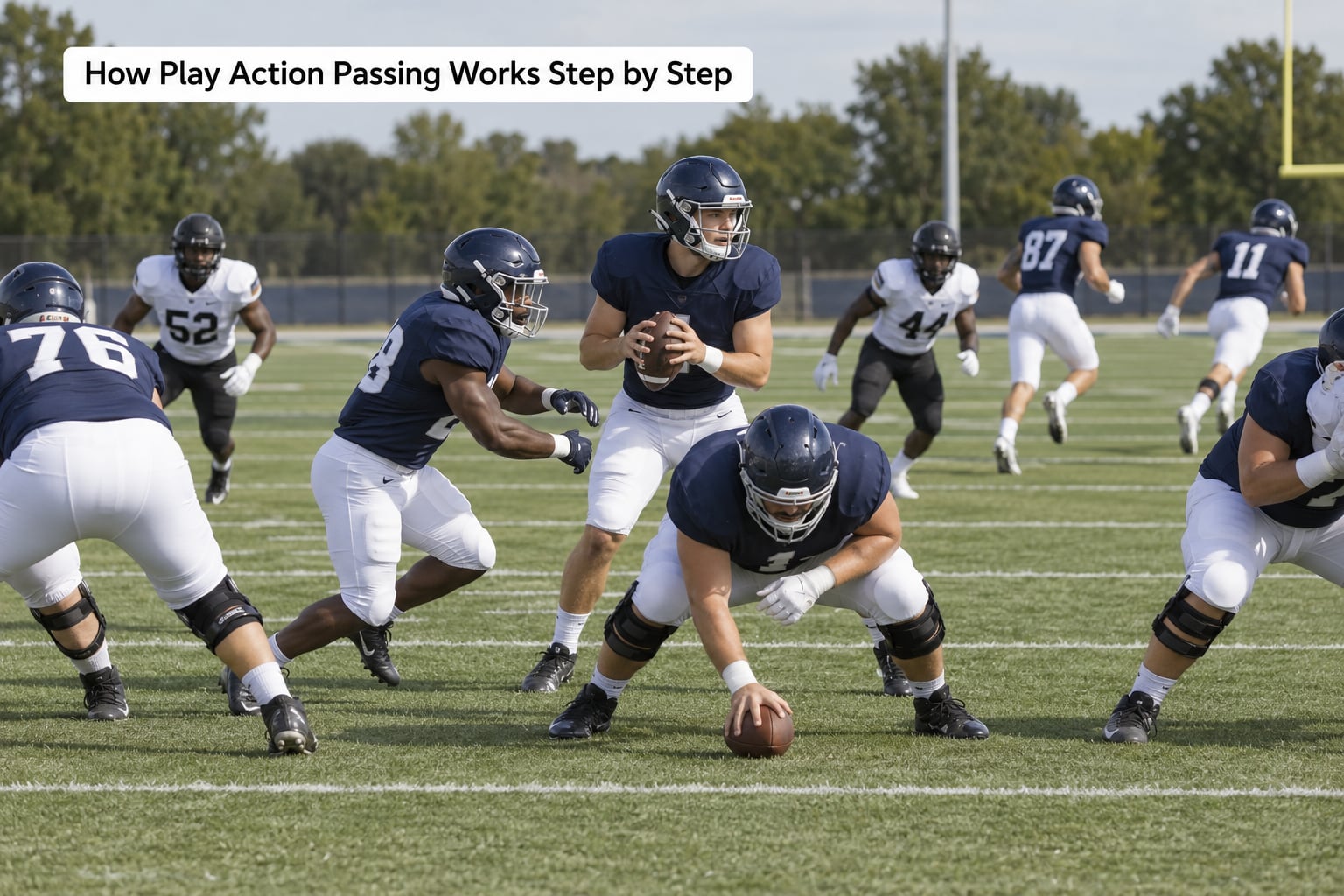
Here is the sequence, in the order it actually happens.
- The snap and the mesh. The center snaps the ball, and the running back moves across the quarterback’s path to take the handoff. The point where the two players cross is called the mesh point, and the exchange is supposed to look exactly like a real one.
- The fake handoff. The running back takes the ball, keeps it, and follows the designed run path. If he stops short, the deception dies immediately.
- The pull. One or more offensive linemen leave their run-blocking assignments, cross the formation, and head toward the quarterback’s backfield or the edge of the pocket. This is what makes a real pocket appear out of a blocking scheme built for a run.
- The pullback and read. The quarterback brings the ball back to his body, steps into the space the pull just created, and looks downfield. Only now does he decide to throw.
- The release. He throws to a receiver running a route designed around the movement the fake caused, usually a crossing route, a shallow dig, or a shot downfield.
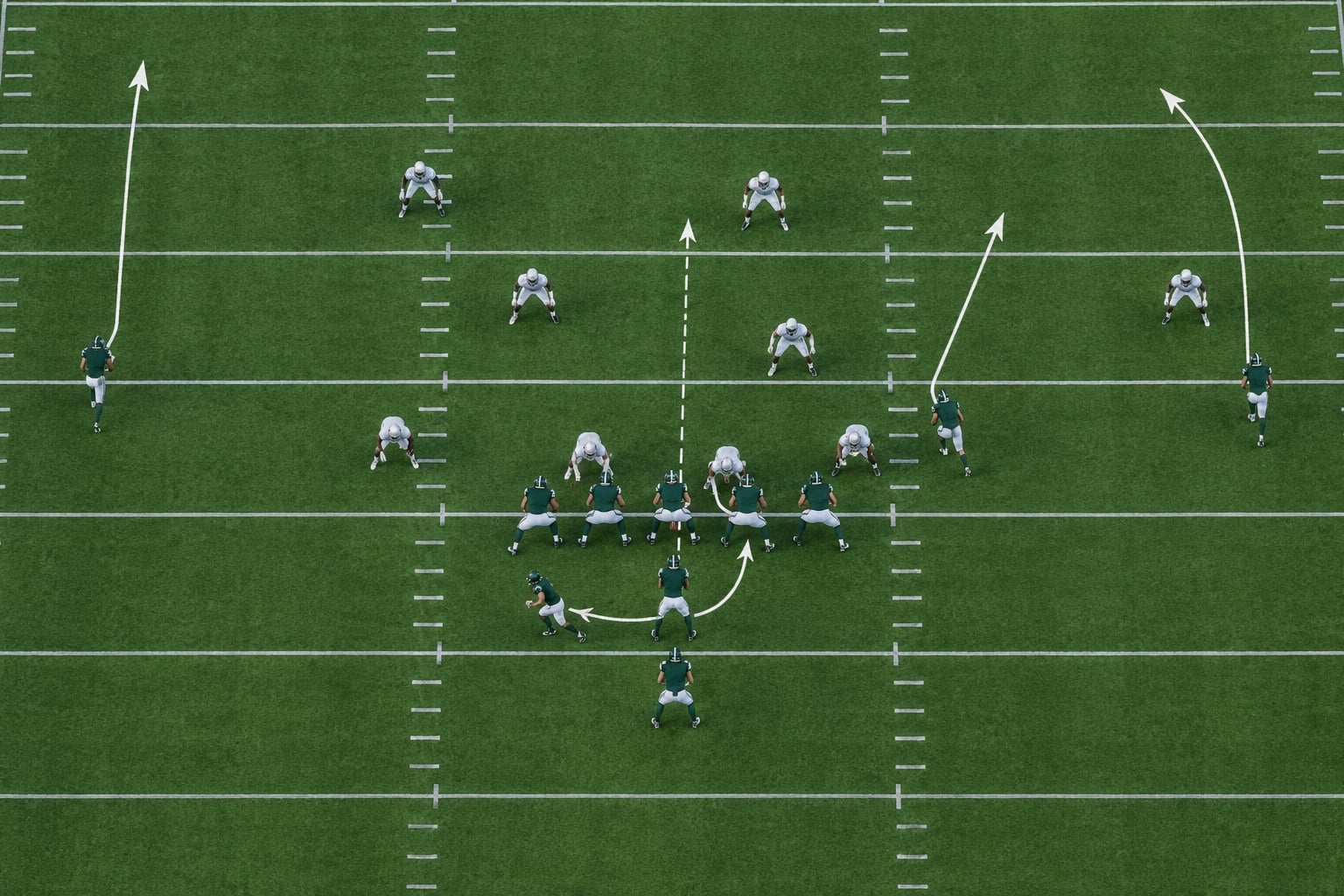
To picture it, imagine a five-man protection concept out of the shotgun with a guard pulling around. The quarterback takes the snap, the back crosses for a fake, the guard loops from the right side, and the pocket forms from the backfield outward instead of around the quarterback. Every player who looked at the backfield on the snap made a decision that the quarterback is now punishing.
The Three Parts of a Play Action Pass
Every play-action pass has three working parts, and they succeed or fail together.
The run fake does the deceiving. It includes the running back’s path, the exchange, the quarterback’s hands, and the blockers who sell the idea of a handoff.
Protection and timing do the physical work. A play action pass is usually slower to develop than a dropback because the quarterback has already spent a fraction of a second giving the ball away. Max protection schemes exist for exactly this reason, and protection that is too weak gives the defense a free rush.
The pass itself does the scoring. Flood, Mills, and shot concepts are the most common attachments because each puts receivers in vertical space the linebackers just vacated.
When only one part works, the play usually fails. A perfect fake with no time to throw is a sack. Great protection with a slow fake is a play action that arrives after the coverage has adjusted.
How the Fake Handoff Creates a Defensive Mistake
Defenders are not guessing randomly. They are reacting to what the offense showed them on the snap, and in the first second most of them have already decided what the play is.
Linebackers are the most common victims. A linebacker reads the quarterback’s hands and the running back’s depth. When both look like a handoff, the linebacker takes a step or two downhill to fill the run gap, often with a linebacker in the flat already behind him.
Safeties make a similar read from deeper. A safety who believes the play is a run gains depth and closes toward the line of scrimmage, because a safety deep in a run is a wasted defender.
Several details decide whether the fake sells:
- The running back’s path. He has to look like a runner aiming at a gap, not a back drifting sideways.
- The exchange. A handoff with no ball, or a ball delivered after the quarterback has already turned his shoulders, is a tell.
- Blocking technique. Run blocks are low and wide with sustained contact. Pass blocks are upright and quick. If the line looks like a run, the defense has a legitimate reason to trust it.
- Quarterback base and eyes. A quarterback who has faked often drifts toward the mesh point as he looks downfield, and that head turn tells a safety everything.
Coaches who break down film say the same thing: the deception between the pulling lineman and the fake to the back has to be simultaneous. Show the run for one extra beat and the defense is right to ignore you.
Why Quarterbacks Use Play Action Passing
Quarterbacks run play action for five practical reasons.
It buys time. The quarterback’s hands are busy for roughly half a second. Extra protection, usually max protection with six or seven blockers, keeps rushers away while he gets the ball back.
It clears the middle. Linebackers step toward the run and leave a gap in the middle third of the field. A dig route thrown into that vacated space is one of the highest-percentage throws in football.
It creates mismatches. A linebacker who took two steps downhill and a safety who gained depth are now matched against receivers in space.
It opens underneath and downfield. Underneath, the simple flat or hitch throws become available. Downfield, the movement in the box leaves the deep middle open for a post or a shot.
It disguises intent. Defenses adjust to what they have seen most. A team that mixes in play action makes every other concept harder to diagnose in the two seconds before the snap.
What Timing Is Involved in a Play Action Pass?
Timing is the part fans usually miss, and it is the difference between a working play and a highlight-reel mistake. Watch the same play at full speed and at quarter speed and the delay becomes obvious.
| Moment | What defenders see | How the offense exploits it |
|---|---|---|
| The snap | Backfield action, blocking shape, motion | Everything after the snap is a reaction to the snap |
| The mesh | A handoff that looks real | Linebackers step up, safeties close |
| The pull | Linemen leaving run blocks | A pocket forms behind the moving line |
| The pullback | Quarterback’s head turning downfield | Deep safeties hesitate, leaving the middle open |
| The release | Arms coming forward | The defense is already one step behind the throw |
The receivers know the same clock. Routes are timed so a crossing route meets the ball at the same moment the quarterback’s foot lands after the pullback, which is why route timing matters more here than on a quick dropback.
How to Read Play Action as a Defensive Fan
You do not need coaching credentials to spot a good fake. Look for these five things.
- The quarterback’s base. A quarterback holding a real handoff has his hands low and forward. A quarterback keeping the ball has it tucked, and a quarterback faking often pauses for a fraction of a second.
- The running back’s depth. If the back never gets to the line of scrimmage with the ball hidden, the fake is weak.
- Early receiver releases. Receivers who run full speed off the line on a play called as a run often reveal the play.
- Unusual linebacker movement. A linebacker stepping downhill and looking at the ball carrier rather than dropping is the clearest sign of a bite.
- The blocking shape. Low, wide, sustained run blocking suggests a run. Upright, retreating pass blocking says the opposite.
Pause the film at the moment of the snap and ask one question: what did the defense decide to do? Then watch whether the quarterback threw at that decision. That single habit explains most of what people notice in games.
Common Play Action Variations
The variation names mostly describe where the quarterback goes and what kind of fake sells it.
| Play | Fake | Protection | Quarterback read | Best against |
|---|---|---|---|---|
| PA Slide | Handoff to the back | Slide to the pull side, five or six blockers | Dropback inside a pocket | Linebackers biting early |
| PA Boot | Full flow handoff, back runs a deep fake | Extra blocker leads, quarterback rolls out | Flats and crossing routes on the run | Two-high safety shells that over-commit |
| Shot Play | Handoff, defender takes an inside step | Play-action protection | One contested deep throw | Defenses with an inside linebacker lean |
| PA Read | Handoff taken straight off the mesh | Read option protection | The defender’s read itself | Disciplined linebackers |
| Waggle | Under-center handoff | Rollout to the opposite side | Rolling pass, or a designed run | Defenses that over-pursue the fake |
| Sprint-out and delayed action | Abbreviated or late handoff | Rolling protection | Quick throws on the move | Man coverage and pressure looks |
One note on terminology, because coaches argue about it in forums constantly. A PA Read is not ordinary play action. It is a read option with a passing branch attached, and the read belongs to the running back, not the quarterback. Coaches building personal playbooks often conflate the two, which is why the term causes confusion in film sessions.
A Simple Arizona-Style Play Action Example
Here is a generic college example, invented for illustration rather than taken from any real play or roster.
The offense is in the shotgun with a quarterback, a running back offset to one side, and five offensive linemen. The running back starts wide, then crosses in front of the quarterback to take a mesh handoff at the point where the two players meet in front of the line. A guard pulls from the back side to form a pocket on the quarterback’s front side.
The routes are a pair of shallow crossing routes, a flat, and a corner route that clears the top of the window. The safety reads the handoff, takes a step downhill to help on the run, and the quarterback throws the crossing route into the space the safety just left.
The same personnel against a bracket coverage produces a completely different result, because the bracket defender stays home and the crossing route is contested. Same fake, different answer. That is the whole strategic argument for play action in one example.
Why Some Play Action Passes Fail
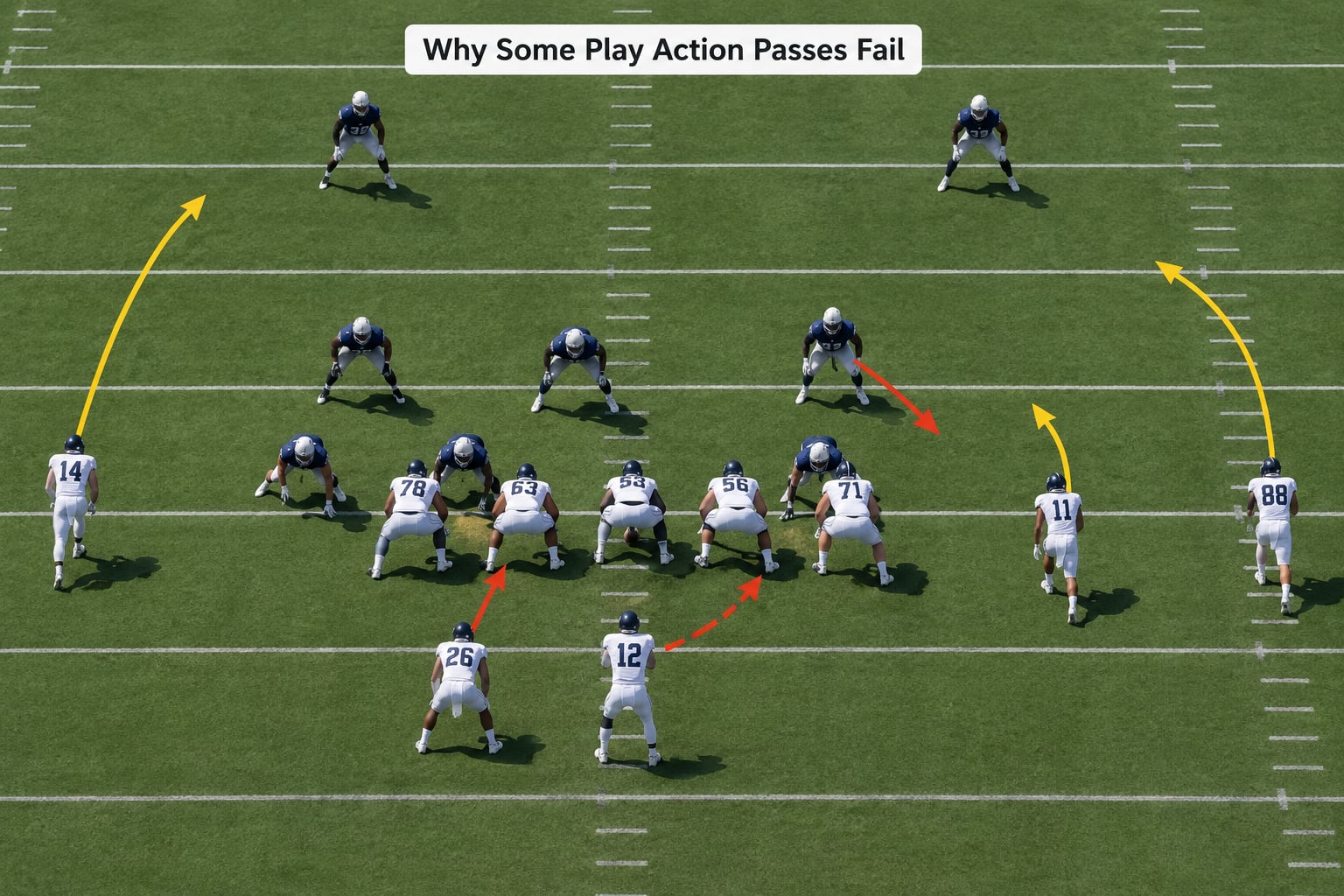
Five problems cause most failed play-action passes, and each has a straightforward fix.
The fake is predictable. If the offense runs play action on every third play from the same formation, the back’s path becomes a habit defenders can time. Mixing in runs, straight dropbacks, and play action on different downs breaks the pattern.
Timing is off. A fake held too long tells the defense what is coming, and a fake that is too quick leaves the quarterback staring down an empty pocket. Drills that fix the exchange to a consistent count solve most of this.
Protection is inadequate. Play action needs one more blocker than a dropback because the quarterback is not a moving target. When the protection is picked up and there is no time to read, the fake succeeds and the play still fails.
Receivers are not actually separated. A play action concept that puts three receivers into the same window gives the defense a traffic jam no amount of deception can fix. The concept has to fit the route combination.
The look is obviously pass. If the running back stops, the quarterback stands upright, and the routes are already at their breaks, defenders recover early. This is why run fakes in modern offenses frequently look identical to real running plays.
Coverage matters too. Quarters coverage, where a safety plays deep half, and bracket or matchup coverage, where a defender follows a specific receiver, are the two setups that most often neutralize a play action pass. A defense that has read the play correctly can recover because the quarterback has already given up half a second.
Formations are less of a limitation than people think. Play action works under center, out of I-form, from the pistol and from the shotgun. The real difference is the angle of the mesh and how far the defense has to trust the backfield, not the formation name.
Frequently Asked Questions
What is the difference between play action and a quarterback keeper?
A play action pass ends with the ball in the quarterback’s hands and thrown to a receiver. A quarterback keeper ends with the quarterback running with the ball. The backfield action looks almost identical, so defenders have to make the same read either way. The difference only becomes obvious at the moment the quarterback decides, which is why the two plays are often disguised from each other.
How do defenders know when a quarterback is faking the handoff?
They look for the same things an offensive coach watches on film: whether the running back reaches depth with the ball hidden, whether the quarterback pauses with his hands low and forward, whether the blocking looks like sustained run blocking, and whether receivers release early at full speed. One tell is enough. A fake with a single flaw gets diagnosed, and a well-defended play action pass usually contains one.
Does play action passing work best against man coverage or zone coverage?
Zone coverage is the more common answer, because zone defenders have to make their read on the backfield action and then play the whole field rather than one receiver. Man coverage defenders can be pulled step by step by the routes, so the fake matters less. That said, play action against man often wins by creating separation after the linebacker commits, which is why modern offenses use both together.
What is the mesh point in a play action pass?
The mesh point is the exact spot where the running back and quarterback cross paths for the handoff. Timing matters because the running back needs to clear the quarterback’s line of vision, and the quarterback needs to take the ball at the moment that looks identical to a real exchange. Mesh drills exist for exactly this reason, and a rushed mesh is one of the most common reasons a fake fails.
How much time does a quarterback have to throw after the fake?
Less than on a normal dropback, and more than most fans expect. The exchange costs roughly half a second, and a well-called play action concept includes extra protection so the quarterback has time to step into a pocket and read. The practical window is a few seconds, which is enough for one read and one throw, but not enough to stand in the pocket and reset.
Why do offenses run play action before their best passing play?
Because play action is usually run off a run look, and a defense that has just seen a handoff is positioned to stop a pass. Run the play action first and the coverage shell is already leaning toward the run, so the concept that follows gets softer coverage. It is sequencing rather than a statement about which play is better, and the effect disappears if the defense catches on.
Conclusion
Play action passing is coordinated deception built from four things: a run fake that looks real, protection that keeps the quarterback upright, timing that matches the routes, and a passing concept built for the space the fake just created. Miss any one of them and the defense recovers, usually within about two seconds.
Start with the first-second read. Watch a game and pick one defender, usually a linebacker, then freeze the film at the snap and ask what he committed to. If he steps downhill and the quarterback throws into the space behind him, you have just seen the entire principle in one play.