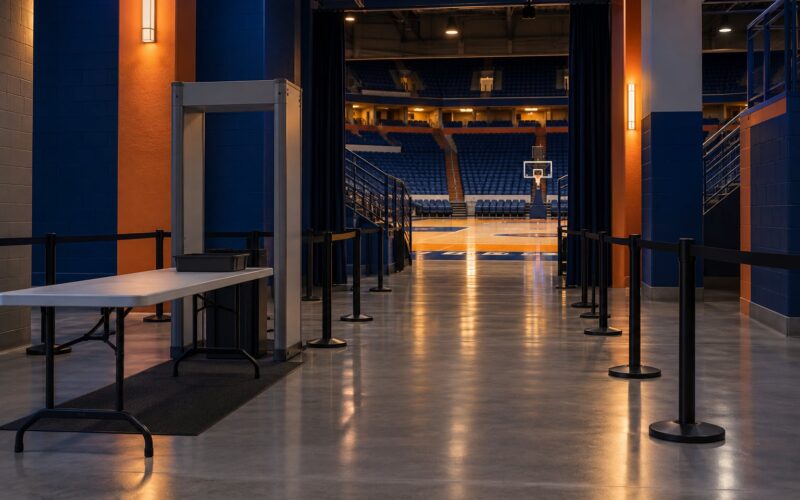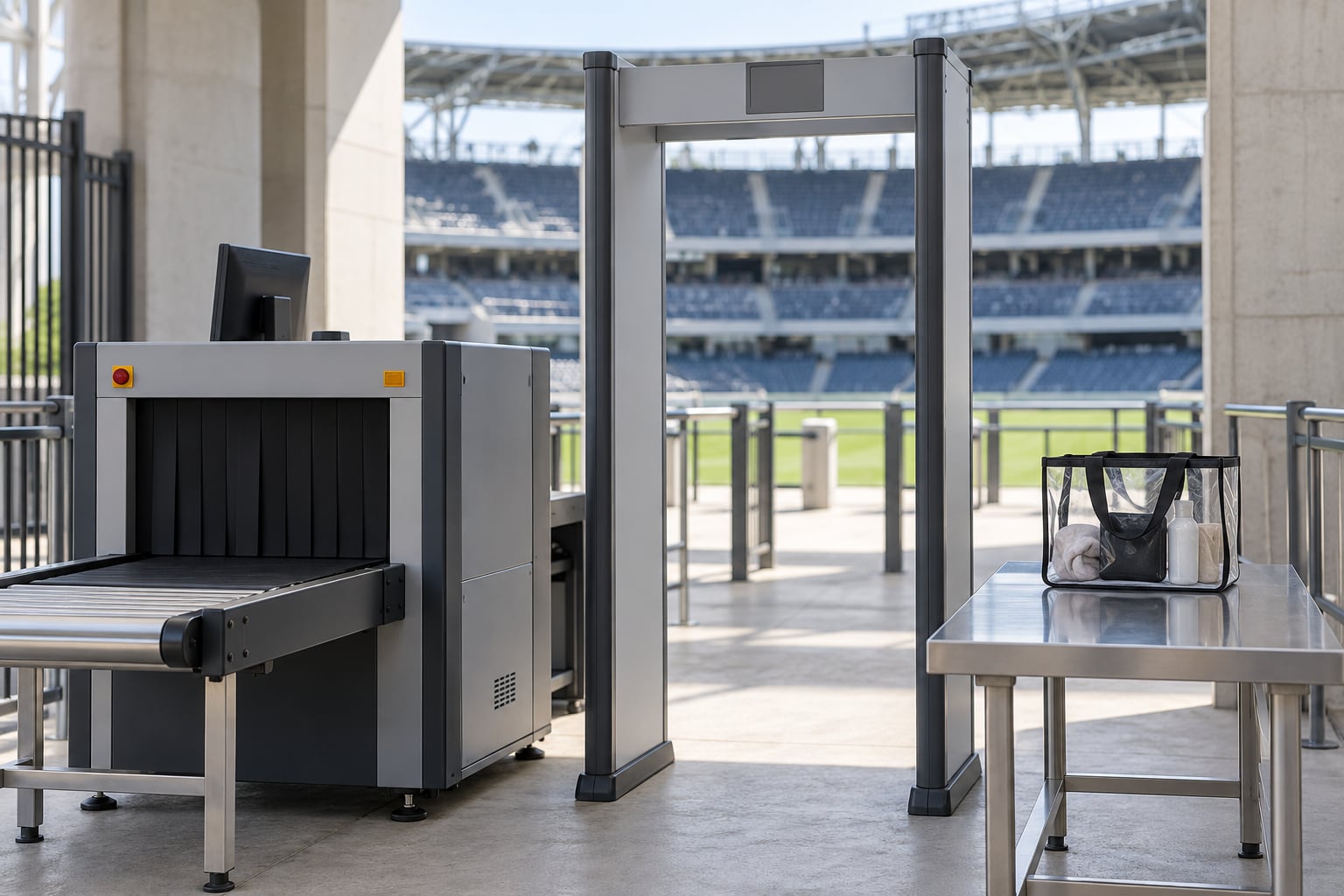
Stadiums have clear bag policies because a transparent bag lets security staff see what is inside without opening it, which turns a hand search into a quick look and moves thousands of fans through the gate faster. The rule also limits what can be carried in, so a prohibited item has to be assembled somewhere that is itself being screened. If you are puzzling over why stadiums have clear bag policies, the short version is speed plus deterrence, and the practical consequence for you is that packing happens before you leave home, not in the parking lot.
For Wildcats fans heading to Arizona Stadium or any college venue, this matters because college policies rarely match the NFL rule word for word. Dimensions, belt bag rules, and beverage limits all vary. Here is what the policy actually is, how the checkpoint works, and what to pack.
Table of Contents
- Why Stadiums Have Clear Bag Policies
- What Is a Clear Bag Policy?
- What Bags Are Allowed at Stadiums?
- How Security Teams Inspect Bags and Screen Fans
- What Can You Bring Through the Clear Bag Check?
- Why Can’t I Bring Certain Items Into a Stadium?
- What Happens If My Bag Does Not Meet the Policy?
- How Can I Avoid Delays at the Stadium Gate?
- Frequently Asked Questions
- Check the Venue Policy and Pack Before You Leave
Why Stadiums Have Clear Bag Policies
The rationale behind most stadium bag policies comes down to three things, and only one of them is about catching a specific prohibited item.
1. Visibility replaces opening. A screener at a stadium security checkpoint can look through a clear tote and see the wallet, the phone charger, the sunscreen, and the jacket in about two seconds. A zipper purse takes considerably longer because somebody has to unzip it, spread the contents out, feel around the lining, and zip it back up. When university athletics administrators describe the rule, the language they use is that it is intended to enhance public safety while minimizing time spent searching bags at security checkpoints. That phrase has been consistent across college and pro announcements for a decade.
2. Throughput. Queue length at a stadium entrance is set by the slowest person in the lane, not the average one. If a small share of fans require a full bag search, every one of them holds up everyone behind them. Making most bags visible shrinks that tail, so a venue can run more screening lanes with the same number of staff. That is the real mechanism behind the promise of faster entry.
3. Deterrence and perimeter control. Venue security planning has been shaped since the September 11 attacks by the idea of large public gatherings as soft targets. The Department of Homeland Security’s If You See Something, Say Something campaign pushes awareness and reporting rather than screening technology, but it runs on the same assumption: reduce what an attacker can bring in and reduce the chance of an incident. A clear bag rule narrows the list of things that can be carried past the checkpoint in the first place.
One thing the policy is not: a guarantee that prohibited items get found. Fans point this out constantly, and it is fair. A clear tote can hold almost anything if someone is willing to hold their breath for a wanding. The rule is a low-cost, high-coverage filter, not a metal detector.
What Is a Clear Bag Policy?
A clear bag policy is a venue security rule that limits what fans can carry inside. Most versions require bags to be made of clear plastic, vinyl, or PVC, with size limits and a separate allowance for small non-clear items like a clutch purse.
What you should understand about the term is how little it means on its own. It is not a federal requirement, and there is no national standard that binds a college stadium to a particular dimension. Each venue publishes its own version, sometimes a league hands down a conference-wide mandate that individual schools then implement, and special events can override the published rule entirely.
College venues are also less uniform than NFL ones. A major conference school may sit on a strict clear-bag-only rule, while a smaller program or a non-conference opponent sets its own standard for that game. Treat any bag rule you read about a different stadium as information, not as your policy.
What Bags Are Allowed at Stadiums?
The common version of the rule allows one clear bag per person, plus a few small items. Exact numbers are set by the venue, so check yours before you pack.
| Bag type | Common limit | Notes |
|---|---|---|
| Clear tote or pouch | 12 inch by 6 inch by 12 inch | Clear plastic, vinyl, or PVC. Most frequent stadium size limit. |
| Clear plastic freezer bag | One gallon | Often allowed in addition to the clear bag, sometimes instead of it. |
| Clutch purse, wristlet, or small handbag | About 4.5 inch by 6.5 inch | Does not need to be transparent as long as it fits the limit. |
| Belt bag or small hip pack | Varies by venue | Some venues permit a small belt bag that fits inside the clear bag. Others do not. |
| Crossbody bag | Varies by venue | Frequently approved only if it stays inside the size limit or rides inside the clear bag. |
| Seat cushion | Varies by venue | Listed as allowed at some pro venues, restricted or banned at others. |
| Medical and diaper bags | Exempt, subject to inspection | Normally permitted regardless of the clear bag rule. |
Two practical notes. First, lightly tinted or frosted bags are the most common point of failure. A fan buys a compliant clear tote, the material is smoked or mirrored for privacy, and a screener declines it at the gate. If you want a bag that passes, buy one you can read a newspaper headline through.
Second, the privacy problem is real and so is the workaround. Fans who dislike carrying a wallet and phone in the open put them in an opaque zip pouch or a small organizer inside the compliant clear bag. The outer bag still complies; the contents are simply not on display.
How Clear Bag Policies Work at Stadium Entrances
A screening lane is a sequence, not a single checkpoint. You queue, you reach the front, and you are asked to open your bag and separate your items. Screeners look through your bag, and your person is checked separately with a magnetometer or a handheld wand.
Items that cannot pass through the lane on their own, such as a large drink or a jacket, are usually pulled aside for secondary screening at a nearby table so the main line keeps moving. A clear bag does not skip inspection. It shortens what the inspection involves.
What Security Teams Look For During Screening
A screener’s attention goes to the items that do not belong in a spectator’s bag at all: weapons, glass, oversized containers, and anything that could throw liquid. Those are listed as prohibited items on the venue’s published page, and the screener’s job is to confirm they are absent rather than to inventory your snacks.
If something looks wrong or feels wrong, you go to secondary screening with a supervisor. That is not a confrontation and it is not automatically an offense. It happens for an unexplained cord, an unlabeled bag, or an item the screener cannot identify.
How Security Teams Inspect Bags and Screen Fans
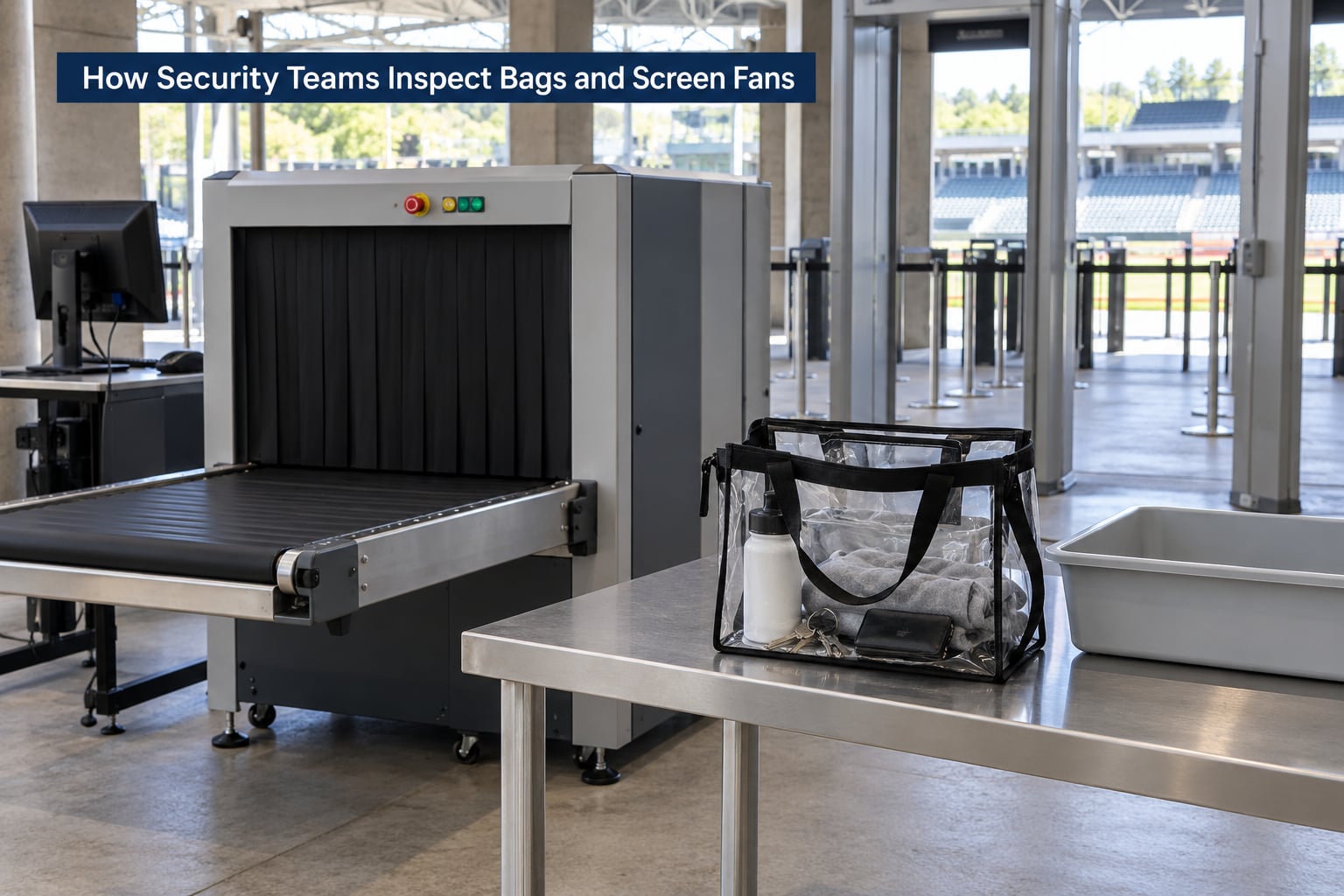
Stadium bag inspection is a visual check first, then a person check, then a hand search only if something triggers it. Most fans never leave the first two steps.
The visual check works because the bag is transparent. A screener looks for prohibited items and for anything the bag is not supposed to contain, and they are looking at the whole interior in one pass rather than item by item.
Your person is screened separately. That is the part of the process that has nothing to do with bags: a magnetometer arch, a handheld metal detector wand, and in some venues a bag search on the way out because of an alert in the stands.
A hand search on the way in happens when a screener cannot identify an object, when a bag looks heavier or fuller than its size suggests, or when a bag is not compliant. Policy for prohibited items found in a bag is generally to confiscate them and, depending on the item, deny entry.
What Can You Bring Through the Clear Bag Check?
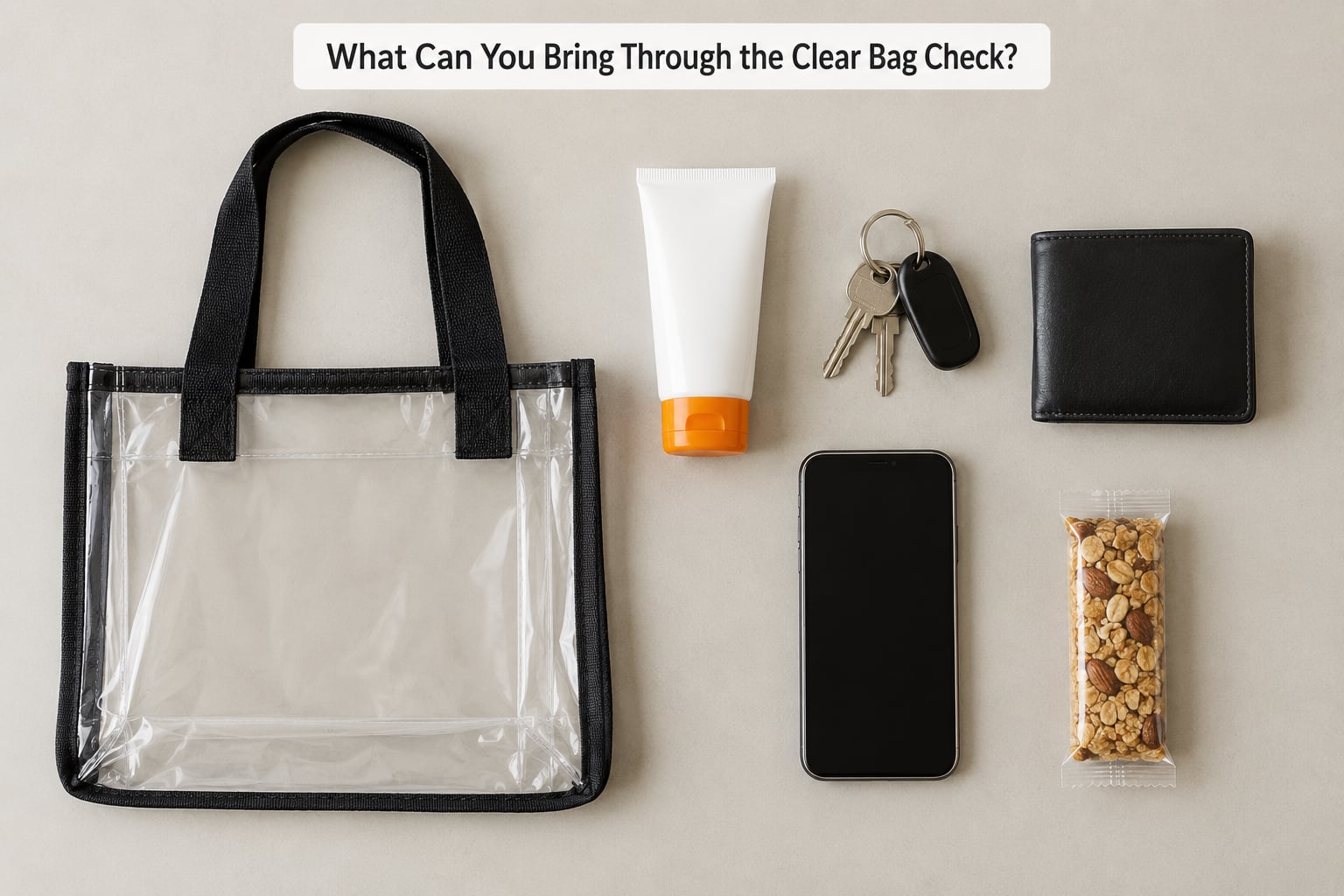
Most of what you carry every day passes. The items that cause refusals are the ones the venue lists as prohibited, and outside drinks and food are where the surprise usually comes from.
Generally fine, inside your compliant bag:
- Phone, wallet, keys, and a small power bank
- Sunscreen, sunglasses, a hat, and a light jacket
- Medication you need, in its original packaging
- Unopened food from home, subject to the venue’s food rules
- A camera without a detachable long lens
- Prescription glasses and earplugs
The items that get turned back:
- Outside beverages, including water bottles and refillable drink packs at many venues
- Glass containers and any glass-bottled drink
- Weapons, folding knives, and stun devices
- Oversized bags, duffels, and backpacks above the size limit
- Outside alcohol, aerosols, and pressurized canisters
Water is the one to plan for. Some stadiums allow an empty bottle you fill at a fountain inside. Others do not allow personal bottles at all, and many sell refillable drink cups rather than letting fans bring anything in. Check the venue’s list, and buy a clear drink cup on site if that is the arrangement.
Why Can’t I Bring Certain Items Into a Stadium?
Prohibited items fall into a few categories, and the reason is usually specific rather than general caution.
Weapons and bladed items are prohibited because a stadium bowl with tens of thousands of people in it removes any meaningful distance between two people. Glass is prohibited for the same reason in reverse: it breaks, and broken glass in a seating section is a hazard to the people seated there and to the staff clearing it. Large alcohol containers matter because of the crowd density, not because a venue is judging your drink. Pressurized aerosols and anything that shoots or sparks fall under venue rules about items that could injure a crowd.
Outside drinks and food are treated differently, because the reason is operational rather than safety. Liquids slow a screening lane down, and a venue that sells concessions has a commercial reason to control what comes through the gate.
Oversized bags are prohibited as a side effect of the policy’s own logic. A bag that cannot be opened quickly and emptied quickly defeats the visibility rule that justifies everything else.
Lists are not identical between venues. One ballpark allows seat cushions and another does not. One stadium bans clear bags entirely for a playoff game. Assume nothing carries over.
What Happens If My Bag Does Not Meet the Policy?
Nothing dramatic happens, but the outcome depends on how far into the lane you are and how strict the staff at your gate happens to be. The realistic options are repackaging, secondary screening, returning items, or being turned away.
- Repack at the check-in area. Many venues have a staffed table before the metal detectors where staff look at your bag, tell you what is wrong, and watch you fix it. This is the good outcome.
- Send it back. Prohibited items are typically taken and not returned. Small comfort items like an oversized sunscreen may be allowed to go back into your car.
- Buy a compliant bag on site. Some venues sell clear totes at the gate. Fans on Reddit have reported buying one and still being told it did not comply, so treat this as a fallback, not a plan.
- Lose entry. If a bag cannot be resolved, you can be denied admission even with a valid ticket.
Enforcement is not perfectly uniform, and fans say so. Threads on r/MLS and r/NFL describe compliant bags refused at one gate and waved through at another, and lightly tinted bags turned back at a stadium that officially allows them. The rules can also differ by entrance level. If your bag is within the published limits and you get a different answer, asking for a supervisor is a normal thing to do.
There is also a standing argument about whether the policy is worth it. The counter-case, raised most directly in an r/MLS thread about the league’s standard bag policy, is that adding more gates, newer detection units, and more staff per entrance would raise security more than limiting what fans carry. Fans on both sides of that debate agree on one point: the queue is where the policy is most visible, and skipping the line of people who forgot the rule is its one unambiguous benefit.
How Can I Avoid Delays at the Stadium Gate?
Nearly every gameday delay traces back to a bag packed at home. This checklist takes about five minutes the night before.
- Open your venue’s official bag policy page. This is the only source that matters for your gate. Aggregator sites and bag brand pages describe other stadiums’ rules.
- Check whether the policy is required or merely allowed. Some venues only cap bag size and never require transparency. Others require clear only.
- Measure your bag before leaving. Twelve by six by twelve inches is the common clear-bag size. If your tote is a little bigger, that is the problem.
- Empty it and rebuild it from scratch. Open every zipper and pocket. Hidden dividers are where screeners find the thing nobody declared.
- Move big items out. Leave the full-size water bottle, the travel mug, the laptop, and the large sunscreen at home.
- Put your phone and wallet in a pouch. Keeps them together and gives you something to grab when you leave.
- Leave the car keys out of the bag. A return trip to the parking lot is where gameday really gets lost.
- Arrive on the early side. The last thirty minutes before kickoff is the slowest lane of the day, and policies usually tighten near the start.
On exemptions, the categories that matter most are medical supplies, diaper bags, and hygiene products such as tampons or sanitary pads. Those are normally allowed regardless of the clear bag rule and may be inspected separately. A question worth asking in advance is whether hygiene items need to be in a clear bag at all, since venues handle that differently. If you carry medication that is not in its original container, bringing the prescription label or a photo of it smooths the check.
Frequently Asked Questions
Are stadium clear bag policies required by federal law?
No. Clear bag policies come from individual venues, universities, conferences, and leagues, not from federal law. The Department of Homeland Security and the If You See Something, Say Something campaign shape how venues think about security, but no statute sets a bag size for stadiums. That is why two schools playing the same sport can publish different rules on the same Saturday. Your venue’s own gameday guide is the only authority on what applies at your gate.
Does a clear bag still get searched at the stadium?
Yes. A clear bag changes the type of inspection, not whether one happens. Because contents are visible, screeners can usually do a visual check without opening anything, which takes seconds instead of a minute. You will still be screened as a person, and anything the screener cannot identify or does not expect sends the bag to secondary screening. A hand search remains possible at any checkpoint.
Why do stadiums limit the size of bags?
Size limits exist for two practical reasons. A big bag is harder to open, empty, and check quickly, so it slows the whole lane behind you. It also gives someone more room to carry something the venue does not permit, which undercuts the visibility logic the policy is built on. The most common clear bag allowance is 12 inches by 6 inches by 12 inches, with small clutches around 4.5 by 6.5 inches allowed separately.
Can I bring an empty water bottle through the gate?
Sometimes, and the answer is venue-specific. Plenty of stadiums let you bring an empty bottle and fill it at a fountain inside, precisely because that serves them well without letting outside liquid slow the lane. Other venues do not permit personal bottles at all and sell refillable drink cups instead. A few allow sealed drinks in a small clear bag. Check the venue’s list before you pack one, because filling up at home means standing in line again.
Can I bring sunscreen, medicine, and unopened food?
Sunscreen and medicine are usually fine, especially anything medically necessary, which is typically exempt from the bag rule and subject to inspection instead. Sunscreen sprays and oversized containers can hit size limits, so move them into a compliant bag or leave them. Unopened food is usually permitted at college venues but restricted at some pro stadiums, and the rules can also exclude food from specific seating areas. Outside drinks are far more often the thing that gets you sent back.
Check the Venue Policy and Pack Before You Leave
Do one thing first: open your stadium’s official gameday or bag policy page and read it. That page decides your dimensions, your belt bag question, and whether you can bring a drink, and it is the answer that overrides anything written here or anywhere else. Then pack at home into a fully transparent bag, leave the oversized stuff behind, and give yourself a little extra time at the gate. Last updated for October 2026, and policies do change between seasons, so check again before each new one.