Tempo is the speed at which an offense snaps the ball, and it changes almost everything you can measure about that offense: how many possessions it gets, how many plays it runs, how explosive those plays are, and how many mistakes it makes. Understanding how tempo affects college football offenses comes down to one idea — a team that snaps the ball faster gets more chances to be good and more chances to be terrible in the same 60 minutes.
Below is the practical version: what the numbers mean, how tempo reshapes play selection and scoring, where it costs an offense, and how to tell whether a program is genuinely fast or just playing a lot of snaps. Last updated October 2026.
Table of Contents
- What Is Tempo in College Football Offenses?
- How Coaches Measure Football Tempo
- How Tempo Changes an Offense’s Play Selection
- How Tempo Affects Scoring and Drives
- Why Tempo Can Help or Hurt an Offense
- How Does Tempo Affect Quarterbacks and Running Backs?
- Can the Defense Adapt to a Fast-Tempo Offense?
- When Should a Team Use Tempo in a Close Game?
- How to Tell Whether a Program Is Actually Playing Fast
- Frequently Asked Questions
- Conclusion
What Is Tempo in College Football Offenses?
Tempo in college football is how quickly an offense runs from the end of one play to the snap of the next, measured as average seconds per offensive play and as total plays per game. A high-tempo offense, also called a no-huddle or hurry-up offense, starts the next snap as soon as it can rather than gathering in a huddle.
You’ll hear the same idea called several things. No-huddle means the offense does not break into a team huddle between plays. Hurry-up describes going quickly while staying legal. NASCAR is the nickname coaches use when an offense snaps so fast that the defense looks like stock cars changing lanes. And some programs only go fast in specific situations, which coaches call situational tempo — fast in the red zone, slow on third down, quick out of bounds to save a timeout.
One important distinction up front: tempo is not the same thing as pace. Tempo describes what the offense chooses to do between snaps. Pace describes how many possessions the game produces, and the defense influences pace every bit as much, usually by creating stops that burn the clock on the other side.
How Coaches Measure Football Tempo
Coaches rarely look at one number. They read several together, because a team can look fast on one measure and slow on another.
- Seconds per play — total elapsed time divided by offensive snaps. It includes huddles, sideline adjustments, penalties and the dead time after a big gain.
- Plays per game — the raw snap count. The median FBS team runs around 73 plays a game, with the fastest programs in the high 80s and low 90s.
- Possessions per game — how many times the offense gets the ball, which drives scoring opportunities more than any other tempo stat.
- Time of possession — the share of game minutes a team holds. A deliberate-pace offense uses this deliberately, not incidentally.
- Yards per play — the efficiency measure. Once tempo is controlled for, this is the fairest read on an offense or a defense.
The part most people skip is that only about five seconds of a typical play involves the ball in flight. A no-huddle team might run a 22-second snap cycle in practice but still have 60 or more snap opportunities in a regulation game.
The comparison below is a rough frame, not a scouting report. Programs move between tiers as coaches, personnel and game situations change.
| Tempo tier | Seconds per play | Plays per game | What it usually looks like |
|---|---|---|---|
| Up-tempo | Under 22 seconds | 85 to 90-plus | No huddle, pre-snap motion, quick-passing concepts, run plays that survive contact |
| Up-tempo with a mid-tier pace | 22 to 26 seconds | 70 to 80 | Huddle most downs, hurry-up on third down and after gains, scripted first series |
| Balanced | 26 to 29 seconds | 65 to 72 | Huddle every play, deliberate formations, planned substitution patterns |
| Deliberate pace | Over 29 seconds | Under 65 | Time of possession as a weapon, fewer possessions, slower-started drives |
How Tempo Changes an Offense’s Play Selection
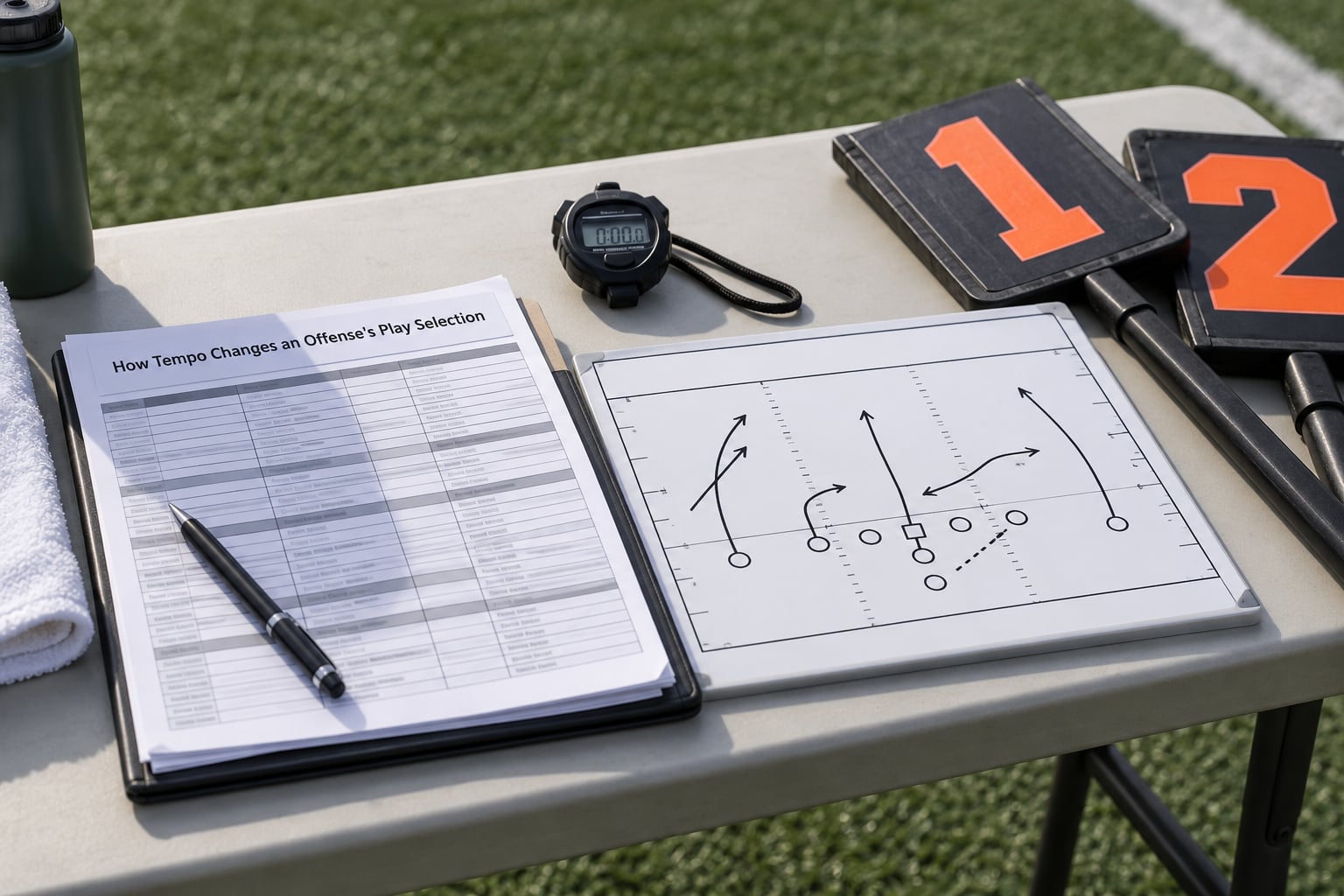
A fast tempo does not just run the same plays faster. It changes which plays are worth calling, because the offense has less time to get into them and less time to correct after them.
Quick-passing concepts become disproportionately valuable because the ball is out before the defense can rotate. Screens and draws buy the quarterback time that a slow offense would have created through the line. Run plays that survive contact — sweep, outside zone, read option — keep working when the blocking scheme is wrong for a beat, which matters more when you cannot afford a stalled drive.
Pre-snap motion is the clearest example. In a hurry-up system, motion is a live tell. When the offense breaks a huddle and runs motion, the defense has time to answer it; when the same motion runs off a snap that fires within seconds, the defense is reacting rather than planning.
Substitution math changes too. An offense that snaps quickly denies the defense its substitution window unless the defense calls a timeout, which costs a down and a timeout. Programs like Syracuse under Dino Babers were forced to build practice and preparation around that reality, and in 2016 the offense moved from roughly 28.1 seconds between snaps to about 21.2 — close to a 25 percent jump.
The cost of all that speed is structure. A team that snaps immediately after a first down has no sideline huddle to fix what just happened. A play that fails because of a protection problem is a play that repeats.
How Does Tempo Affect College Football Offenses When the Pace Slows?
Slowing down hands the offense back its playbook. With 30 seconds and a huddle, a coaching staff can change formations between series, build multi-concept route combinations, and pick a run blocking scheme that matches the front it expects.
It also changes who is on the field. A huddle creates a substitution window the offense controls, which means a deliberate-pace offense can line up its best pass-heavy personnel without volunteering that information.
Ohio State’s 2024 season is the recent counter-case fans still argue about. The offense averaged 26.9 seconds per play the prior year, ranking 82nd in the FBS, and the shift toward a slower, Chip Kelly-influenced approach was read by plenty of people on r/OhioStateFootball as a trade of explosiveness for control and fewer turnovers. Whether that trade was worth it is still unsettled.
How Tempo Affects Scoring and Drives
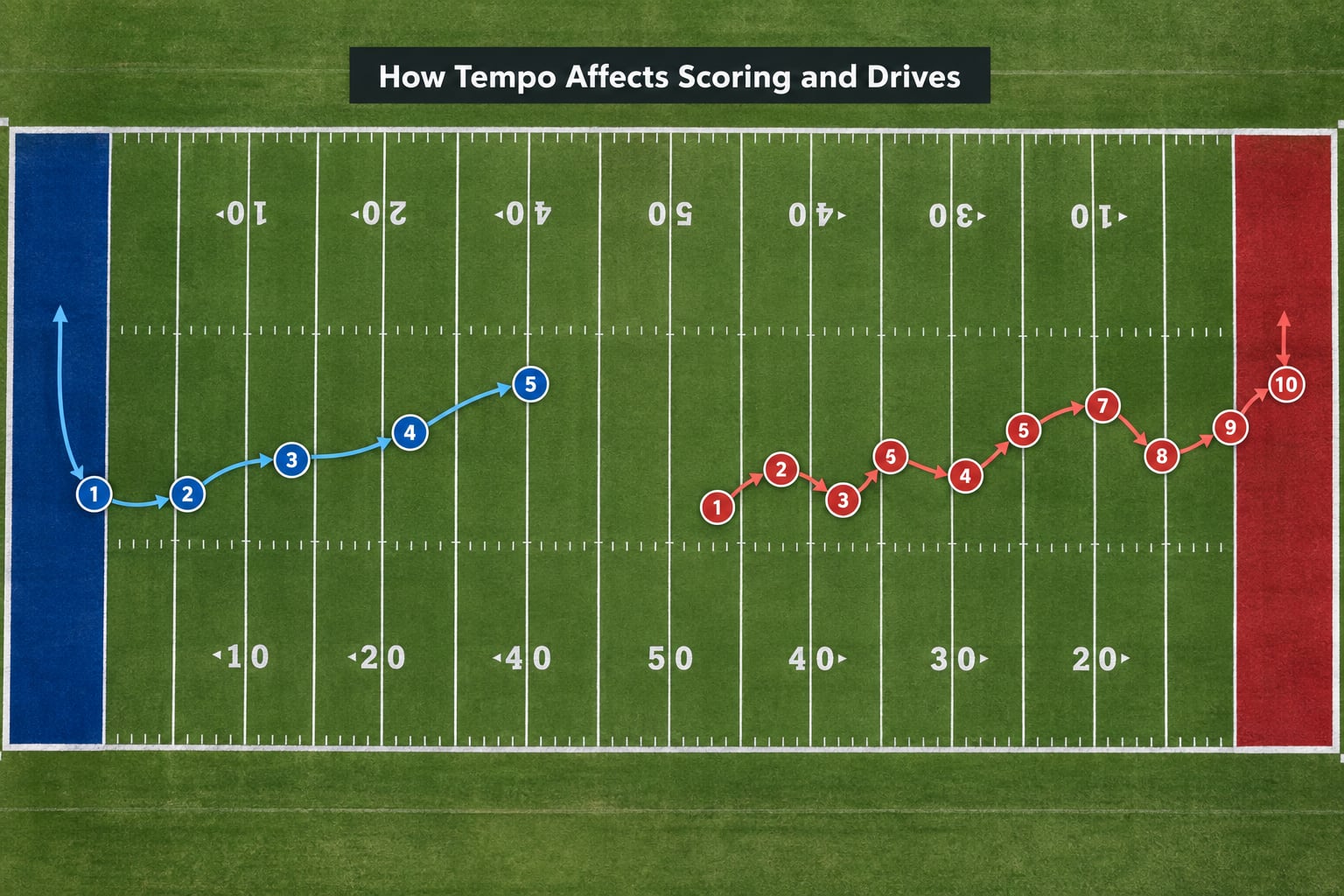
Here is where tempo gets confused with efficiency. Fast tempo produces more possessions, and more possessions produce more total yardage and more points over a full season. That is arithmetic, not proof of a better offense.
Two offenses can both average 6.8 yards per play and finish with wildly different yardage totals, because one got 85 snaps and the other got 65. Total yardage therefore says as much about tempo as about execution, which is why yards per play and success rate are the metrics coaches and bettors trust.
Drives shorten. A drive that ends in eight plays at high tempo covers the field fast and takes about three minutes of game time. A ten-play drive at balanced pace takes closer to five. Same field position, different cost in possessions for the opponent.
Points per drive is the measure that exposes whether the speed is actually working. If a fast offense produces 2.1 points per drive but concedes 2.2, the tempo is not creating value — it is just making the scoreboard move.
Why Tempo Can Help or Hurt an Offense
| What tempo gains | What tempo risks |
|---|---|
| Denies defensive substitutions, forcing backups onto the field at key spots | Multiplies mistakes: every snap is another chance at a misread, a bad exchange, a tipped pass |
| More possessions, so more scoring chances over a game | Negative plays cost the same 5 to 8 seconds whether or not they are scripted |
| Disguise, because pre-snap motion and play type happen inside the defense’s reaction time | No sideline correction window after a failed series; bad calls repeat |
| Exhausts defensive depth and legs, particularly late in games | Communication errors in the no-huddle format, especially after a turnover |
| Burns clock on the opponent’s side when it produces long drives and first downs | Fatigue accumulates on the offense too — roughly 20 seconds of rest per snap at up-tempo pace |
| Lets the offense pick its tempo by situation instead of one global setting | Turnovers become pick-sixes more often, a complaint that shows up constantly on r/CFB |
The turnover point deserves emphasis because fans misread it constantly. More snaps means more attempts, and more attempts means more turnovers in absolute terms. A 20 percent turnover rate on 85 snaps is more giveaways than a 15 percent rate on 65 snaps. Tempo does not raise the risk on any given play; it raises the number of plays.
How Does Tempo Affect Quarterbacks and Running Backs?
A quarterback in an up-tempo offense operates with a shortened decision window. Fewer seconds to read coverage, fewer seconds to identify a blitz, and fewer comfortable repetitions of the same concept against the same look.
That creates a specific role — the tempo throw. A quick, decisive throw to a running back in the flat or a curl before the rush arrives keeps a fast-tempo offense functional, and it is a different skill from the low-percentage deep shot that slower systems can afford.
Running backs face the opposite problem: contact arrives on schedule. A slow offense can pull the ball in the flat on a checkdown to reset the series. An up-tempo team runs into a box already committed to the run, so the ball has to survive contact or the drive stalls.
Durability is the quiet cost across both groups. At roughly five seconds of play action and 20 to 30 seconds of rest, the limiting factor for high-tempo programs becomes aerobic recovery between snaps, and linemen take the cumulative collision load that comes with 90 snaps a game.
Can the Defense Adapt to a Fast-Tempo Offense?
Partly. A defense can win its substitution window back by calling timeouts, by simplifying its calls, and by building depth so that a tired unit is replaced with fresh legs rather than a freshman.
The counter most defenses use is disguising coverage. When plays come fast, defenders have to react rather than anticipate, so defensive backs make their reads earlier and adjust after the snap. Linebackers communicate at the level instead of after the snap, because there is no after the snap.
Practice is where the real adaptation happens. Defenses that face a 16-second snap cadence run scout-team offenses at close to that pace so the second group gets the same look as the first. That way of training has become standard, and it is also why second-team defenses tend to fade late — they rarely see 85-plus snaps a week.
The two levers that actually move the pace of a game are defensive stops and time of possession. A defense that gets stops shortens its own offensive series’ opponent possessions, and a defense that wins the turnover battle gets the ball back fast. Fans on VolsNation have argued this for years: the defense, not the offense, controls the tempo of most games.
When Should a Team Use Tempo in a Close Game?
The right tempo is a function of situation, not identity. A few situations where each choice pays off:
- Down by 14 in the third quarter. Tempo wins here. More possessions means more shots, and a defense that has not yet hit its depth is still fresh.
- Up 17 in the fourth. Slow down. Each snap you run short and incomplete hands your defense the ball back with less rest for them, and it costs you almost nothing.
- Third and short inside the 20. Slow down. This is a play-calling problem, not a conditioning problem.
- Goal line, short yardage. Slow down. Formation and identity are worth more than another snap.
- Backups in at quarterback. Slow down, unless the defense’s backups are also in. Tempo with a third-string quarterback is usually negative.
- Limited timeouts, unreliable fourth-down conversion. Slow down. Your ability to bleed the clock is only as good as your fourth-down math.
The common thread is that tempo is a resource spent on the scoreboard and on the opponent’s depth. Spend it when you need volume, and hoard it when you need certainty.
How to Tell Whether a Program Is Actually Playing Fast
Announcers say “they’re going fast” every week, and they are usually describing tempo that is situational rather than structural. Here is how to check.
- Pull seconds per play first. Anything under 22 seconds is genuinely fast; the high 20s is deliberate regardless of how animated the booth sounds.
- Count plays per drive, not per game. A team that scores in six plays a drive is fast even if its total snap count is ordinary.
- Watch what happens after a first down. Instant re-snap or a huddle tells you which system the coach actually trusts.
- Check the substitution pattern. Persistent five-man substitutions on every snap means the offense is dictating the terms.
- Separate pass-heavy from fast. Incompletions stop the play clock, so a throw-heavy offense can average 28 seconds per play while averaging 90 plays a game.
- Look at red-zone efficiency. Tempo only earns its cost if those extra possessions turn into points.
That fifth point trips up almost everybody. The most explosive offenses are not always the fastest, because a completed pass over the middle resets the clock to 25 seconds and an incompletion kills it entirely. Pass-heavy spread teams can pile up yards and plays while sitting near the bottom of the league in tempo.
Some fans take the opposite position, arguing that hurry-up offenses spend the first three downs playing at a disadvantage and that pre-snap snap counts telegraph themselves anyway. That argument has real merit against certain defensive personnel packages. It is a fair debate rather than a settled one.
Frequently Asked Questions
Does tempo mean plays per minute in college football?
Not quite. Tempo is usually tracked as average seconds per offensive play and as total plays per game, not plays per minute. A team snapping every 22 seconds is running a little under three snaps per minute, while a deliberate-pace team running every 29 seconds is near two. Plays per minute stays constant because the game is 60 minutes, so the number of snaps is what actually differs between offenses.
Is a spread offense automatically faster than a traditional offense?
No. A spread formation is a personnel and alignment choice, not a speed setting. Spread teams can huddle on every down and run a deliberate pace, and traditional teams can hurry-up out of bounds after a gain. What makes an offense fast is the snap cycle after the whistle: quick substitution, no huddle, and plays that end quickly rather than running long.
Does a fast-tempo offense score more points?
Often, because it gets more possessions and more total plays, but the margin is smaller than it looks. Once tempo is controlled for, fast and slow offenses are far closer in yards per play and success rate. The honest test is points per drive: if a high-tempo offense is not outscoring its opponent at the drive level, the extra possessions are just moving the scoreboard, not winning the game.
How does up-tempo football affect player fatigue?
Fatigue lands mostly on the defense, but not only there. At an up-tempo pace a team can average only about 20 seconds of rest per snap and roughly 85 to 90 plays a game, which makes aerobic recovery between plays the limiting factor. Offensive linemen absorb the cumulative collision load that comes with high snap counts, and second-team defenses are the ones most likely to fade badly in the third quarter.
Can a team change tempo during a game?
Faster than most fans expect. Coaching staffs can hurry-up after a big gain, slow down on third and short, spread the field to manage a clock, or go no-huddle for an entire series to deny substitutions. Smart programs make these choices by down and distance rather than adopting one tempo for the whole game, which is why some of the fastest teams are also the ones that deliberately huddle near the goal line.
Conclusion
If you watch one thing next Saturday, count snaps rather than yards. Notice how many plays each offense gets, how quickly they come, and whether the extra possessions turn into points at the drive level. Everything else — total yardage, points per game, the volume of turnovers — is downstream of tempo.