How basketball offensive sets are named comes down to habit, not a rulebook. There is no league office or rulebook that approves offensive set names. Teams name them by habit: after the formation on the floor, the action the players run, the coach or school who invented them, or a word short enough to shout in two seconds.
That means a set called Floppy looks a certain way almost everywhere, while a set called 41 could mean two completely different screens in two different programs. Once you know the handful of conventions behind those names, the vocabulary stops being noise and starts being a map.
Table of Contents
- How Basketball Offensive Sets Are Named
- What Is an Offensive Set in Basketball?
- How Basketball Offensive Set Names Are Built
- Common Categories of Offensive Set Names
- How Formation, Action, and Player Labels Affect a Set Name
- Examples of Popular Basketball Offensive Set Names
- Why Coaches and Teams Use Different Names for Similar Sets
- How to Read Set Names in Play Calls and Diagram Keys
- Frequently Asked Questions
- Is there a standard way to name basketball offensive sets?
- What does a 1-4 basketball set mean?
- What is the difference between an offensive set and an offensive play?
- Why do basketball teams call similar sets different names?
- What does a motion set mean in basketball?
- How can I learn the offensive terminology used by a specific team?
- Conclusion
How Basketball Offensive Sets Are Named
Coaches draw on six recurring conventions when they label an offensive set, and most teams mix all of them in a single playbook.
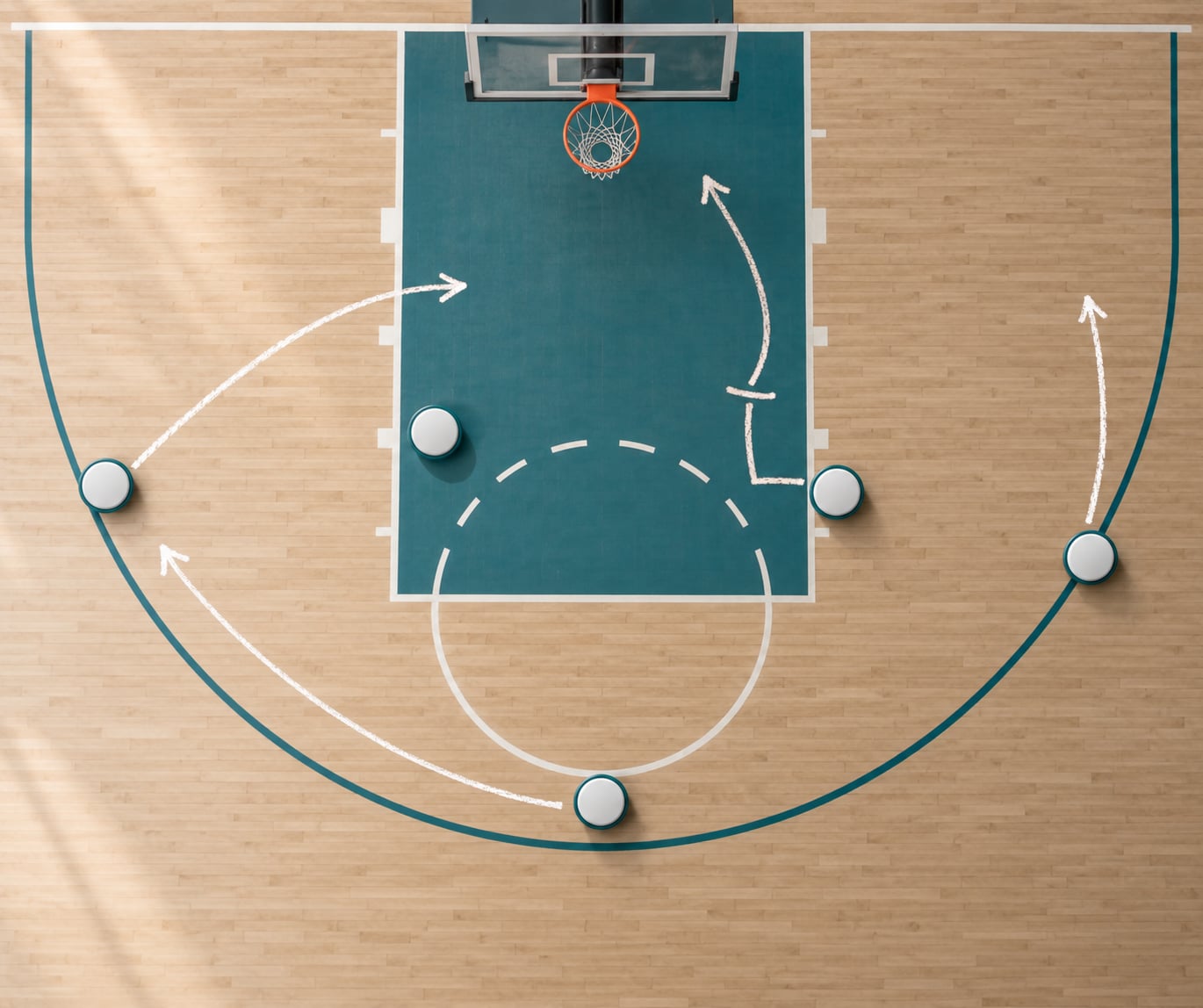
- Number sets. The name describes where the players stand. A 1-4 puts one player at the top and four on the baseline. A 2-3 splits two guards outside and three bigs around the lane. Four-out and 5-out name the same idea for spacing-heavy teams.
- Action names. The name describes the ball action. Screen & Roll, Elevator, Zip-Loop-Hammer and Quick Hitter all tell you what happens, not where everyone starts.
- Alignment names. The name describes the shape. Horns, Floppy, Drag, Stack, China and Lopo are the everyday vocabulary of nearly every modern half-court offense.
- Alphanumeric codes. Two digits do the describing. A 41 usually means a point guard screening for the power forward; a 45 means the guard screening for the center.
- Coach and school namesakes. The set carries the name of the program or the person who made it famous: Bulldog from Mark Few at Gonzaga, the Aggie from Steve Forbes, the Illini from Lou Henson, MSU’s 14-Circle from Tom Izzo.
- Arbitrary memory names. Some names describe nothing at all. Ghost, Black, White, Flip, Yo-Yo and Prowl are chosen because they are one syllable and do not collide with a real word a player might hear in a huddle.
The sixth category trips up newcomers most, and it is entirely deliberate. A name that means nothing is a name nobody argues with.
What Is an Offensive Set in Basketball?
An offensive set is a pre-organized package of alignment and action that a team runs on purpose, usually from the same starting positions, to create a specific advantage such as a post matchup, a shooting lane, or a ball screen on the wing.
Three nearby words get used as if they were the same thing, so it helps to keep them apart.
Set versus play
A set is the whole package. A play is one option inside that package. Izzo can call 14-Circle and then have a guard run a dribble-drive, a big set a back screen, and a wing slip to the baseline — three plays, one set. Fans hearing one name on a broadcast usually only catch the play that happened.
Set versus system
A system is the season-long philosophy underneath the sets: how you defend, how you rebound, how much you walk the ball up. Sets are the tools inside that system. A team can change its entire set menu on Sunday and still be running the same system on Monday.
Set versus play type
A play type is generic, like dribble handoff, pick-and-roll, or baseline inbound. Types are descriptive categories. Set names are labels a specific program uses, which is why a type can be a set name in one playbook and invisible in another.
Set versus sequence
A sequence strings several sets together in a fixed order, usually for the last two minutes of a game or to start a possession. Coaches call it a play, a script, or a package. The individual set names still exist inside it.
How Basketball Offensive Set Names Are Built
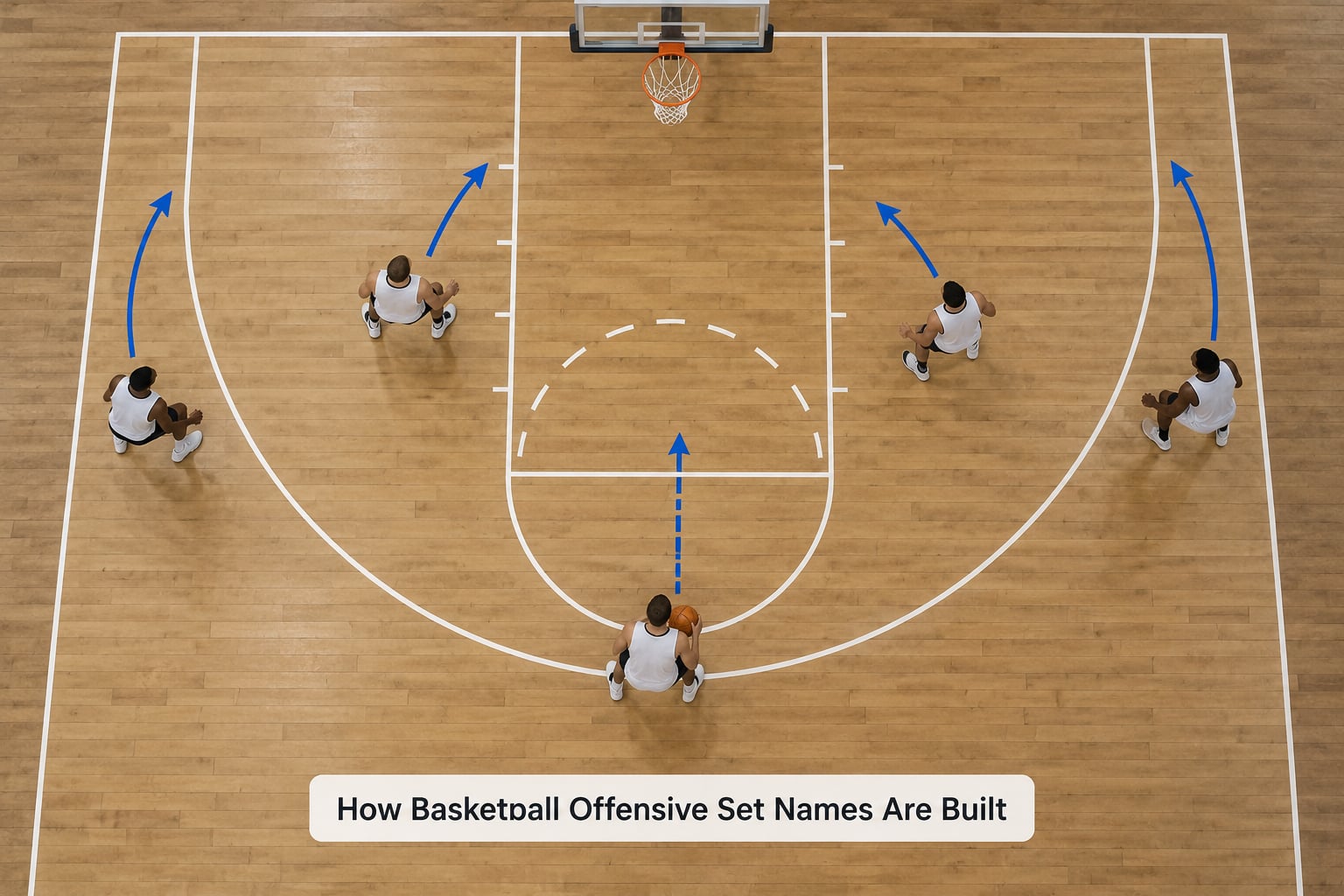
Most descriptive set names are assembled from the same four pieces, usually in that order.
The alignment label
Where players begin. Four-out, 1-4, horns and box all belong here, and this piece is usually the first word in a compound name.
The action word
What the ball handler does next. Drive, flare, handoff, elevator and backdoor are the action words. If the action is the most distinctive thing about the play, it becomes the name instead of the formation.
The player number
Who is involved. Two digits, said back to back, pin the screener and the receiver. This is the origin of codes like 41 and 45, and it is the single most useful trick for a newcomer to learn.
The origin tag
Who invented it or where it came from. Bulldog, Aggie and Hoyas work this way. The tag matters because a name tied to a coach travels with the coach and gets reused by other programs.
When a name uses fewer of those four pieces, it is usually because the coach wanted it short. Three syllables is already pushing it when a point guard has to call it over a loud crowd.
Common Categories of Offensive Set Names
| Category | What the name describes | Examples |
|---|---|---|
| Number sets | Player locations at the start of the possession | 1-4, 2-3, 3-2, 4-out, 5-out |
| Alphanumeric codes | Which player sets the screen and who receives it | 41, 45, 24, 90 series |
| Alignment names | The static shape of the floor | Horns, Floppy, Drag, Stack, China, Lopo |
| Action names | The screen, cut or ball movement | Elevator, Zip-Loop-Hammer, Quick Hitter, Screen & Roll |
| Origin names | The coach, school or program that made it famous | Bulldog, Aggie, Illini, Hoyas, Alabama, MSU 14-Circle |
| Arbitrary names | Nothing at all, chosen only to be memorable | Ghost, Black, Flip, Yo-Yo, Prowl |
Two categories routinely get mixed up. Inbound sets are their own family: BLOB is baseline out of bounds and SLOB is sideline out of bounds, and those two acronyms are named for the words, not the formation. Alignment names describe where you stand; continuity names describe what happens next.
How Formation, Action, and Player Labels Affect a Set Name
Once you know that a name is built from labels, you can usually work out what an unfamiliar one means by reading its structure.
Number sets decoded: 1-4, 2-3, 3-2, 4-out and 5-out
The numbers in a number set are jersey numbers, listed by height above the floor. It is why point guards are always 1, 2 and 3, and why centers are always 5.
| Name | What the numbers mean | What the shape looks like |
|---|---|---|
| 1-4 | One player above the arc, four along the baseline | Four players share the paint, one guard initiates |
| 2-3 | Two guards outside, three bigs inside | Post-heavy, low spacing, feeds to the block |
| 3-2 | Three players outside, two inside | One big in the lane, one on the wing |
| 4-out, 1-in | Four players outside the arc, one inside | Wide spacing, dribble penetration, kick-outs |
| 5-out | All five players outside the arc | Almost no post play, pure drive and kick |
| 3-out, 2-in | Three outside, two around the lane | Zone-break friendly, with a big screening at the top |
The same idea can carry different names depending on how far the naming committee cared about accuracy. A high 1-4 and a low 1-4 are different sets with the same numbers, which is why coaches add a word rather than a digit.
Alphanumeric codes: what 41, 45 and the 90 series mean
In the most common system, the first digit is the screener and the second is the player who comes off the screen or receives the pass. A 41 is a point guard screening for the power forward. A 45 is that same point guard screening for the center.
That is a convention, not a law. Programs that run mostly high pick-and-roll may invert the order, so a code only decodes once you know which staff wrote it.
Formation and action words combined
Compounds put the two labels together: a 1-4 set with a 45 action is a high pick-and-roll out of the high stack. Read the name left to right and it tells you the starting spots, then the first action.
Examples of Popular Basketball Offensive Set Names
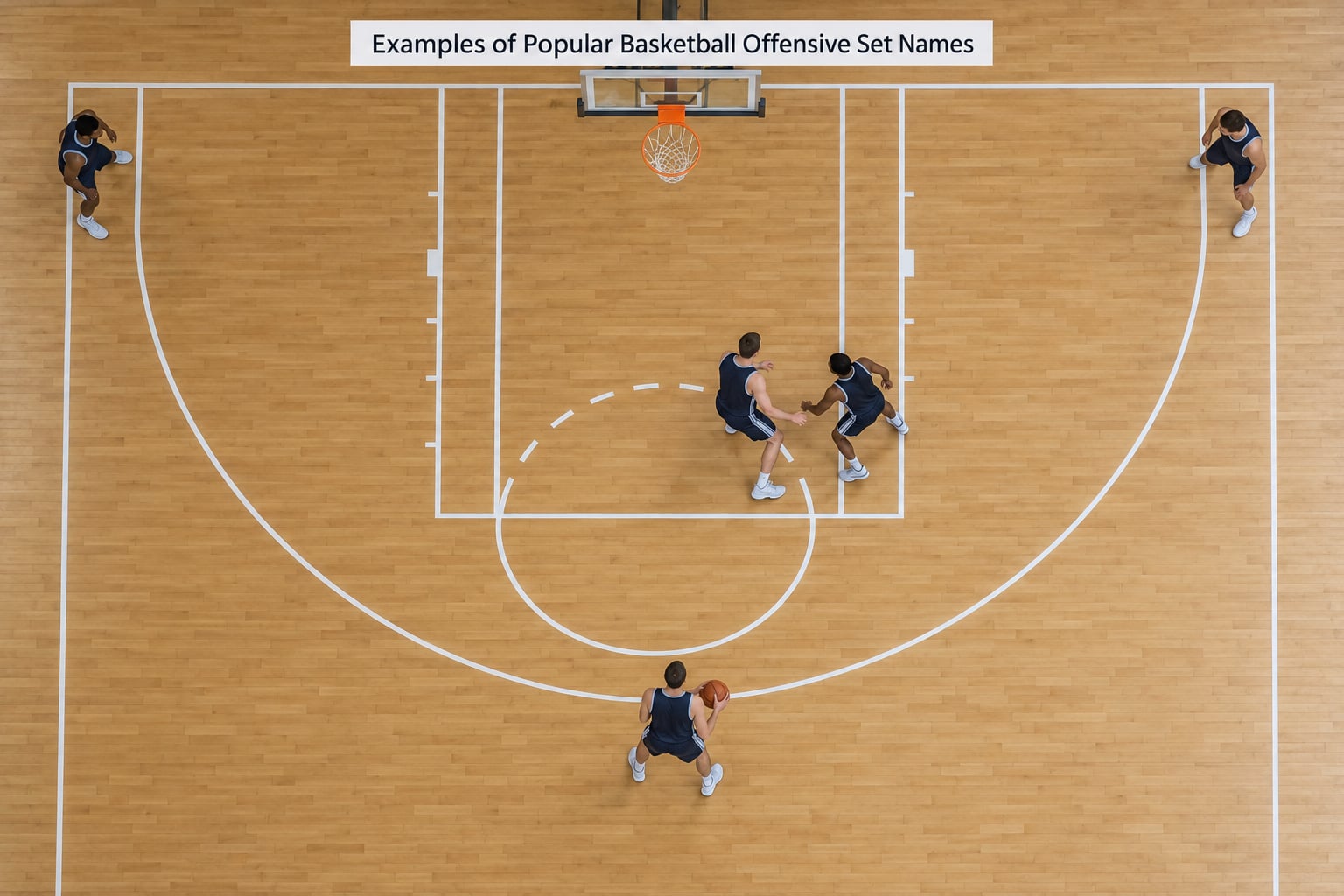
This decoder covers the names you will hear most often on a broadcast or in a scouting report.
| Set name | What the name signals | Typical alignment |
|---|---|---|
| Horns | Two bigs at the elbows, guards in the corners | Half-court, elbow extension, high post entry |
| Floppy | Bigs stagger out of the lane, one big sets a screen in the paint | Half-court, drive and pick-and-roll |
| Drag | A big steps up to the arc to screen for the ball handler | Space, off-ball guard screening |
| Stack | Players align in a vertical column and cut off screens in sequence | Space, corner threes, cut first and pass second |
| China | A big starts on the wing, enters the post, then comes to the high post | Space, post hub |
| Lopo | Short for Loyola, a diagonal into the post | Space, cross-court entry to a big |
| Quick Hitter | One-pass action aimed at a shot before the defense is set | Any, usually 4-out |
| Elevator | Two screens in a row on the same side, the screener rolling | Space, pick-and-roll chain |
| Zip-Loop-Hammer | A zipper screen feeds a loop, then a hammer screen for a third man | Space, three-man chain |
| Screen & Roll | Ball screen and roll, no dribble handoff | Any, most often 4-out |
| BLOB | Baseline out of bounds set | Inbound, end of clock or after a made basket |
| SLOB | Sideline out of bounds set | Inbound, late-clock situations |
| Bulldog | Mark Few’s Gonzaga action for the high post | 1-4, entry pass and handoff |
| Aggie | Steve Forbes’ spread look with heavy pick-and-roll use | Space, guard screening for a big |
| Illini | Lou Henson’s motion look built around screening and cutting | Five-out or 4-out |
| 14-Circle | Tom Izzo’s high ball screen in a 1-4 shell | 1-4, guard screening at the top |
Notice how much of that table describes spacing rather than movement. In modern college basketball the majority of named sets exist to create four-on-four or five-on-five spacing, and the name mostly records where the ball screen will happen.
Why Coaches and Teams Use Different Names for Similar Sets
No committee reviews set names, so each program invents its own dialect and then protects it.
The first reason is coaching lineage. Assistant coaches carry terminology with them when they get promoted, so a set developed at one school travels to the next one largely intact. Izzo’s Michigan State staff exported the 14-Circle to places with entirely different personnel and the name came along.
The second is brevity. A call has to land over a screaming crowd in under two seconds. Once a program has three play types that all work as a high pick-and-roll, the coach will invent short names for each so nobody has to think, and the descriptive name gets dropped.
The third is a kind of tribal boundary. A program wants its players to think in its own terms, and shared vocabulary is part of that. Two coaches who mean the same alignment will often insist their own label is the correct one.
Fourth, sets get renamed mid-season. A new coordinator arrives in March, brings in a set from the last job, and half the roster needs a fresh name anyway. Coaches will tell you the new name is the same play with a different window.
How to Read Set Names in Play Calls and Diagram Keys
You do not need to memorize hundreds of labels. You can decode an unfamiliar name in four steps by treating the name as compressed scouting language.
- Find the numbers. If the name contains digits, the digits almost always describe positions or personnel. Read 1-4 as one above the arc and four on the baseline.
- Find the shape word. Horns, box, stack and China all describe where the body is standing before anything moves.
- Find the action word. Roll, cut, hitter, drive and out all describe what happens once the ball moves.
- Check the origin tag. If the name is a mascot or a last name, search for the clinic or the film session, because nobody will guess it from the label alone.
How diagrams label players, and how to use that key
Coaches’ film notes and scouting documents use X’s and O’s or numbered O1 through O5 for the offense and X1 through X5 for the defense. Numbers always run 1 through 5 by height, with 1 at the top of the key and 5 in the paint. That is the same reason 1-4 and 41 decode the way they do.
A scouting report saying the opponent ran 20 pick-and-roll possessions out of a horns set tells you the starting shape, the frequency, and the primary action in five words. Read it that way and the abbreviation stops being a code and starts being a sentence.
Frequently Asked Questions
Is there a standard way to name basketball offensive sets?
No. There is no governing body for basketball terminology. Names come from a handful of recurring conventions: number sets such as 1-4, action names such as Elevator, alignment names such as Horns and Floppy, alphanumeric codes such as 41, coach or school namesakes, and purely arbitrary memory names. Programs mix them freely, so the same label can mean different things under different coaches.
What does a 1-4 basketball set mean?
The numbers in a number set are jersey numbers, ordered by height above the floor. A 1-4 places one player at the top of the key and four players along the baseline, so the bigs share the paint and a single guard initiates the offense. High and low variants start the same four players in different spots, which is why coaches add a word instead of another digit.
What is the difference between an offensive set and an offensive play?
A set is the whole package of starting alignment and action. A play is one option inside it. A coach can call a set and then run a dribble-drive, a back screen or a baseline cut from the same start, so three plays can come out of one set. Fans usually only catch the single play a broadcast happens to show.
Why do basketball teams call similar sets different names?
Names are program-specific by design. Assistant coaches carry terminology with them when they are promoted, and set names travel along with the staff that invented them. Brevity is the other driver: once three plays all work as a high pick-and-roll, a coach will invent short labels so nobody has to think during a loud huddle. New coordinators also rename sets mid-season.
What does a motion set mean in basketball?
A motion set is organized around continuous movement rather than a fixed pass. Screens, cuts and handoffs keep happening, and the offense reads and reacts to whatever the defense shows. Motion sets are usually easier to learn because they repeat a handful of rules instead of a long menu of named plays, and they punish a defense that stands still.
How can I learn the offensive terminology used by a specific team?
Start with the numbers, since 1 through 5 mean the same thing everywhere, then learn the two or three formations that team uses most. Watch a full game with a pen and note every name you hear with what was on the floor. Scouting notes from that program, postseason documentation and coaching clinic footage will confirm the alignment faster than any generic glossary.
Conclusion
There is no naming committee in basketball, only six habits: numbers for the formation, a word for the action, a shape name for the alignment, two digits for the screener and receiver, the originating coach or school, or a nonsense word chosen for speed.
Read the formation first, then the action, then check who the name honors. Do that and an unfamiliar call on a broadcast stops being a puzzle and becomes a description you can picture.