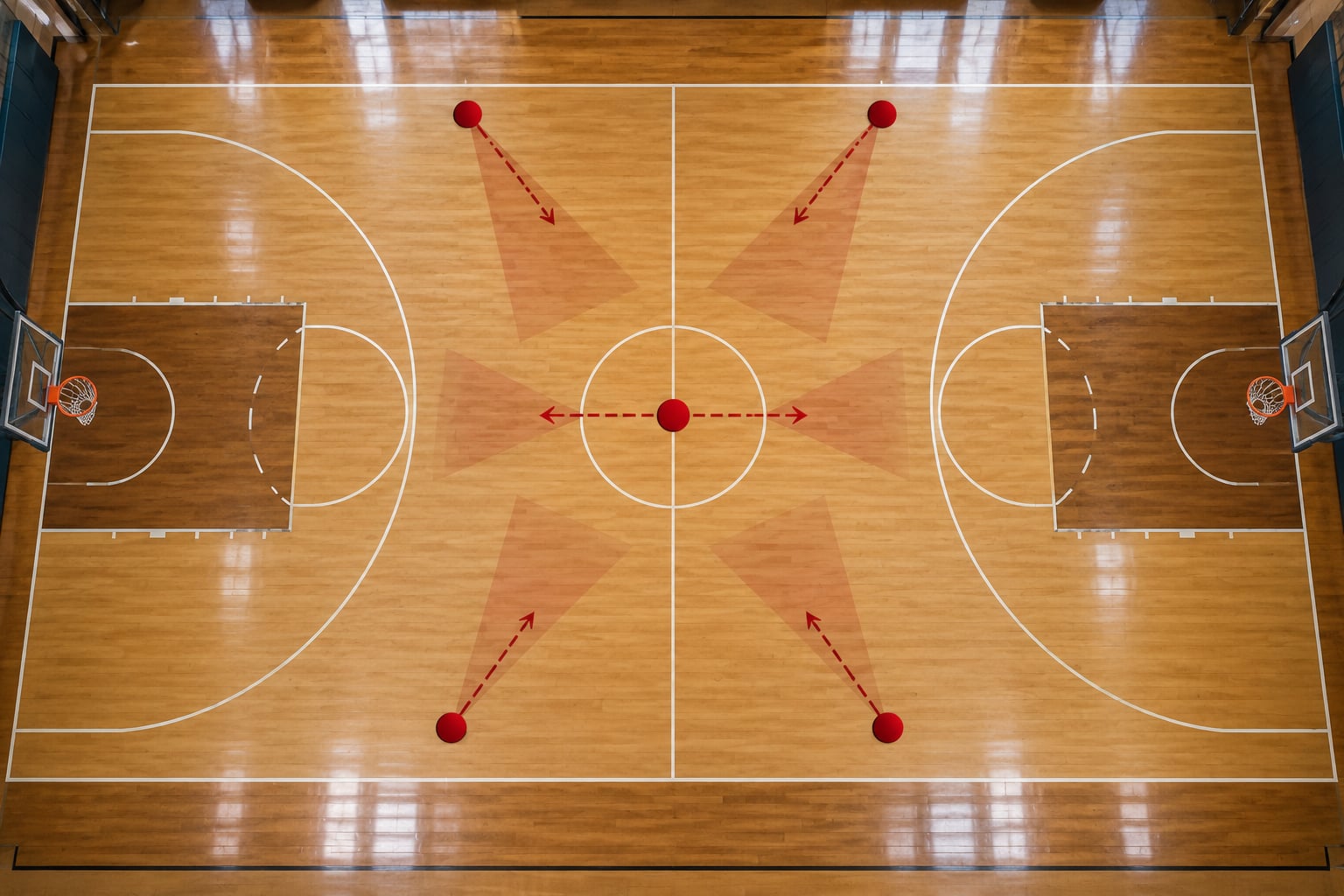
A press defense applies pressure to the ball and the passing lanes from one baseline to the other, instead of waiting in the half court for the offense to set up. Defenders crowd the ball handler, deny the easiest pass, and shift together as a unit so every possession starts in a rush. The whole scheme is built around one goal: win the ball before the offense gets comfortable.
That is the short answer, and it holds whether you are a coach installing a press, a guard trying to survive one, or a fan wondering why a team suddenly has no time to think. Everything below breaks the scheme down piece by piece.
Table of Contents
- What Is a Press Defense in Basketball?
- How Does a Press Defense Work in Basketball?
- What Are the Main Types of Press Defense?
- How Do Defenders Trap the Ball Handler?
- Why Is Press Defense Effective?
- How Do Teams Beat a Press Defense?
- What Are the Biggest Press Defense Mistakes?
- How Can Players Practice Press Defense?
- Frequently Asked Questions
- Conclusion
What Is a Press Defense in Basketball?
A press defense is a full-court scheme in which the defenders play the ball rather than only their assigned people. They pressure the inbounder, chase the dribbler, take away passing lanes and close out on receivers, all while sliding as a group toward the ball.
Pressing tries to accomplish three things at once. First, it forces turnovers, ideally live-ball ones that produce a fast break. Second, it controls tempo, because an offense that spends its first ten seconds surviving the backcourt rarely gets to run the set play it drew up. Third, it disrupts, making a routine entry pass into the half court look like an act of survival.
The main difference between full-court and half-court pressure is where it happens. A full-court press begins the moment the other team puts the ball in play and covers the entire floor. A half-court trap waits until the offense crosses midcourt, which saves some energy and gives defenders time to match up, but it lets the offense run its transition game first.
Two other terms keep getting mixed up. A press is the defense. The press break is the offense’s answer to it, a set of rules and actions for surviving and beating the pressure.
How Does a Press Defense Work in Basketball?
Every press, from the simplest to the most exotic, runs the same repeating cycle. The difference between a good one and a bad one is how cleanly each step gets executed.
1. Pressure the ball before it moves
The first defender meets the ball while it is still being inbounded or picked up. The goal is to force the pass to be made under control, not to steal it outright. On the inbound, the defender cuts off the obvious first pass; on the dribble, the defender plays the ball handler’s hip and forces a decision now rather than later.
2. Deny the easiest pass
A second defender takes away the single most direct passing angle, usually into the middle. That leaves the ball handler with wide, angled options instead of a clean look. A trap press and a press built only on pressure are different schemes for the same reason: one removes the first option, the other just crowds it.
3. Protect the backcourt
Two or three defenders stay behind the ball to protect against the long pass and the fast break. This is the part casual fans misread. A press that leaves its backcourt open will hand back the exact possession it was trying to steal, so the backcourt defender’s job is to deny the lead pass and then recover to the middle.
4. Shift together as the ball moves
When the ball changes sides, the whole formation slides, not just the defender nearest it. Communication carries the shift: the defender leaving the middle calls the name of the player taking his spot. A press breaks down quietly when those calls stop, because everyone is waiting for someone else to move.
5. Trigger the trap
Once the ball enters a designated trap zone, the on-ball defender and a second defender converge. The rest of the defense collapses toward the ball to take away the easy outlets, while staying balanced enough to recover if the ball escapes.
6. Convert or recover
If the trap produces a deflection, the pressing team has what it wanted: a live-ball turnover and a runout. If the offense escapes, the defenders chase back, re-form the shape and try again, or fall back into a half-court shell and man defense. A good press re-forms rather than panics.
What Are the Main Types of Press Defense?
Presses sort into two families by how defenders handle their assignments. Man press defenders chase specific players across the whole floor. Zone press defenders guard areas and pass the ball handler off from one defender to the next. Most modern teams borrow from both.
Man press, zone press, run-and-jump and matchup
A man press is the fastest thing to install and the hardest to sustain, because every defender has to cover a specific opponent through contact and screens. A zone press is easier to run because the assignments stay fixed, but it can be attacked with ball movement and correct spacing. Run-and-jump is a man defense where the defender hedges toward the passing lane and then either takes the ball handler or drops back to guard his own man. Matchup is a zone press where defenders pick up specific people on the backcourt while still playing by area up top.
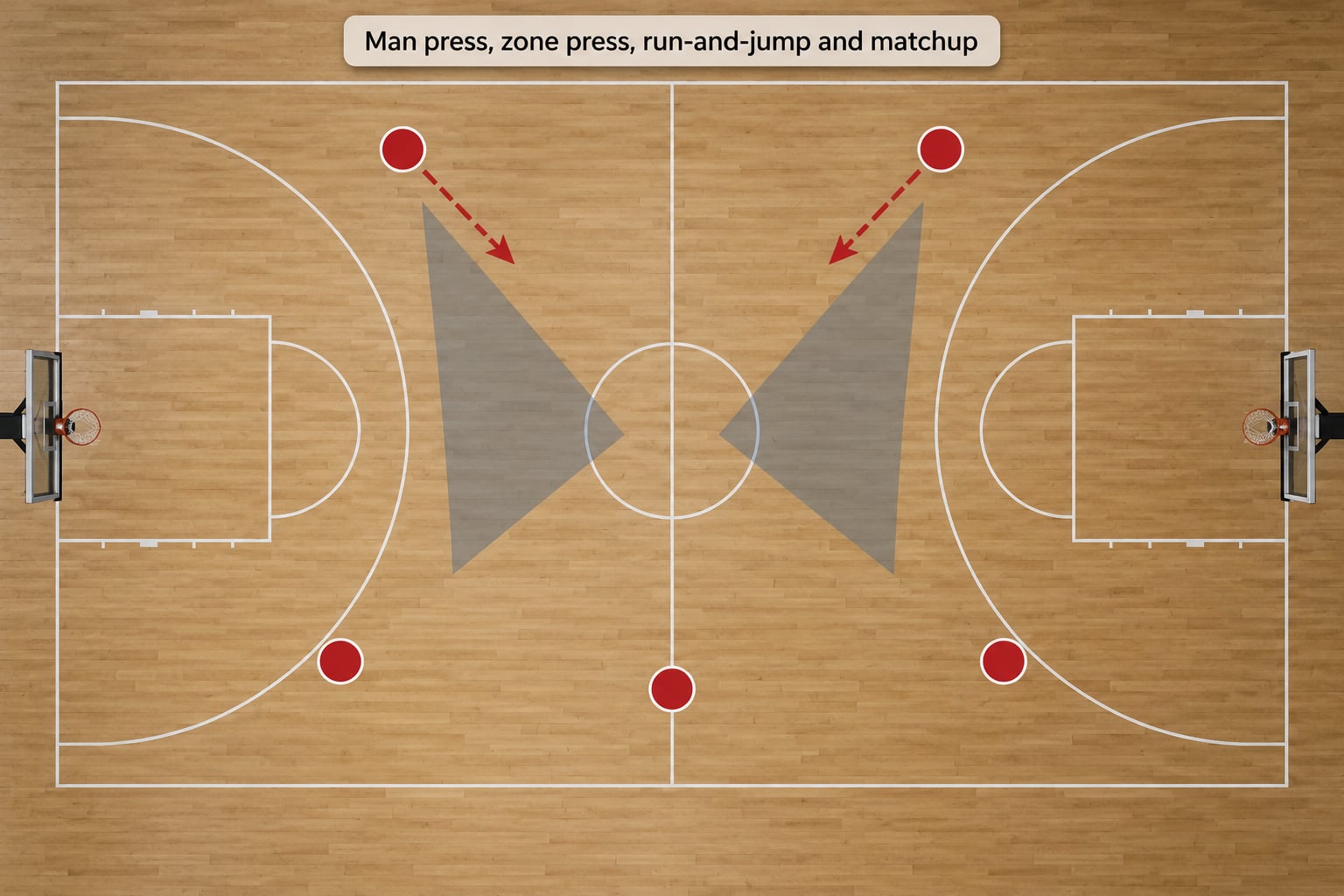
The full-court formations
The numbers tell you where defenders start relative to the ball. A 1-2-2 has one defender on the ball, two in the middle and two at the bottom. A 2-2-1 box has two pressuring, two protecting the middle and one long defender denying the backcourt pass. A 1-2-1-1 diamond spreads the pressure evenly with a player at every level. A 2-3 tandem sends two defenders at the ball and three play the runout.
Here is the comparison, and it is worth memorizing because every other question about pressing flows out of it.
| Formation | Alignment | Man or zone | Key personnel demand | Best used when |
|---|---|---|---|---|
| 1-2-2 | One on the ball, two in the middle, two deep | Usually zone | Quick guard who can pressure and recover | Against average ball handling in the backcourt |
| 2-2-1 box | Two pressuring, two middle, one long | Usually zone | One long defender for the backcourt denial | When you want to attack a specific ball handler |
| 1-2-1-1 diamond | Pressure at four levels | Zone or matchup | Speed at every spot, no weak link | Against a team that reverses the ball well |
| 2-3 tandem | Two pressuring, three protecting the rim | Usually zone | A second guard willing to chase | End of a game against a team that cannot advance |
| Man press | Full-court man assignments | Man | Athleticism and foul discipline | Late game, small point margins |
| 1-3-1 half-court trap | One on the ball, three middle, one deep | Zone trap | Cover ability from the bottom corner | Against teams that live in the mid-range |
The 1-3-1 half-court trap
The 1-3-1 trap is the natural extension of the press, sitting at the foul line extended in front of the offense. The middle player guards the passing lane up top, the two wings shade toward the ball, and the bottom defender must cover from corner to corner on two passes. That last duty is why the scheme fails for teams without range in the middle of the floor.
With three-point shooting now spread across all five spots, the bottom defender has a much longer trip than the trap diagram suggests. Modern versions of the 1-3-1 push the middle defender higher to force the ball toward the sideline, where the offense has less room to operate.
How we got here
Zone pressure is old. The trap-heavy 1-2-2 was the standard high school weapon for decades, largely because it was the cheapest way to make a quick team slow and turn it over. College programs then moved toward the 2-2-1 box and the 1-2-1-1 diamond, where pressure comes from more spots and the offense cannot simply feed one trap.
What changed the math is shooting range. When the trap wants the ball on the sideline, a team with corner shooters has no reason to move it toward the middle at all, so traps that used to work started giving up threes. Presses built since the three-point line widened tend to load the ball side, send two defenders to the ball and hold a defender in the middle as a deterrent rather than as a receiver.
How Do Defenders Trap the Ball Handler?
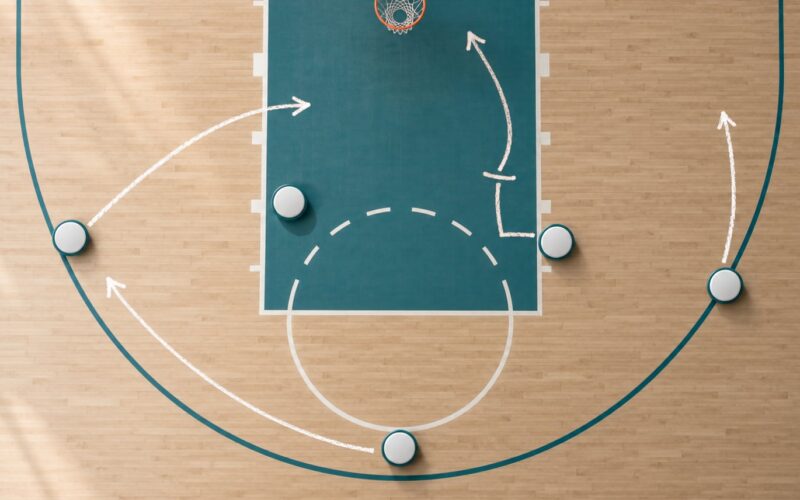
A trap is two defenders on the ball at once, timed so the ball handler cannot pick up his head, and placed so a mistake becomes a turnover rather than a reset. The mechanics matter more than the enthusiasm.
The on-ball defender’s job is containment. He angles the ball handler toward a sideline and slightly away from the middle, keeps his hips between the ball and the middle of the floor, and funnels rather than reaches. The second defender approaches from the middle or from behind a screen, arrives with hands up, and closes the passing lane the ball handler was counting on.
Three defenders help around the trap. They deny one pass away, which means they give up direct catches but take away the easy recovery pass. This is the whole trade: the trap takes away the safe outlet and the help defenders take away the safe second option, so the ball handler has to either dribble out or eat the turnover.
Common trap locations are the sideline near midcourt, the backcourt just over half court, and the top of the key. Sideline traps are the most effective because they remove the escape lane. Traps in the middle of the floor look exciting and work badly, because the ball handler has open court on three sides.
The risk is real enough that coaches measure it. When two defenders are on the ball, three defenders cover four offensive players. Two clean passes out of the trap usually produce an uncontested shot, and one pass plus a dribble drive can produce a layup. That arithmetic is why a trap belongs on a trigger rather than on every possession.
Why Is Press Defense Effective?
Pressing is effective because basketball is a timing sport played by tired people. Pressure attacks the timing first and the talent second.
Forced turnovers are the headline, but live-ball turnovers are the ones that matter. A deflection stolen near the sideline produces a short trip the other way. A turnover that comes off the dribbler stepping on the sideline, or out of bounds, or into a trap where help is two feet away, produces a short trip too. Steals are the sexy version; live-ball turnovers are the ones coaches actually want.
Tempo control is the second benefit and the one that matters most in a close game. A press forces an offense to spend 8 to 12 seconds simply getting the ball across half court. Those seconds are taken from the shot clock of the possession that follows, which means fewer possessions for the other team and less rhythm for their best shooter.
Rushed decisions follow from the other two. A ball handler under pressure does not read a help defender rotating two steps late. He cannot survey the whole floor, so he throws the pass he saw first instead of the pass that was open. Presses work on the two seconds of confusion before an offense’s execution catches up.
There are conditions, and coaches are honest about them in coaching forums. r/basketballcoach threads about pressing keep landing on the same idea: a press works when you are the better team, and pressing a superior team for a full game usually ends with a loss. Teams that press out of desperation rather than advantage spend their best possessions on defense and still lose the game on the scoreboard.
The trade-off in plain terms
A press bets that the offense will make a mistake under pressure. Every possession is a small wager: win the ball and score four points in transition, or lose the ball and score four points the other way. Teams that press well run the wagers in their favor by making the same mistakes hard to repeat and by making the recovery easy.
The wager is easiest to win in specific spots. A team that has to inbound twice in the backcourt against a set trap is already losing the bet. A team that gets pushed into the corner and forced into a contested shot is ahead of the odds. A team with five ball handlers who can all pass on the move is gambling against the house, and no amount of scheme change fixes that.
Fatigue cuts both ways. Pressing costs a great deal of energy, and the effect arrives around the fourth quarter, which is exactly when the offense that survived the press is freshest. Coaches who press for six minutes of a 40-minute game get the benefit without the bill.
The press also creates easy runout layups, which sounds like an offensive benefit but is really a defensive one. A team that steals at the 28-foot line only needs two passes to score, and those two passes are made against a defense that has already rotated twice.
When teams press and when they back off
The situations that suit pressing share one trait: the offense does not want the extra possessions. Pressing a team that plays slow and rarely turns the ball over steals the best feature of its offense and replaces it with something worse. Pressing a fast team that lives on turnovers hands them the possessions they wanted.
Teams press for four common reasons. They are trailing late and need more possessions than the game clock will give them naturally. They want to protect a lead against an opponent who scores quickly. They face a point guard they cannot guard one on one. Or they want to set the tone early and see whether the other team can handle it at all.
The reasons to back off are just as common. The opponent has turned the press into easy layups, and more pressure will produce more layups. Your own guards are picking up fouls at a rate that kills the game. Your conditioning has slipped and the press works for two quarters. Or simply, the other team is better, and pressing them is the fastest way to find out.
How Do Teams Beat a Press Defense?
The answer is short enough to say out loud and long enough to practice: stay strong, meet the pass, move the ball before the trap arrives, and play at your own pace. Coaches who break presses usually fail at the first item, not the fourth.
A post from r/basketballcoach framed press breaking as three things, and the summary is accurate. You need enough capable ball handlers, you need the scheme to be executed rather than improvised, and you need one guard who can handle pressure well enough to make everything else work. That last one is the trump card, and it is rare.
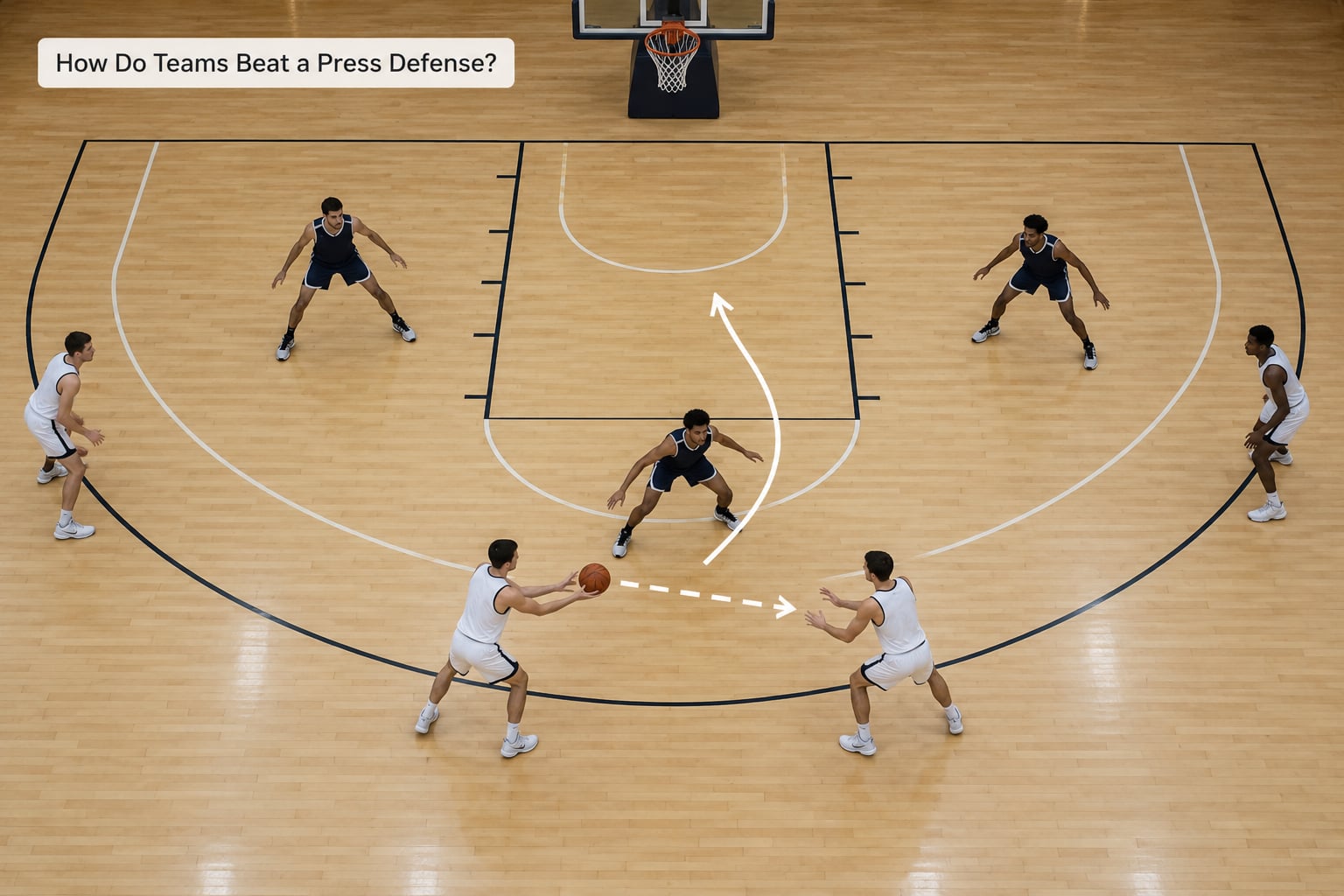
Stay strong with the ball
The simplest counter is also the most skipped. Ball handlers who retreat with their off hand or stop dribbling to think immediately lose the possession. Catch the pass, get your feet set, and let the pressure come to you.
Meet every pass
Receivers should attack the pass rather than waiting on their heels. Meeting the ball cuts the distance a press has to cover and keeps the offense’s spacing honest, which in turn keeps the trap honest.
Pass on a straight line
An angled pass against a trap is a turnover waiting to happen. The direct pass, even under pressure, is the safe one, and it is almost always available if the receiver has moved to make it available.
Reverse the ball before the trap
Reversing side to side forces the entire press to travel. The trap only exists on the side the ball is on, so two swings get the offense into the frontcourt without anybody touching the ball under pressure. Teams that reverse as a unit do far better than teams that try to dribble out of the trap.
Keep a release valve
The release valve is one player who stays open deep in the frontcourt, usually the trailing big, who presents a safe target once the press is broken. It exists so a broken press does not turn into a fast break the other way. Presses that have no outlet become press breaks that go the wrong direction.
Attack the weak pressure angle
Every press has a spot where the pressure thins out, usually the sideline the trap does not favor, or the middle after the deepest defender commits to the ball. Spacing wide stretches the formation, and one player driving that seam at speed beats a scramble.
Play at your pace, not theirs
The pressing team wants the game rushed and rushed toward the trap. Take the ball to the half court, set up, and run your offense. If the press forces 20 possessions in the first half, most teams would rather have 35 possessions of their own.
One last warning: the danger zones. The inbound spot, the corner of the backcourt, and the spot just over half court are where traps live. Cross into them with your eyes up and a pass ready, or slow down and let the press come to you.
What Are the Biggest Press Defense Mistakes?
Almost every failed press traces back to one of six things, and most of them are habits rather than scheme.
Quiet communication
The defender who vacates the middle has to tell somebody. Presses collapse in the second half, almost never the first, and the collapse usually starts as silence on a rotation that nobody called out loud.
Over-trapping
Trapping on every possession removes the defense’s best tool. A team that traps on six straight possessions has given up six straight looks at the rim. Trap on a trigger, not on a whim.
Inconsistent pressure
Half pressure is worse than none. If the ball handler learns that half the time he can coast through the backcourt, he will coast every time and simply wait out the press.
Fouls and reach-in
A press that rakes at dribblers gives away 4 to 6 free throws per game and stops the press entirely. Sliding hips with a low stance and taking the ball away cleanly is slower and far more effective than reaching.
Leaving open shooters
The trap collapses, the kick-out pass goes to a shooter who has been standing in the corner for eight seconds, and the press traded a turnover for three points. Presses that deny the first pass away instead of the first pass itself avoid this.
Abandoning the press at the worst moment
Coaches frequently quit pressing when the game gets tight, because the possessions against the press are ugly. That is backwards. The press is most valuable when the margin is small, and the team that can still execute it in the last four minutes is usually the team that wins.
How Can Players Practice Press Defense?
Presses get installed live or not at all. Walk-throughs teach the shape, but the shape only survives when players have practiced the rotations under speed and pressure.
Two-line press break
Start with a live-ball press-break drill against one defender. The offense inbounds and tries to advance; the defender pressures, then falls back to protect the backcourt. The coaching point is the transition from pressure to recovery, which is where young guards lose the drill.
Rotational 3-on-3 trap drill
Three defenders rotate through trap, recover and backcourt positions on a whistle, with the rest of the team calling the assignments. Run it 30 seconds at a time and stop on every miscommunication. Calling out the rotation is the whole point of the drill.
Closeout and recover
Work the closeout on a stationary shooter, then add the pass that pulls the defender back to the middle. This is the single most repeated defensive mistake in the half court, and it is the same mistake a press makes when a trap collapses.
Three-on-two break
Two defenders press, three offensive players advance with no dribble for the first half of the court, then turn it over. The coaching points are balance, no reach-ins, and finishing the possession without fouling.
For rec leagues and pickup games, the version that actually works is a 1-2-2 with two calls: name the middle when you leave it, and go get it when it comes to you. Nobody has time to install a 1-2-1-1, and nobody needs to. Press a pick-and-roll once and the whole gym will stop bringing the ball up, which is usually the entire point.
Individual work matters too. A press lives or dies on the defensive slide, so cone work with a low center of gravity, hip strength and short choppy steps builds the base that the scheme sits on. A defender who slides well but stands upright will not get close enough to pressure, and a press without real pressure is just a fast transition defense.
Frequently Asked Questions
What is the best press defense in basketball?
There is no single best press, because formations match situations rather than talent rankings. A 2-2-1 box press suits teams with a strong long defender, a 1-2-2 fits teams with quick pressure guards, and a 1-3-1 half-court trap punishes offenses without range. The best press is the one your personnel can execute for 30 straight possessions without giving up easy layups.
Can you explain the full-court press in basketball?
A full-court press applies defensive pressure from baseline to baseline instead of waiting in the half court. Defenders pressure the inbounder or ball handler, deny the easiest pass, protect against the backcourt pass, and shift together as a unit. The goal is to force turnovers and slow the offense before it can run a set, then convert a steal into a fast break.
What is the 1-2-2 zone defense in basketball?
In a 1-2-2 zone press, one defender pressures the ball, two guard the middle passing lanes, and two play deep to stop the long pass and the break. It is a zone, so defenders guard areas and pass the ball handler off to each other. The scheme forces the offense toward the sideline, where it has the least room to operate.
Is a 2-2-1 press good?
A 2-2-1 press is one of the most reliable full-court schemes because it puts two defenders on the ball, two in the middle, and one deep. It works when you have one long defender who can protect the backcourt and two guards who can pressure without fouling. It fails when that deep defender is average, because the backcourt pass becomes an easy runout.
How do I get out of a full-court press?
Stay strong with the ball, meet every pass, and reverse the ball side to side before the trap arrives. Do not try to dribble out of the trap, because teams that reverse as a group beat presses far more often. Keep one player open deep as a release valve so a broken press does not become a fast break the other way, then set up and play at your own pace.
Why do some teams stop pressing in the second half?
Most teams stop pressing because the press works less as the game gets tighter and the possessions get ugly. That is usually the wrong call, since a press is most valuable when the margin is small. Coaches also quit because of fatigue, since the press costs a lot of energy and arrives tired in the fourth quarter. The better fix is to press in defined stretches rather than abandoning it.
Conclusion
So how a press defense works in basketball comes down to a cycle: pressure the ball, deny the easy pass, protect the backcourt, shift together, trap, then convert or re-form. Run well, it wins possessions without shooting. Run badly, it hands back the possessions it tried to steal.
If you are watching, start with four things: the pressure point, the trap trigger, the help rotation, and the lane the offense takes when the press breaks. That sequence tells you everything about why a possession went the way it did.
Updated for 2026.