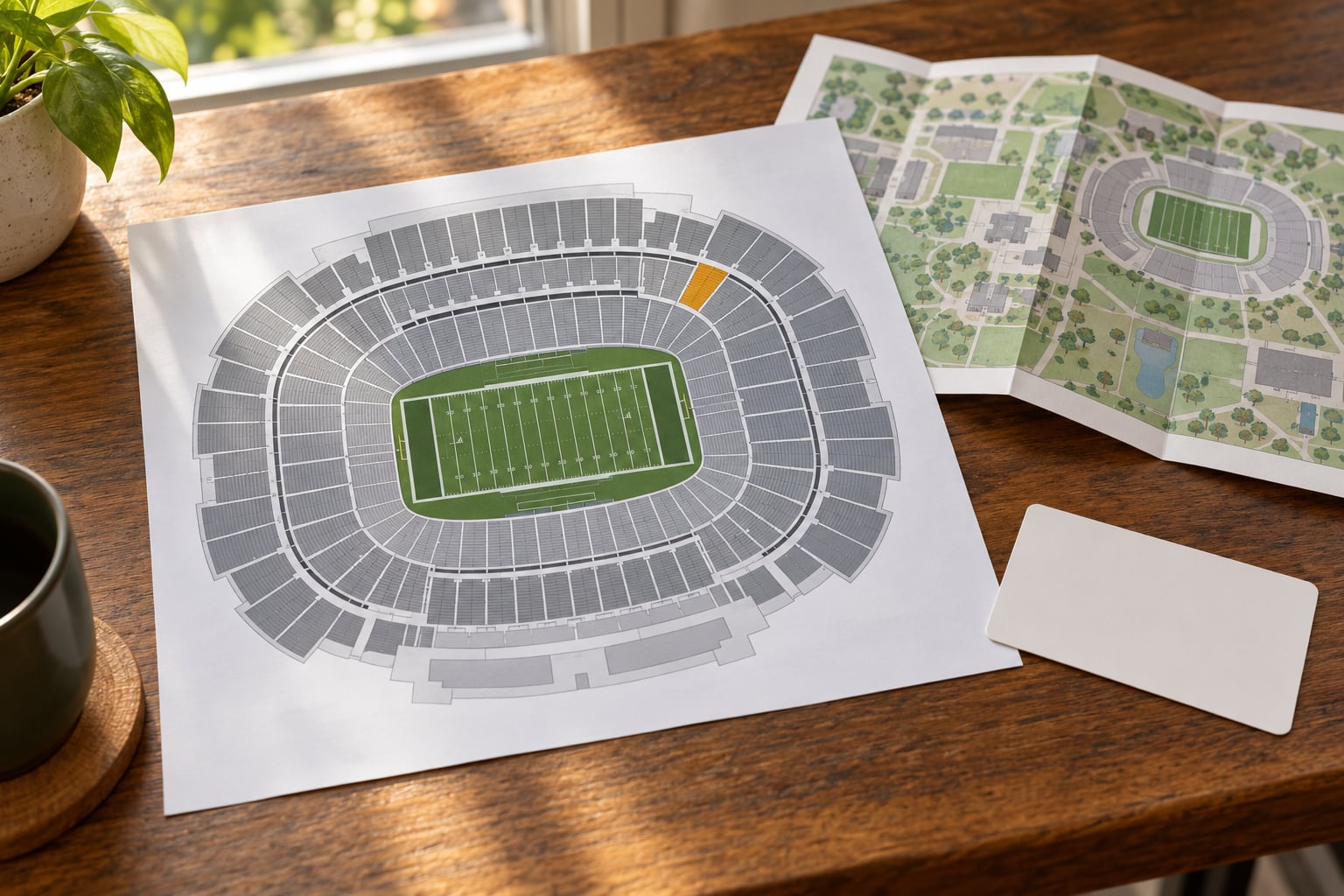
A seat license is a one-time, usually non-refundable fee that gives you the right, and typically the obligation, to buy season tickets for one specific seat at a university stadium every year you want it, as long as the school keeps playing in that venue.
Most people hear “seat license” and picture the NFL, where it means a five-figure up-front bill for the right to keep buying tickets. College athletics runs on a different version of the same idea. At many schools you do not buy a license outright; you earn a seat location through a booster point system or giving level, and the license attaches to that location.
Either way the mechanic underneath is identical: one fee, one specific seat, an annual renewal obligation, and a set of rules about what happens if you stop paying or hand the seat to someone else. This guide covers how seat licenses work at college stadiums in plain language, since the contract language is where fans get stuck.
Table of Contents
- What Is a College Stadium Seat License?
- Why Do Some Stadiums Require Seat Licenses?
- How Seat Licenses Work at College Stadiums
- Do You Need a Seat License for Every Game?
- What Does a Seat License Cost?
- How Buying and Renewing a Seat License Works
- How Seat License Transfers and Resales Work
- How Seat Licenses Work on Game Day
- Can a School Revoke or Take Back a Seat License?
- What to Check Before Buying a Seat License
- Frequently Asked Questions
- Conclusion
What Is a College Stadium Seat License?
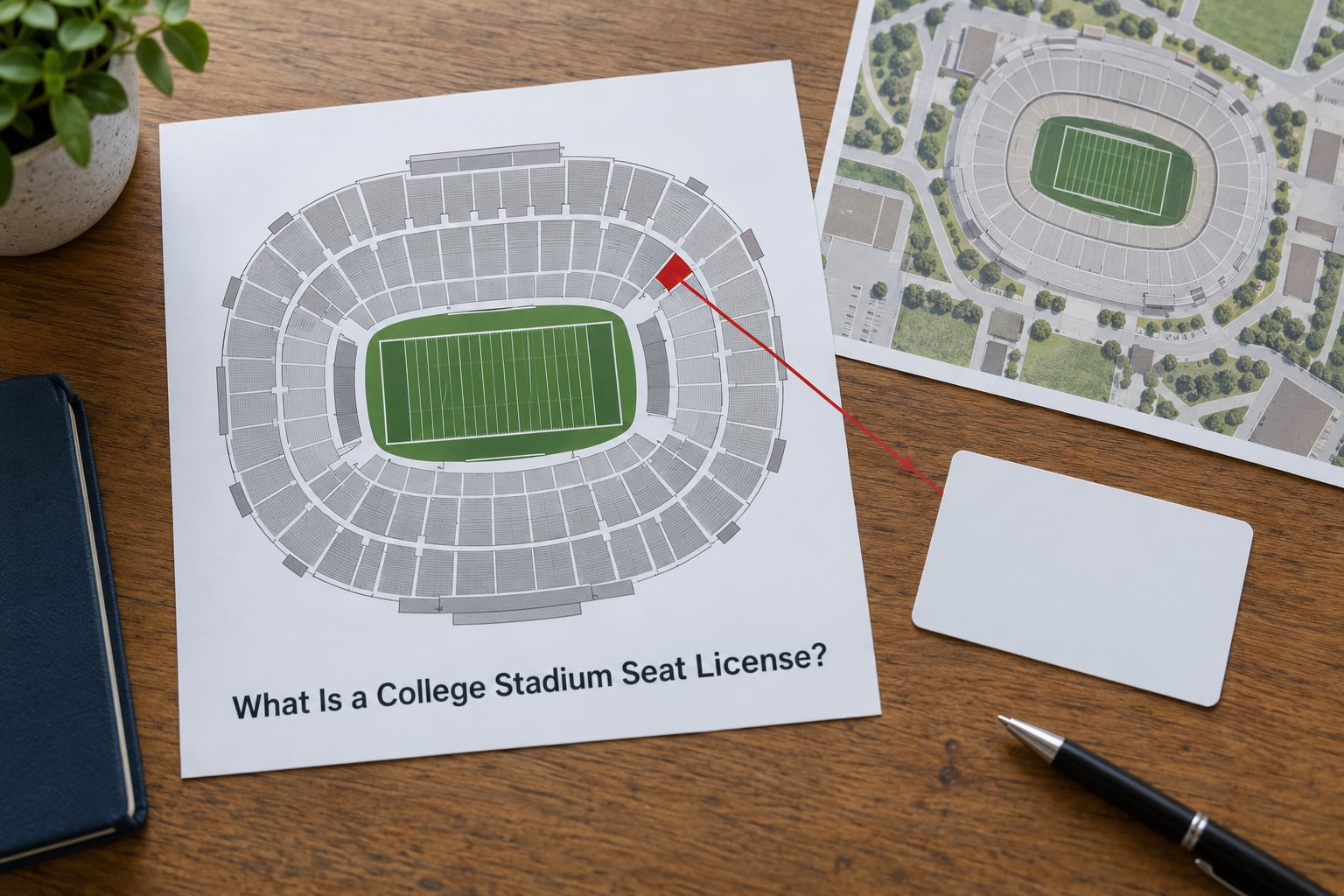
The short version, in four sentences: you pay a fee tied to a specific seat, you commit to buying that seat’s season tickets every season, you keep the same location while you keep paying, and you give the license back if you stop. That last part catches people who assumed they were buying a seat rather than renting a place in the inventory.
Think of the license as a claim on a location, not a ticket. The seat stays the school’s until you buy it, and the school’s obligation only begins once you have. Two fans can sit ten rows apart and have completely different obligations, because the number in one contract is attached to the location and not to the person holding it.
Seat license or season ticket: the distinction that trips everyone up
They are two different purchases that arrive together. The season ticket is what gets you through the gate on game day, and its price moves with the market every season. The seat license is the claim on the location, and its price is set once when the seat is issued.
Some schools use the term “seat contribution” or “seat endowment” instead of license. Others fold everything into a single annual charge with no separate license at all. If you cannot find the exact term your school uses, search your ticket office site for “seat license,” “seat rights,” and “point system” before assuming your school does not have one.
College names for the same mechanic
- Personal seat license (PSL) — the standard North American term, borrowed straight from pro sports.
- Stadium seat license (SSL) and stadium builder license (SBL) — common in newer venues where the fee helped pay for construction.
- Charter seat license (CSL) — a deeper commitment, usually tied to a multi-year term and heavy giving requirements.
- Seat endowment — the license money goes into a restricted fund rather than paying down construction debt, so the seat stays with the school longer.
- Booster points or seat points — not a license at all, but the system most colleges actually use to decide who gets which seat.
Why Do Some Stadiums Require Seat Licenses?
Because the seat is the product. Once demand outruns the good seats, a school has to decide how to divide them, and a license turns a jumble of requests into an ordered list with money attached.
Five reasons show up again and again, and they vary by school:
- Funding a building. A new stadium or a major renovation rarely pays for itself on ticket revenue alone, so license fees are sold to close the gap.
- Managing demand. When 30,000 people want 8,000 good seats, a fee and a waiting list sort out who gets in.
- Locking in revenue. Annual renewal obligations give a school predictable income across a decade instead of chasing fans one season at a time.
- Creating a donor ladder. Seats become the reward structure for annual giving, which is how booster clubs fill their rolls.
- Preserving inventory. Reserved, licensed and club inventory has to exist somewhere, or every seat looks identical and premium pricing dies.
Not every school requires one, and plenty of schools only use licenses in a handful of premium sections. Treat any claim that “you must buy a seat license” as school-specific until you read your own stadium’s rules.
How Seat Licenses Work at College Stadiums
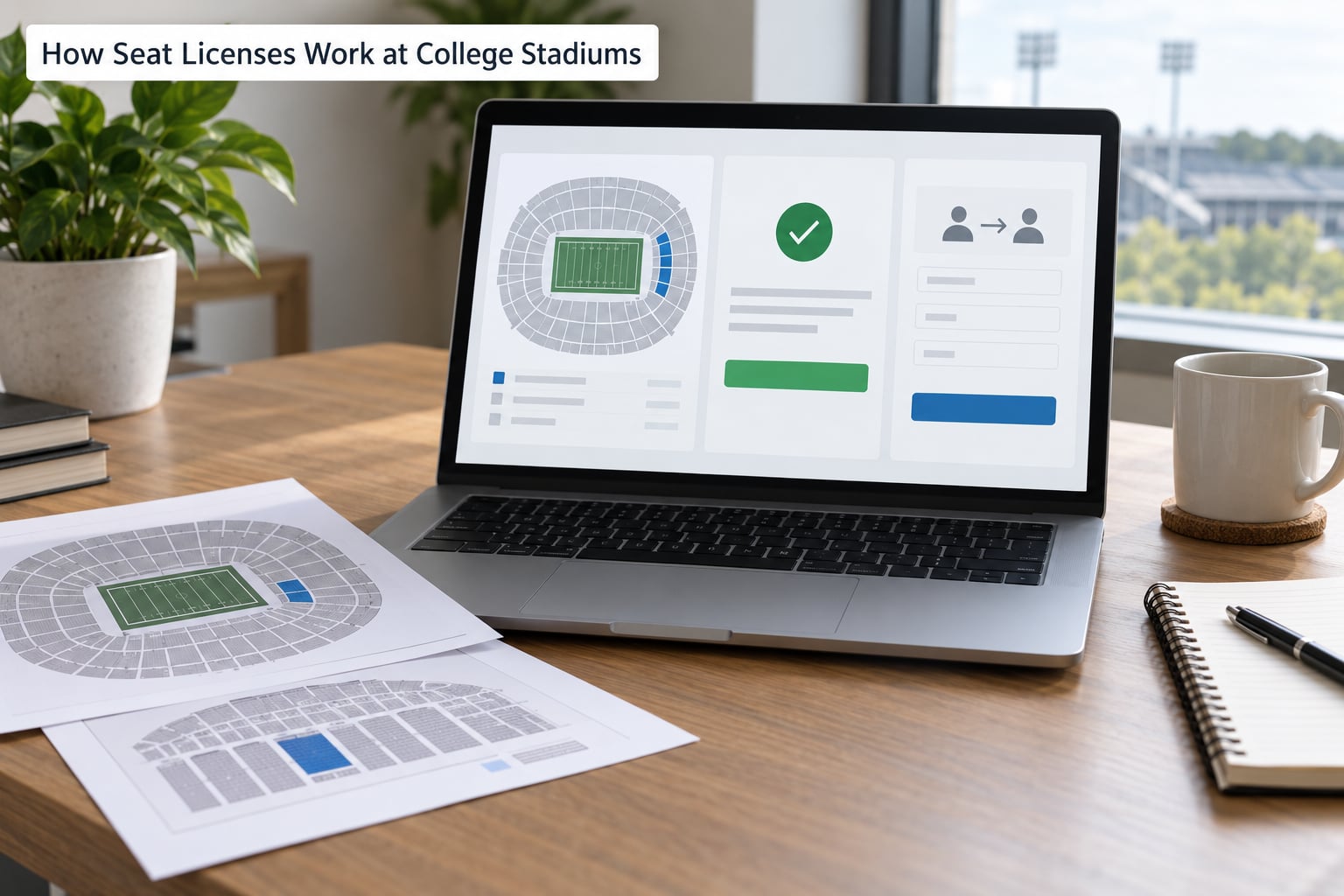
Seven steps cover nearly every system in the country, though the order and the deadlines shift from school to school.
1. Get on the account list
Most college seat allocation starts with a ticket account and, for high-demand sections, a waiting list. New fans rarely buy a license cold; they buy season tickets for a few years, build a record, and wait for an opening. A point person or account manager often handles outreach during new-stadium projects, which is the role fans describe when they mention being “walked through” the decision.
2. Qualify through points, giving or seniority
College seat selection is not first-come-first-served. Your booster points, cumulative giving, years of attendance and existing seat location decide your priority when a location opens up. Current holders in better locations usually get first refusal, which is why schools contact account holders in waves rather than opening the seats to everyone at once.
3. Choose or receive a seat location
You either pick a section from a seating chart or you get an assignment. Higher sections near the 50-yard line carry the largest fees. End zone and upper-level seats usually cost less, and some schools discount student sections or sell them as general admission instead of licensed seats at all.
4. Pay the license fee, usually once
This is the up-front, non-refundable part, and most schools offer a payment plan since the totals run into five figures for good seats. Interest is common on those plans. Read the schedule before you sign; a plan that stretches ten years keeps the annual number small and the total much larger.
5. Buy the season tickets every year
The license does not include tickets. Every season you renew, you pay the current ticket price for that seat, and the school can raise it. A seat that cost one amount in your first year can cost meaningfully more in year five, and the license fee does not protect you from that.
6. Use the bundled benefits
Depending on the tier, benefits include first access to postseason tickets, earlier entry, parking, club or lounge access, and sometimes tickets to non-football events in the same venue. Benefits are what turn a legal obligation into something that feels worth it, and they are also the part most likely to be trimmed later.
7. Transfer it, or lose it
Transfer rules are set by the school. Some let you reassign the license to a family member once per year. Some count it as a gift. Some allow no transfer at all. If you stop renewing, most agreements hand the license back to the school, usually without a refund, and it returns to the general pool.
Do You Need a Seat License for Every Game?
No. A seat license governs your right to a seat for a season. Single-game buyers, casual attenders and most students never touch the system at all.
| What it is | What you are buying | When you need it | Can you sell it |
|---|---|---|---|
| Single-game ticket | One seat, one game | Any time you just want to attend | Only if the school or an authorized seller lists it |
| Season ticket | The same seat for a full season | When you want to attend most games | Usually transferable as a gift, rarely resold |
| Seat license | The right to keep that specific seat year after year | When you want a guaranteed location for years or decades | Only under the school’s transfer rules |
| Booster or donor points | Priority for seat locations and benefits | When you want first choice of inventory | No; points are tied to your account |
Two things people mix up. Premium memberships, club seats and parking packages are often bundled into the license tier but are separate products on their own. And a guest ticket is almost always included with a season ticket package, so you can bring someone without transferring anything.
What Does a Seat License Cost?
The honest answer is that there is no single number, and anyone quoting you one without naming the school, the section and the year is guessing. What I can give you is the set of line items that make up the total.
| Cost component | What it covers | How it usually behaves |
|---|---|---|
| Initial license fee | The claim on one specific seat | One-time, non-refundable, set when the seat is issued |
| Annual season ticket renewal | Tickets for the current season | Every year, and the price can rise each cycle |
| Service or account fee | Per-order or per-account handling | Small, but it recurs |
| Payment plan interest | The cost of spreading the license fee | Adds meaningfully to the total over a long term |
| Benefit bundle value | Parking, club access, early entry, postseason access | Often included; sometimes sold separately |
| Related extras | Parking, suites, hospitality packages | Separate agreements, separate renewals |
Prices are set by each school and change every cycle, so treat any figure you hear as a snapshot rather than a fact. Your ticket office will have the current schedule, and it is worth asking for the total annual cost, not just the license fee, before you commit.
Supporters of seat licensing argue that good locations near the field are genuinely scarce and a fee is a fair way to allocate them. Critics answer that the fee is charged for the privilege of buying tickets again, not for anything you receive on game day. Both positions are reasonable, and your answer depends on how much the location and the benefits are worth to you.
How Buying and Renewing a Seat License Works
Buying follows a predictable sequence: create a ticket account, qualify for seat eligibility, choose or accept a location, sign the seat license agreement, pay the fee or start a plan, then renew the season tickets on the account every year before the deadline your school sets.
Renewal is the part worth planning for. Most schools give you a window in spring, and missing it usually means losing priority rather than losing the seat outright. Renew early and the choice stays yours.
If a renewal is declined or you decline to renew, the school typically reverts the license to its general pool. Your account record and points usually survive, so you may be able to get back in later at a worse location. Ask specifically what happens to your standing, because that is rarely spelled out as clearly as the forfeiture itself.
How Seat License Transfers and Resales Work
Transferring a license and transferring a single-game ticket are completely different actions. A single-game ticket is a coupon for one seat at one event. A seat license is a contract with your school, and the school decides whether it can move.
What usually applies at college stadiums:
- Authorized transfers go through the ticket office, often limited to immediate family and often capped at once or twice per season.
- Many agreements let you give the seat to someone else for a season as a gift, with the license staying in your name.
- Relinquishing the license permanently is possible at many schools, and it is usually treated as a forfeiture rather than a sale.
- Resale on an open market is rare. There is no liquid secondary market for college seat licenses the way there is for some NFL seats, so expect the money to be locked in.
The lack of a resale market is the single biggest difference from professional sports, and it changes the math entirely. A professional seat license can be traded at a premium or at a discount. A college license, in most cases, is worth exactly what your school says it is: nothing to you when you stop using it.
How Seat Licenses Work on Game Day
On game day the license is just the background to a normal ticketing process. You activate the account in the school’s app or ticketing platform, the season tickets for that seat appear on your account, and you scan in with your mobile ticket or the physical card the school issued.
Most schools issue digital tickets, which means the account holder has to be the one who can load them. That is a practical problem for families who share a seat across two households, and it is worth sorting out before the first home game rather than in the parking lot.
Entry, seat access and re-entry follow the same rules as any other ticket at that venue. License benefits, when they exist, sit on top: earlier entry windows, club access, dedicated entrances, guest privileges and postseason access. If something goes wrong, the first call is always your account manager rather than the general ticket office line.
Can a School Revoke or Take Back a Seat License?
Yes, and the agreement will spell out when. Common causes include an unpaid balance, a default on a payment plan, violations of the school’s resale or transfer rules, and conduct that breaches the ticket terms.
Stadium projects create a different kind of loss. If a school renovates, expands or replaces a venue, licenses can be relocated, re-priced or converted into a different product. Your contract language determines how much of your original deal survives. Fans at professional venues have gone to court over exactly this, and college disputes generally play out through the same contract language rather than any guaranteed grandfathering.
Most schools allow an appeal through the ticket office and sometimes a higher athletics or compliance office. Appeal in writing, keep copies of every notice, and respond before the stated deadline. A verbal conversation with an account manager rarely changes an outcome on its own.
What to Check Before Buying a Seat License
Work through this list before you sign anything, and it covers most of what goes wrong later.
The seat itself
- Look at the view from an actual game, not a rendering. Check how much of the field is visible and whether a support column sits in front of you.
- Confirm the section name, row and seat number in writing before payment.
- Ask whether the seat is licensed, reserved, or part of an unreserved lower-bowl section that could later be converted.
The money
- Get the total annual cost, not just the license fee.
- Ask what the fee was ten years ago and what it is today, and whether it escalates automatically.
- Model the payment plan at full term, including interest, before you sign.
- Confirm in writing whether any part is refundable. Usually none of it is.
The rights
- Who can the license be transferred to, how often, and at what fee?
- What happens to the license and your account standing if you skip a season?
- Which benefits are guaranteed in writing versus described as subject to change?
- What happens to your seat if the stadium is renovated or replaced?
Red flags in the agreement
- Auto-renewal language with a short opt-out window and a heavy cancellation fee.
- Automatic price escalation written to adjust without notice.
- Relocation rights with no stated replacement value.
- Automatic downgrade language letting the school substitute a cheaper product while keeping your payments.
- Benefit lists phrased as “may include” or “subject to availability” rather than promised.
One more question worth asking: how many people hold this license and who paid before you. At schools with point-based systems, the answer tells you how long the wait is and how stable your location will be.
Frequently Asked Questions
Is a seat license the same as a season ticket?
No. A season ticket buys your seat for one season and its price changes each year. A seat license is the one-time fee for the right to keep buying that same seat year after year, and it comes with an annual obligation to renew. You need both: the license holds the location, the season ticket gets you in the gate.
Do I need a seat license to buy a single-game ticket?
No. Single-game buyers never need a license at most schools, and casual fans should not buy one. A license only matters if you want the same location every season for years. Schools also sell separate season ticket packages without any license attached, which is the usual starting point for new fans.
Can I transfer my college stadium seat license to someone else?
Usually only under the school’s own rules. Most agreements allow transfers to immediate family, often limited to once or twice per season, and some schools require the ticket office to process them. Resale on an open market is rare, so do not expect to recover what you paid if you stop using the seat.
What happens if I do not renew my seat license?
Most schools let the license revert to the general pool without a refund, and your seat location can be reassigned. Your ticket account and any booster points usually survive, so you may be able to get back in later at a worse location. Renew inside the window your school sets each spring to keep your priority.
Are seat-license refunds available if I move or stop attending games?
Rarely. These fees are almost always non-refundable, which is why the agreement should be read carefully before payment. Some schools offer a one-time gifting option to a family member, and some will convert a license during a stadium renovation, but neither is a refund. Ask about both in writing before you buy.
Conclusion
How seat licenses work at college stadiums comes down to one rule: a fee buys you a specific seat, and keeping that seat costs you money every season. Everything else, points, deadlines, transfers and benefits, is variation on that theme.
Start with your school’s official seat license or seat rights page, then ask your ticket office for the total annual cost, the renewal deadline and the transfer policy in writing. If the location and the benefits are worth real money to you, a license is a defensible purchase. If you are buying it hoping to get it back later, that hope is the part to drop first.