A season ticket renewal is the annual re-purchase of the season ticket package you already hold. You are not buying from scratch; you are renewing your claim on the same seats at a price the school sets for the coming season, inside a defined renewal window with a hard deadline. Renew on time and you usually keep your seats. Do nothing and those seats can be released to other buyers.
That is the whole answer in short. The rest is timing, money and paperwork, and almost all the confusion fans complain about comes from those three things rather than from the process itself.
As of October 2026, there is still no national renewal deadline for college sports. Every program sets its own, and the calendars barely overlap between football and basketball. Check your own athletics site rather than trusting any general timeline, including this one.
Table of Contents
- What Happens During a Season Ticket Renewal?
- When Do College Sports Teams Send Renewal Notices?
- How Do You Know Whether You Are Renewing or Buying New?
- What Are the Typical Season Ticket Benefits?
- How Do Payments, Installments, and Refunds Work?
- What Can Change Before You Confirm Your Renewal?
- What Should You Do If Your Seats Are Unavailable?
- Frequently Asked Questions
- Conclusion
What Happens During a Season Ticket Renewal?
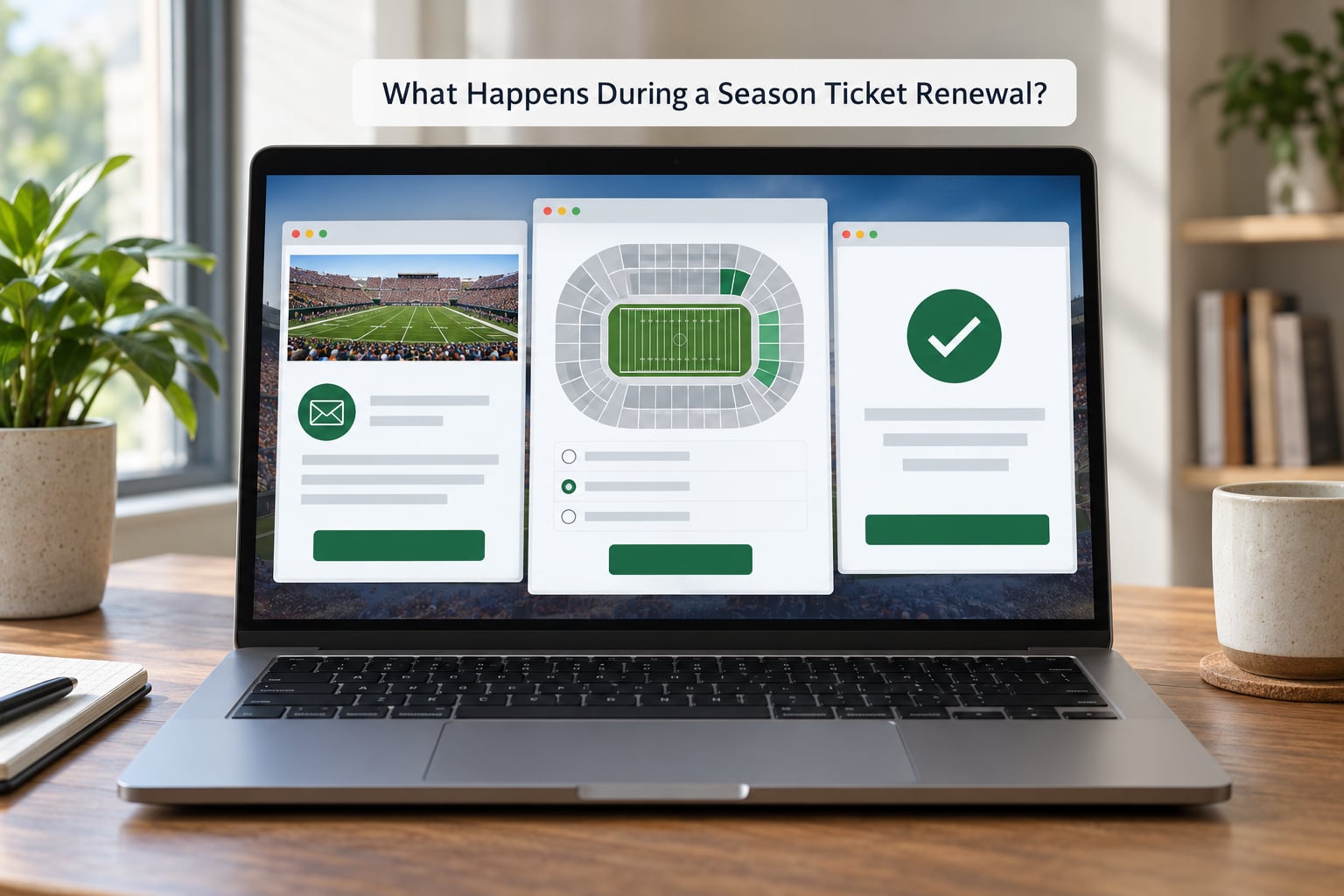
A renewal is a re-purchase with a seat attached, not a transfer, not a gift and not a subscription you can pause. Five beats repeat every year for nearly every program in college football and basketball.
- The renewal notice arrives. Existing holders get an email or a portal message with the coming season’s prices, the deadline and any bundled annual contribution.
- The renewal window opens. Account holders get first access, usually a couple of weeks before the public on-sale date. New buyers enter afterwards, often through a lottery or a waitlist.
- You choose a payment option. Most schools offer full payment up front, an interest-free installment plan, and an opt-in autorenew that charges the card on file automatically.
- Your seat is confirmed or relocated. If construction or reseating is happening, seats may move. Otherwise your seat is held and re-issued for the new season.
- You receive pre-sale access. Confirmed holders get first pick on single games, postseason tickets and any playoff or bowl allocation before those go to the public.
Two things look like renewal but are not. A new membership request happens when you have no account, and it puts you into the same queue as every other new buyer. A single-game ticket is one admission, and a mini plan is a fixed bundle of home games, neither of which carries seat rights or postseason priority.
When Do College Sports Teams Send Renewal Notices?
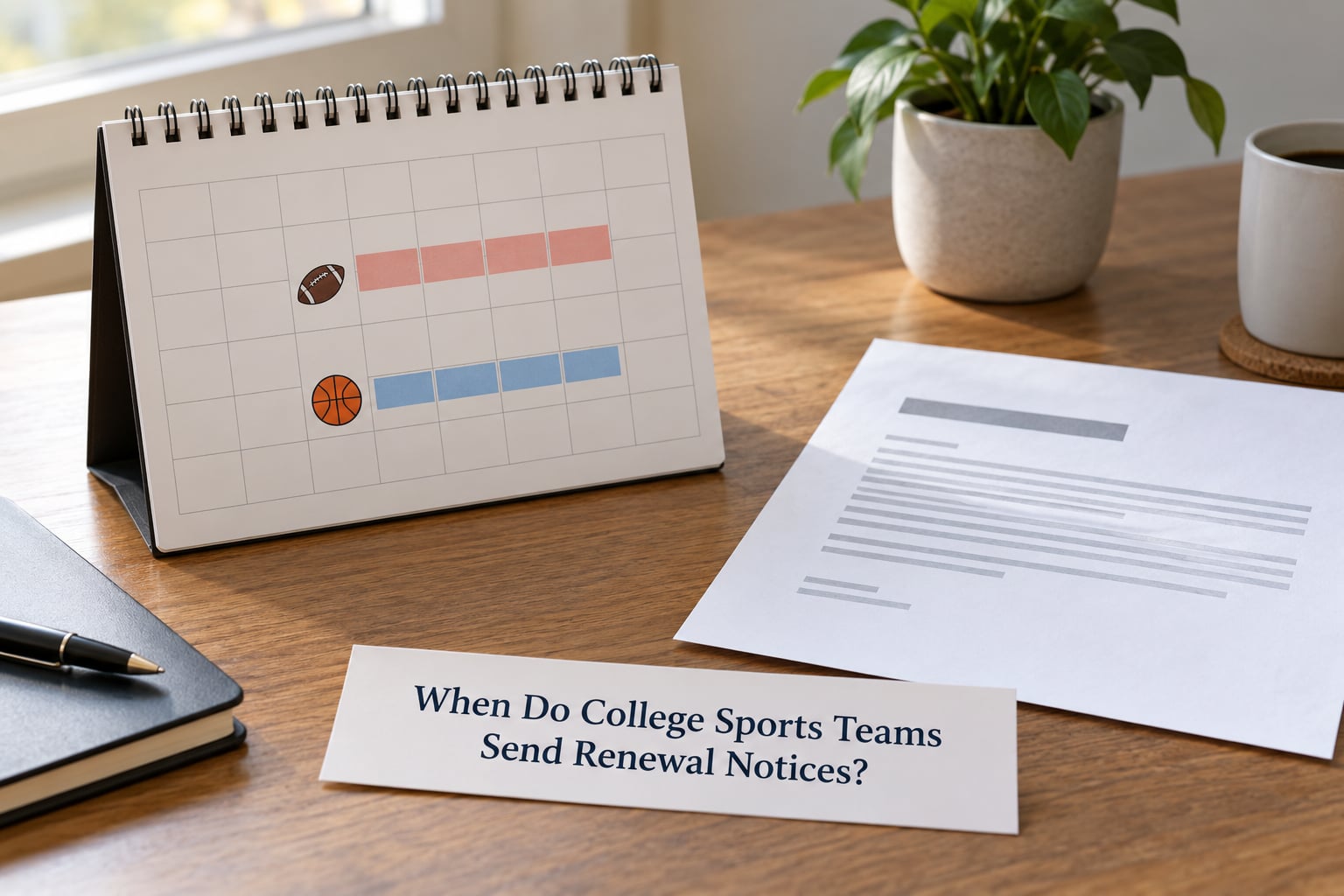
Renewal notices go out months before kickoff, and the window is usually measured in weeks. Football programs cluster in the winter, basketball programs cluster in the spring, and baseball or soccer fans may deal with two short windows in one calendar year.
| Stage | Football programs | Basketball programs |
|---|---|---|
| Notice to existing holders | Late winter, roughly January | Early spring, roughly March |
| Renewal window opens | January to February | March to April |
| Renewal deadline | Late February to March | April to May |
| Public on-sale | After the renewal deadline | After the renewal deadline |
| Installments finish | Close to opening day | Close to opening day |
Those are ranges, not rules. One conference school publicly documented a renewal window opening mid-January and closing around March 20, while another out West advertised renewals starting in mid-July with an August deadline. A basketball guide for the current cycle noted renewals opening July 17 with a deadline on August 21.
The pattern is consistent even when the dates are not. Notice first, account holders second, public third, deadline last. If you only remember one thing, remember that window opens before the schedule is fully public, which is why prices sometimes change between the notice you read and the season you end up watching.
Why there is no single deadline you can look up
Each athletics department sets its own dates around its own schedule, its own capacity and its own fiscal calendar. Conference realignment, stadium projects and media rights deals all move the goalposts. A date published by one school tells you nothing about a rival five states away.
How Do You Know Whether You Are Renewing or Buying New?
Four paths look similar from the outside and carry very different consequences. Find yours before you pay anything.
Automatic renewal
If your account has autorenew switched on, the school charges the card or bank account on file at the deadline and your seats are confirmed without a click. This is the easiest path and the easiest to forget about. Check the setting in your account, because opting out usually takes an action and opting back in may take a phone call.
Account-holder renewal
You get a notice addressed to your account with your current seats listed. You confirm, relocate, change the seat count or pay a deposit to hold the seats while you arrange payment. This is the most common path for long-tenured holders.
New-member request
No account exists, so you are entering the public queue. Best seats are usually gone. Upper-level inventory may be allocated by lottery, and lower-bowl or premium areas often carry a required capital contribution that functions as a multi-year commitment. Renewal pricing simply does not apply to you.
Waitlist
A waitlist is not a purchase. You are expressing interest, and the school tells you when inventory becomes available. Waitlist timing varies enormously, and being near the top of one guarantees nothing.
The tell is in the paperwork. Renewal notices list your existing seats and your account number. New-buyer pages ask you to pick from a map with no seats preselected. If the language is about joining a waitlist or entering a lottery, you are not renewing.
What Are the Typical Season Ticket Benefits?
Most benefits fall into two groups. The first is what every program with a renewal program offers. The second is specific to one school and can be added or removed between cycles.
Benefits you can generally count on
- The same seat for every home game, in most seasons and in most buildings.
- A discount against buying single games, usually in the range of 10 to 30 percent off the cumulative face value of the same games bought individually.
- Pre-sale access to single games that are not part of your package.
- Postseason allocation for bowl games, conference championships or an NCAA tournament run, subject to a separate order form.
- A guest ticket allowance or discounted additional-seat pricing.
- Member events such as practices, open workouts and season kickoff gatherings.
Benefits that come and go
Parking has been bundled, unbundled and made premium at different schools within the last few years. Included food and beverage credits, in-stadium charge privileges and complimentary guest counts move around too. Treat any benefit list as a snapshot of the coming cycle, not a permanent entitlement.
Postseason deserves its own note. Being a season ticket holder does not automatically mean a seat in a bowl game, the College Football Playoff or an NCAA tournament session. Those are separate purchases, and holders usually get a short ordering window before the general public. A deep postseason run can consume a budget you did not plan for, which is a good reason to ask about postseason pricing before you commit to the base package.
How Do Payments, Installments, and Refunds Work?
Payment is where first-time renewers get surprised, usually because of an item on the invoice they did not know was there.
The two-part invoice
Plenty of programs bundle a required annual contribution or advancement gift with the ticket cost. Fans on the Nebraska boards described exactly this: a contribution invoice arriving in one month and the ticket renewal invoice arriving later as a separate bill. If your program does this, missing the contribution bill does not pause the ticket renewal, and the ticket office will usually treat the two separately.
Ways to pay
- Full payment at confirmation, sometimes at a discount to the installment total.
- Interest-free installments spread evenly from renewal through opening day, offered by most large programs.
- Autorenew, where the balance is charged automatically on the deadline date.
- A deposit to hold seats while you arrange the balance, common when a payment plan exists.
Fees are worth reading closely. A per-game convenience fee applied to every game in your package can exceed the nominal discount against single-game pricing, so the real comparison is total cost for the season, not the headline rate.
If a payment fails
A missed installment usually triggers a notice and a short grace period, then a lapse. Programs differ on whether they retry the charge, suspend the account or release the seats outright. Assume the seats go back into inventory unless the ticket office tells you otherwise in writing.
Refunds are a separate question from renewals. Typically a cancellation, a schedule change or a policy exception produces account credit rather than a cash refund, and the request window is short. Read the refund language before you buy, not after a game gets moved.
What Can Change Before You Confirm Your Renewal?
The renewal invoice is a proposal, not a settlement. Between the notice and your payment date, several things can move.
- Seat relocation. Construction, a new seating deck, a video board project or a premium-area conversion can shift your seat without any change on your part. Forum complaints about renovation-driven moves cite altered sightlines and lost chairbacks more often than anything else.
- Reseating even with no project. Some programs periodically rebuild sections for sightline or safety reasons and use a priority points system to decide who picks first.
- Price changes. Increases can come from seat upgrades, fee changes, a required contribution, capital project pledges or a general rate adjustment.
- Seat-count and account changes. Adding, removing or splitting seats is usually allowed before you pay, and programs cap the number of seats a single account can hold.
- Transfers. Most programs let you move a package to another named account holder under conditions that vary widely. Some allow it freely, some require the incoming holder to meet a tenure threshold.
A pre-payment checklist
Before you confirm, log in and read the order summary line by line. Confirm the seat location and section match what you expect. Check the seat count. Compare the total against last season, including fees and any contribution. Confirm your payment plan dates and your autorenew setting. Note the renewal deadline and the refund request deadline. Screenshot the summary and keep the confirmation email.
If your seat moved and you do not like the new location, this is the moment to ask about relocation. After payment, your leverage drops sharply.
What Should You Do If Your Seats Are Unavailable?
Losing a seat you have held for years is disorienting. Work the official channels in order, and stay calm, because the second-best seat in the house is still a good seat.
- Check the portal first. Look for a waitlist, a seat release, an upgrade offer or an alternate inventory list. Some programs release returned inventory quietly and never email anyone.
- Contact the official ticket office. Use the phone number and email published on the athletics site, not a resale listing. Account managers and donor services staff can see options a general inbox cannot.
- Ask about the waitlist explicitly. Ask for your position and how often inventory actually becomes available, because the honest answer is sometimes rarely.
- Ask about alternate seating. A relocation offer, an unsold block or a different price tier may be available even when your exact seat is gone.
- Ask about credits and refunds. If you paid and then lost the seat, find out what happens to your money in writing before you buy anything else.
Skip anyone promising guaranteed seats at a discount without a verifiable history, and treat social media posts claiming a waitlist shortcut with the suspicion they deserve. College ticket offices do not sell back channels, and neither does anyone honest.
Always verify anything time-sensitive with your own ticket office. Policies in this area change between cycles, and this guide is a general explainer rather than a source of record for any one program.
Frequently Asked Questions
Do season ticket holders pay every year?
Yes. A season ticket is a commitment to a season, not a one-time purchase, so holders pay again before each new season starts. Renewal pricing usually sits below what you would pay for the same games individually, typically by a 10 to 30 percent band, but the total can still rise year over year because of seat relocation, fee changes or a required annual contribution. Setting up autorenew means the balance is charged on the deadline date without another step from you.
Can I use my season ticket on the day it expires?
Only until the current season ends. Your entitlement runs through the home games on your existing schedule, not through the calendar year, so tickets stop working once the season closes even though the deadline for paying the next season may still be weeks away. If the deadline passes unpaid, the seats usually go back into inventory and access ends immediately. Renew before the deadline and the same seat simply rolls forward into the new season.
What happens if I miss the season ticket renewal deadline?
Your account is usually treated as declined. The seats return to inventory and may go to other buyers, and any accumulated seat credit, tenure or priority points can be lost along with them. Some programs allow a late reinstatement through an official ticket office, but it is a courtesy rather than an entitlement. Ask your ticket office before the deadline, not after, whether a short grace period or a seat-saving deposit is available in your situation.
How does season ticket pricing work?
The school sets the price and publishes it in the renewal notice, then applies any increases through a published process rather than at the checkout screen. Common drivers include a seat upgrade, a seat relocation during construction, higher per-game fees, a required annual contribution, or a capital project pledge attached to premium areas. Renewal holders normally pay a discount versus buying the same games singly, while new buyers face higher tiers, lotteries or waitlists for the best locations.
Can season ticket holders go to away games?
Usually not as part of the package. A season ticket covers home games at your school’s venue, and away, neutral-site, bowl and postseason events are sold separately even for the most loyal holders. Away tickets come through the visiting school’s ticket office or an official exchange, and postseason games come with their own ordering windows and separate pricing. If you travel to road games a lot, budget for that separately or ask your ticket office whether any package includes it.
Conclusion
Start with the renewal notice itself. Log in, confirm the account and the seats, compare the full total against last season, and check the payment plan and autorenew settings before you pay.
If anything on that summary looks wrong, call the official ticket office while you still have time. The deadline is the only real forcing function in this process, and questions asked a week early cost nothing while questions asked a day late usually have no good answer.