
A college sports information department, usually called athletics communications, is the office inside a university athletic department that tells the story of its sports programs to fans, reporters, recruits and supporters, and that runs the media side of game day. It reports to the athletic director, and it handles game notes, statistics, interviews, press releases, social accounts, records requests and crisis communication for every sport the school fields.
Most fans have interacted with this office without naming it. The starting lineup that posts before tipoff, the box score that appears minutes after the final horn, the coach’s postgame quote in a video clip, the season-ticket email that lands on a Tuesday in October — all of it comes from a small staff, usually working from a narrow window of desks somewhere inside the athletic department.
The rest of this guide walks through that work in the order a reader would ask about it: what the department actually is, how a game day runs, what the director handles, how the office publishes, and how you can use its official channels as a fan. Structure and job titles vary by school and division, so treat the patterns here as the common case rather than a rule for any single program.
Table of Contents
- What Is a College Sports Information Department?
- How College Sports Information Departments Handle Game Day
- What Does a Sports Information Director Do?
- How Do Information Departments Work With Coaches and Athletes?
- How Do Sports Information Departments Publish News and Statistics?
- How Do These Departments Reach Fans Beyond the Game?
- How Do Sports Information Departments Handle Interviews and Media Requests?
- What Happens When Something Goes Wrong?
- How Can Fans Use Official Sports Information Responsibly?
- Frequently Asked Questions
- What does a college sports information department actually do?
- Are sports information departments the same as athletic departments?
- How do college sports information departments report game results?
- Can fans request interviews with coaches or college athletes?
- Where should fans verify official college sports news?
- How do sports information departments handle inaccurate or breaking information?
- Conclusion
What Is a College Sports Information Department?
The sports information director title is older than the department it describes. Almost every school now calls the office athletics communications, but the sports information director, or SID, is still the word fans hear and still appears in plenty of job postings. Both names refer to the same function.
That function is twofold. The department serves as a media outlet for the athletic department, producing original content and distributing it to beat reporters and national media. It also serves as a service office inside athletics, handling game-day logistics, statistics requests, credentialing, records administration and award paperwork.
It is worth separating this work from the rest of the athletic department, because the roles get blurred constantly. Coaches decide who plays and run practices. Athletic trainers keep athletes healthy and manage medical care. Compliance staff interpret NCAA rules and monitor eligibility. Communications staff write, publish, host and record.
How the department relates to the rest of athletics
The communications office usually reports to the athletic director or a senior administrator who does. In a large athletic department there are often two or three communications people, each assigned a set of sports. At a smaller school one person may hold every hat, including publishing the media guide for the entire fall.
The office works alongside marketing and ticketing on promotion, alongside compliance on policy language, alongside fundraising on donor and alumni communications, and alongside university media relations on anything that reaches beyond the athletic department’s own channels. When a story involves a student-athlete’s health, safety or legal status, communications staff rarely speak first. They usually wait on compliance, athletic trainers and university counsel.
Sports information staff are also often the ones who tell recruits anything at all about the school. While coaches do the recruiting, the communications office produces the recruiting materials, the prospect clinics, the social content and the record-setting highlight packages that a prospect sees weeks before a visit.
How College Sports Information Departments Handle Game Day
Game day is the busiest stretch of the department’s calendar, and it starts long before anyone asks about a starting lineup. Pregame work fills the days before tipoff, game day is a sequence of timed decisions in the stadium, and the postgame window is where most of the written coverage is actually produced. Each phase depends on a different set of staff.
Before the game
The game notes, historically printed and now usually distributed as a PDF or pushed straight to phones, are assembled days ahead. They carry the probable starters, team notes, an opponent series, career notes on individual players and, usually, a set of records and streaks that broadcasters can reference without doing the math themselves.
Media credentialing runs in the same window. The department decides who covers which sport for the season, collects outlet contact details, issues credential cards that determine press box seating, sideline access and photo or video positions, and then hands those lists to stadium security. Press box seating assignments, media parking passes and interview requests all trace back to this office.
Interview requests come in here too. A reporter asks to talk to a coach, a player, an athletic trainer or the athletic director, and somebody in the department has to decide whether that gets scheduled, who approves it and where it happens.
During the game
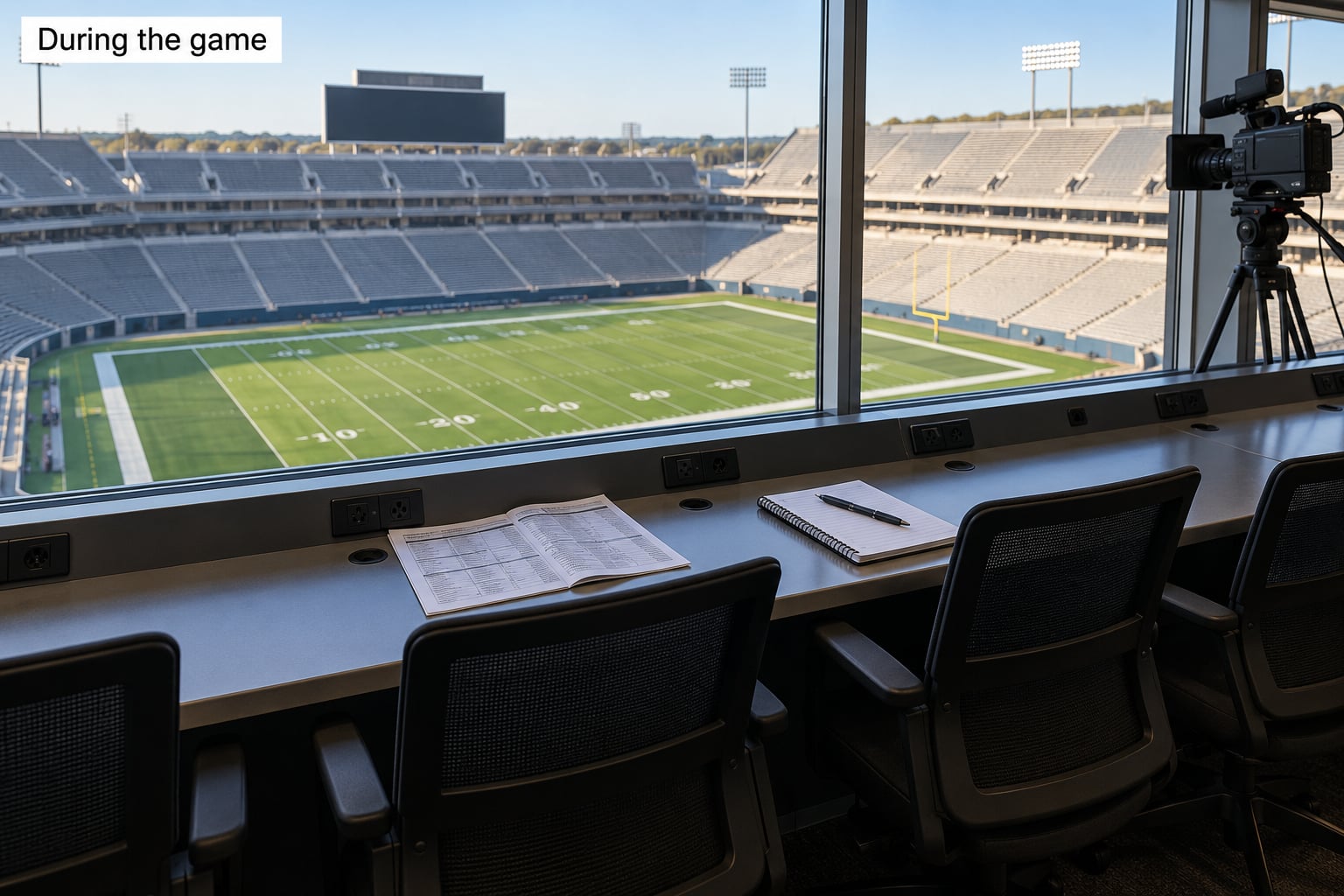
Live box score updates are generated from feeds during play and checked before they post. Photos are shot and captioned. A social media producer is posting real-time updates to every account the school owns, which for a large department can mean a dozen separate feeds with different rules about what appears where.
On bigger games there is usually a media host whose only job is reporters: escorting them to the interview locations, tracking who has been seated, flagging a coach stepping to the podium, and handing out notes at halftime. That host is usually a communications staffer or a student assistant working a specific sport.
After the game
The box score is confirmed, quick-hit quotes are pulled from the postgame interview, and a written recap goes live within a short window. Then come the follow-ups: stat corrections, a quote from a coach who missed the flow, a photographer’s request for a better photo of a specific play.
Game day for a large program is a schedule that runs past midnight for some people. For most sports, staff cover the road half of a season as well, working out of hotel meeting rooms and producing stats in temporary offices. How much travel a given staff member does depends almost entirely on how many sports he or she covers.
How Sports Information Departments Spend an In-Season Week
The game-day window is the visible part. The rest of the week is publishing, planning and upkeep, and the shape of that week changes completely between in-season and off-season.
| Phase | Typical work | Who does it |
|---|---|---|
| Pregame | Game notes, probable starters, media credentials, opponent research, interview scheduling, preview copy | Assigned staffer for the sport, with a statistics contributor |
| Game day | Live stats, media hosting, photos, real-time social updates, postgame interviews | Full travel squad for that sport, plus student assistants |
| Postgame | Recaps, box scores, stat verification, photo captions, correction requests | Assigned staffer, often on a deadline measured in hours |
| In-season week | Feature stories, roster updates, award submissions, recruiting content, sponsor deliverables | Staffer plus student assistant, with department-wide priorities |
| Off-season | Media guides, record books, season recap packages, website rebuilds, hiring and training | Department as a whole, which makes late spring and summer the busiest stretch |
That table is roughly the shape of a communications office calendar, and the last row explains something fans often miss. A quiet basketball game week in January can be busier for the department than game week in January.
What Does a Sports Information Director Do?
The sports information director runs the office. At a smaller school that title is paired with the director job; at larger programs the director usually supervises assistant athletic directors for communications who each run their own sports. Either way, the director’s job is less about writing posts and more about deciding what the athletic department says and making sure it gets said consistently.
In practice that means setting the communication strategy and the brand standards everyone works inside. How the school logo is used, how a coach is quoted, whether a result gets posted to Instagram as well as X. Those decisions live at the director’s desk and apply to every sport on the schedule.
The director also manages the staff. That covers hiring, assigning sports to people, approving what gets published, and setting deadlines. A common practice is a weekly or twice-weekly production meeting where every staffer lists what is scheduled and where coverage is thin.
Crisis management is the part outsiders never see coming. When a story broke at midnight, the director is the one on the phone with the athletic director, the university’s media relations office and compliance, deciding who speaks and when. Most of the time the answer is that nobody speaks publicly until the facts are checked, and the department’s job is to hold the line on that silence without looking like it is hiding something.
The director also protects coaches and athletes from themselves. Requests, interviews and posts are filtered through the office so that a well-meaning comment from a player doesn’t become a six-hour problem. Supporting the rest of the athletic department is a large part of the role even though it never appears in a job description.
How Do Information Departments Work With Coaches and Athletes?
The work only works because relationships hold up under deadline pressure. Coaches control the interview calendar and decide who is available; athletes are usually in class, in treatment or asleep. The department’s job is to make both groups easy to cover without burning them out.
Staff learn each coach’s preferences. Some will do every radio request during the season, others will handle media only through the communications office. Knowing which coach is which is a real skill, and new employees get it wrong for a while.
Athlete information gets verified before it is published. Names are checked for spelling and pronunciation, hometown names are checked against the roster of record, and eligibility questions get routed to compliance. Getting a hometown wrong is a small error that can follow a student-athlete for years.
Requests also have to respect privacy and university policy. A request about a student’s grades, health record, discipline or family situation is not the communications office’s to answer. Those questions go to the registrar, the athletic trainer, the dean of students or university counsel, and staff learn quickly to recognize the difference.
Feature stories are usually the part athletes enjoy most, because somebody is writing about them as people rather than as numbers. A good feature requires hours of interviews and a relationship built over a season or more, which is why the best ones almost always come from staff who cover those athletes every year.
How Do Sports Information Departments Publish News and Statistics?
Publishing is the department’s core deliverable, and every piece follows a basic chain: the information is gathered, someone checks it, someone edits it, and someone schedules it. The interesting part is what fans receive at the end of that chain and why each format exists.
Game notes are the reference document for a single game. They are designed so a broadcaster can find the number they need in seconds, which is why they read in fragments rather than sentences. Schedules, rosters and standings are maintained continuously and are the pieces most likely to be wrong if nobody owns them, so they get more attention than their simplicity suggests.
Stat tracking is a specialist function. Someone has to feed the official scoring system, someone else verifies it against the box score, and a third person watches for how those numbers get described in the record book, which is the school’s permanent record of results. Student assistants usually do a large share of this work, which is how a lot of people enter the profession.
| What the department publishes | What it is for | Who mainly uses it |
|---|---|---|
| Game notes | Quick reference for one game: probable starters, notes, records | Reporters, broadcasters, beat writers |
| Media guide | Season-long record book, roster history, bios, statistics | Media, opposing staff, alumni, students |
| Recaps and previews | Written coverage around a game or a series | General fans, website visitors |
| Press releases | Official announcements about staff, dates, awards, results | Media, aggregators, other schools |
| Social posts and video | Real-time and evergreen coverage across every platform | General fans, recruits, sponsors |
| Feature stories | Longer reporting on athletes, staff and program history | General fans, alumni, recruiting audiences |
Accuracy checks happen at several points. A stat pulled by a student assistant is reviewed by a coordinator, the recap is read by a supervisor before it goes out, and anything involving an award or an NCAA record gets a second look because those details are checked by outside offices. Corrections are issued as corrections, with the original updated and the change noted.
Aggregators and data providers are a fourth audience that the older descriptions of the office tend to forget. Score feeds, rankings sites and recruiting databases all pull from department output, and keeping that information clean is unglamorous work that prevents a wrong score from circulating for a week.
How Do These Departments Reach Fans Beyond the Game?
Official websites are still the home base. Schedules, rosters, stats, archives and the media guide live there, and everything else points back to it. Most fans who want detail end up on a roster page or an old record book, which is exactly how the department intends the archive to be used.
Social media is where most of the daily voice lives now. Departments post scoring updates, schedule changes, signing announcements, senior-day recognition and short video. The volume is enormous; a mid-sized program’s department can publish more in a game week than a small daily paper would in a month.
Email is quieter and often more useful. Ticket information, season member details, premium point benefits and alumni updates usually arrive by email, and they tend to be the messages a supporter actually reads rather than scrolls past.
Video covers highlights, coach and athlete interviews, full-game and press conference archives, and recruiting packages. Community events, alumni gatherings and clinics fill the same role in person, and they usually run through athletics marketing with the communications office supplying the content and the announcement.
NIL and direct revenue sharing with athletes added a communication workload that did not exist before. Department staff now help athletes announce deals, build personal brands, and make sure sponsored content is properly disclosed. It is a meaningful share of the modern job, and no job posting from a decade ago would have mentioned it.
How Do Sports Information Departments Handle Interviews and Media Requests?
Media access in college athletics is credentialed and structured, not open. The department decides who enters the press box, sits on the sideline, shoots photography and enters restricted areas, and it builds that list at the start of each season rather than on game day.
Requests arrive through the office and follow deadlines. A request submitted the morning of a game for a player who is traveling or in treatment may simply not be possible, and part of the job is explaining that clearly rather than leaving reporters guessing.
Some material carries an embargo, meaning it is distributed early under the condition that nothing is published before a set time. Postseason awards and tournament field announcements are the classic cases. Official records requests follow state public records law, and the office usually has to route those through the university rather than answer them independently.
The distinction between an official response and outside commentary matters more than it looks. The department can confirm a result, announce a hire or release a statement the school has approved. It generally cannot offer opinion on a coach’s performance, a conference decision or a referee’s call. The version of that quote you saw in a podcast the next morning is commentary, not information, even when it came from a coach.
What Happens When Something Goes Wrong?
Errors are routine. A box score gets a rebound total wrong, a release names the wrong opponent, a social post announces something that then changes. The department corrects the original, updates the archive, and moves on, because a visible correction is far better than a quiet one.
Fast-moving stories are harder. When something happens involving an athlete, a coach or a program, the standard sequence is to verify what is known, route it to the athletic director and the university’s media relations office, and hold public comment until those checks are done. That silence gets read online as evasive no matter how carefully it is managed.
Social media controversies move faster than any approval process. A coach’s post, a player’s story or an old photo resurfaces, and staff spend hours tracking the volume of reaction while leadership decides whether a response helps or hurts. A short, factual response usually beats a long one.
Cancellations and schedule changes have their own rhythm. Weather postponements, pandemic-era interruptions and facility issues all get communicated through the same channels, in a fixed order: the website, then the email list, then social, then the media list. The box score people check when a game is called is the same one they checked for a win.
A correction to a record book, a coach’s departure or a dispute involving NIL can run for weeks, and those are handled at the department level with the rest of the athletic department and the university behind it. For a fan, the practical signal is simple. One post is a reaction, two posts from the same account with the same facts are a story, and an announcement that appears on the athletics site with a date is a decision.
How Can Fans Use Official Sports Information Responsibly?
Check the athletics site before you trust a screenshot. Schedules, rosters, results and staff changes are published there first, and the site is the version that gets corrected when something was wrong.
Follow accounts run by the department rather than aggregators or reposts. A reporter’s account is useful for reporting and opinion, but the official account is where a confirmed result appears first.
Ask when a coach’s availability is uncertain. If a request comes to the office with a deadline and a subject, it is far easier to answer than an open-ended message asking about a future game. Small details help: the sport, the outlet, and the date you need it by.
Read the date on an announcement. Old releases stay online for years, and a page about a coach who left three seasons ago is still a page about a coach who left three seasons ago.
Accept that some things stay unconfirmed. Not every rumor about a coaching change, a transfer or a dispute becomes an announcement, and a department that never comments is usually applying the same rule it applies to everything.
Frequently Asked Questions
What does a college sports information department actually do?
It is the office inside a university athletic department that covers its sports for fans and the media. The staff write and publish game notes, schedules, rosters, statistics, recaps, features and press releases, run the media side of game day, host reporters, arrange interviews, keep official records accurate, and handle announcements and fast-moving stories. Most programs now call the office athletics communications, though the sports information director title is still widely used.
Are sports information departments the same as athletic departments?
No. The athletic department is the whole organization, including coaches, athletic trainers, compliance, marketing, ticketing and fundraising. The sports information department is one office inside it, reporting to the athletic director and focused on media, statistics and communication. Coaches decide who plays and trainers handle medical care, while communications staff write, publish, host media and manage game-day media operations.
How do college sports information departments report game results?
Scores are generated from the official scoring system during the game, checked against the box score, and published to the athletics website, then distributed to media outlets, data providers and aggregators. Recaps with quotes usually follow within hours, and any correction is issued openly and the original page is updated. The website version is the one to trust when a score circulates wrong online.
Can fans request interviews with coaches or college athletes?
You can ask, but requests usually go through the athletic department’s communications office rather than to a coach directly. The office decides who is available, when, and where, and it filters requests around class, treatment, travel and team schedules. Media outlets get priority because interviews are part of the department’s actual job. Sending a specific request with your outlet, subject and deadline gets a better answer than an open-ended message.
Where should fans verify official college sports news?
Start with the athletics website and the department’s official social accounts. Schedules, rosters, results, staff announcements and record books are published there first, and corrections land on those pages. Reporters and aggregators are useful for context but sometimes report early and sometimes wrong, and reposts of old announcements are common. Check the date on any page before treating an announcement as current.
How do sports information departments handle inaccurate or breaking information?
They verify what is known, then route it to the athletic director, compliance and university media relations before commenting publicly. For simple mistakes like a wrong box score or a misspelled name, the department publishes a correction and updates the original page. For fast-moving stories, the usual practice is to hold public comment until the facts are checked, which often reads as silence to people following the story online.
Conclusion
A college sports information department is a small communications and media operation that sits inside a larger athletic organization and carries the public voice of every sport the school fields. Its week runs from game notes and credentials before tipoff, through live stats and media hosting during play, to recaps, corrections and features after the horn, and it does all of that while keeping records, answering reporters and protecting coaches and athletes.
Start with the athletics website and the department’s official accounts when you need a confirmed result, a roster change or a schedule update. Everything else, including a great deal of speculation, starts there first.