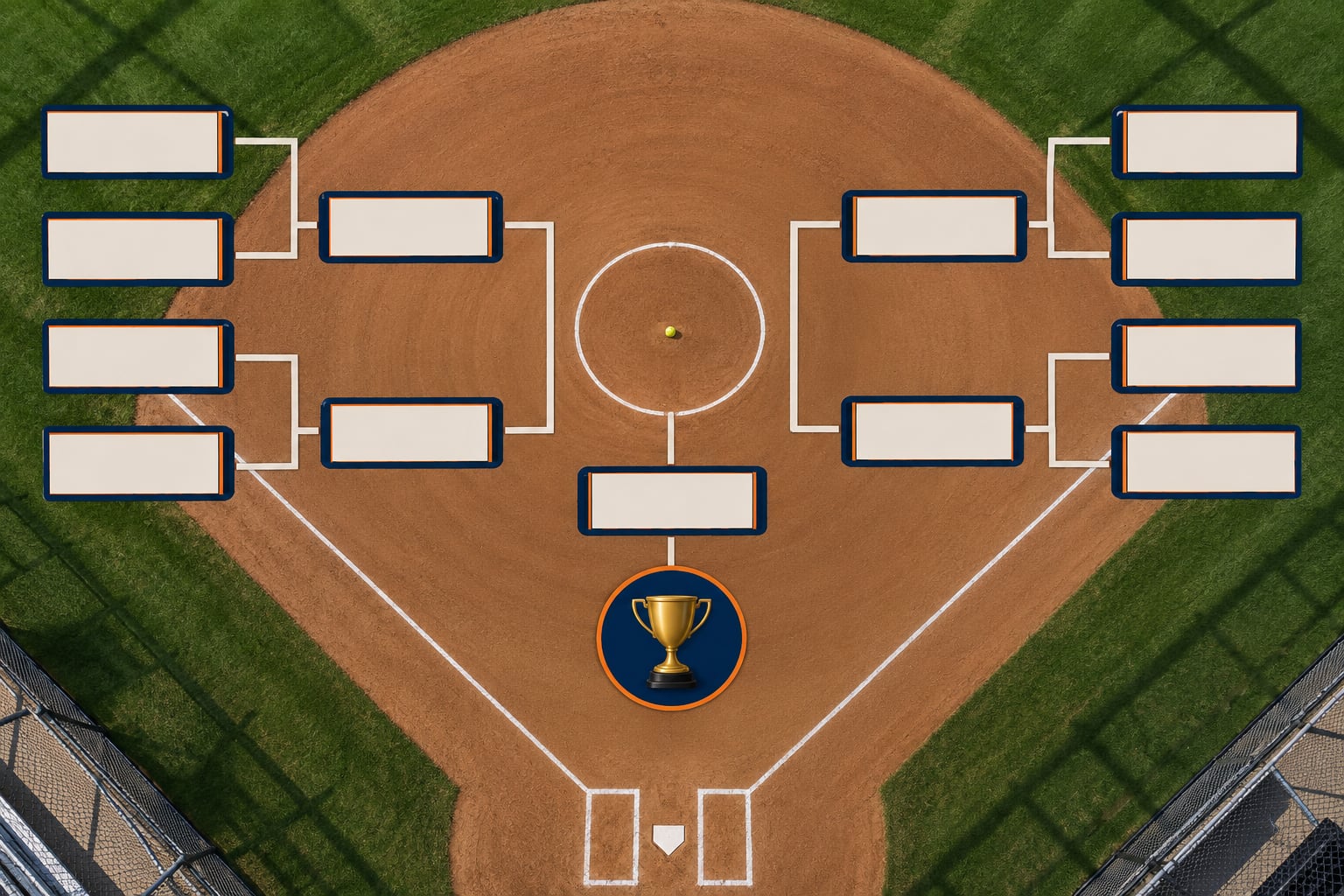
College softball regionals are the opening round of the NCAA Division I tournament. Sixty-four teams are split into sixteen four-team regionals, each played as a double-elimination bracket over roughly three days. Sixteen winners advance to eight Super Regionals, and those eight winners go to the College World Series in Oklahoma City.
It is the one part of the postseason that trips up almost every new fan, because it does not look like March Madness. There is no single 64-team bracket. There are sixteen separate four-team pods, and a team can lose twice before it is eliminated. Once you see that the sixteen regionals are paired into eight Super Regionals, the whole thing clicks.
Everything below explains how how college softball regionals work, from who gets in and how they are seeded to who hosts, how games advance, and why winning a regional can still leave a brutal road to Oklahoma City.
Table of Contents
- How College Softball Regionals Work: The Big Picture
- What Is the NCAA College Softball Tournament Format?
- How Are the 64 Division I Teams Assigned to Regionals?
- How Does the College Softball Regional Bracket Work?
- What Happens on Each Day of a Regional?
- How Are Regional Softball Games Scheduled and Hosted?
- How Do Regional Winners Advance to Super Regionals?
- How Do Teams Qualify for the College World Series?
- What Do Seeding Numbers Mean in College Softball?
- How Does the NCAA Choose Regional Hosts and Sites?
- Why Can a Regional Champion Have a Difficult Road to Oklahoma City?
- Frequently Asked Questions
- Are college softball regionals double elimination?
- How many teams advance from each college softball regional?
- Does a No. 1 seed automatically host the College World Series?
- What does an at-large bid mean in college softball?
- Do college softball regionals reseed after the first round?
- How are college softball regional hosts selected?
- Conclusion
How College Softball Regionals Work: The Big Picture
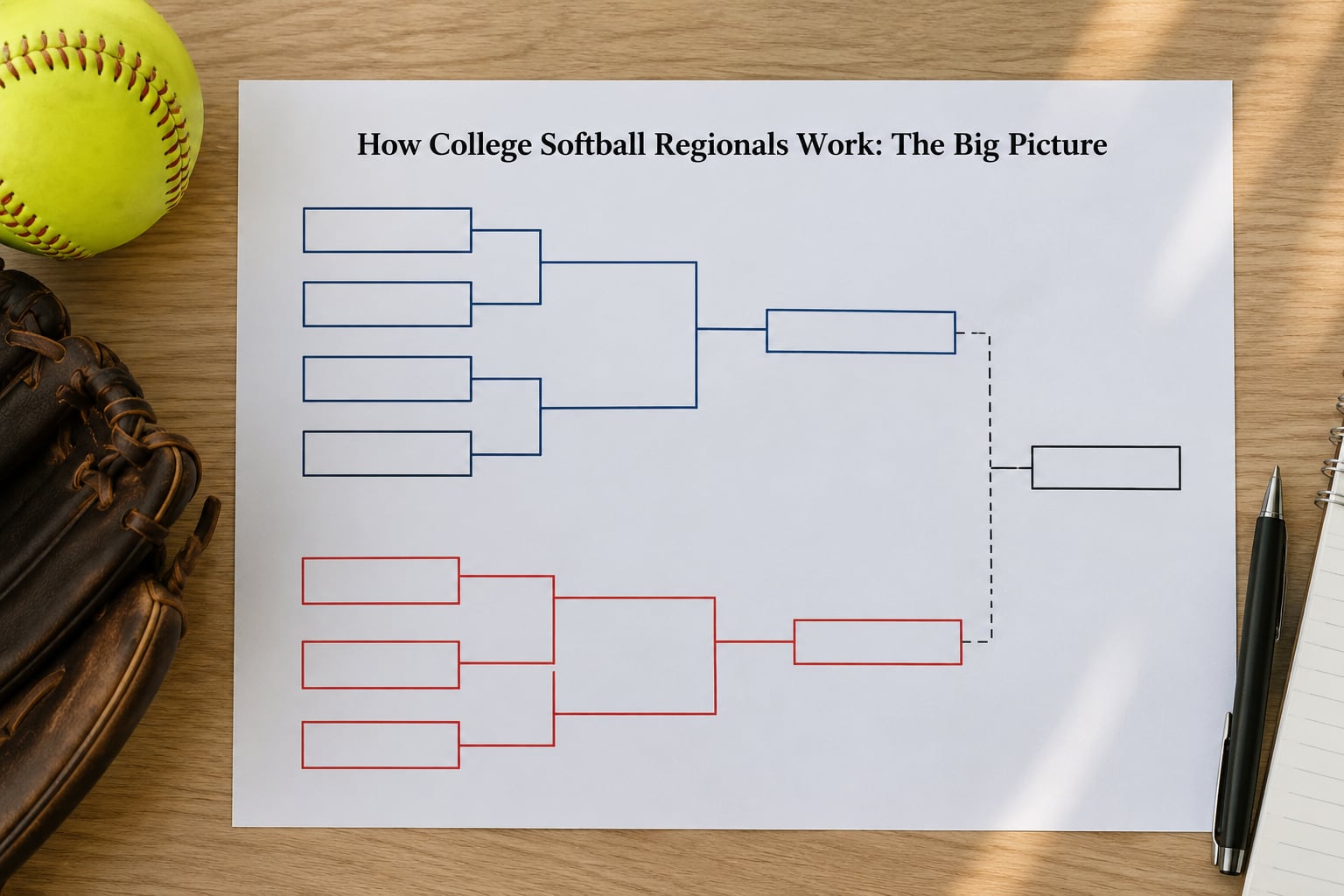
Here is the short version. The NCAA Division I softball tournament has three rounds after selection. Regionals take 64 teams down to 16. Super Regionals take those 16 down to 8. The Women’s College World Series, or WCWS, is a final eight-team double-elimination bracket played at one neutral site.
Every round from regionals through the WCWS championship is double elimination. That means a team only goes home after two losses, and a No. 1 seed can survive a 2-0 start and still be eliminated on the final day. It is the single biggest structural difference from NCAA baseball, where the first round is also double elimination but the rest of the tournament narrows quickly.
Division I runs on this 64-team format. Division II also uses a 64-team field with regionals and super regionals. Division III splits the country into eight regionals of eight teams and then goes straight to a sixteen-team championship in Cary, North Carolina, with no Super Regional round.
What Is the NCAA College Softball Tournament Format?
The whole championship is three stages, and the field shrinks by half at each one until eight teams remain.
| Round | Teams In | Sites | Format | How You Advance |
|---|---|---|---|---|
| Regionals | 64 | 16 regional sites | Four-team double elimination | Win the regional, 2 or 3 games |
| Super Regionals | 16 | 8 sites | Two regional winners per site, best-of-three | Win the series, 2 games |
| Women’s College World Series | 8 | 1 site in Oklahoma City | Double elimination | Win the WCWS |
One team advances out of each regional, which is why 64 becomes 16. Your regional champion is not heading to meet some team you have never heard of from across the country. It is heading to the Super Regional paired with its regional, and that pairing is announced separately once regionals finish.
So the tournament is really two parallel races rather than one long line. The sixteen regionals run on their own calendars, then the eight Super Regionals run on theirs, then everything converges in Oklahoma City.
How Are the 64 Division I Teams Assigned to Regionals?
Of the 64 teams, 32 come in as automatic bids and 32 are selected at-large by the NCAA softball selection committee.
An automatic bid goes to a conference tournament champion. Most conferences have one, though a few conferences split their automatic bids into two separate tournament winners. The remaining teams fill the other half of the field through at-large selection, which means the committee is picking them based on the full-body record rather than a conference trophy.
The committee then does two more jobs. It sets sixteen national seeds, one for each regional, numbered 1 through 16 based on the season’s body of work rather than region. And it assembles the four-team fields, placing seeds so that no regional contains two of the top eight seeds, while still trying to keep teams geographically sensible.
Here is the part fans argue about most, and it is worth being straight about. The selection committee publishes its criteria in advance: win-loss record, strength of schedule, quality of opponent wins, and how recently those wins happened. Rating systems like RPI are calculated and published too, and the committee uses that data as one input among several. It is not a formula that spits out a field. Anyone who tells you the field is purely mechanical is overselling it, and the r/CollegeSoftball thread asking how seeding actually gets decided is the most-read page on this whole topic for a reason.
How Does the College Softball Regional Bracket Work?
Every regional contains four seeds. The opening day pairs the 1 and 4 seeds against each other and the 2 and 3 seeds against each other, and those two winners meet in the winner’s bracket final while the two losers meet in the elimination game.
From there the paths interlock. The team that beats the loser of the 2-versus-3 game is into the regional final with one loss on the card. The team that loses that elimination game is done. The loser of the 1-versus-4 side faces the winner’s bracket finalist in the other elimination game, and whoever comes out of that is the last team alive alongside the undefeated team.
That produces the rule that catches new fans: advancing out of a regional takes two or three wins. The team that sweeps its opener and its winner’s bracket final needs only two. Any team that takes a loss along the way needs three. A double-eliminated 3 seed winning three straight on the final day is a real and repeatable postseason story.
Because a team can lose twice, the top seed is never truly safe. A No. 1 seed that drops its winner’s bracket final goes to the elimination side of the bracket and has to play twice more in a single day to reach the regional final.
What Happens on Each Day of a Regional?
A regional runs Friday through Sunday at most sites, and the schedule is built around how late the day has to run.
Friday is the opening day with the two quarterfinal games. Saturday has the winner’s bracket final in the morning and an elimination game, then the second elimination game in the late afternoon or evening. Sunday holds the winner’s bracket final early, the other elimination game in the afternoon, and the regional final at night if it is necessary.
Games that start late finish late, which is why a Sunday regional can run past midnight. Hosts plan for that, and facilities that bid for a regional are expected to be able to hold a full slate at night. Not every site follows the exact same pattern, because scheduling depends on how many fields a complex has, but the three-day arc holds almost everywhere.
Useful shorthand for tracking a team: if your school wins its opener, it is playing Saturday and Sunday. Win Saturday and Sunday can be skipped only if the win clinches the regional. Drop the winner’s bracket final on Saturday and Sunday becomes a double-elimination day.
How Are Regional Softball Games Scheduled and Hosted?
Regionals are played on campus at a school that has bid to host. The NCAA awards sites through a rotation and a bid process, and a program that puts in a winning bid gets the gate revenue, the national television inventory, and the exposure that comes with hosting postseason games.
Most hosts run a dedicated softball complex rather than the main stadium. Fields need permanent lighting for night games, seating for a few thousand, and the ability to run four teams across two fields on the same day, which is what keeps a regional inside three days.
First pitch is usually in the low-to-mid afternoon range, with nightcaps near 6 p.m. or later so a full slate fits. Games are almost always streamed, and ESPN and the conference networks carry the major sites. Weather is the main disruption risk, and a rain-shortened Friday pushes everything back, sometimes into a doubleheader Sunday that starts before noon and ends after midnight.
How Do Regional Winners Advance to Super Regionals?
All sixteen regional champions are paired into eight eight-team Super Regionals, and each site hosts four games played as two best-of-three series between the champions of two neighboring regionals.
This is where the national seeds become useful. The eight No. 1 seeds are grouped into four pairs of two, and each pair shares a Super Regional. So the No. 1 seed from Regional 1 and the No. 1 seed from Regional 2 end up in the same eight-team pod, along with the winners of Regional 1 and Regional 2. Regional 1’s champion therefore plays three games inside one bracket rather than a fresh opponent every day.
The remaining four Super Regionals are assigned by the committee from the other eight regionals, using seed proximity and travel. Hosting rights follow the seed. A No. 1 seed that wins its regional hosts the No. 1 seed from the paired regional. A No. 5 seed regional champion may be sent anywhere, and travel is real.
A best-of-three series means two games to win, with a third game only if the teams split the first two. Fans often get an unexpected treat: because the series is short, an underdog that wins game one in a host’s park can flip the whole thing.
How Do Teams Qualify for the College World Series?
The eight Super Regional winners make the Women’s College World Series, and the field is then reseeded from 1 through 8 by a national seeding committee. That reseeding is why Super Regional home-field advantage does not guarantee a favorable WCWS path.
The reseeding takes the eight winners, ranks them, and splits them into two four-team WCWS brackets of the standard double-elimination shape. A No. 2 seed that wins its Super Regional can easily end up as a No. 6 or No. 7 seed in Oklahoma City, because the committee weighs the full season and not just the postseason run.
Teams are re-seeded into a new bracket every season under the current format, which keeps the WCWS from becoming a yearly repeat of the Super Regional pairings. The finals run at one neutral site in Oklahoma City, at the USA Softball Hall of Fame Stadium complex, which has hosted the championship for decades.
What Do Seeding Numbers Mean in College Softball?
Seeds describe where a team landed in the national ranking of the season, and in practice they tell you two things: who they play first, and how much rope they get before a loss matters.
| Seed | Typical First Opponent | Competitive Tier | Realistic Path |
|---|---|---|---|
| 1 | 4 seed | Favorite to win the regional | Two or three wins, one loss is survivable |
| 2 | 3 seed | Strong | Beat the 3 seed early and the regional opens up |
| 3 | 2 seed | Solid, tested | Winners’ bracket is hard; losers’ bracket is long |
| 4 | 1 seed | Underdog with a live path | Win game one and the bracket tilts toward them |
| 5 | 12 seed | Upper at-large tier | Survive the 4 seed and you are in the winner’s bracket final |
| 6-8 | 11-9 seed | Solid but unproven in postseason | Two or three wins still gets them out |
| 9-16 | 8 seed and lower | Home field and nothing else | Three straight wins required, with the 5 seed waiting on the other side |
The important thing about the bottom of that table is how little protection a low seed gets. A No. 9 seed is not playing three warm-up games. It is playing a 1 seed, then almost certainly a 4 seed on the elimination side, then whoever survived. Low seeds reach super regionals every year, and a No. 4 seed from Texas once went from a regional win all the way to the championship final in Oklahoma City without ever beating a top-four team.
How Does the NCAA Choose Regional Hosts and Sites?
Hosts are chosen through a formal bid process run alongside the bracket, and it operates on a rotation so that regions keep getting tournaments over time.
A school that wants a regional puts together a bid covering facility quality, attendance history, ticketing, transportation and lodging for the eight teams, broadcast capability, and a contingency plan for weather. The NCAA reviews bids against published standards, and the sites are then placed in the bracket so the four assigned teams are the ones that fit the geography.
Programs bid well in advance, often years out, because a regional is a multi-day commitment with a lot of moving parts. Successful hosts build a small permanent staff for the event, run multiple fields at once, and have a rain plan that does not require moving anyone to another city.
Why Can a Regional Champion Have a Difficult Road to Oklahoma City?
Winning your regional guarantees a Super Regional, not a soft landing. The difficulty comes from three places at once.
First, regional strength. A No. 3 seed that wins a regional containing a No. 1 and a No. 2 has already beaten two teams better than it on paper. Second, Super Regional geography. The pairing of regional champions is largely decided by the top-eight seeds, so a 1 seed and a 5 seed from the same region can be drawn into the same pod. Third, reseeding at the WCWS. A team that survives three brutal rounds can be seeded seventh or eighth once eight winners are ranked, and the No. 8 seed in a WCWS bracket is nobody’s idea of a gift.
None of this is a flaw in the format. It is the format. The reason it works is that a strong team has to prove itself repeatedly, and a team that keeps winning through a hard draw is more tested than one that walked a soft bracket to Oklahoma City.
Frequently Asked Questions
Are college softball regionals double elimination?
Yes. All sixteen NCAA Division I regionals are played as a four-team double-elimination bracket. A team is eliminated only after its second loss, which is why a top seed that loses its winner’s bracket final on Saturday can still play twice on Sunday. Super Regionals are best-of-three series and the Women’s College World Series is double elimination as well, so the entire postseason uses that format.
How many teams advance from each college softball regional?
One team from each of the 16 regionals advances, so 16 teams reach the Super Regionals. Those 16 are paired into eight eight-team Super Regionals, and the eight Super Regional winners form the field for the Women’s College World Series. That is why the number halves cleanly at each stage: 64, then 16, then 8, then one champion.
Does a No. 1 seed automatically host the College World Series?
No. No. 1 seed status carries one specific hosting benefit: if a No. 1 seed wins its regional, it hosts the No. 1 seed from the paired regional at the Super Regional. The College World Series is played at one neutral site in Oklahoma City for every team, and the field is reseeded 1 through 8 by a national seeding committee, so WCWS seeding is decided by the season body of work rather than by regional seed.
What does an at-large bid mean in college softball?
An at-large bid is one of the 32 Division I spots in the 64-team field that go to teams the selection committee picks directly, rather than to a conference tournament champion. Thirty-two teams qualify as automatic bids through their conference tournaments, and the other 32 are at-large. Committees weigh win-loss record, strength of schedule, quality of opponent wins, and how recent those results are.
Do college softball regionals reseed after the first round?
No regional does. Seeds 1 through 16 stay fixed for the whole regional, which is why the bracket is stable and a 4 seed can still win after beating a 1 seed on Friday. Reseeding happens twice later in the postseason: the eight Super Regional winners are reseeded 1 through 8 for the Women’s College World Series, and the World Series field is split into two four-team brackets. Regionals also never get redrawn, so results carry forward.
How are college softball regional hosts selected?
Regional sites are awarded through a bid process that runs on a rotation, so different regions host on a recurring cycle. A school submits a bid covering facility quality, permanent lighting, seating capacity, transportation and lodging, broadcast capability, and a weather contingency plan. The NCAA then pairs bids with the four teams assigned to that regional so travel stays reasonable for all four programs.
Conclusion
College softball regionals are sixteen independent four-team double-elimination brackets, and the winners are paired into eight Super Regionals that feed the eight-team College World Series. Seeds never move within a regional, so a low seed still has to win three times to get out.
If you are following a specific team, start with three things: its national seed, the other three seeds in its regional, and where that regional champion is headed on the Super Regional map. Those three answers tell you almost everything about how hard the next two weeks are.