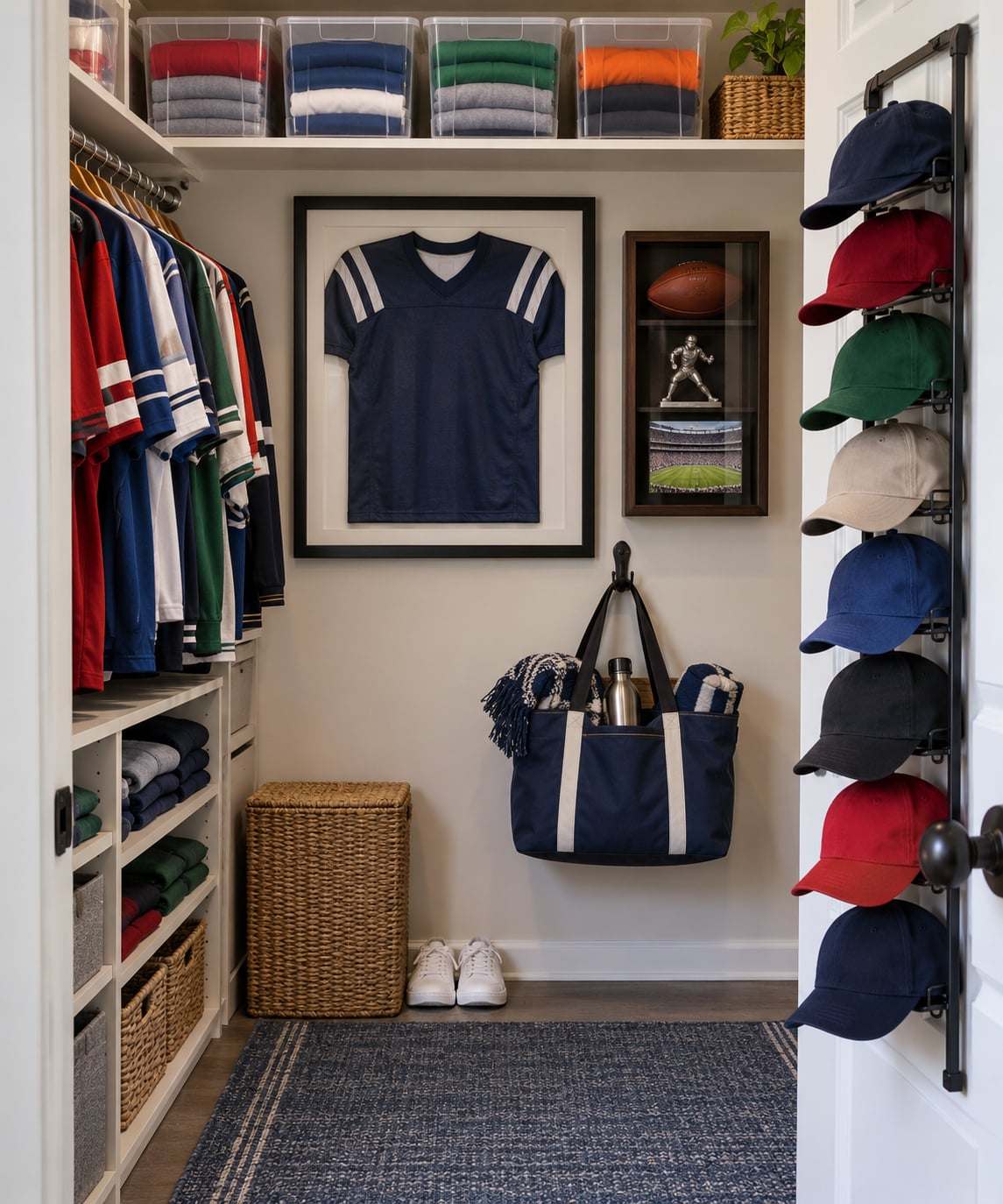
The most effective way to organize a fan gear closet is to divide it into zones based on how often you use each item: game-day apparel at eye level, off-season pieces in labeled bins up high, and your best memorabilia on a display shelf where you can see it. Most fans finish the whole job in one afternoon.
The reason it matters is simple. Fan gear does not arrive in a tidy stack. It shows up after a win, a birthday, a holiday, or a trip to the team store, and it piles up wherever there is room. Six months later that pile is crushed, faded, and impossible to search.
If you have never done this before, learning how to organize a fan gear closet comes down to one rule: everything gets a zone based on how often you use it. Nothing is allowed to live in a pile, and nothing gets a bin until it has a label on the front.
Table of Contents
Key Takeaways
- Sort into five piles before anything goes back in the closet: wear, display, store, trade, and donate.
- Put game-day apparel at eye level between roughly waist and shoulder height, where you can reach without searching.
- Give every category one container type and one location. Consistency beats clever.
- Label the front of every bin, hook group, and shelf, in the order you will actually look for them.
- Separate display from storage. A memorabilia closet that doubles as a warehouse is neither.
- Run a ten-minute pre-game pack the week before kickoff, then leave that zone alone.
What You Need
You do not need custom cabinetry. You need a handful of supplies and, more importantly, three decisions made before you move a single jersey.
Containers matched to each category
Clear, latching plastic bins for off-season apparel and accessories. Clear is the default because the most-repeated advice in organizing forums is simply to stop storing things you cannot see. Anyone who has owned nesting bins without lids will tell you lids matter more than looks.
Bins only work if they are actually the same size. Mixed depths defeat stacking, and mismatched lids are how collections turn back into piles. Measure one bin, then buy that size in two or three depths rather than a grab-bag.
A label maker or masking tape and a marker
Label the front of every bin, and label the shelf edge where the bin lives. Shelf-edge labels cost almost nothing and are the difference between pulling one bin and sliding out six.
Dividers for the drawers and small containers
Velcro or wooden dividers for socks, mouthguards, patches, and scratch-offs. Small flat items are where closets lose the most time, because they slide under the fold line and disappear.
A cleaning kit
A lint roller, a soft brush, a deodorizer safe for fabric, and a spray bottle for hard case shells. Purge odor before you sort. Everything you move later carries that smell into its bin.
An inventory method
A paper list, a note on your phone, or a spreadsheet with four columns: item, category, frequency, and destination. Fans who skip this tend to buy containers first and end up with more bins than gear.
Three decisions to make first
- Which closet? Pick the one closet that becomes the fan closet rather than splitting the collection across three rooms.
- Display or storage? Decide which five to ten pieces are worth seeing daily. Those get the shelf; everything else earns a bin.
- Whose fandom? If two people in the house root for different teams, agree now on a divider. Retrofitting shared space is the fastest way to lose the argument later.
Step-by-Step: How to Organize a Fan Gear Closet
The goal through all of this is one sentence: separate what you wear on game day from what you look at once a season. Everything below serves that split.
Empty and Categorize the Closet
Take everything out, including the things in the corners that you are fairly sure you have already moved twice. Set up five piles on the floor or bed and work through the closet in one direction so nothing gets skipped.
- Wear: anything you put on in the last two years and would wear again this season.
- Display: signed items, a favorite game jersey, a helmet, a pennant you want to see.
- Store: off-season apparel, winter gear, archived jerseys.
- Trade or sell: duplicates, sizes you have moved out of, the same player on three different teams.
- Donate: things you never wear and would not pick up if it were free.
The trade pile deserves real effort, not a shrug. Signed items especially are hard to let go of emotionally, but a duplicate signature in a size you keep is worth more in a trading community than in the back of a closet. One fan on r/gamecollecting described the fix for a six-year collecting problem as one dedicated display shelf, which forced a real decision about what stayed out and what left.
Do this in two passes. First pass sorts roughly, second pass pulls the winners forward. Trying to be perfect in one pass is how organizing sessions turn into three-hour arguments with yourself. Working out how to organize a fan gear closet this way means the decisions get easier as you go, because every item lands in a named pile by the second pass.
Create a Game-Day Priority Zone
This is the part most people skip, and it is the whole reason the system works. Build one zone, at eye level, holding only what you touch in the twenty minutes before a game.
That zone holds your game-day shirts and jersey, a jacket, socks, a cap, and the small stuff. The range that counts as eye level is roughly waist to shoulder height, which is exactly where your hand goes when you are dressing without thinking.
Go one better and preassemble the outfit. Hang the shirt and jacket together on one hanger with the socks rolled inside and the cap clipped to the hanger hook. People on bike gear forums have used the same trick for years, hanging a shirt with the shorts and socks on a single hanger to save both space and decision-making.
Keep that zone limited. If it holds twenty items, you are back to searching. Five to eight pieces is the sweet spot, and that constraint is what forces the trade pile decision you skipped earlier.
How to Organize a Fan Gear Closet by Category
Every gear type has one right answer, and it is rarely expensive. Use this list as the shortcut rather than re-inventing it category by category.
- Game-day jerseys: hanging, single garment, wide padded hanger, eye-level rod in the game-day zone.
- Off-season jerseys: folded with the name and number written on the fold, clear latching bin, top shelf or upper bin stack.
- T-shirts and hoodies: folded in stacks of five, shelf with a lip or a bin, middle shelf.
- Caps and beanies: stuffed so the brim keeps its shape, multi-tier cap rack or cube organizer, door or top shelf.
- Trading cards: sleeved and sorted sport then set, two-row shoebox or card box, flat shelf away from the window.
- Autographs and memorabilia: visible but protected, shadow box or framed shelf, eye-level display shelf.
- Pennants and banners: hung rather than rolled, command hooks or a wall rail, interior wall or back of the door.
- Foam fingers and oversized props: upright in a tall bin, tall clear bin, floor level or the garage.
- Helmets and bats: mounted or vertical, wall mount or floor cradle, floor corner or wall.
- Game-day bag contents: packed into one tote, single clear tote with a lid, hook at the door.
Jerseys need one extra decision. Hanging is right for the ones you wear or display, and folding is right for everything else, because a hanging shelf eventually sags under a wall of jerseys. When you fold, write the name, number, and size on a scrap of archival tissue tucked in the fold so you never unfold the wrong one.
Caps are where fans report the most frustration, and the fix is boring: stuff the crown so it keeps its shape, stack them crown-down, and never pile anything on top of a brim. A door-mounted rack works if the door has clearance, otherwise a cube organizer on a shelf gives the same result with less hardware.
Cards want consistency, not sophistication. Sorting by sport first and then by set, all in identical boxes, is the approach collectors describe over and over, and it beats any elaborate shelving scheme because you can carry the whole thing to a friend and read it end to end.
Label and Arrange the Storage System
Label every bin and every shelf edge. Write the label as you will search for it, not as you stored it. “Arizona caps” beats “hats.” “Jerseys, name and number labeled” beats “off season.”
Then arrange by location, which is what fans who travel between homes tend to do instinctively: one zone for the gear at your place, one for the gear that lives at a parent’s house or in a locker. Each zone gets its own short list. Simplicity survives contact with real life better than a complicated numbering scheme.
Put the heavy things low. Card boxes, foam props, and helmet cradles belong at or below waist height, both for safety and because they are impossible to lift overhead when a shelf is loaded. Light seasonal bins go up top, where the humidity and the light are lower anyway.
Keep duplicates out of prime real estate. A second copy of a jersey you already own belongs in the trade bin, not on the eye-level rod stealing space from the one you actually wear.
Test the System Before Game Day
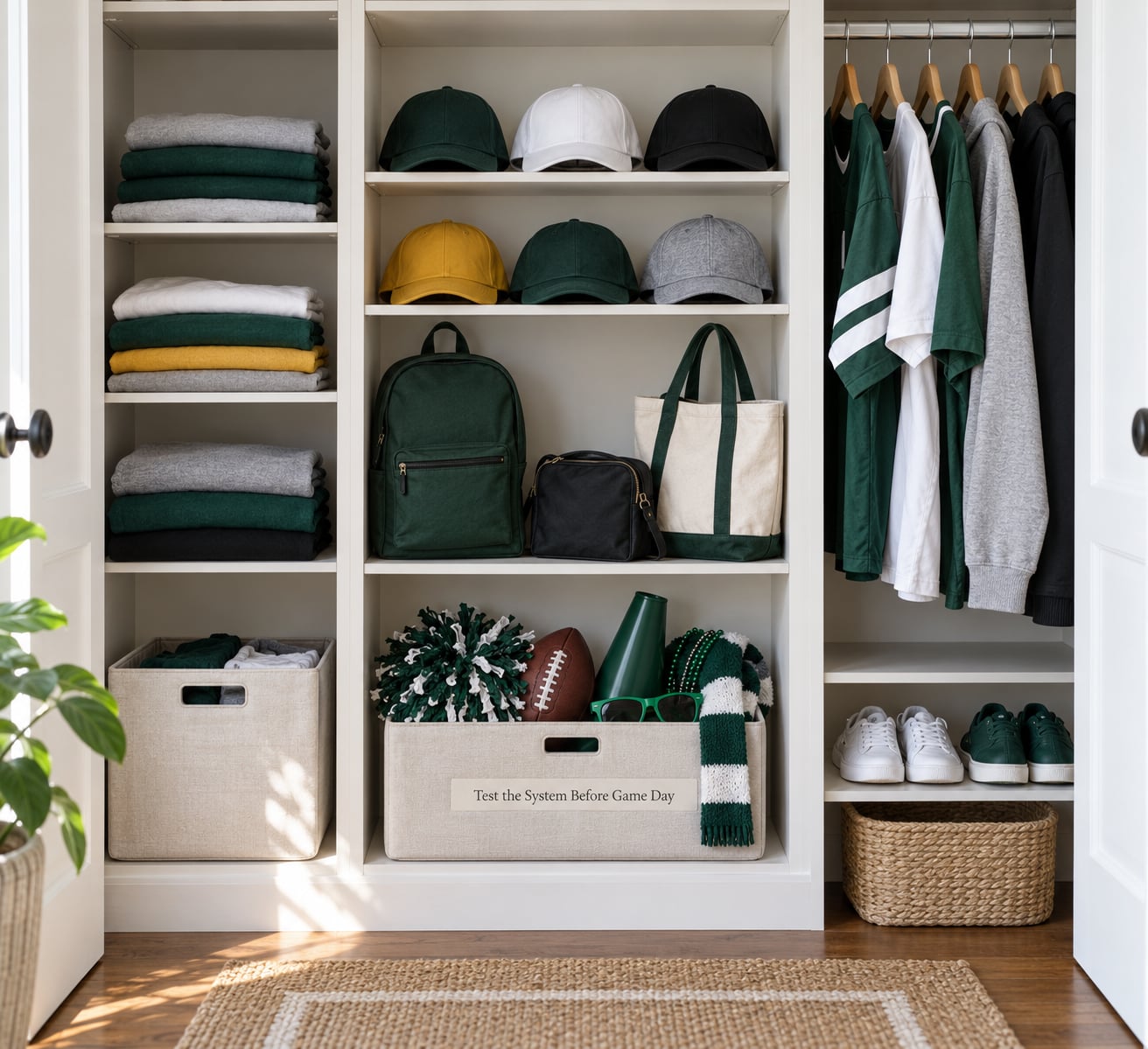
Stand in front of your finished closet and pretend it is ninety minutes before kickoff. Grab the shirt, the undershirt, the socks, the cap, and the bag, in that order, without moving anything that is not in the game-day zone.
Whatever you fumbled is your real to-do list. If the socks required a search, they belong in the game-day zone. If the bag was not where you expected, it needs a hook at the door. Do not walk away from a test run with notes.
Run the test twice. The second pass catches the things the first one went past because you already knew where they were.
Common Mistakes to Avoid
Most closet systems do not fail because the plan was bad. They fail because one of these eight things happened.
- Overpacking. If the bin lids need two hands and a knee, nothing goes back in. Leave a hand’s width of empty space in every container.
- Mixing collectibles with everyday gear. Your game-day shirt and a decade of archived jerseys in one bin means one dig for both. Keep them in separate zones.
- Using the wrong hangers. Thin plastic hangers drop to the floor under a jersey, and they take the shoulder shape with them. Use wide, sturdy hangers for anything with a name on the back.
- Skipping labels. Unlabeled bins fail the same way unlabeled drawers fail. You open all four to find one thing, and eventually you stop opening them at all.
- Unrated shelving. Particleboard shelves sag under card boxes and helmet weight. Check the load rating before you fill anything, and add a center support if the span is wide.
- Storing cards and jerseys in direct light. A shelf beside a window fades a jersey number and can damage card surfaces over time. Move the display tier away from the glass.
- No maintenance rhythm. A ten-minute reset once a month keeps it working. Without one, the pile rebuilds by the second home game.
- Forcing sentiment into storage. A signed item crammed in a bin gets forgotten, which is worse than displaying it and valuing it. Frame it, hang it, or trade the duplicate.
Two more come up constantly. Bulky gear, like helmets, bats, and giant foam fingers, breaks any standard plan because it needs floor space or a wall mount, so solve it before the shelves go in. And if someone hands you a collection inherited in plastic totes with no provenance, do not try to sort it in place. Empty it onto a table, sort by sport and set, and label every box as it closes.
The Ten-Minute Game-Day Pack
Build this once before the 2026 season and it stops being a chore.
- Game-day shirt and jersey, hung together.
- Socks and any underlayers rolled into the shirt.
- Cap on the hanger hook.
- Card sleeve, cash, and parking pass in a small zip pouch in the bag.
- Bag hung on the door hook, packed, not staged.
- Phone charged, which sounds obvious and solves a real problem.
Leave it alone until next week. The habit worth keeping is the ten-minute reset, not the packing ritual.
Frequently Asked Questions
How much space do I need for a fan gear closet?
A single reach-in closet handles about six to eight outfits across one or two seasons, plus a shelf for caps, cards, and a bin for off-season pieces. Walk a tight game-day zone first, then use the top shelf and floor for storage. Measure your current pile before buying bins, since most fans overestimate how much room they need and underestimate how much they own.
What is the best way to store college jerseys?
Hang the ones you wear or display on wide, sturdy hangers, and fold the rest in labeled bins. Write the player name, number, and size on a scrap of tissue tucked into each fold so you never open the wrong one. Keep hanging rows short, because a full row of jerseys eventually drags a shelf down. Rotate folded jerseys out of the bin when the season changes.
How should I organize hats and other fan accessories?
Group hats by how often you wear them, then give each group its own spot. Stuff the crown with paper or tissue so it holds shape, stack caps crown-down, and never rest anything on a brim. A door-mounted rack works if the door clears the wall, otherwise a cube organizer with clear bins keeps contents visible without opening them. Scarves and gloves roll and stand upright in one bin.
Where should I put rare or collectible fan gear?
On a display shelf at eye level, protected but visible, and away from direct window light and any shelf shared with damp items. Framed autographs and shadow boxes work well for flat pieces; helmets and bats want a floor cradle or wall mount. Keep collectibles out of bins entirely, since a bin is where signed items go to be forgotten. Archive only the duplicates in labeled bins.
How often should I reorganize my fan gear closet?
A ten-minute reset once a month is enough to keep the system intact, and a full sort twice a year, once before your season starts and once at the end. New gear arrives constantly, so give it a home the day it arrives rather than letting it land on a pile. If you find yourself re-sorting shelves weekly, the problem is usually overpacking, not frequency.
How can I keep a game-day outfit ready each week?
Hang one complete outfit on a single hanger: shirt and jacket together, socks rolled inside, cap clipped to the hook. Store the bag contents in one lidded tote on a door hook, packed and ready to lift. Keep the whole kit inside the eye-level game-day zone and take it back out untouched after the game, which is why that zone stays small and limited to five to eight pieces.
Start With the Game-Day Zone
If you only do one thing, empty a single section and rebuild it as the game-day zone: five to eight pieces at eye level, preassembled on a single hanger. That is how to organize a fan gear closet without spending a whole weekend on it, and everything else can wait for another Saturday.