NIL stands for name, image, and likeness, and it lets college athletes earn money from the commercial use of their name, photo, and signature. If you want the short version of how NIL deals work for college athletes: a company, a local business, or a donor pays an athlete for specific deliverables like a social post or an appearance, the school checks it for compliance, and the athlete keeps the money without losing eligibility.
That is the whole idea. The fine print is where it gets interesting, and most fans never get that far. This guide walks through the mechanics, the kinds of deals that actually exist, the rules schools operate under, and what an athlete should check before signing anything.
Table of Contents
- What Is NIL and How Do College Athletes Earn From It?
- How NIL Deals Work for College Athletes Step by Step
- What Types of NIL Deals Can College Athletes Sign?
- How Much Can College Athletes Earn Through NIL?
- What Are the NIL Eligibility and School Rules?
- Do College Athletes Pay Taxes on NIL Income?
- What Should Athletes Look for in a NIL Deal?
- Frequently Asked Questions
- Can high school athletes earn NIL money?
- Do college athletes need their school’s permission to make NIL deals?
- Is NIL income the same as an athletic scholarship?
- Are college athletes required to pay taxes on NIL earnings?
- Can college athletes make money from social media posts?
- How can a college athlete tell if a NIL offer is legitimate?
- Conclusion
What Is NIL and How Do College Athletes Earn From It?
NIL is a property right, not a favor. Before it existed, a college athlete’s name, photo, and jersey number belonged to the school in exchange for a scholarship, a roster spot, and scholarship benefits. Now an athlete can license those assets commercially while staying eligible to compete.
Eligibility is broad. Any currently enrolled student-athlete at an NCAA school can earn NIL income, which means starters, bench players, walk-ons, and specialists all count. There is no minimum playing time requirement.
Money reaches an athlete through three channels:
- Direct individual deals. A brand or business contracts with one athlete and pays that athlete directly.
- Collectives and NIL clubs. Fans subscribe or a group of athletes pools agreements, and proceeds get split by a published formula.
- School-operated and revenue-sharing deals. The institution runs its own program and distributes funds under a modernized framework.
How NIL Deals Work for College Athletes Step by Step
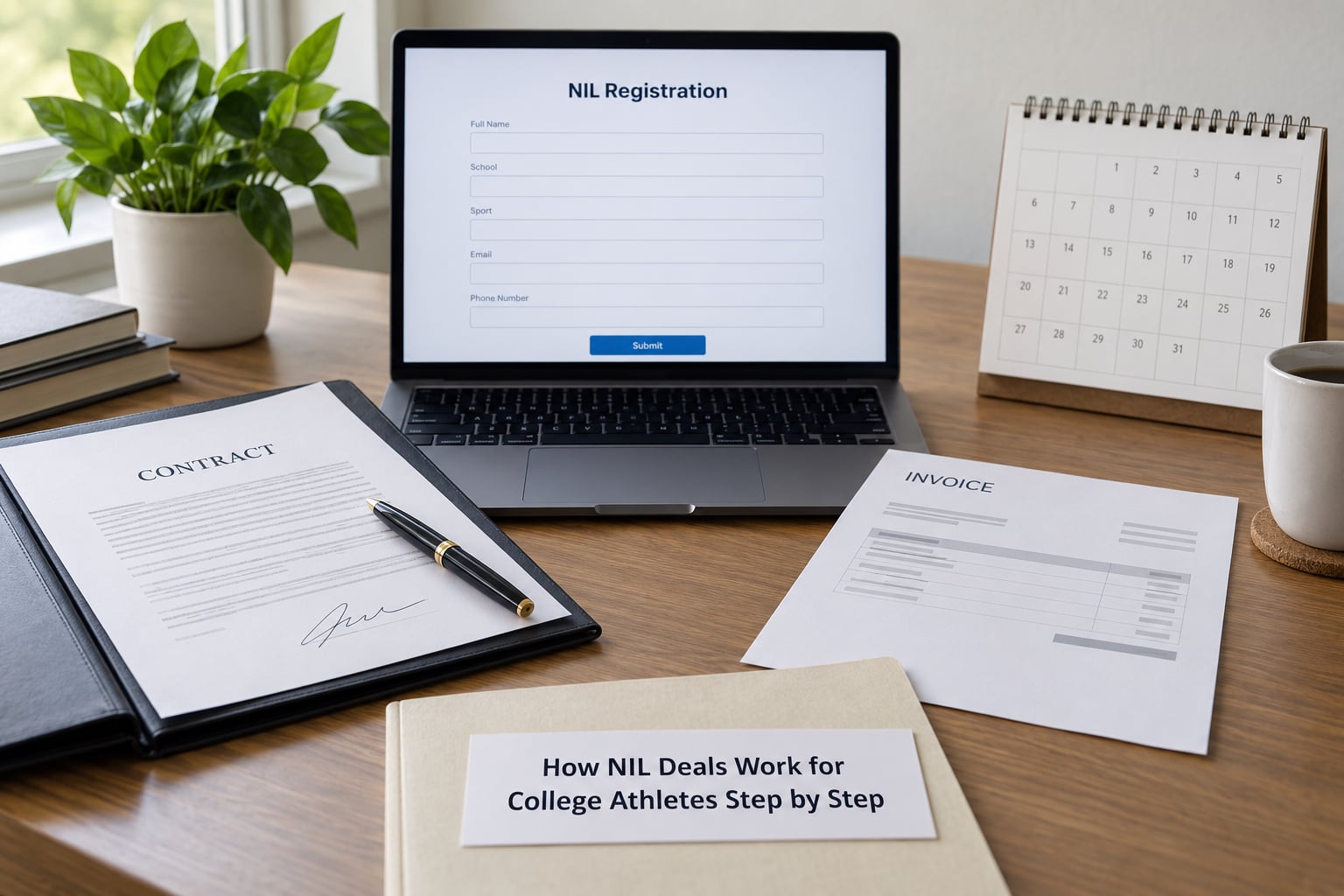
The process is shorter than most people expect. Here is how a deal actually moves from interest to money in an athlete’s account.
- Build a NIL profile. The athlete or their representative assembles a media kit: bio, sport, school, social reach, engagement rate, past campaigns, and rate card if one exists.
- Identify opportunities. Approaches come from agents, collectives, local businesses near campus, national brands, and alumni groups. Postseason and bowl-game appearances are prime territory for local offers.
- Negotiate the terms. Both sides settle on money, deliverables, term length, image rights, exclusivity, and cancellation terms. Everything gets written into an agreement.
- Run it past the school. The compliance office reviews the agreement for conflicts with team sponsors, existing contracts, and school policy. A number of states also require disclosure to the university.
- Receive payment. Funds come from the payer, sometimes routed through a collective’s LLC, an agency, or the athletic department. Timing ranges from on delivery to 30 or 60 days.
- Keep records. Every invoice, agreement, and payment gets logged, because the income has to be reported and taxed.
What Types of NIL Deals Can College Athletes Sign?
The deal categories are stable enough to describe plainly. Most athletes who earn anything at all earn it from one of the first three.
How NIL deals work for social media promotion
The athlete posts or appears in branded content. Deliverables usually specify the number of posts, whether the athlete’s face or voice must appear, approval rights on the content, and how long the post stays up. Reddit users in r/NILClubs describe the current market bluntly: brands are paying for attention and social influence, not only for statistics.
Personal appearances and speaking
Local restaurants, gyms, car dealers, and community events book athletes for a few hours of presence, a signing table, or a short talk. r/CFB posters summarize most of these deals as appearances in exchange for payment, which is accurate for the long tail of small deals.
Merchandise and signature licensing
The athlete licenses their name and number for apparel, trading cards, or memorabilia. This one is usually structured through a collective or an equipment partner because the licensing chain is more involved.
Autographs, content creation, and digital products
Paid autograph sessions, sponsored content for a business, or a subscription program where fans pay monthly for access to the athlete’s content and behind-the-scenes material.
Group and team deals
A booster group or company pays a pool of athletes as a package. Distribution is set by a formula the members agree to in advance.
Business and freelance work outside athletics
Not every deal involves a jersey. Tutoring, camps, coaching clinics, and work for a family business all count as compensated use of an athlete’s public profile.
How Much Can College Athletes Earn Through NIL?
There is no universal maximum and no universal average, because the spread is enormous. Some athletes earn nothing at all. A small number pull in figures that would have been unimaginable before NIL existed, and everything else falls between those two poles.
What drives the number is usually audience, not production. Social reach, engagement rate, sport visibility, school brand, and geography all feed into a brand’s willingness to pay. A quarterback at a national program with millions of followers operates in a completely different market than a distance runner at a Division III school with a strong local following.
Honest framing matters here. A large share of college athletes report no NIL income at all, and the headline deals get the attention because they are the ones reporters can write about. For anyone trying to work out how NIL deals work for college athletes who are not stars, the answer is that plenty of non-stars do get paid, but mostly in small local deals rather than national contracts.
Here is how the money types are different:
| Deal feature | Estimated headline value | Money guaranteed to the athlete | Potential upside |
|---|---|---|---|
| Social media promotion | Varies widely by audience | Fixed per post or per campaign | Renewals and brand extensions |
| Local appearances | Usually modest per event | Fixed per appearance | Repeat bookings during a hot season |
| Collective or NIL club share | Based on the plan’s projected pool | Only what the pool actually raises | Grows if subscribers and wins grow |
| Group or team deal | Package total agreed up front | Split by a published formula | Renewal at a higher rate |
| Licensing and merchandise | Share of sales or a flat fee | Flat fee, or minimum guarantee | Royalties on continued sales |
Collective money is the part fans misunderstand most. A NIL collective is usually an LLC that negotiates with brands and passes a share of everything it collects to its members. The 40-60-80 rule is a distribution formula some collectives use: a fixed percentage of revenue is split evenly among all members, a larger percentage is divided based on participation in collective activities, and the remainder is split by contribution level. Athletes who join know the formula before they sign, which is the only sane way to join one.
As r/NILClubs users point out, collective money depends on boosters staying interested and the team winning. That makes it variable income, not a paycheck.
What Are the NIL Eligibility and School Rules?
NIL does not mean no rules. Several layers of policy still apply, and athletes who ignore them create problems for themselves.
- NCAA baseline. An athlete must be eligible to compete and must disclose the agreement where the school requires it. Some sports’ governing bodies hold their own positions, and a few have adopted NIL limits of their own.
- State law. Dozens of states now have NIL statutes, and a number require athletes at public universities to disclose deals to the school, which can make details subject to open-records requests.
- Institutional policy. Schools run different compliance processes. Some require review before signing, some require notice after, and some limit use of school marks and equipment in sponsored content.
- Conflicts. A deal that competes with an existing team sponsor is the most common reason a compliance office pushes back.
- Recruiting. Schools cannot offer NIL to recruits as an inducement to sign. Booster-funded packages that look like disguised pay-to-play are exactly what the rules are written to prevent, and the scrutiny around them has grown.
- International athletes. Athletes on F-1 visas are effectively locked out of NIL because paid activity can conflict with visa status. That is a real gap rather than a gray area.
- High school. High school NIL rules vary by state and often cap earnings or require disclosure before an athlete signs. Rules differ enough that a high school player needs to check state law rather than assume college rules apply.
Do College Athletes Pay Taxes on NIL Income?
Yes. NIL earnings are taxable, and most athletes and their families are surprised by how straightforward the classification is: the IRS treats NIL payments from schools and collectives as non-employee business income, which means self-employment tax applies alongside federal income tax and state tax.
In practice that means a 1099 at year end for many athletes, quarterly estimated payments, and a business bookkeeping habit from day one. An athlete who spends NIL income on anything personal and waits until spring to sort it out usually ends up owing more than they planned.
Rates and thresholds shift with legislation and change from state to state, so this is general information rather than advice. A CPA who understands athlete income is worth the fee in the first year, and the earlier in an athlete’s career that conversation happens, the better.
What Should Athletes Look for in a NIL Deal?
Contract terms decide whether a deal helps or hurts. Before signing, check these items:
- Compensation. The exact amount, the payment schedule, and whether expenses like travel and travel time are covered.
- Deliverables. Specific and countable. “Two posts during the season” beats “ongoing social media engagement.”
- Term. How long the deal lasts, and what happens when it ends.
- Image rights. Whether the brand can use the athlete’s likeness after the contract expires, and for how long.
- Exclusivity. A category lock blocks other sponsors in the same space, and a broad one can block a lot.
- Cancellation. Game results, injury, a coaching change, or an academic problem can trigger termination. The clause decides who absorbs the loss.
- Compliance. Whether the deal clears school policy and state law.
Red flags read like this: perpetual usage rights for a name and likeness, auto-renewal with no exit, a morality clause broad enough to swallow anything, an exclusivity window longer than the term, or an NDA blocking the athlete from describing the work publicly. r/CFB skeptics have a fair point that opaque deals are hard to verify, and an athlete who cannot describe the deal later usually wishes they had read that clause.
Nobody signs anything on the spot. A review by an attorney who works in athlete representation is the cheapest part of a deal that might pay well for years.
Frequently Asked Questions
Can high school athletes earn NIL money?
It depends on the state. A number of states have NIL laws for high school athletes, and they differ on whether earnings are capped, whether a deal must be disclosed to the school, and whether a parent must consent. Some states leave it undefined, so a player in those places has no clear protection. Check the specific state statute before signing anything, because the rules a college player follows are not the rules a high school player follows.
Do college athletes need their school’s permission to make NIL deals?
Not always permission, but usually some form of review or disclosure. The NCAA baseline requires disclosure where the school asks for it, and a significant number of states require athletes at public universities to report deals to the institution. Many schools also review agreements for conflicts with existing team sponsors. An athlete who skips the process risks an eligibility or conduct review later, so asking compliance first is the safer route.
Is NIL income the same as an athletic scholarship?
No. A scholarship is athletic financial aid tied to recruiting and eligibility, and it comes from the institution. NIL income is compensation an athlete earns for commercial use of their name, image, and likeness, and it belongs to the athlete regardless of whether they are a starter. Some schools bundle NIL payouts into a player’s overall package as a recruiting tool, which blurs the line for fans, but the two payments are legally separate.
Are college athletes required to pay taxes on NIL earnings?
Yes, in most cases. The IRS treats NIL payments as non-employee business income, so federal income tax, self-employment tax, and state tax can all apply. Many athletes receive a 1099 and are expected to make quarterly estimated payments. Rules and thresholds change, and treatment varies by state, so an athlete with real earnings should get individualized advice from a tax professional early rather than at filing season.
Can college athletes make money from social media posts?
Yes, and for most athletes it is the largest category. Sponsored posts, branded content, and subscription programs all count as NIL activity because the payment comes from using the athlete’s name, image, and likeness commercially. Brands care about audience size and engagement rather than statistics alone, which is why a walk-on with a strong following can out-earn a star with a small one. Deliverables should still be written down precisely.
How can a college athlete tell if a NIL offer is legitimate?
Look for a written agreement that names the compensation, deliverables, term, and payment schedule, and check that the entity exists. Be cautious with anyone demanding money up front to connect an athlete with brands, guaranteed returns on an investment, or an NDA covering the whole deal. Verify the collective’s membership list and distribution formula before joining, and never wire funds to unlock opportunities.
Conclusion
Start by confirming eligibility and what your school requires. Document the opportunity in writing, define exactly which rights you are selling and for how long, ask how a collective would split the money before joining one, and get the contract reviewed before you sign rather than after. That is the practical answer to how NIL deals work for college athletes, and most bad outcomes trace back to a rushed yes.