
A redshirt in college football is a player who spends a season with the team but does not play in games, and that season does not count against the four years of athletic eligibility. The word comes from the red practice jersey a Nebraska coach gave a freshman in 1937 so he would not be confused with the varsity players already on the field. Today the term covers several different arrangements, and the version most fans mean is the one where a player can still suit up.
That distinction matters more than it sounds. What is a redshirt in college football, in practice, is a way of extending a career from four seasons to five while a program keeps a highly recruited player on its roster. The rules around it have changed twice since 2018, and the version most explainer pages still describe is out of date.
Table of Contents
- What Is a Redshirt in College Football?
- How Does the NCAA Redshirt Rule Work?
- Why Does a College Football Player Redshirt?
- Does a Redshirted Player Lose a Year of Eligibility?
- How Does Redshirting Affect Quarterbacks and Other Positions?
- Is Redshirting the Same as Sitting Out Because of Injury?
- What Do Fans See on Rosters, Scoreboards, and Box Scores?
- Frequently Asked Questions
- Does a redshirted player get a full year of college football eligibility?
- Can a redshirted player practice and appear in a game?
- Does redshirting hurt a player’s draft stock?
- Can a player redshirt more than once?
- How can I tell whether a player is redshirted or injured?
- Can a walk-on redshirt in college football?
- Key Takeaways for College Football Fans
What Is a Redshirt in College Football?
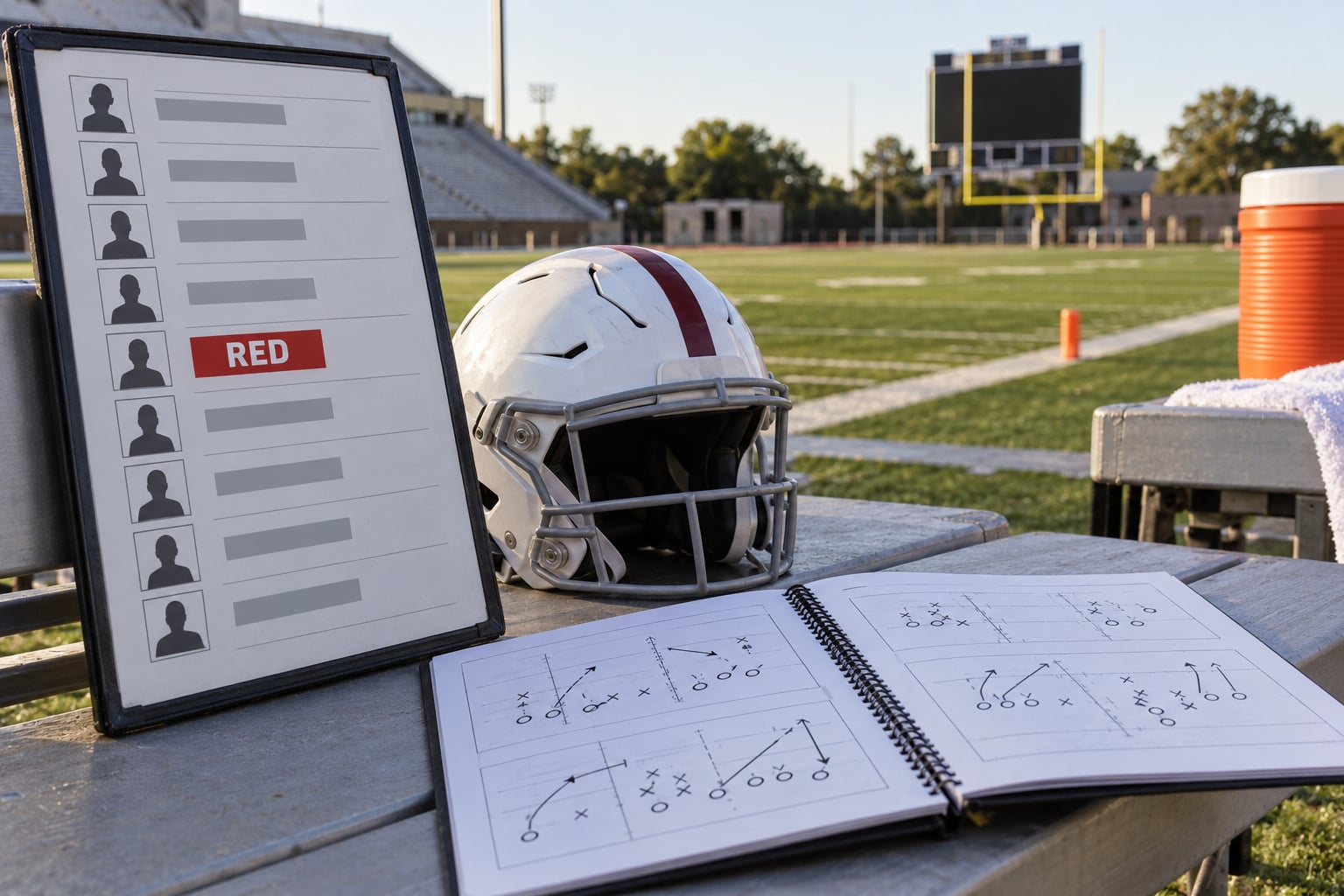
The short version: a redshirt is a season of practice without a season of competition. A true freshman who sits out that way still trains every day, takes part in meetings, travels with the team, and is listed on the roster, and he arrives the following fall still holding all four of his seasons of competition.
The word dates back to Warren Alfson, the Nebraska Cornhuskers scout and coach who in 1937 gave a freshman a red jersey without a number so he could not accidentally enter a game. Within decades, a red jersey turned into a designated year of sitting out, and the term outlived the jersey.
Plenty of people hear “redshirt” and assume it means injured. It does not. A player who misses a season because of a torn ACL is usually using a medical redshirt, which is a different process entirely with different paperwork and different consequences. The section on injury redshirts below sorts that out.
On a roster you will usually see a label rather than a number, something like RS next to a position. The label is not a sentence, and a lot of fans misread it. The decoder further down handles that.
How Does the NCAA Redshirt Rule Work?
The current framework lets a first-year player appear in up to four regular-season games in a season and still keep his season of competition in reserve. The NCAA adopted the four-game version in 2018, replacing an earlier framework that was much harder to use. Since 2024, postseason games no longer count against that four-game limit, which is the change most pages still get wrong.
Four things about the rule trip people up, and they are worth stating plainly.
- Only regular-season games count. Bowl games, conference championships, the College Football Playoff and the FCS playoffs are all exempt from the four-game limit.
- The status is provisional. A coach may pull the redshirt designation off a player mid-season if the depth chart changes, and the designation only becomes official when the season ends.
- You get one. A player cannot bank two years of competition in college football, with hardship situations handled separately.
- Division II plays by a different line. The three-game rule adopted in 2023 is the standard there, while Division I FBS uses four and NAIA sets its own standards.
What that adds up to in practice, scenario by scenario:
| Scenario | Games in the season | Result |
|---|---|---|
| Player never takes the field | 0 regular-season games | Keeps four full seasons of competition |
| Player gets a few special teams snaps | 1 to 4 regular-season games | Still a redshirt, no eligibility burned |
| Player plays a full slate of regular-season games and a bowl | More than 4 total, fewer than 5 regular-season | Still a redshirt because the bowl does not count |
| Player plays five regular-season games | 5 or more | Redshirt is gone, one season of competition used |
| Injury redshirt approved before the season ends | Any, after an injury | Season restored, though practices and games missed earlier still count against later years |
That third row surprises people most. A freshman can start a full regular season, play in the conference title game and the bowl, and still enter his sophomore year with all four seasons intact. The cost is a season on the depth chart, which is exactly the trade some programs dislike.
Why Does a College Football Player Redshirt?

Coaches redshirt for five broad reasons, and they are rarely sentimental about it. A four-star recruit is not sitting out because he needs a break; he is sitting out because the program wants him in a system for a year before the schedule gets hard.
- Physical development. A 17-year-old coming straight from high school often has a frame that college strength coaches want to rebuild before contact work. Linemen are the most common example.
- Learning the playbook. College offenses run hundreds of formations and protections. A quarterback who spends a year as a scout-team quarterback is often more valuable than one thrown into live snaps too soon.
- Depth chart competition. If two upperclassmen are ahead of a freshman at running back, the freshman can either transfer or take a year to develop behind them.
- Injury recovery. A torn ACL in October usually ends a player’s season. An approved medical redshirt can give them most of a year back.
- Academics or admissions. A player who needs to finish a class, retake a credit, or complete an admissions requirement may be told to stay off the roster for a year, which is what people mean by an academic redshirt.
- Roster management. Recruiting classes have to fit under a roster limit. Redshirting is one of the levers a staff uses when the class is heavy at one position.
What Is a Redshirt in College Football During a Player’s First Year?
During that first season, a redshirted player is a full member of the squad. He practices every day, gets individual reps, travels on the road, and dresses for games on the sideline. He can enter a game briefly under the circumstances that apply, and a handful of coaches will use a redshirt in a short, low-risk role such as a late kneel or a single carry.
None of that appears in his statistics. A season of competition is only used when a player plays in more than the allowed number of games, so the year stays in the bank. The part that trips fans up is the class designation on the roster, which is a separate thing from the playing status.
Does a Redshirted Player Lose a Year of Eligibility?
No. The redshirt year is a calendar year, not a season of competition, and those are tracked separately. The NCAA gives a student-athlete four seasons of competition that must be used within five years of first enrollment, which is the five-year clock most fans have heard about. A redshirt year is what makes those two numbers line up for most players: year one produces nothing, years two through five are the four seasons that count, and a typical Division I player finishes in four calendar years when nothing goes sideways.
Eligibility is also a moving target. A player has to stay within the allowed number of credit hours each year, and if a term is lost to a grade or a withdrawal the clock does not simply pause. Hardship decisions can restore a season when a student-athlete’s own injury or a documented family emergency is what cost them the time, and those decisions are made by the school through its compliance office, not by the athlete.
Transfers get their own wrinkles. A player who redshirts and then enters the transfer portal does not get a clean slate in the way people sometimes assume. Years already spent count against what remains, and how much counts depends on where the student-athlete is sitting academically. A redshirt year can be the year that makes a transfer complicated, not the year that makes it easy.
How Does Redshirting Affect Quarterbacks and Other Positions?
Quarterbacks are the position where fans argue about redshirting most, because the sample size is small and every snap is scrutinized. The common pattern is a high-rated recruit arrives, runs an offense in practice, and does not start, because the established starter is still there and the new offense needs a season to install. Scouts have become used to the label, and while it costs a year of production it rarely costs a player his place on a future depth chart.
Running backs and receivers get a different treatment. Because the depth chart is often crowded by committee, a freshman may redshirt by default rather than by plan, and in either case the usual result is a bigger role in year two. Offensive linemen are the most common redshirts in the sport, since almost every one of them arrives underweight for the position. Defensive players redshirt for the same development reasons, and specialists such as kickers and punters almost never do, because the job is available and there is nothing to learn that a year off the roster would fix.
Walk-ons are a special case. A walk-on who is told to redshirt is usually given a grayshirt instead, which is a completely different arrangement. The comparison table further down sets the two side by side.
Is Redshirting the Same as Sitting Out Because of Injury?
No, and the difference is a season of eligibility rather than a jersey color. A voluntary redshirt is a choice the program makes before or during the season, and it protects all four seasons of competition. A medical redshirt is a request the school makes to the NCAA after an injury, asking the NCAA to restore a season of competition the player lost for a documented medical reason.
That request needs paperwork, an athletic trainer’s statement and institutional review, and it is generally submitted within a set window after the season. A hardship waiver is the broader category that covers the same request for non-medical reasons such as a family emergency, and it has a stricter standard, generally requiring the absence or departure to be outside the athlete’s control.
The practical differences show up in the numbers. A player who redshirts voluntarily has no career games on a stat page. A player who got a medical redshirt has the games they did play, and the season they lost restored. For fans tracking a player’s history, that is the first thing to check.
What Do Fans See on Rosters, Scoreboards, and Box Scores?
Rosters are the best source, and the labels follow a simple pattern. Here is the decoder.
| Label | What it means | Competition status |
|---|---|---|
| True freshman | First year out of high school, playing | Season of competition used |
| RS / Redshirt freshman | First year out of high school, sitting out | All four seasons still banked |
| R-Fresh. | Same as RS, abbreviated in a media guide | All four seasons still banked |
| R-Soph. | Academic sophomore, second year on campus, first year of play | First of four seasons used |
| R-Jun. | Third year on campus, second year of play | Second of four seasons used |
| R-Sen. | Fifth year on campus, fourth year of play | Last season of eligibility |
| 5th-year senior | Sixth calendar year, used after a redshirt or a lost season | Final season of eligibility |
The other colored shirts come up too, and they are not redshirts even though people use the words interchangeably. A grayshirt is a scholarship-free year given to a walk-on, used for a mission, a deployment or a year away from school, and it keeps the player on the roster. A blueshirt is a recruited player held out of the first season of practices and given no season of competition, which in practice means the roster spot goes to someone else. A pinkshirt is the arrangement used for a student-athlete who takes a pregnancy leave. An academic redshirt is a coach telling a player to stay off the field for a term to fix a grade or finish a requirement, and because the player was never enrolled in a full term, the year typically comes off the clock.
| Status | Who grants it | Cost to eligibility | What it usually means |
|---|---|---|---|
| Redshirt | Coaching staff | None, if under the game limit | A season of practice and no season of competition |
| Grayshirt | Coaching staff | Clock may or may not pause | A scholarship-free year, usually for a walk-on |
| Blueshirt | Coaching staff | Uses a year in most cases | Held out of practices entirely, roster spot not held |
| Pinkshirt | School, on request | Restored when the student-athlete returns | A pregnancy-related leave |
| Academic redshirt | Coaching staff | Term comes off the clock | Fixing grades or admissions before enrolling fully |
| Medical redshirt | School, approved by the NCAA | Season restored | Documented injury cost a season |
One authority point worth making plainly: coaches decide. Not the player, not the family, and not the recruiting service, however strong an opinion those people may have. A highly recruited prospect can arrive expecting to play immediately and be told to redshirt in the same conversation, and the designation is not locked in until the season is over.
Scoreboards and box scores are less useful than people hope. A player who suits up but does not appear simply does not show up, so the only way to spot a redshirt on game day is to check the roster or a depth chart before kickoff, and to notice the non-padded warmups that suggest a player is not expected to be hit.
Frequently Asked Questions
Does a redshirted player get a full year of college football eligibility?
Yes, and that is the entire point. A redshirt year is a calendar year of practice that does not count as a season of competition, so a player can arrive as a redshirt freshman, sit out, and still have all four seasons of competition available across the following four years. The catch is that the year still passes, and it has to be used within five years of first enrollment.
Can a redshirted player practice and appear in a game?
A redshirted player practices every day, travels with the team and suits up. He may also appear briefly in a game, and under the current rule a first-year player can take part in up to four regular-season games and still keep the designation. Bowl games, conference championships and playoff games do not count toward that limit, so a player can play a full regular season plus a bowl and still have all four seasons left.
Does redshirting hurt a player’s draft stock?
It can cost something, and it depends entirely on the position and the reason. Quarterbacks and receivers usually lose a year of production without much damage, because scouts care about the film they can project forward. Linemen often benefit, since an extra year of development and weight is the point. A redshirt taken after a serious injury reads very differently from one taken in August, and coaches rarely explain which one it was unless asked.
Can a player redshirt more than once?
No. A college football player gets one voluntary redshirt year, so once that season of competition is burned it cannot be banked again. Players who lose additional seasons go through a hardship process instead, and those requests have to be tied to a documented injury, a family emergency or another qualifying circumstance outside the athlete’s control. Transferring does not hand you a fresh set of banked seasons either.
How can I tell whether a player is redshirted or injured?
Check the roster label first. A player marked RS, R-Fresh. or similar is redshirting, while a player listed without those marks who has been absent from the depth chart may simply be recovering. Game notes and the school’s injury report are the better source, since they will say whether a season-ending injury is being handled through a medical redshirt request. The distinction decides whether the player has lost a season of competition or not.
Can a walk-on redshirt in college football?
A walk-on usually cannot take a conventional redshirt, because the version that protects all four seasons of competition requires a full year of enrollment and institutional aid. What walk-ons are often given instead is a grayshirt, a scholarship-free year that keeps them on the roster, makes them a full participant in practice and lets them suit up, but that is a different arrangement and the rules around the clock are not identical.
Key Takeaways for College Football Fans
What is a redshirt in college football, in one line: a season of practice that does not use up one of the player’s four seasons of competition, currently capped at four regular-season games with postseason games exempt.
The second thing worth remembering is the difference between a choice and a circumstance. A voluntary redshirt is a recruiting and development tool the staff controls. A medical redshirt is a paperwork fight to get a season back, and the outcome is not always in the player’s favor.
Before you read anything into a player’s situation, check three things: the roster label, the game notes, and whether the year was taken in August or after an injury. Those three answers cover nearly every case a fan will run into during a season.