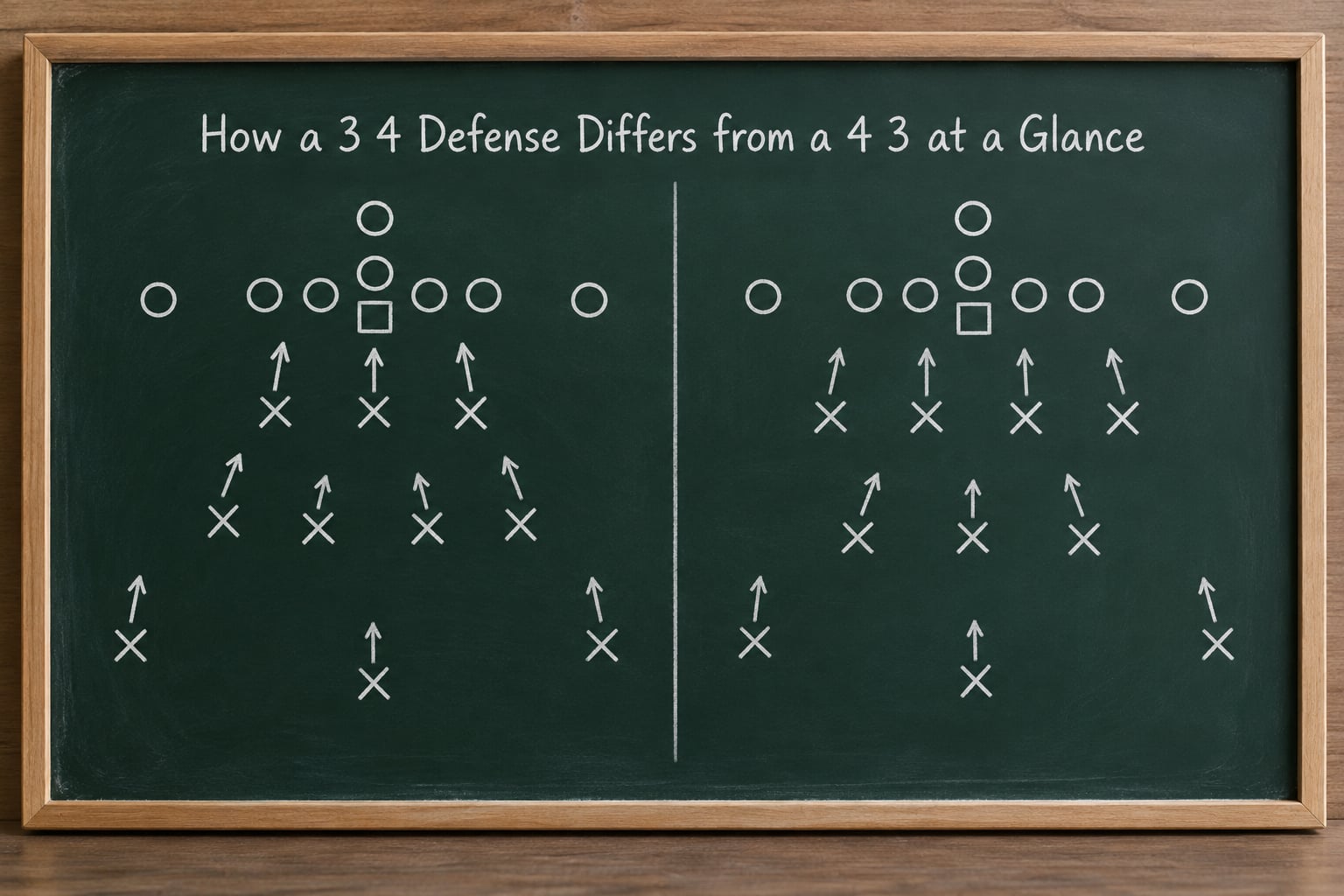
The short answer is where the players stand and who owns which gap. A 3-4 defense puts three defensive linemen on the line and four linebackers behind them; a 4-3 defense puts four linemen on the line and three linebackers behind them. Both add four defensive backs to reach 11. How a 3 4 defense differs from a 4 3 is therefore less about the number of defenders and more about which body group absorbs the interior blocking load. The 3-4 asks a nose tackle to control the middle while linebackers flow to the ball; the 4-3 spreads four linemen across so each one owns a single gap.
That one change ripples into recruiting, depth charts, draft capital, and what a team can do on third down. Fans who understand the two schemes usually stop arguing about which is better and start asking which fits the roster in front of them.
Table of Contents
- How a 3 4 Defense Differs from a 4 3 at a Glance
- What Is a 3-4 Defense?
- What Is a 4-3 Defense?
- How the Front Seven Alignments Change
- How Each Defense Handles the Run
- How Each Defense Handles the Pass
- 3-4 vs. 4-3: Personnel and Recruiting Differences
- 3-4 vs. 4-3: Strengths and Weaknesses
- How Teams Adapt the 3-4 and 4-3
- Which Should You Choose?
- Frequently Asked Questions
- Conclusion
How a 3 4 Defense Differs from a 4 3 at a Glance
| Category | 3-4 Defense | 4-3 Defense |
|---|---|---|
| Defensive linemen | 3 | 4 |
| Linebackers | 4 | 3 |
| Defensive backs | 4 | 4 |
| Named positions | Nose tackle, two defensive ends, two outside linebackers, two inside linebackers | Two defensive ends, two defensive tackles, Sam, Mike, Will |
| Gap model | Mostly two-gap: five interior players each own a gap and a half | Mostly one-gap: four linemen each own a single gap |
| Common fronts | Stack, tite (mint), Okie | Over, under |
| Interior run support | Linebackers | Defensive tackles |
| Built-in pass pressure | Outside linebackers rush from off the ball | Defensive ends rush from the line |
| Typical pass defenders | 4 or 5 linebackers plus secondary | 3 linebackers plus secondary |
| Ideal roster profile | Rare, rangey athletes; a true nose tackle | Larger, deeper defensive line; average-size linebackers work |
Add those numbers up and you get the same eleven defenders in both schemes. Only the distribution changes.
What Is a 3-4 Defense?
A 3-4 defense is a base front built around one nose tackle, two defensive ends, and four linebackers who usually split into two outside and two inside. The nose tackle lines up directly over or shaded beside the center, takes on the interior blocking, and occupies the guards so the linebackers are free to move.
Teams run it when the priority is speed at the second level. The scheme gives you four linebackers, which usually means four players who can cover, blitz, or flow into the run. Modern versions replace the nose tackle with a defensive lineman who plays on the edge of a two-gap front, but the structure stays the same.
The common misconception is that a 3-4 defense has no defensive ends. It has two, and they are often the strongest pass rushers on the field.
What Is a 4-3 Defense?
A 4-3 defense spreads four defensive linemen across the line, typically a defensive end and a defensive tackle on each side, with three linebackers behind them. Those linebackers are conventionally the strong-side Sam, the middle Mike, and the weak-side Will.
The scheme trades a fourth linebacker for a fourth body on the line of scrimmage. That front seven has one more down lineman to control the line, which is why run-heavy programs have leaned on it for decades.
One practical note: the 4-3 under front looks almost identical to a 5-2 once the safety shows up as a fifth lineman. Alignment charts flatter the 4-3 more than the label suggests.
How the Front Seven Alignments Change
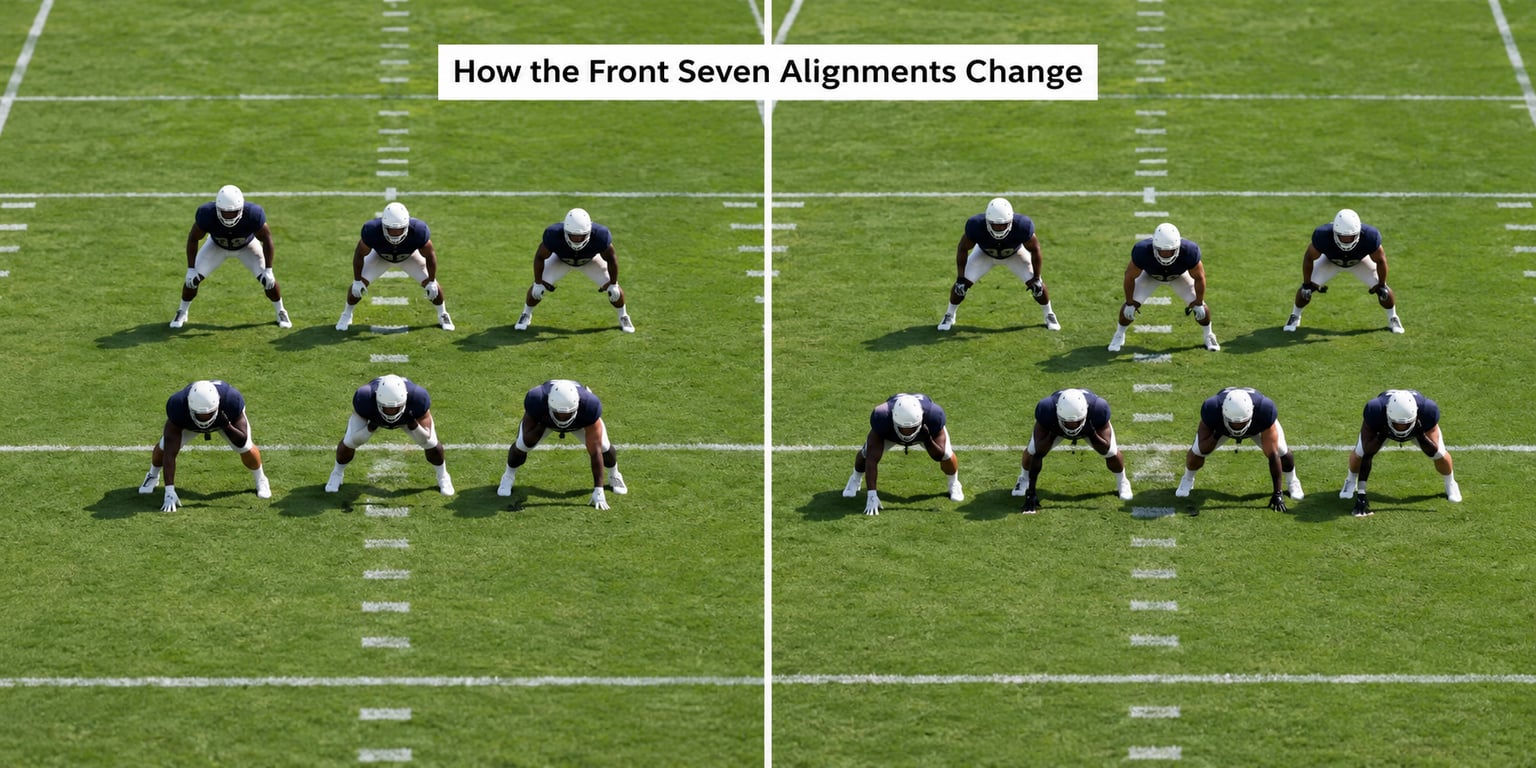
Coaches call alignments with technique numbers, where the line of scrimmage is zero and the numbers count outward in yards. A 4 technique is a hand on the ground outside the tackle, a 3 technique puts a hand on the ground inside the guard, a 0 technique is head up on the center, and a 4i technique is the head-inside version of the 4.
Stack, tite, and Okie are the common 3-4 fronts. A stack front puts every interior player on the same line so off-tackle and outside runs widen the gaps. Tite slides the ends slightly behind the nose, which protects the edges and invites plays away from them. Okie brings a defender up at the linebacker depth to attack an interior run.
The 4-3 splits into over and under. In over, the front shades gaps in opposite directions, one end working outside and down, the other inside, which suits defensive ends with different strengths. Under puts all four linemen just outside their gaps so they can fight blocks and keep the line of scrimmage tight.
A one-gap 3-4 front, where the defensive ends get an inside hand and the nose guard takes a shade, ends up functionally very close to a 4-3 under. Anyone comparing the two schemes on a diagram should look at who owns the A gap before drawing any conclusion.
How Each Defense Handles the Run
The 3-4 runs a two-gap philosophy in its base alignment. With the nose tackle, two ends, and two inside linebackers, that’s five players covering the A, B, and C gaps on a one-to-one basis, each responsible for a gap and a half. The outside linebackers hold the edges, read the play, and decide whether to crash or contain.
The 4-3 is a one-gap system in both of its standard fronts. Four linemen own four gaps, and the three linebackers clean up behind them. Each defender has one gap, which usually makes run fits easier to memorize but harder to absorb when the offense blocks down and creates a cutback.
The trade-off shows up against specific attacks. A 3-4 struggles when an offense stretches the box horizontally, because the linebackers have to cover ground sideways and the ends get isolated against blockers. A 4-3 struggles when the offense runs downhill with a full backfield, because flow gaps appear behind the linebackers rather than in front of them.
How Each Defense Handles the Pass
Four linebackers is the real pass advantage of the 3-4. The OLB dropped into coverage functions like a safety, and cover 3, cover 4, cover 2, and a straight man scheme all come out of the same base alignment with no substitution. Zone blitzes come natural too, since the dropped linebacker is already near the throw.
The 4-3 gives up a linebacker but gains a defender on the line, which makes man coverage and pressure concepts cleaner. With ends on the ball, a five-man rush works without sending anyone, and a third linebacker dropping into the hook zone gives the secondary an extra underneath defender.
Both schemes can run either style of coverage. What differs is the cost of the change-up. A 3-4 team swaps a linebacker for a defensive back and keeps its front intact; a 4-3 team often swaps a lineman out to do the same thing.
3-4 vs. 4-3: Personnel and Recruiting Differences
Start with the nose tackle. A true 3-4 needs a 300-pound-plus interior player who can play on the nose and survive double teams. A 4-3 can absorb a rotating pair of defensive tackles, and average-size prospects fit the room more easily.
Next comes the linebacker room. The 3-4 wants four players with enough size to set the edge and enough speed to carry coverage into the hook zone. The 4-3 wants three, with the middle backer needing to diagnose plays behind four linemen.
That is where the draft capital difference shows up. In the analytics discussion around the one published EPA comparison of these schemes, the consistent point was that 3-4 programs need rarer, higher-drafted athletes at nose tackle and outside linebacker, while 4-3 teams can win with more average talent.
Substitution patterns follow the same logic. Against three or four wide receivers, a 3-4 team removes a linebacker and still plays a three-man front. A 4-3 team is more likely to replace a defensive end with a back, which changes its run fits late in the game.
3-4 vs. 4-3: Strengths and Weaknesses
The 3-4 defense is built for versatility: more linebackers, built-in disguise, and pass rush from off the ball without a blitz. Its weaknesses are equally clear. It is vulnerable to horizontal stretch runs, it depends on a nose tackle who is hard to find, and it looks wrong when a base defender gets isolated against a tight end.
The 4-3 defense is built for run control and simplicity: four bodies on the line, clean gap responsibilities, and a straightforward diagnosis for the middle linebacker. Its weaknesses are fewer coverage weapons, less disguise before the snap, and a harder time matching up when an offense puts four receivers on the field.
Neither weakness is automatic. A 3-4 team with a heady edge setter handles the stretch fine. A 4-3 team with three athletic linebackers and versatile ends can pressure without ever blitzing.
How Teams Adapt the 3-4 and 4-3
Very few teams play their base defense as installed, which is why labels mislead. Stunts and twists in the defensive line shift who actually occupies a gap at the snap. Position swaps, where an end and an outside linebacker trade responsibilities after the snap, disguise the front without changing the personnel.
The 4-2-5 is the most common modern offshoot of the 3-4, and it is simply a nickel version of that front: two defensive ends, a nose tackle, a defensive tackle, and five defensive backs. It exists because the answer to four-wide formations is more speed, and the 3-4 gets that speed without giving up its front structure.
Some coaches call a 4-3 with three linebackers a multiple defense, playing 4-3 base on early downs and nickel or dime on passing downs. The gap between the two schemes on the box score is far smaller than the gap on a coaching staff whiteboard.
Which Should You Choose?
For a high school or youth program, the deciding factor is the athletes you already have. If you have one dominant interior lineman and four quick linebackers, the 3-4 defense will make them all better. If your line is deep and your linebacker group is thin, a 4-3 puts bodies where you need them.
Coaching style matters too. New coaches get more out of the 4-3 because run fits are simpler. Programs with experienced linebackers and a defensive coordinator who wants pressure without blitzing tend to land on the 3-4.
Match the opponent and the level. Against a spread offense that wants to stretch the box horizontally, favor the 4-3. Against a pro-style offense that uses tight ends and play action, favor the 3-4 and its ability to keep a linebacker over the slot. For IDP fantasy players, the 3-4 generally means more linebacker scoring chances; the 4-3 means more nose tackle and defensive tackle work, with defensive ends as the most consistent source of sacks.
Frequently Asked Questions
What is the weakness of a 3/4 defense?
The main weakness of a 3/4 defense is horizontal stretch running. Because a nose tackle and four linebackers handle interior gaps, the linebackers must travel sideways, and offensive linemen can widen the gaps around them. A 3/4 team is also dependent on finding a true nose tackle, a position that is expensive to fill and easy to double team.
Is a 4-3 defense better than a 3-4 defense?
Neither is better in the abstract. The 4-3 gives you more run control and simpler gap fits; the 3-4 gives you four linebackers, better disguise, and pressure without blitzing. The one widely cited statistical comparison, published in 2010, found the 3-4 ahead on defense, but its own authors cautioned that talent, not scheme, explained much of the gap.
Do any NFL teams use a 3/4 defense?
Yes. Several NFL teams list a 3-4 as their base alignment, and a fair number of teams that prefer a 4-3 keep a 3-4 package in their playbook for specific downs. Usage data from recent seasons shows base defense snaps declining overall, so the honest answer is that most teams mix multiple schemes and label one of them as the base.
What is a 3/4 defense good against?
A 3/4 defense is good against pro-style offenses that use tight ends, play action, and protection schemes that limit the number of receivers. Four linebackers let a team keep a defender over the slot, cover up the middle of the field, and bring pressure from off the ball. It is less comfortable against spread offenses that stretch the box wide.
What is a 4-2-5 defense in football?
The 4-2-5 defense is a nickel front: four defensive linemen, two linebackers, and five defensive backs. It is the standard answer to four-wide offensive formations, replacing one linebacker with an extra corner or safety. Because most teams already build their base from a 3-4, the 4-2-5 is usually described as a modern offshoot of that scheme.
What is the best defense to run in youth football?
Match the scheme to the roster you have, not to a chart. One big interior lineman with four athletic linebackers points to the 3/4 defense. A deep defensive line with fewer linebackers points to the 4-3. Keep the calls simple at youth levels, make every player’s gap assignment identical on every down, and let kids play fast rather than drowning in scheme variations.
Conclusion
The core difference is a single redistribution. The 3-4 defense gains flexibility by cutting the defensive line to three players and pushing speed into the second level; the 4-3 defense uses four linemen to build more front structure and hands the cleanup to three linebackers. Everything else, from stunts to position swaps to nickel packages, is a variation on that choice.
Evaluate the personnel first. If you have a nose tackle and linebackers who can cover, the 3-4 is the higher ceiling. If your strength is a deep, physical defensive line, the 4-3 will put those players where they matter most and keep the calls simple.