To get into a college basketball arena early, you want to be through security and seated roughly 60 to 90 minutes before tipoff, and the way you do that is simple: find the venue’s published gate time, arrive before that gate opens, and walk in with a bag the venue allows and a ticket already loaded on your phone. Nobody is sneaking anywhere.
The reason people miss out is that they arrive early and still stand outside. Most arenas open parking and campus grounds long before they open the doors, so an early car park does not equal an early seat. What you control is the gap between your arrival at the gate and the moment that gate opens, and that gap is decided by what you do in the 48 hours before gameday.
This guide covers the whole sequence: finding the official door time, picking the correct public entrance, clearing a metal detector without losing your early-arrival advantage, and knowing what to do with the extra half hour once you are in the building.
Table of Contents
- What You Need
- How to Get Into a College Basketball Arena Early
- Step-by-Step
- Common Mistakes
- Frequently Asked Questions
- How early should I arrive to a college basketball game?
- How do I find out what time the doors open at an arena?
- Why is there a long line to get into the arena when I already have a ticket?
- Can you get into a college basketball arena before doors open?
- What can I bring into a college basketball arena?
- Can I leave a college basketball arena and re-enter?
- Conclusion
What You Need
Most of what you need is digital and takes five minutes to prepare. The physical items are smaller than people expect.
- Your ticket, already loaded. Open the app or download the PDF before you leave home. Screenshots of an app that needs a signal to render a barcode are the single most common reason a ticket fails at the scanner.
- Photo identification. Arenas commonly require a matching ID for will call, student tickets, and comp tickets. A driver’s license or a state ID covers nearly every case.
- A bag that fits the published size limit. Many venues require a clear bag, and Citadel’s published football fan guide, one of the most detailed public policies available, uses a 12 by 6 by 12 inch standard. Basketball policies vary, so read the specific venue’s list rather than assuming.
- A payment method. Parking, shuttles, and concourse concessions increasingly run card or mobile pay only. Bring a backup card on a different account so one dead phone does not strand you at the gate.
- Parking and shuttle specifics. Lot names, lot open times, shuttle stops, and rideshare drop-off zones are published in the same gameday guide as the door time, and reading them in advance saves you from circling the campus once gates are open.
- Comfortable shoes and a light layer. Concourses are long, and you will be standing in them longer than you expect.
- Your student app, if you are a student. Several programs scan students in through the athletics app at a separate gate, sometimes well before the general doors.
If you are bringing young kids, add one thing that is not on anybody’s list: a plan for the first restroom break. Concourse lines spike hard in the twenty minutes after doors open, and knowing which restrooms sit near your section saves you from walking the whole ring twice.
How to Get Into a College Basketball Arena Early
Arenas do not open once. They open in tiers, and each tier belongs to a different kind of fan. Parking and campus grounds usually open earliest, often hours ahead. Will call and the ticket office open next. Student sections and premium or donor levels often open before the general gates. General admission and the public doors come last, somewhere between 30 and 90 minutes before tipoff.
The published numbers vary more than fans expect. Auburn-Montgomery’s basketball protocols put admission gates at 20 minutes before scheduled tipoff. Wyoming’s basketball gameday document has students scanning in through the app one hour before tipoff, with the main ticket office opening four hours before tipoff. The Citadel’s football fan guide, which is not basketball but is the most granular public entry document located, lists gates at 90 minutes before kickoff, will call at two hours, and parking lots at four hours.
Those three numbers span 20 to 90 minutes on the same day of the week at Division I programs. That spread is why “arrive an hour early” is bad advice on its own. The useful habit is to convert the venue’s published door time into your own arrival time, then work backwards.
The T-minus arrival timeline
This is the timeline that turns a tipoff time into a plan.
- T-120 minutes: Parking and traffic. Lots are usually open by now, and shuttles begin running. This is when you drive, not when you walk.
- T-90 minutes: Gates and security. The screening lanes open and fill fast. If your venue opens gates at 90, being in the line at 95 is wasted time; being at 70 is not.
- T-60 minutes: Student section stand. If your program runs an app scan-in for the student section, this is the window. Be there at the start of it, not the end.
- T-45 minutes: Concourse. You should be walking to your section with time to find the row, the seat, and a restroom without a crowd pushing past you.
- T-30 minutes: Warmups. Players are on the floor, shooting, stretching, and the band is often playing. This is the payoff for arriving early.
- T-5 minutes: Introductions and the team walkout. From here you are watching from your seat instead of over someone’s shoulder.
Now the part that frustrates almost everyone: arriving very early does not always help. Plenty of arenas hold the exterior line outside until close to tipoff, sometimes because the concourse behind the doors is not staffed yet and sometimes because of building operations. Fans complain about it constantly on the Indiana board keaneyblue.com, where a thread about the Ryan Center in-game experience drew a blunt reply from a returning poster telling people to stop complaining about waiting in line and simply get to the arena earlier.
The honest reading is that a queue outside is sometimes unavoidable, but it is almost always shortest for people who are already in it when the line opens. The worst outcome is arriving at what you assumed was doors time, discovering a forty-minute wait, and sitting down five minutes before tipoff. That is the experience this guide is built to prevent.
Step-by-Step
Step 1: Check the Arena’s Official Entry Times
Start with the venue’s gameday guide, then confirm it against your ticket email. The arena website and the athletics site both publish gate times, will call hours, parking lot open times, bag rules, and prohibited items, and the gameday guide usually consolidates them into one page.
Check for four separate things, because they are often different numbers: the general door time, the student section scan-in time, will call hours, and parking lot hours. If the program has a season ticket member priority window or a premium seating early entry, that appears on the same page under a different heading.
When sources disagree, the ticket confirmation email wins for your specific game, because it reflects the specific event. Policies do shift between seasons, so a page from two years ago is a starting point and nothing more.
Step 2: Choose the Right Entrance
Use the public entrance listed for general admission or your seat location. Arenas typically run several doors, and the difference matters: the student section scan-in gate, the will call window, the accessible entrance with its lift and shorter line, and the credential lane for coaches, media, and comp tickets are all separate from the main public doors.
Walking to the wrong door at game time is the most common self-inflicted delay for first-timers. If your ticket says a section number, look for signage matching that range, and ask a staff member before you commit to a line.
Step 3: Arrive Before the Main Queue
Target the published gate time minus 15 to 20 minutes for a general admission seat, and the start of the scan-in window for a student section. On a rivalry game, a ranked opponent, a conference tournament, or a March Madness game, subtract another 20 minutes.
Build the buffer around the parking lot opening time, not the gate time. A lot that opens at T-150 does not mean you can be seated at T-120, because the walk, the shuttle, and the screening line are all still ahead of you. On a cold night with a slow shuttle loop, that buffer is the difference between being relaxed and being rushed.
Step 4: Have the Ticket and Entry Details Ready
Open your ticket before you reach the scanner and keep the screen awake. Screenshot the barcode if the app is unreliable, and know whether your ticket is mobile-only, since some venues no longer print.
Have your ID out too if you are picking up at will call or using a student or comp ticket. While the ticket is open, check the venue’s re-entry policy, since a re-entry stamp or wristband rule determines whether you can step outside later for food or a tailgate without losing your seat.
Step 5: Pass Security and Locate the Seating Area
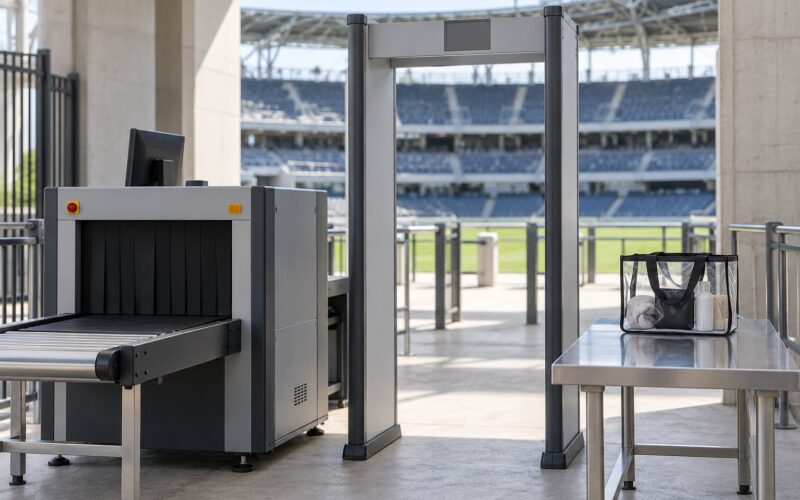
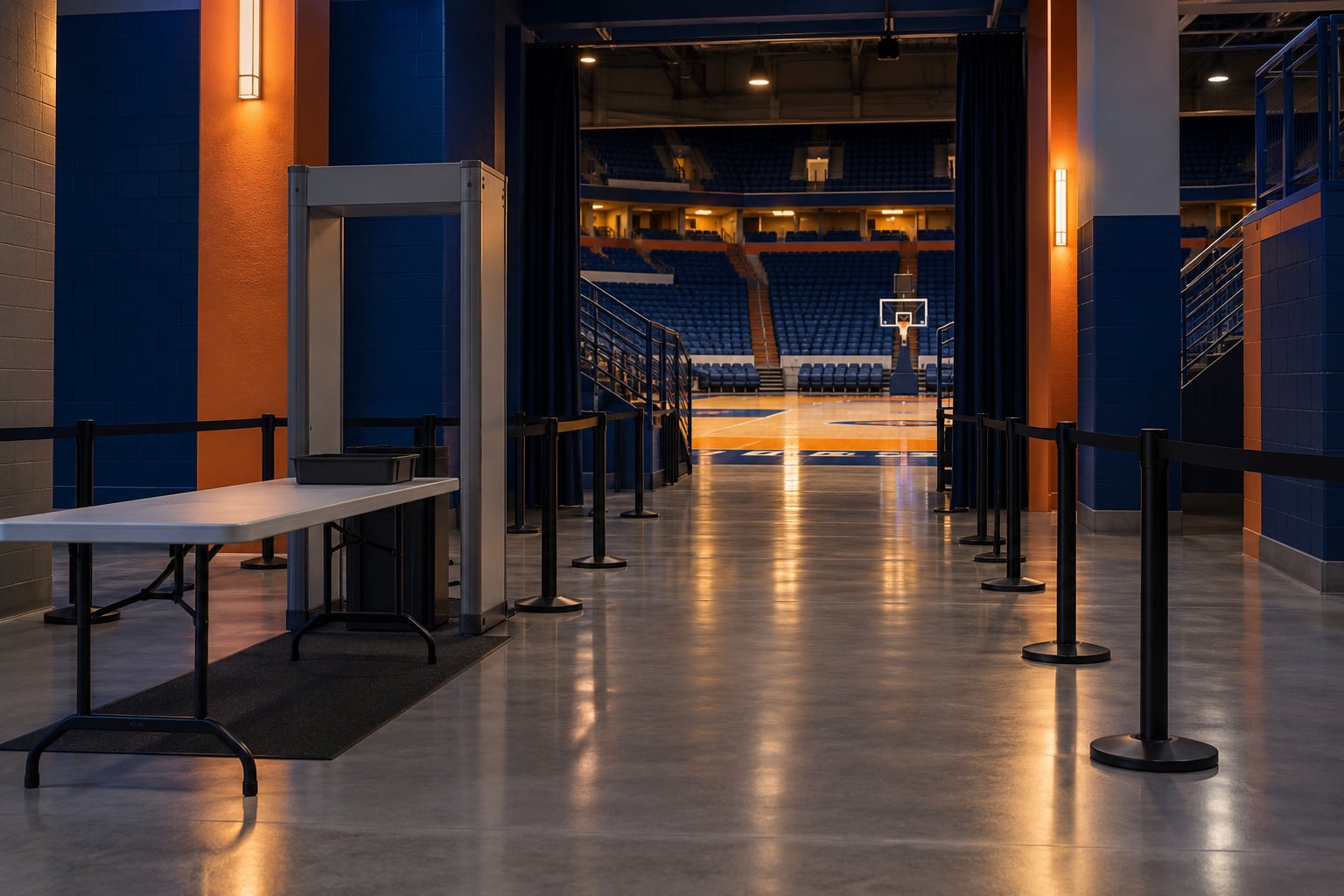
Expect a bag check, a walk-through or wand screening, and a ticket scan, in that order. Know the venue’s prohibited items list beforehand, because a bag inspection at the front of the line is where early arrival efforts actually die.
Once inside, follow section signage to your level rather than the first sign you see, and take note of two landmarks as you walk: the nearest restroom and the nearest stairwell. In most older arenas the concourse loop is longer than visitors expect, and the seat-finding scramble is why people arrive early and still miss warmups.
Step 6: Use the Extra Time Productively
Settle in before the noise peaks. Sit down, look at the court, watch the warmups, and get your photo spots taken now while standing room is still open.
The fans who remember a tournament game rarely point to their seat as the highlight. In an r/CollegeBasketball thread asking about the best in-person tournament experiences, the answers were about atmosphere: a coach’s final home game, a 13 seed beating a 4 seed, a 12 seed knocking out a 5 seed. That atmosphere builds in the half hour before tipoff, and it is the reason to be in the building early rather than in the parking lot.
Common Mistakes
- Arriving at doors time instead of before it. Doors time is when the line is shortest, not when you should arrive. Fix: subtract 15 to 20 minutes from the published gate time.
- Assuming every fan gets early access. Student sections, premium levels, and donor areas frequently open before the general doors, and that privilege comes with the ticket. Fix: check whether your seat type has its own window.
- Using the wrong entrance. Walking to a closed or credential-only door costs you several minutes. Fix: match the door to your section type before you reach the building.
- Standing in the wrong line. Will call, student scan-in, and general admission are different queues even at the same building. Fix: identify your line before you join it.
- Forgetting identification. Will call, student, and comp tickets usually require a matching ID, and the problem surfaces after the wait, not before it. Fix: keep your ID in hand from the walk to the door.
- Ignoring the bag policy. Clear bag rules and prohibited item lists are published and enforced at the front of the line. Fix: read the list the day before and pack down to it.
- Ignoring the weather and the lot situation. Rain slows walking, snow slows shuttles, and a full lot can turn a 10-minute drive into a 30-minute loop. Fix: check lot status and add time.
- Expecting a better seat because you arrived early. Early arrival buys time, not location. Seat location comes from what you bought. Fix: pick your section for sight lines before gameday, not on the day.
- Leaving the good stuff early. Some fans arrive at T-90 and then stand in the aisle or the concourse for twenty minutes. Fix: sit down and stay seated until introductions.
Frequently Asked Questions
How early should I arrive to a college basketball game?
Plan to be seated 60 to 90 minutes before tipoff. For a general admission seat, arrive at the gate 15 to 20 minutes before its published opening. For a student section using app scan-in, arrive when that window opens, often 60 minutes before tipoff. For rivalry games, ranked opponents, or tournament games, add another 20 minutes.
How do I find out what time the doors open at an arena?
Start with the venue gameday guide on the arena or athletics website, then confirm against your ticket confirmation email for the specific game. Look for four separate times, which are often different: general doors, student section scan-in, will call hours, and parking lot opening. Policies change between seasons, so treat any older page as a starting point.
Why is there a long line to get into the arena when I already have a ticket?
A ticket guarantees entry, not a fast entry. Every public gate runs bag checks, screening, and ticket scans, so the queue reflects how many people arrived in the same window. Some arenas also hold the exterior line until close to tipoff because the concourse behind it is not staffed yet. Arriving before the line opens is the only part you control.
Can you get into a college basketball arena before doors open?
Not as a general admission fan. Outside the published door time you will wait outside. The exceptions are ticket types with their own early window: student sections that scan in through the athletics app, and premium, donor, or courtside levels that open before the public gates. Those privileges come with the seat, and the arena publishes them on its gameday guide.
What can I bring into a college basketball arena?
Expect to pass a bag check and a screening at every entrance. Many venues require a clear bag within a published size limit, and Citadel’s public football fan guide uses 12 by 6 by 12 inches as its standard. Prohibited items usually include outside food and drink, glass, weapons, and large audio equipment. Read the specific venue’s list before you pack, because rules differ by school.
Can I leave a college basketball arena and re-enter?
Some venues allow re-entry with a hand stamp or wristband, others do not allow it once you are inside. This matters if you plan to step out to the tailgate lot or a food truck. Check the venue’s fan guide or ask at guest services before tipoff, since leaving without a stamp can mean standing outside when play resumes.
Conclusion
Verify the arena’s official entry schedule first, because that single number decides everything else. Then work backwards: published gate time, minus 15 to 20 minutes, plus whatever parking and weather add, arriving at the correct public entrance with a compliant bag and a ticket already loaded.
Do it once and gameday stops being a logistics problem. You walk in, sit down early, and watch warmups from your seat instead of explaining to a friend why you were still outside.