Sportsbooks build a college football point spread by subtracting two neutral-field power ratings to get an expected margin of victory, then layering on home-field advantage, injuries, rest and schedule, and weather before a human oddsmaker reviews the number. Once the line opens, money moves it.
That is the short version, and it is worth knowing even if you never intend to place a bet. When your school opens as a 16.5-point favorite, the number is a statement about how the entire market rates two programs against each other, not a claim about any single analyst’s opinion of the season.
I have watched enough Arizona games to know the number is usually not personal. It is arithmetic applied to a résumé, then adjusted for everything that résumé cannot see.
Table of Contents
- What Is a College Football Point Spread?
- What Factors Do Sportsbooks Use to Set a Line?
- How Team Strength and Performance Affect the Spread
- How Do Injuries, Rest, and Scheduling Affect the Line?
- Why Does Home-Field Advantage Matter?
- How Does the Opening Line Differ From the Current Spread?
- How Do Sportsbooks Balance Sharp Money and Public Bets?
- How Can You Read a Point Spread Before a Game?
- Frequently Asked Questions
- Key Takeaways for Reading College Football Spreads
What Is a College Football Point Spread?
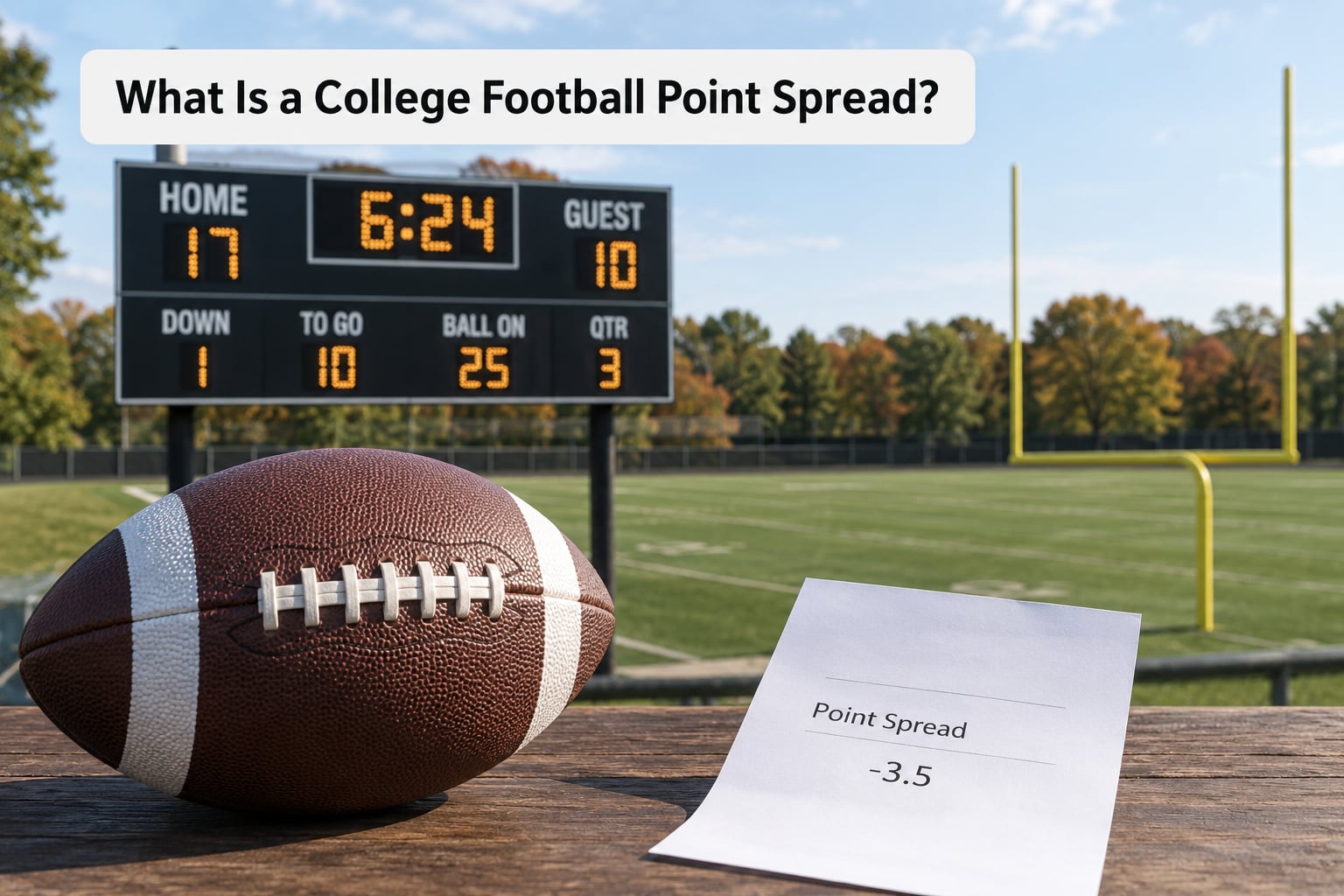
A point spread is a handicap that turns a mismatched game into a contest with two roughly even sides. The favorite is listed with a minus number and must win by more than that number. The underdog is listed with a plus number and can win its bet by winning outright or by losing by fewer points than the number.
Take Arizona opening as a 16.5-point favorite over a mid-tier opponent. Arizona is -16.5, which means it has to win by 17 or more for the bet to win. A 24-10 Arizona win loses the bet by two and a half points. A 17-10 win loses it too, because 7 is not more than 16.5.
| Final score | Margin of victory | Arizona -16.5 result |
|---|---|---|
| 24-10 | 14 points | Bet loses |
| 17-10 | 7 points | Bet loses |
| 31-16 | 15 points | Bet loses |
| 35-17 | 18 points | Bet wins |
Why half points exist
Most football games are decided by an odd number of points, which is why half points are standard. A spread of 16.5 can never be landed on exactly, so the bet either wins or loses. Whole numbers appear on alternate lines and teasers, and they can produce a push, where the stake is returned.
A whole-number spread of 16 with a 16-point win is a push. Half points remove that possibility entirely, which is one reason books are careful about where they place them relative to key numbers.
What the -110 means
Spreads are priced at -110 on both sides, meaning you risk 110 units to win 100. Because both sides carry the same price, the book makes its money from the vig, the built-in margin inside those two prices, not from correctly picking a winner. If a bet lands on a key number and pushes, the book loses roughly half the action on that side.
That single fact explains most of what happens next.
What Factors Do Sportsbooks Use to Set a Line?
Sportsbooks combine several inputs, and no single one of them sets the number. A desk of oddsmakers pulls power ratings, efficiency data, injury reports and weather forecasts, models the matchup, and then argues about the output before anything goes on the board.
How point spreads are set for college football games, step by step
- Start with neutral-field power ratings. Each program carries an internal rating that estimates how many points it would win by on a neutral field against an average opponent.
- Subtract one rating from the other. That difference is the expected margin of victory, which is the raw basis for the number.
- Add a home-field adjustment. Travel, crowd noise and familiarity with the venue push the expected margin toward the home team.
- Layer in availability. Injuries, suspensions, rest advantages and bye weeks shift the margin one way or the other.
- Apply situational inputs. Weather, altitude, kickoff time and expected pace get folded in when a desk believes they matter.
- Hand the projection to a human. An oddsmaker reviews the model output, checks it against recent film-level information the model cannot see, and settles on a number.
- Post it, then react to money. The opening line goes up, and from that moment every bet placed shifts the number to rebalance the book’s risk.
Why the human step is not optional
Models are good at what history can measure. They are less useful the week a starting quarterback sits out, when a team plays a non-conference opponent nobody has scouted, or when a bowl roster is in flux. The oddsmaker’s job on the trading desk is to weigh the information the model ignores and to decide how much of it to price in.
Commercial rating systems and their competitors publish numbers that look similar in structure, and most sportsbooks license at least one. The output still gets adjusted by hand before it is posted.
How Team Strength and Performance Affect the Spread

Team strength is not the win-loss column. A team with nine wins might be a five-point favorite and a team with eight wins a seven-point favorite, because what matters is the margin, the opposition and where those wins came from.
Desks lean on four things: scoring margin, strength of schedule, efficiency and recent form. Scoring margin answers how much a team won by. Strength of schedule asks who they did it to, which is why beating a ranked opponent at a neutral site usually moves a rating more than beating a rebuilding FCS program does.
Efficiency metrics are the modern refinement. Points per drive, success rate on downs and adjusted pace describe a team more honestly than points per game, because pace and schedule strength distort raw scoring. A team that scores 34 points a game by running 80 plays a night against soft competition may be rated lower than a team scoring 30 in the same conference with a better defense.
Recent form gets a smaller adjustment than fans expect. Nobody sets a line because a team won three straight, though a losing team with new quarterback play can move a number by a point or two.
Why college football spreads are much bigger than NFL spreads
This is the part that surprises people from other sports, and it is the single most useful thing to understand about the number in front of you.
The Football Bowl Subdivision contains roughly 134 programs. There is no salary cap, no draft and no floor on roster investment, so talent pools separate into visible tiers that do not exist in the NFL. An SEC or Big Ten power playing a mid-major in September is not a small mismatch. It is one of the largest talent gaps that exists in American team sports.
The bettling public says the same thing in its own words on betting forums: college football differs from the NFL mainly in scale, with the size of the FBS, no draft or salary cap, and far wider talent gaps that produce bigger spreads. The numbers reflect that. A 24-point spread is not a pricing error; it is an accurate statement about the difference in rosters.
Conference strength of schedule plays a related role. Because teams rarely play across conferences, an SEC schedule is genuinely harder than a mid-major schedule, and models that account for opponent quality end up rating those programs where the market already has them. Lines in weaker leagues tend to compress instead, which surprises fans who assume every program is being measured against elite competition.
How Do Injuries, Rest, and Scheduling Affect the Line?
Availability is the adjustment that moves a number fastest, because a starting quarterback is worth several points of expected margin on its own. A line that opens before a quarterback is ruled out is a different number from the line that exists after the ruling, and the difference shows up in how far the spread moves during the week.
College football has a built-in reporting window that shapes this. Practices are closed to the public, and media availability is limited, so teams are required to make injury designations by a deadline roughly six days out from the game. Statuses get updated afterward, but the big picture is usually set before bettors start moving a number.
Rest and scheduling matter just as much in a sport with 12 regular-season games. Two schools can be one week apart in a bye schedule, and the team that had the extra week enters with fresher legs and a meaningful head-to-head edge. Cross-conference road games add travel, and a late kickoff on a Saturday night in the Mountain or Pacific time zones is a small disadvantage that some desks price and others ignore.
Why early-season non-conference games are the least reliable numbers of the year
September games carry more uncertainty than any other week on the calendar. Rosters are unsettled, some starters sat out all summer, and for true non-conference opponents, neither staff has played a comparable schedule.
One program has faced four ranked teams. The other has faced two FCS opponents and has never been tested. The models know this and widen their confidence bands, which is why early lines are posted with less confidence than the same matchup in November, and why late September numbers have historically been the softest of the season.
Why Does Home-Field Advantage Matter?
Home-field advantage in college football is worth more than the same adjustment in the NFL, and the reason is physical. NFL teams travel by charter jet to a familiar stadium on a compressed schedule. College programs drive buses across multiple time zones, sleep in unfamiliar hotels, eat at different restaurants and face a stadium built to intimidate anyone who has not been in it before.
Travel distance in college football is measured in states, not hours, so the adjustment does not scale the way it does in the league. The typical value sits close to three points, and some desks apply more when the visiting team crosses multiple time zones or plays its third straight road game.
Here is the important caveat for fans. Home-field advantage is a market practice, not a physical law. Roughly a quarter of college football home favorites lose outright, which is exactly the reason the adjustment exists in the first place, and home-field teams push against the spread less often than they win. Read the adjustment as an average, never as a promise.
How Does the Opening Line Differ From the Current Spread?
The opening line is the market’s first estimate, built before bettors have reacted to anything. The current spread is that number after money and news have had a say. The gap between them is the most informative part of the whole exercise.
Opening lines tend to be the softest numbers available, because the desk that posts first takes on the most uncertainty. A line that is already off by four points when you look at it was probably wrong by a couple of points at the opener.
Key numbers and why they change everything
Three and seven are the most consequential numbers in football betting, because they are the most common final margins of victory in the sport. A line that reaches 3 or 7 does something the model never intended: it turns every bet into an almost-even coin flip.
When a spread sits at exactly 3 or 7, an enormous share of bets on that side push. Books lose money on those pushes instead of winning the vig, so they have a strong incentive to keep lines off those values. That is why half points cluster just above and below them, and why a 16.5 or a 20.5 tells you something about how the desk is protecting itself as much as about how it rates the teams.
| Stage of the week | What usually happens | How much weight it carries |
|---|---|---|
| Opening line | First number posted from ratings and early injury notes | Least reliable; most likely to be off |
| Early week | Money begins moving the number across books | Mostly sharp and institutional action |
| Injury deadline | Designations drop and the number adjusts around them | Highest single cause of movement |
| Late week | Weather, kickoff time and remaining reports get priced in | Small but consistent adjustments |
| Close | Final number before kickoff | Treated as the market’s best single forecast |
Serious bettors treat the closing line as the best available forecast of the true number, which is why they would rather bet early at a worse number than wait for confirmation they can no longer get. For a fan, the practical lesson is simpler: the current spread is more informed than the opener, and neither one guarantees anything.
How Do Sportsbooks Balance Sharp Money and Public Bets?
A book does not need an opinion on the game to run a spread. It needs to avoid being wrong too badly on one side. Because both sides are priced at -110, the book profits when money arrives on both sides in roughly the amounts that will produce a similar payout.
When action piles up on one side, the desk shifts the line to discourage more of it. That single mechanism is why a line moves before kickoff: the book sets a number that balances the people betting each team, so the line shifts as the distribution of bets changes.
| Trait | Sharp money | Public money |
|---|---|---|
| Typical stake size | Large, often worked across books | Smaller and single-book |
| Reaction speed | Moves the line within minutes | Moves it slowly, often late |
| Typical target | Key numbers, closing-line value | Favorites, rivalry games, big names |
| How reliable as a signal | High | Low on its own |
Steam moves and syndication
A steam move is a sharp, sudden push that drives a line several points in a short window. When it happens at one book, it appears almost immediately at the others, because major operators share a market feed and copy the first significant move rather than price it independently. That copying is why a number can move at five books at once and why an individual book is rarely the original source of what you are seeing.
Public action has the opposite signature. It tends to arrive late, concentrate on favorites and big brands, and produce the movement fans notice most while carrying the least information.
Ticket splits versus money splits
Action reports break down two different things, and beginners routinely confuse them. A ticket split counts how many bets came in on each side. A money split measures the total amount wagered on each side.
When 80 percent of tickets are on Arizona but only 60 percent of the money is, that is small-stakes money from a large number of people, and it usually moves a line less than the raw ticket percentage suggests. When the money percentage runs well ahead of the ticket percentage, the larger bets are on the other side.
How Can You Read a Point Spread Before a Game?
You do not need a model to read a college football line well. You need the opener, the current number, and a short list of context checks.
Start by comparing where the line opened with where it sits now. A number that has barely moved from the opener with two key injuries already reported usually means the opener accounted for them, so you are not looking at fresh information. A number that has moved four points in a day without a comparable news event is telling you something.
Then check participation, not headlines. The designation list around the injury deadline is more reliable than a report that a quarterback is “unlikely” to play, because the designation is an administrative statement the school has to stand behind.
Next, look at where the number sits relative to key numbers. A line parked at 7 or at 3 tells you the desk considered moving past it and chose not to. A line at 7.5 is a different bet than a line at 7, and the difference is a whole push scenario.
Finally, compare the price across several books. A spread can sit at the same number everywhere while the price differs, and small price gaps are the most accessible edge available to anyone reading a board for the first time.
| What moves a spread | What moves a total |
|---|---|
| Injuries and suspensions | Wind, rain, snow and temperature |
| Rest and bye schedules | Altitude and stadium roof status |
| Home field and travel distance | Expected pace and play-call tendencies |
| Coaching and scheme matchups | Situational absences of offensive weapons |
| Quarterback quality on both sides | Surface changes and field conditions |
A spread answers who wins by how much. A total answers how many points get scored. The inputs that move them overlap only sometimes, so a wind report will shift a total while barely touching a spread.
If you do decide to place a wager, keep it to amounts you would not miss, treat a loss as the cost of entertainment rather than a result to chase, and remember that legal betting age and state rules apply. A number on a board is a market estimate, not a tip, and no market estimate is ever guaranteed.
Frequently Asked Questions
Why do college football point spreads move?
College football spreads move for four main reasons: bettors arriving and the book rebalancing its risk, sharp money arriving quickly, new information such as injuries or weather, and one book copying the first significant move across the market. Balanced action is the underlying mechanism, and it operates the same way in every league.
What does +7.5 point spread mean in football?
A +7.5 spread gives the underdog 7.5 points. The bet wins if the team wins outright or loses by 7 or fewer. Losing by 8 or more loses the bet. The half point means the margin can never land exactly on 7.5, so there is no push.
What does 14.5 spread mean in football?
A 14.5 spread means the favorite must win by 15 or more for the bet to win. Winning by exactly 14 loses. The half point rules out a push, and 14.5 sits just past 14, which is one reason books watch how lines cluster around key numbers like 14.
Does a point spread have to be exact?
No. Half points are standard precisely so the margin of victory can never land exactly on the spread, because most football games are decided by an odd number of points. Whole numbers do appear on alternate lines and teasers, and they can produce a push where the stake is returned.
Is it better to bet the moneyline or the spread in college football?
For most beginners, the spread. A college football favorite on the moneyline often carries a price so steep that you must risk far more than you can win, which is uncomfortable even when the team is very likely to win. The spread converts the same game into a roughly even contest.
Which college football team has the highest point spread?
There is no permanent answer, because the largest spread in any given week shifts constantly as schedules change. Record spreads come from talent mismatches between a national power and an in-state or lower-level opponent, which is also why college football produces more double-digit lines than the NFL.
Key Takeaways for Reading College Football Spreads
Six things worth remembering before you look at a board this weekend.
- The line is built from two neutral-field power ratings plus adjustments, not from one person’s guess.
- College football spreads run big because roughly 134 FBS programs, no salary cap and no draft create talent gaps the NFL does not have.
- Injuries, rest and travel move spreads, while wind, altitude and pace move totals.
- Key numbers matter. Lines rarely rest on 3 or 7, because pushes at those values cost the book money.
- The current spread is more informed than the opener, and the close is treated as the market’s best single forecast.
- Ticket splits and money splits tell different stories, and only one of them reflects stake size.
If you take one habit from this, make it the opener-versus-current comparison. Check what the line opened at, what it is now, and whether an injury designation explains the difference. That single check puts you ahead of most casual readers, and it keeps the number in its proper place as information about the market rather than a verdict on your team.