
If you want the short version of how first four games work in March Madness: eight teams that earned their way into the field but did not have a secure spot play four single-elimination games, and the four winners advance into the main 64-team bracket. Everything else is logistics, seeding math and a naming quirk that trips up new fans every year.
The First Four run two days before the rest of the tournament, all in one arena, in one city. That detail matters more than it sounds, and I will come back to it.
Table of Contents
- How First Four Games Work in March Madness
- What Is the NCAA Tournament First Four?
- How First Four Games Fit Into the 68-Team Field
- Who Qualifies for the First Four?
- How Are First Four Teams and Seeds Selected?
- How Do the Four First Round Games Pair Teams?
- What Happens After a First Four Game?
- Do Winning the First Four Improve a Team’s Seed?
- How Does the Rest of the March Madness Bracket Work?
- Why Does the NCAA Call Eight Teams the First Four?
- What Should Fans Watch During the First Four?
- Frequently Asked Questions
- Conclusion
How First Four Games Work in March Madness
The First Four are four single-elimination play-in games that trim the NCAA tournament field from 68 teams to 64. Eight teams play, four lose and go home, and the four winners take the open spots in the main bracket before the Round of 64 begins.
Two of the games pit one seed against another seed (11 against 11), and two pit the lowest seeds (16 against 16). No team picks its opponent, and no team knows its Round of 64 matchup until the play-in is settled.
What Is the NCAA Tournament First Four?
The First Four is the smallest round in the tournament and the only one played in a single building. Four sessions, four games, one elimination each. Once the Wednesday night game ends, the field is complete at 64 and the regionals that everyone fills out on paper become real.
Here is the part that confuses people. The official field is 68 teams. The bracket you print is 64. The First Four is the mechanism that turns the first number into the second, and it runs in the same week as the first two rounds of the main bracket, not a separate season.
A useful way to sort the vocabulary:
- First Four — the four play-in games before the main draw.
- Round of 64 — the first real round, 32 games across 16 regions.
- First Two Rounds — the Round of 64 plus the Round of 32, because the first round is now treated as a single weekend.
- First Four Out — the four teams that lose a play-in game. They are still in the tournament season, in the NIT.
How First Four Games Fit Into the 68-Team Field
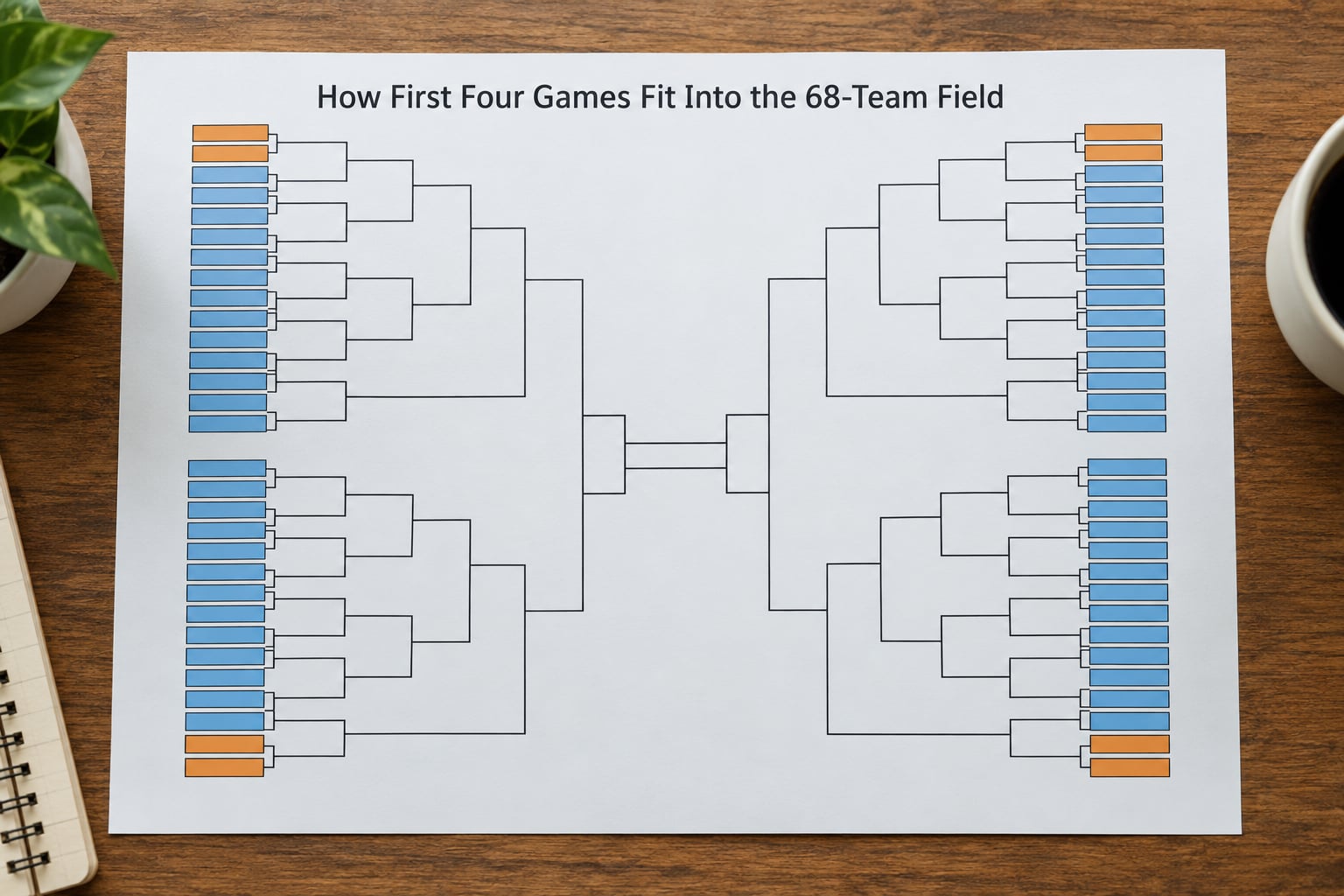
The field gets built in layers. A 12-member committee fills the 68 slots using automatic bids, at-large bids and the results of the play-in games. The play-in teams are not extras; they are part of the 68 from the moment Selection Sunday names them.
| Route into the field | How it happens | Play-in involved |
|---|---|---|
| Automatic bid | Win your conference tournament | No |
| At-large bid | Selected by the committee from the rest of the field | No |
| First Four berth | Won a game the committee watched, but finished outside the cut line | Yes, one game to survive |
| First Four Out | Lost that game | Eliminated from the main draw |
The split between automatic and at-large spots shifts from year to year as conferences change. The women tournament runs its own parallel version of this structure, including its own First Four, added for the 2021-22 season, so both tournaments now hold preliminary games in the same week.
Who Qualifies for the First Four?
Eight teams qualify, four by winning a conference tournament and four by earning at-large selections. In practice the mix is usually two of each, because conferences holding their tournament late in the season often produce teams that bubble out while still holding an automatic bid.
The committee picks all of them. It sorts teams by record, strength of schedule, quality of wins and losses, conference strength and how teams performed against other good opponents, then decides which eight get the play-in slots and which four at-large teams are safe.
That cut line is where the arguments start. Fans of the teams ranked just above it think their group was wrong. Everyone agrees the process is subjective. The rulebook is not.
How Are First Four Teams and Seeds Selected?
Seeding and pairing happen in one step. The committee places the 68 teams on a seed line, the four lowest 16 seeds are separated into two pairs, the four lowest 11 seeds are separated into two pairs, and those four games become the play-in slate.
Double-seeding is why you see two 11 seeds and two 16 seeds instead of a ladder from 9 to 16. The play-in exists to fill the empty seats on the seed line, not to test whether a 9 seed can survive a worse one.
How first four games work in March Madness, step by step
- The conference season ends and conference tournaments hand out automatic bids.
- A selection committee reviews résumés and names the 36 at-large selections, completing a 68-team field.
- The eight teams without a secure position are assigned to the First Four, two at 16 and two at 11.
- Tuesday sessions and Wednesday sessions are played at the same host arena, one game per session.
- Winners are placed into the vacated slots in their regions. Losers become the First Four Out.
- The Round of 64 begins the next day with a full 64-team field.
Because the committee does all of this at once, a play-in winner inherits the exact path its opponent left behind. It does not get a softer draw for winning.
How Do the Four First Round Games Pair Teams?
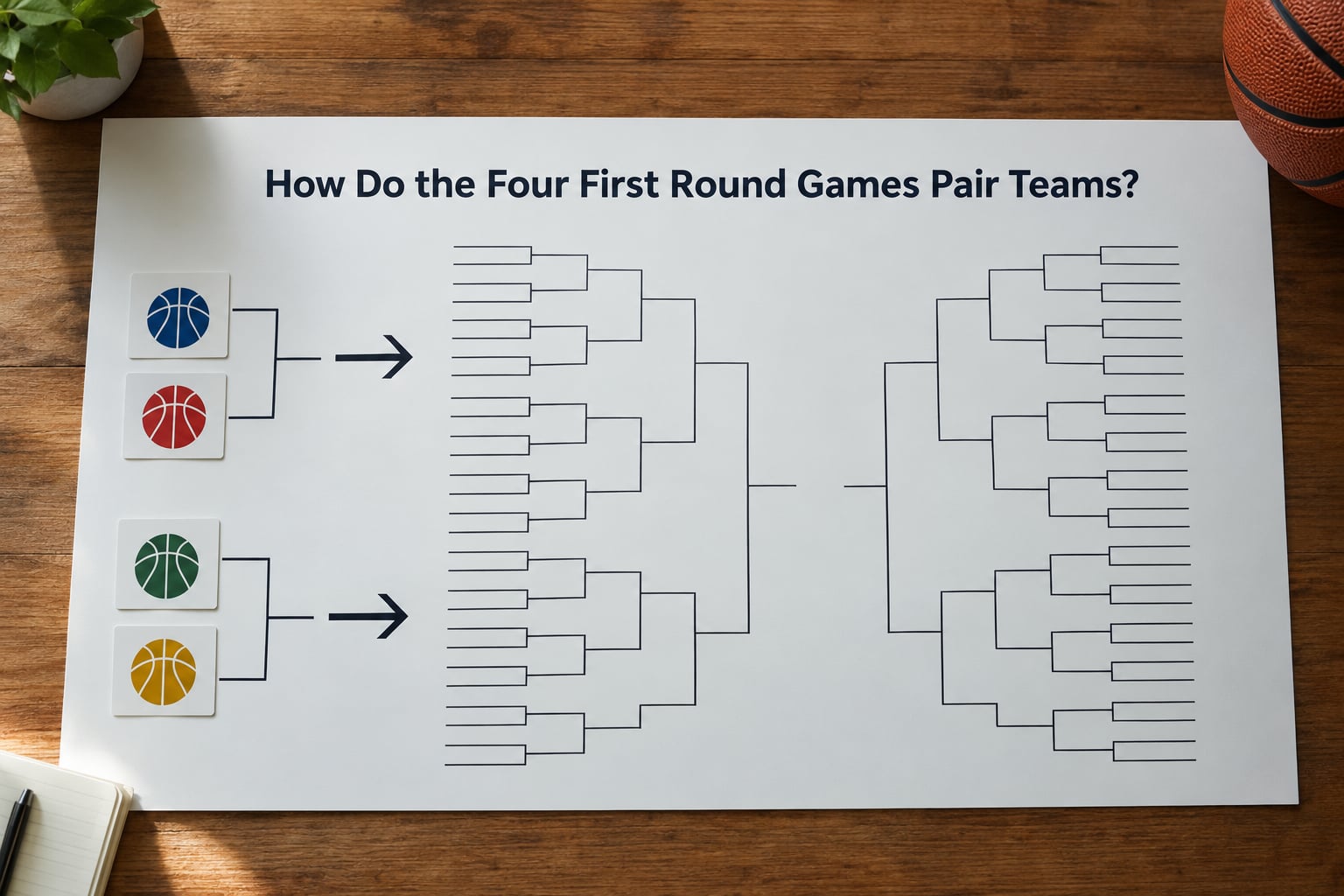
Pairings follow the seed line strictly. The two 16 seeds play each other, and the two 11 seeds play each other. Winners stay in their own region, so a 16 seed that survives does not jump into a different part of the bracket.
The schedule is the same every year in shape, with two sessions on Tuesday and two on Wednesday at the host arena:
| Session | Matchup type | Winner goes to |
|---|---|---|
| Tuesday night | 16 vs. 16 | Region 1, opening slot |
| Tuesday night | 11 vs. 11 | Region 2, opening slot |
| Wednesday night | 16 vs. 16 | Region 3, opening slot |
| Wednesday night | 11 vs. 11 | Region 4, opening slot |
Regions are assigned by the committee, so the exact region number depends on the year. Staging all four games in one building keeps the winners on neutral ground and avoids giving an 11 seed a home crowd advantage before the main draw even starts.
What Happens After a First Four Game?
Winners take the seat vacated by the team they beat. Losers are not erased from the postseason; they are the First Four Out, and they seed the field for the NIT, or the WBIT on the women’s side. The NIT is a second-chance tournament with its own bracket and its own automatic bids.
Here is the catch that almost nobody explains in previews. A winner on Tuesday plays again on Thursday or Friday in another region, sometimes across multiple time zones. A Wednesday winner can play on Friday or Saturday with even less turnaround. Two or three games inside about 72 hours is a real physical tax, and the team you face in the Round of 64 has had a full week to prepare.
Nobody gets to skip that round. A play-in win buys entry, not rest.
Do Winning the First Four Improve a Team’s Seed?
No. The seed stays exactly where the committee put it. Winning on Wednesday does not move a 16 seed up the bracket, and it does not hand you a better opponent. What it changes is the number of games required to win a title.
A team that starts in the Round of 64 needs six wins. A team that comes through the First Four needs seven. That is the entire bracket consequence, and it matters when you are counting up a pool’s total games or wondering why a Cinderella has to keep playing.
History says the ceiling is real but not low. Since the four-game format began in 2011, thirteen teams have won more than one tournament game after surviving the play-in. VCU reached the Final Four as an 11 seed in 2011, and UCLA did it as an 11 seed in 2021. Two Final Four appearances from eight teams a year is not a shortcut, but it is not a death sentence either.
How Does the Rest of the March Madness Bracket Work?
After the First Four, the tournament is a straight single-elimination line. No reseeding, no double elimination, one loss ends the season.
| Round | Teams remaining | Games |
|---|---|---|
| First Four | 68 | 4 |
| Round of 64 | 64 | 32 |
| Round of 32 | 32 | 16 |
| Sweet 16 | 16 | 8 |
| Elite Eight | 8 | 4 |
| Final Four | 4 | 2 |
| Championship | 2 | 1 |
Each region feeds one team into the Final Four, and the four survivors play semifinals in a second host city before two of them meet for the title.
Why Does the NCAA Call Eight Teams the First Four?
The name is inherited, not descriptive. The men’s tournament first used a single play-in game in 2000-01 to give the last four spots on the seed line to teams that had earned them. That was four teams and two games, and fans called it the play-in round.
When the format expanded to four games, the committee kept the original label even though eight teams now play. The women’s tournament used the same name when it added preliminary games later. So “First Four” means the round, not the team count, and the people on the court are eight.
What Should Fans Watch During the First Four?
Start with how each team got there. A team that had to play three days of conference tournament basketball before Selection Sunday arrives with less rest than one that sat out the last weekend of league play, and it shows up in the box score and the first turnover margin.
Then watch the possession-level details that decide elimination games. Live-ball turnovers decide more of these than any other single number, because a bad pass ends the night. Shooting efficiency from the midrange separates a 16 seed that can actually function from one that survives on deflections and free throws. Rebounding on the offensive glass matters less in theory than it does in practice at this pace.
Finally, notice which side adjusts. The higher-seeded 11 usually has the better offense, and the 16 usually has nothing to lose. When a favorite is still adjusting in the second half, that is the whole game.
Do not treat the results as a formality, though. A team that wins has to do it all again roughly 48 hours later against a rested opponent.
Frequently Asked Questions
Are First Four games the same as play-in games?
Yes. Play-in game and First Four are two names for the same four single-elimination games that trim the field from 68 to 64. The play-in name came first, back when only two games were played. The NCAA expanded the round to four games and kept the old label, which is why eight teams play under a name that says four.
What happens if a team loses a First Four game?
The team is eliminated from the main 64-team draw and becomes part of what is called the First Four Out. Those four teams are not done with their season. They seed the field for the NIT, or the WBIT on the women’s side, and get a second-chance bracket with its own automatic bids.
Does a First Four win move a team into the Round of 64?
It puts the team into the tournament, not into a free pass. A winner inherits the bracket slot vacated by the team it beat and plays an opening game in the Round of 64, usually two or three days later. That means seven wins are needed to win a title instead of the six a team that started in the Round of 64 requires.
Can a play-in team be seeded higher after it wins?
No. Seeds are set by the selection committee before any play-in game is played, and winning does not change them. The one adjustment a team receives is the bye it takes over the team it defeated. After that, the bracket is fixed and results on the court do not reseed anything.
How many teams play in the First Four round?
Eight teams play four games, two sessions on Tuesday and two on Wednesday, all at the same host arena. Two games are 16 seeds against 16 seeds and two are 11 seeds against 11 seeds. Four teams advance into the main field and four are sent to the First Four Out.
Conclusion
Eight teams, four games, one arena, two days. Four winners take the four open spots in a 64-team bracket that was already seeded before anyone tipped off, and four losers head to the NIT with a shorter season and no seed to improve.
Before tournament time, check the official selection release for the eight play-in teams and their seeds, the published schedule for session times and broadcast details, and the updated bracket once the Wednesday games settle. Those three checks tell you everything about how the First Four games work for the year you are watching.