Coaches decide to go for it on fourth down by comparing expected outcomes, not by picking a feel. They weigh yards to go, field position, the score, time remaining, their kicker and punter, and their own conversion numbers, then choose whichever option has the better chance of winning the game. A good call can still fail. That part confuses a lot of fans watching from the couch.
The framework has shifted a lot since the early 2010s. Fourth down used to be an automatic punt for most teams, and an aggressive attempt was treated as a referendum on a coach’s guts. Analytics teams have made it a numbers question instead, and the two most visible artifacts of that shift — the field goal range creeping past 60 yards and the punt shrinking to a formality at the top of the field — have pushed the go-for-it window noticeably toward the end zone.
Table of Contents
- What Does Going for It on Fourth Down Mean?
- How Coaches Weigh Win Probability and Expected Points
- How Game Situation Changes the Decision
- Why Fourth-Down Choices Look Different in the Red Zone
- The Coach’s Decision-Making Checklist
- How Coaches Decide to Go for It on Fourth Down in Real Examples
- What Is the Best Fourth-Down Strategy?
- Frequently Asked Questions
- What is the right fourth-down conversion rate?
- When should a coach go for it instead of punting?
- Why do teams go for fourth-and-1 so often?
- Is punting always safer than going for a first down?
- How much does a first down affect the value of fourth down?
- Does a coach’s fourth-down decision depend on the opponent?
- Bottom Line
What Does Going for It on Fourth Down Mean?
Going for it on fourth down means the coach runs an offensive play instead of handing the ball to the punter or the kicker. The team keeps possession only if it converts, otherwise the ball turns over at the spot.
Every fourth-down call is really a choice among four options, and coaches treat it as one:
- Run a play. Convert and keep the ball, or fail and give the opponent a new possession at that spot.
- Punt. Trade possession for field position, hoping the coverage unit pins the other offense near its own goal line.
- Kick a field goal. Take the points when the kicker is inside range and points matter.
- Spike the ball or take a kneel. Burn the clock and punt or kick later, usually at the end of a game.
None of those is the aggressive choice by default. A punt inside the ten is conservative; a chip shot from the opponent 30 is arithmetic. The label of aggression attaches to the outcome in hindsight more often than to the reasoning in real time.
How Coaches Weigh Win Probability and Expected Points
The core of the decision is a single comparison: the win probability of converting versus the win probability of punting or kicking. Expected points is the practical version of that math. It estimates how many points an average offense scores from a given field position over the rest of the game.
What expected points tells a coach
Field position is worth less than most fans assume, which is exactly why the go-for-it math comes out aggressive. Research on drive outcomes puts the value of starting a drive at roughly 1.7 points from your own 30, 2.4 points near midfield, and 2.8 points from the opponent 35.
Those three numbers explain most aggressive calls on their own. Moving the line of scrimmage ten yards upfield is often worth a fraction of a point, and a failed fourth-and-1 gives the opponent a chance to score but does not hand them the game.
What conversion probability adds
Expected points assumes you have the ball. Conversion probability is the correction applied to the other option: the odds this offense turns a fourth-and-1 into a first down at this yard line, against this defense, in this situation.
Those two numbers combine into a break-even conversion rate. If going for it is worth about 0.2 expected points and punting is worth about 0.1, the offense only needs to convert roughly a third of the time to make going the better choice. That is why the standard coaching heuristic treats fourth-and-1 and fourth-and-2 as automatic attempts on almost any field position outside the shadow of the goalposts, and why fourth-and-5 has a much higher bar.
| Situation | Typical lean | What drives it |
|---|---|---|
| Fourth-and-1 or 2, own half | Go for it | Short distance, high conversion odds, punt expected value close to zero |
| Fourth-and-3 to 4, midfield | Go for it more often than before | Marginal field position gain, analytics threshold in the 55 to 65 percent conversion range |
| Fourth-and-5 or more, top of field | Punt | Longer distance plus long-range field goal ability on the other side |
| Inside the opponent 20, under field goal range | Go for it, especially on short yardage | A first down near the goal line is worth several expected points |
| Opponent 35 to 45 with a strong kicker | Genuinely close call | Teams often try to convert in the roughly 42 to 43 yard range, where field goal range ends and punting starts to look expensive |
| Tied or behind, final four minutes, no timeouts | Go for it | Field position is worth less when there is not enough clock to use it |
How Game Situation Changes the Decision
The base numbers barely move once a game is decided, and the situational variables do most of the work. Score is the first filter. A team protecting a lead punts deep and short; a team down two scores in the fourth quarter is almost certainly converting.
Time remaining changes how much a first down is worth. A first down with ninety seconds remaining is nearly worthless, because there is not enough time to turn field position into points. The same first down with six minutes left is one of the most valuable things on the field, and analytics built around a desperation metric formally discount possession as the clock runs out.
Personnel and specialists matter just as much. A punter who pins opponents inside the five makes punt the safer option, and a kicker who misses from 55 changes the boundary where coaches start going for it. Backup quarterbacks shift the whole calculation, because the offense’s real conversion rate drops when the first-team signal-caller is out.
The opponent’s next possession closes the loop. Punting to a team that starts drives at its own 25 is one thing; punting to a quarterback who can drive the ball down the field in four plays is a different option entirely.
Why Fourth-Down Choices Look Different in the Red Zone
Near the goal line, a first down is worth far more than the same first down at midfield, so the break-even conversion rate collapses. Inside the twenty, coaches are often converting on fourth-and-4 because the expected gain from staying on the ground outweighs the cost of a failed attempt deep in enemy territory.
The famous fourth-and-1 from the Alabama 8-yard line illustrates how that math gets debated. Down three in the third quarter, Georgia ran a play inside the red zone and failed, and the argument split into two camps that rarely talk to each other. One said the analytics were wrong. The other said the decision was defensible and a freshman made a blocking mistake.
That distinction matters more than any single number. A failed fourth down is not proof of a bad call, and a converted fourth down is not proof of a good one. Kirk Herbstreit defended the process behind that Georgia decision while acknowledging how it ended, which is the most honest position available to anyone analyzing a play that already happened.
The Coach’s Decision-Making Checklist
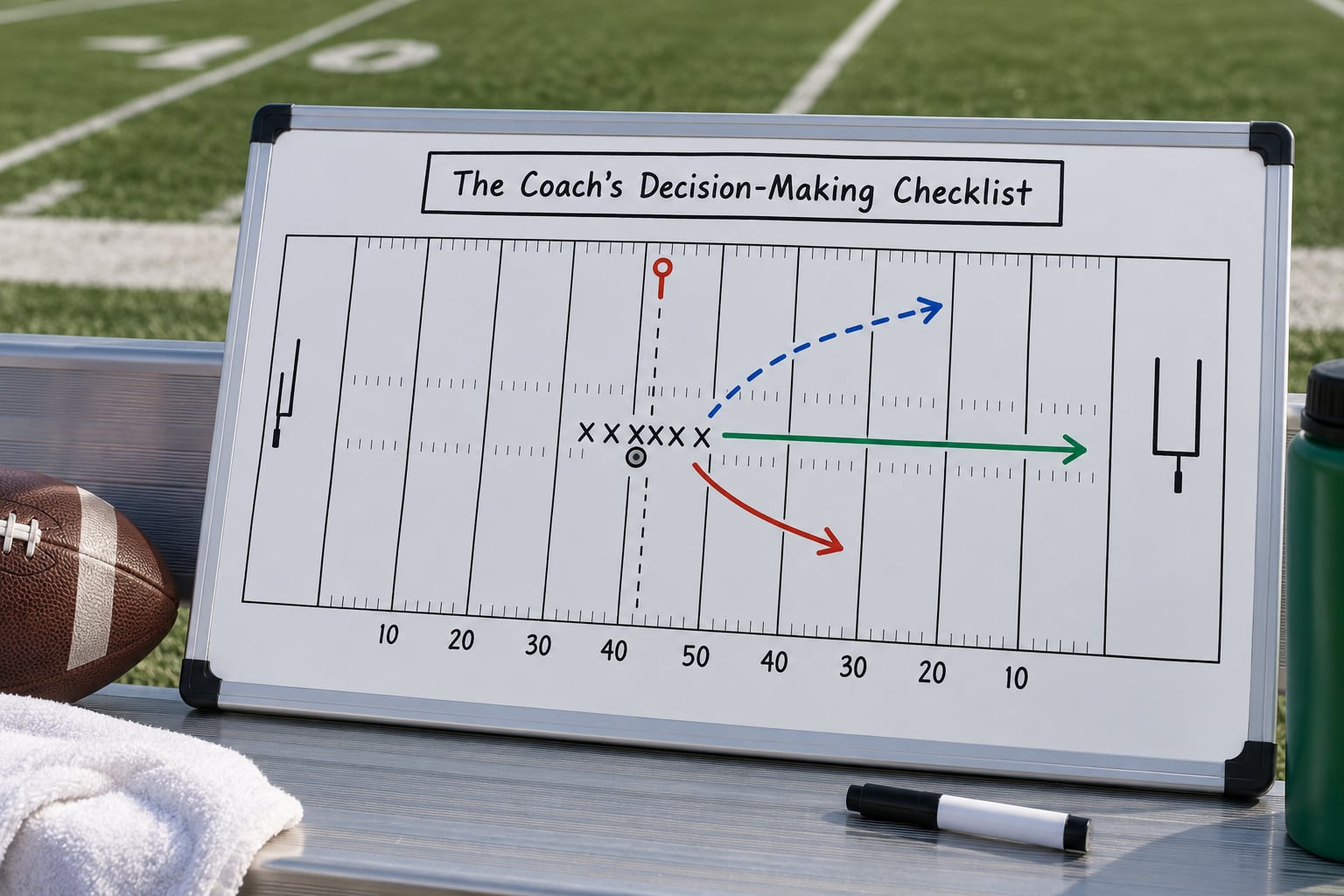
The call is made in a few seconds, but the preparation behind it is not improvised. Here is the sequence most coaching staffs run before the ball is snapped.
How coaches decide to go for it on fourth down, step by step
- Start from the analytics baseline. What does the fourth-down decision chart say at this yard line, down and distance, for an offense of this quality?
- Adjust for the game. Score, time remaining, quarter, and what happens on the other team’s next possession.
- Factor in the specialists. Kicker range, punter net average, and how well the punter has been protecting field position this season.
- Check personnel. Do they have the backfield, the offensive line, and a healthy kicker to make it a real attempt rather than a token run?
- Look at the opponent. Tendencies against this formation, whether the defense gives up the short-yardage look, and what the coordinator expects.
- Call the play. The decision and the design are two separate decisions, and the special teams coordinator gets a voice before the call goes in.
Steps one through three are arithmetic. Steps four through six are football, which is why two coaches can look at the same chart and land in different places.
How Coaches Decide to Go for It on Fourth Down in Real Examples
Three situations show how the same framework produces three very different calls.
The desperation attempt
Third down, fourth down, down 14 with ninety seconds remaining and the offense already in field goal range. There is no value in field position here because there is no time to use it. The offense is not choosing between punting and going; it is choosing between converting and losing, so the bar to attempt drops to nearly zero.
Fourth-and-1 in scoring territory
Same down and distance, different field position. At the opponent 20 with a kicker in range, going for it produces a first down worth several expected points against a turnover that starts the opponent deep. Short yardage is close to automatic in this zone, and the comparison usually favors the attempt even when the analytics chart is close.
The punt that hands over excellent field position
Here the punt looks reasonable on paper and is not. A punt from the opponent 40 that lands at the 10 gives the other team short field position and a real scoring chance, while going for it risks nothing beyond a turnover in the same area. When the numbers for a given matchup swing by several points, punt location ends up tracked as closely as conversion rate, because where the ball stops is half of what you punted for.
What Is the Best Fourth-Down Strategy?
There is no single best strategy, and the teams that look most aggressive are not the ones ignoring the math. They are the ones who have accepted that punting on fourth-and-short is a losing bet and treat the chart as the starting point rather than the answer.
The complication everyone underrates is regression to the mean. A team that converts 70 percent of its fourth-and-2 attempts has probably been lucky, and the model knows it. Charts built on small samples will overrate hot offenses, which is why most staffs shrink the estimate toward league averages before they make the call.
Coaches also face a pressure that never shows up in a model. A failed fourth-down attempt is a headline; a failed punt is a shrug. The job cost of a bad non-traditional decision is far higher for the coach than the on-field cost, which keeps some conservative defaults in place even when the numbers argue the other way. Kevin Kelley built his entire reputation on refusing that logic at Presbyterian, and Detroit’s Dan Campbell has become the NFL version of the same idea.
College football adds its own wrinkle. Kickers in the Big 12 and across the sport have gotten good enough that the field position value of a deep punt keeps shrinking, and the gap between programs with a reliable long-range kicker and programs without one is now one of the biggest inputs into their own decision charts. The Arizona Wildcats have lived in that split, with kicking results swinging from one year to the next and changing how often the safe punt really was.
Frequently Asked Questions
What is the right fourth-down conversion rate?
There is no single number, because the break-even rate moves with field position and distance. On fourth-and-1 it is often below 40 percent. On fourth-and-4 near midfield it sits roughly in the 55 to 65 percent range. Near the opponent goal line it drops again because a first down there is worth several expected points.
When should a coach go for it instead of punting?
Go for it when the break-even conversion rate is lower than your realistic odds. That usually means fourth-and-1 or fourth-and-2 outside your own red zone, fourth down in opponent territory when a first down is worth more than the turnover costs, and almost anything when the game situation makes field position worthless, such as down late with no clock left.
Why do teams go for fourth-and-1 so often?
Because the math almost always supports it. Converting a fourth-and-1 is one of the highest-percentage plays available, and the punting alternative returns very little expected value except from deep in your own territory. Teams that punt on fourth-and-1 are usually protecting field position in a zone where field position is not actually worth much.
Is punting always safer than going for a first down?
No. Punting guarantees the other team the ball but can give them excellent field position, and it gives up points in the red zone. A failed conversion sounds worse than a punt, but punting can be the worse expected outcome. The right comparison is win probability in both cases, not which choice looks more comfortable.
How much does a first down affect the value of fourth down?
Field position is worth about 1.7 expected points from your own 30, 2.4 near midfield, and 2.8 from the opponent 35. A first down close to the goal line is worth more than one at midfield, so the same conversion rate can be worth attempting on the 20 and not on the opponent 30.
Does a coach’s fourth-down decision depend on the opponent?
Yes, in two ways. The defense’s tendencies shape what the call looks like, since some defenses concede the short-yardage look almost every time. And the offense waiting after the punt changes the value of that punt, since punting to a team that drives the ball easily can be worse than the turnover you risked.
Bottom Line
To judge a fourth-down call, start with four things in this order: the score, the time remaining, the field position, and the realistic conversion odds for that specific offense. Then remember that a good decision and a good result are two separate things, which is the part most arguments on message boards skip over.