An onside kick is a deliberately short kickoff in which the kicking team tries to regain possession. The ball has to travel at least 10 yards downfield before anyone on the kicking team can touch it, and after a recovery the kicking team may not advance the ball. That single sentence covers most of the rulebook.
It is a strange play by modern football standards. A team gives up possession on purpose, then tries to take it back in the most awkward spot on the field, with everyone around it knowing exactly what is about to happen. Used to work far more often than it does now.
Table of Contents
- What Is an Onside Kick?
- How Onside Kicks Work from Setup to Recovery
- The Legal Setup for an Onside Kick
- The Essential Onside Kick Rules
- What Must Happen for the Kicking Team to Recover?
- Why Teams Use Onside Kicks
- Common Onside Kick Formations and Concepts
- How Onside Kick Strategy Differs by Situation
- How Do Onside Kicks Work in a Real Game Situation?
- Key Onside Kick Terms at a Glance
- Frequently Asked Questions
- What happens if the kicking team touches the ball before the 10-yard line?
- Can the kicking team recover after the first player down fails to secure the ball?
- Does an onside kick have to travel a minimum distance?
- What happens when an onside kick goes out of bounds?
- Can a team use an onside kick during overtime?
- Conclusion
What Is an Onside Kick?
An onside kick is a kickoff where the kicking team intends to recover the ball after it has traveled at least 10 yards. It is the only legal way for a team that just kicked off to hand the ball to itself.
The word is a leftover. Onside comes from rugby, where a player must stay behind the ball to keep it in play. In American football the restriction has nothing to do with staying behind the ball, so the term is a misnomer that dates back to when rugby was the parent game.
How an onside kick is different from the other kicks
- Kickoff: The ball travels into the deep end zone or back to the 25. The kicking team has no realistic path to a recovery.
- Onside kick: A kickoff aimed short. The kicking team races downfield to recover it after it has gone 10 yards.
- Punt: A scrimmage kick, not a free kick. No kickoff formation, no restraining line, and a punt returner is under no obligation to touch it.
- Placekick or extra point: Kicked from a tee or the ground after a stoppage, with the kicking team already holding the ball.
The distinction that trips people up most often: a punt can be fielded at any time, but an onside kick has a hard boundary. Ten yards, then the ball belongs to whoever gets there first.
How Onside Kicks Work from Setup to Recovery
How onside kicks work comes down to spacing and speed. The kicking team sets up near its own 35-yard line, taps a short kick that bounces into the receiving team’s end of the field, and sprints five players forward. If the ball crosses the 10-yard line, touches the ground, and a kicker teammate reaches it before an opponent does, the kicking team gets the ball at that spot. It cannot move it forward.
How Onside Kicks Work Step by Step
- Spot the ball. The kickoff is spotted on the kicking team’s 35-yard line in college football, on its own 40 in the NFL, and on the 40 in high school under current national rules.
- Take the kickoff formation. A handful of players line up behind the ball on their own side of the 35, spaced across the field rather than bunched. Nobody from the kicking team may line up more than a yard downfield, and the rules require players on both sides of the kicker so nobody can send the whole unit straight down the middle.
- Kick short. The kicker aims for a spot well short of the first returner, either dribbling it or hitting it with a pooch that bounces high enough to hang and then skid. The intent is a slow, awkward ball with nobody certain where it ends up.
- Get to the restraining line legally. Kicking-team players may run downfield as soon as the kick is made, but they cannot initiate contact with a receiving-team player before the ball has traveled 10 yards. Until that happens, receivers are protected, which is why a hard kick at a returner is a penalty.
- Wait for the bounce, then attack. Once the ball passes 10 yards and hits the ground, the ball becomes live and blocking is allowed on either side. The recovery players charge.
- Secure possession. The first kicking-team player to gain possession, or to fall on the ball after it becomes dead, owns it. If a receiver touches it at any point, the ball goes live immediately and the kicker can be dropped.
- Run the next snap from there. The kicking team gets a first down at the spot of the recovery. The play starts at the same ball position with the same down count, so a recovery deep in opponent territory is exactly as valuable as it looks.
The Legal Setup for an Onside Kick
Everything legal about an onside kick is decided by placement before the ball is kicked. Officials use formation, not intent, to judge whether the kick was a fair try.
The receiving team lines up inside its setup zone. In the NFL, returners may be positioned in a setup area between their own 15 and 5 yard lines, and they cannot move outside it once the ball is kicked. That rule exists specifically because an onside kick recovery is a collision, and the league wanted the receiving team’s players to be somewhere predictable.
Why the bunch and wedge formations are gone
Older onside kick alignments had six or seven players packed into a moving wall, sometimes in a wedge that would drive downfield and sweep laterally. Those schemes produced illegal blocks before the ball had traveled 10 yards, and collisions with players who were still legally protected.
The NCAA and NFL both cracked down. The five-player bunch is now the practical limit, with rules requiring players on both sides of the kicker so nobody can send everyone straight down the middle. A tightly packed cluster that pushes downfield as a unit is a formation penalty, blown dead before the kick.
Where the ball has to be spotted
Any onside kick spotted from the wrong place is dead on arrival. That has been the source of several arguments in recent seasons, including one where officials reviewed a fourth-quarter kick and reversed the call after the kickoff was ruled from an incorrect spot. If you see a replay and a flag before the snap, that is usually what is being checked.
The Essential Onside Kick Rules
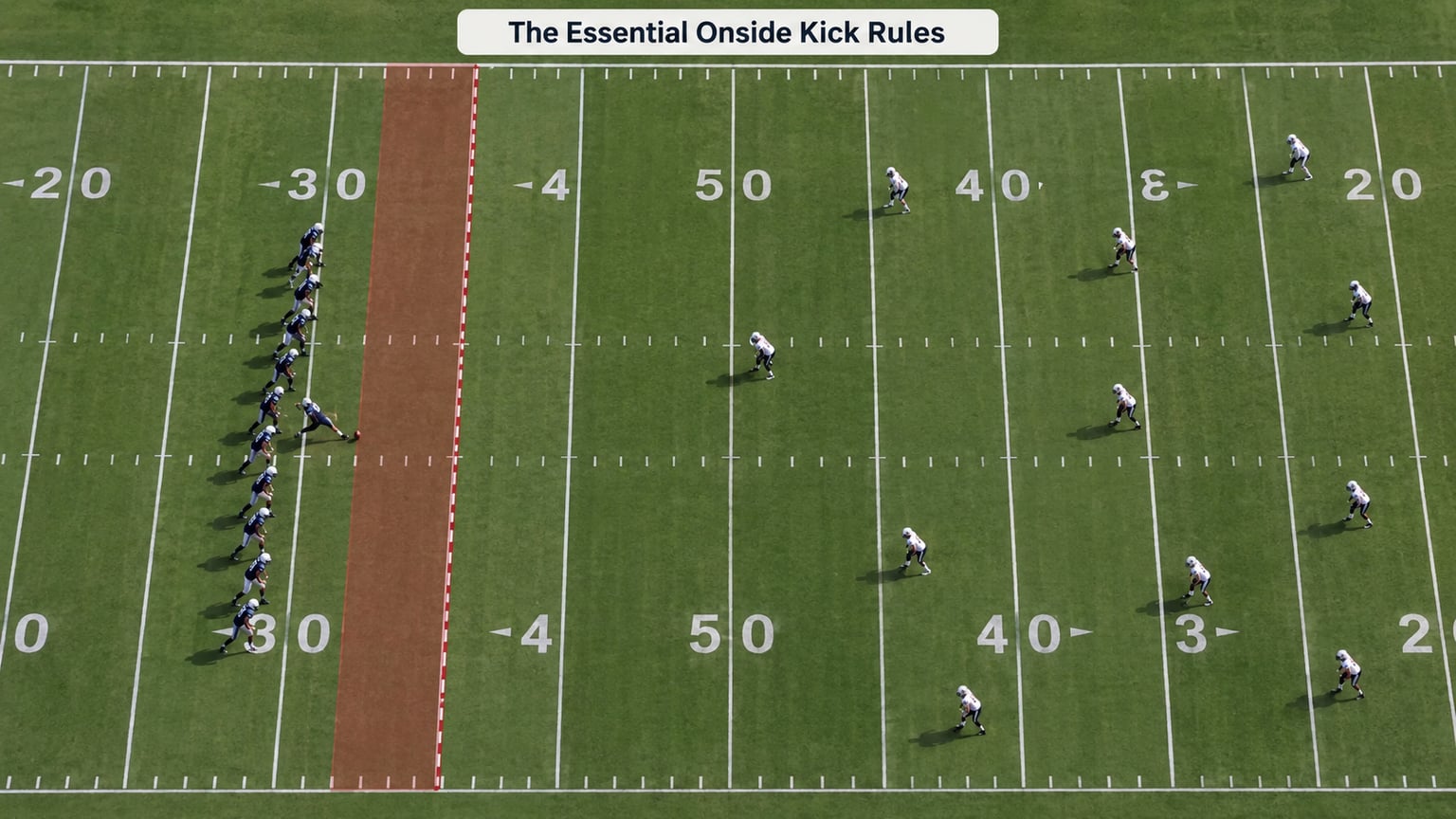
Here is the short version that answers most questions about legality. These are the core onside kick rules, and they read the same way in the NCAA rulebook under 6-4, the NFL rulebook under 8-51, and the national high school rules under 8-5.
- The ball must travel at least 10 yards downfield before any player on the kicking team may touch it.
- The ball must touch the ground before the kicking team can recover it, which is what makes it a kick rather than a pass.
- The kicking team may not initiate contact with a receiving-team player before the ball has traveled 10 yards.
- The kicking team may not interfere with a receiving-team player who has an opportunity to catch the kick.
- Once any receiving-team player touches the ball, it becomes live immediately, exactly like a kickoff return.
- The kicking team may recover the ball but may not advance it, and the next play starts from the spot of the recovery.
- Players on the kicking team cannot line up more than a yard downfield, and the required minimum must be on each side of the kicker.
- A hard kick off the tee that produces a single bounce, the so-called pop-up kick, is illegal and carries a five-yard penalty.
The distinction that confuses almost everybody
Fair catch and opportunity to catch a kick are separate rules, and college fans constantly merge them. A fair catch requires a player to signal and secure the ball on or in bounds. College rules allow that signal on any kickoff or punt rather than only in the closing minutes, but the option disappears the moment the ball touches the ground. Opportunity to catch a kick is the narrower protection that applies to a returner during a kickoff or an onside kick, and it ends as soon as the ball hits the ground or the returner begins a return.
After that point the kicker is a normal tackler. Plenty of onside kick failures come down to a returner waiting one beat too long for a fair-catch option that had already expired.
What Must Happen for the Kicking Team to Recover?
Touching the ball is not enough. The kicking team has to come away with possession, which means a player has to control the ball or fall on it after the ball is dead, and no receiving-team player may have touched it first.
There are two ways to lose a kick that looked like a recovery. The obvious one is a receiver getting a hand on it, which makes the ball live and hands it to the returner. The other is a kicking-team player who dives on the ball in the air, before it has touched the ground, and slides it away from his body. A player falling on a ball that is not grounded loses possession, and the opponent recovers.
Once possession is secured, the offense starts over
A successful recovery produces a first down for the kicking team at the spot where the ball was secured. No advancement is allowed on the play itself, so a recovery at the opponent’s 30 gives a team facing third-and-20, not a first-and-10.
That limitation is why ball placement matters so much. A well-executed onside kick that is recovered at midfield is a genuine swing in field position. The same kick recovered 20 yards into opponent territory is a gift, and the same kick recovered on your own 45 simply gives you the ball back where you started.
Why Teams Use Onside Kicks
The reason is arithmetic. Down late, trailing by a touchdown or less, a team that punts or kicks off hands its opponent the ball with a very short field to score on. An onside kick is a bet that the opponent will mishandle a short kick in a situation where almost everyone is sprinting one direction.
- Clock management: A failed onside kick usually gives the opponent the ball out of bounds, which is one timeout saved on the drive that ends the game.
- Field position: Recovering near the opponent’s 30 or 40 creates a real scoring chance rather than a field goal attempt from midfield.
- Surprise: Even in the era of declarations, a team that kicks deep and then kicks short catches an opponent that has spent the last four seconds blocking deep.
- Down and distance: Even a recovery deep in your own territory can salvage a drive if the next snap creates a manageable third down.
The cost is severe. Miss the kick and you hand the opponent excellent field position, plus a down. That is why the play has drifted toward being a desperation call rather than a routine one.
Common Onside Kick Formations and Concepts
Modern concepts start with five players lined up behind the ball, usually split with two on each side of the kicker and one behind or offset. From there the variations change the running lanes, not the rules.
- Pooch kick: A struck kick with enough backspin to hang, then skid and bounce low. The bounce is unpredictable in speed and direction, which is the whole point.
- Dribble kick: The kicker simply lets the ball take two bounces and aims down the seam. Two bounces are legal; one bounce off a hard strike is the illegal pop-up.
- Spin wheel: One player holds an arc and curves behind it, hunting for a diving catch near the sideline where blocking angles thin out.
- Veer: Players run slightly outside, aiming to beat the returner to the ball rather than running directly at him.
- Hands-up kick: A soft kick that goes straight up so nobody can block on the way down. The trade is a ball that sits in the air long enough for the returner to catch it cleanly.
None of these is a formula. Kickers with the cleanest dribble in the league still fail most of their attempts, because the returner is moving toward the ball at the same time and he usually gets there first.
How Onside Kick Strategy Differs by Situation
Whether an attempt makes sense depends entirely on the situation, and the same call can be sensible in one game and absurd in another.
| Situation | What the team is solving for | What usually happens |
|---|---|---|
| Trailing late, under a minute | Getting the ball back without giving up field position | Expected failure, but a miss often results in a punt rather than a touchdown drive |
| Trailing early in the fourth quarter | Nothing useful | Almost never called. Field position is better served by punting and forcing a three-and-out |
| Protecting a lead | Keeping the opponent from a short field | Rarely worth it, because a failed attempt is worse than the kickoff |
| After scoring a touchdown | Flipping field position against a tired return unit | The most common non-desperation use, though it also often just ends the game |
| Start of the second half | Catching an opponent that has switched its return personnel | Occasionally works, and surprise is doing nearly all the work |
How often do onside kicks work?
The honest answer is rarely, and the historical record shows exactly how much surprise used to matter. Across 2001 and 2010, roughly 60 percent of surprise attempts were successful, against fewer than 20 percent when the opponent knew one was coming. Once every attempt was declared and telegraphed, that gap collapsed.
Later seasons showed the same story in smaller numbers. Four recoveries out of 52 attempts in 2018, then two out of 32 in 2019. Tennessee tried four surprise attempts in 2018 and none in 2019, which is a fair summary of how fast the play lost its appeal.
How Do Onside Kicks Work in a Real Game Situation?
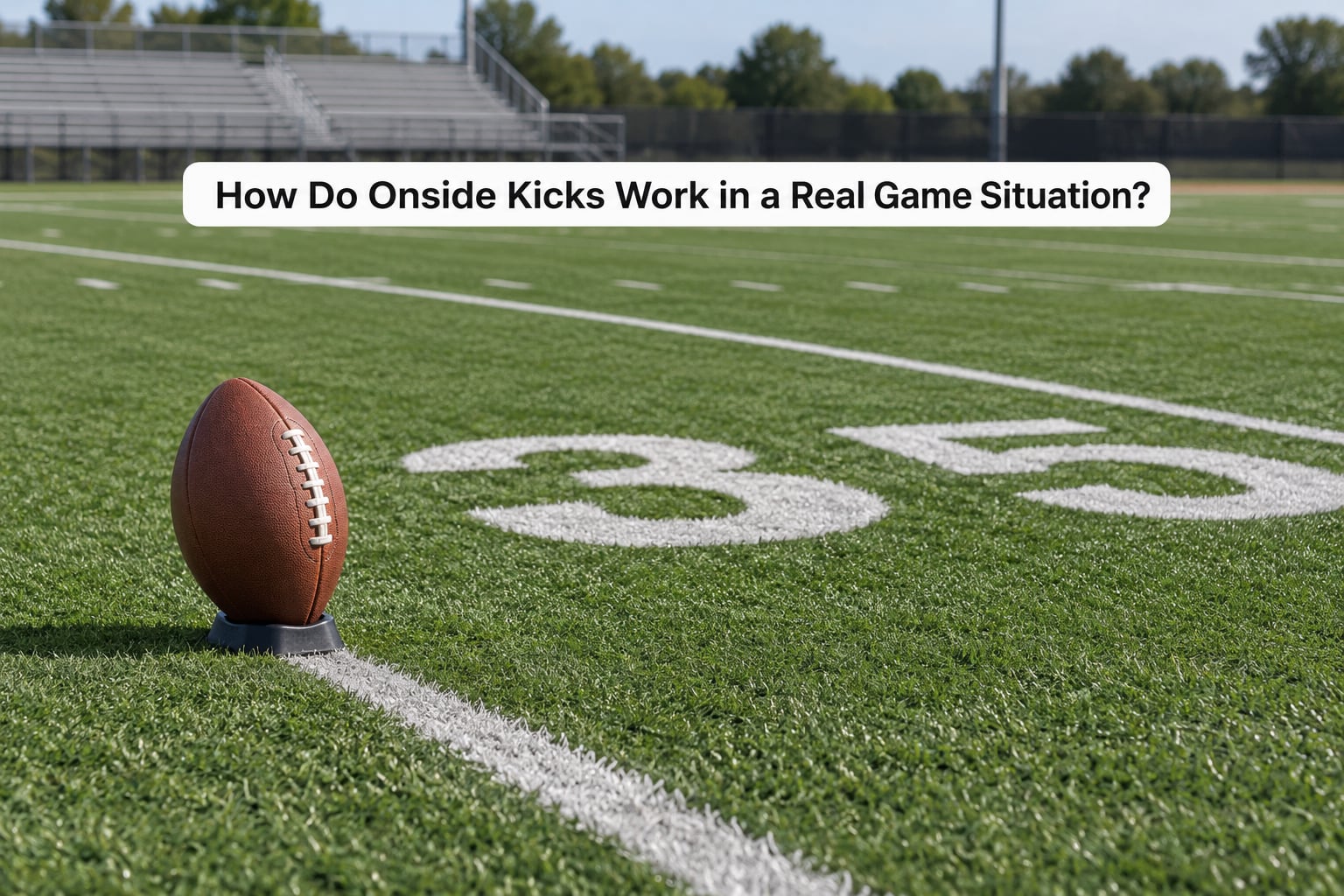
Here is a hypothetical but realistic sequence. The home team trails 24 to 21 with 1:12 left in the fourth quarter. They have just scored, so they must kick onside or concede a possession with almost no time to spare.
The kicker taps the ball so it settles near the opponent’s 32. The receiving team has eight returners spread inside the setup zone, which is standard for a normal kickoff, because nobody told them a short kick was possible.
Four outcomes are realistic from there.
- The kick bounces twice and a diving coverage player reaches it at the 30. The ball is live, the recovery is clean, and the home team has first-and-10 at the 30 with about a minute to play.
- A returner fields it, but his momentum carries him toward his own end zone. He goes down at the 20, the kicking team falls on him, and the kick stands.
- A returner catches it cleanly. The ball goes live instantly, the coverage team is caught behind the play, and the returner has open grass. That is roughly what happens most of the time.
- The kick is ruled dead before the snap for a formation or spot violation. Nothing else on the play matters, and the officials’ conference takes a few minutes.
Notice what each outcome actually changes. Two of them give the home team a short field. One gives the opponent a short field. One gives the opponent first down at the 20 with no time left to answer.
The last case is the one coaches argue about after the game, because the call consumed clock that the team may have needed. Whether it was a good decision depends on the expected value of the attempt in that spot, not on how the play looked on television.
Key Onside Kick Terms at a Glance
| Term | What it means |
|---|---|
| Kicking team | The team that kicked off. It may recover the ball but may never advance it. |
| Receiving team | The team being kicked to. Its first touch makes the ball live, exactly like any kickoff return. |
| Restraining line | The kicking team’s own 10-yard line. Nobody on the kicking team may touch the ball before it gets there. |
| Spot of the kickoff | Where the ball is placed on a tee. An onside kick spotted from the wrong place is dead before the snap. |
| Free kick | Kickoff, punt, or placekick, any kick that is not part of a scrimmage play. |
| Live ball | The state after the ball has touched the ground or been touched by a receiver. Blocking is legal from that moment. |
| First man down | The first player to secure the ball. Kicking team takes possession, but from that spot with no advance. |
| Recovery | Regaining possession of a loose ball. For an onside kick, possession without advancement. |
| Pop-up kick | An illegal kick struck hard enough to produce a single bounce. Five-yard penalty. |
Frequently Asked Questions
What happens if the kicking team touches the ball before the 10-yard line?
The kicking team is penalized and possession goes to the receiving team. Any player on the kicking team who touches the ball before it has traveled 10 yards ends the chance immediately, and contact with a receiving-team player before that point is a separate blocking violation. Under NCAA 6-4 and NFL 8-51, the receiving team takes over with the ball placed where the premature touch occurred.
Can the kicking team recover after the first player down fails to secure the ball?
Yes, if no receiving-team player has touched it first. Once the ball is live, either team can recover a loose ball. If a kicking-team player dives on the ball in the air and slides it away from his body before it is grounded, he loses possession and the opponent picks it up. If a receiver has already touched the ball, the kicking team’s chance ended the moment it became live.
Does an onside kick have to travel a minimum distance?
It has to travel at least 10 yards from the spot of the kickoff, and the ball also has to touch the ground before the kicking team can recover it. Those two conditions are what separate an onside kick from a throw or a kicker run upfield. Officials measure both from the spot of the kickoff, so a badly spotted ball makes the ten yards harder to reach legally.
What happens when an onside kick goes out of bounds?
The ball is dead and the kicking team’s chance is over. The receiving team is awarded the ball, generally at the spot of the kickoff, since the kick failed to reach the end zone and was not a touchback. Officials will also check whether the kick was spotted correctly, because an incorrectly spotted onside kick is dead before it is even kicked and changes who inherits the ball.
Can a team use an onside kick during overtime?
An onside kick is still a kickoff, so the ten-yard rule, the formation limits, and the no-advancement rule all apply the same way in an overtime period that begins with a kickoff. What changes is the clock: there is no running clock to manage in most overtime formats, which removes the main strategic reason to attempt one. Leagues handle overtime kickoff specifics differently, so check the rulebook for your level before assuming an attempt is allowed.
Conclusion
Understanding how onside kicks work comes down to three ideas: the kicking team cannot touch the ball until it has traveled 10 yards, the ball goes live the instant a receiver touches it, and a recovery gives the kicking team a first down at that spot with no advancement allowed.
Watch the formation first, then the spot. If the kick goes 50 yards and nobody moved early, the problem was the kick. If a flag comes before the snap, the problem was alignment. And if you want to see how rare a successful attempt is, count the onside kicks a team tries in a season rather than the ones it recovers.