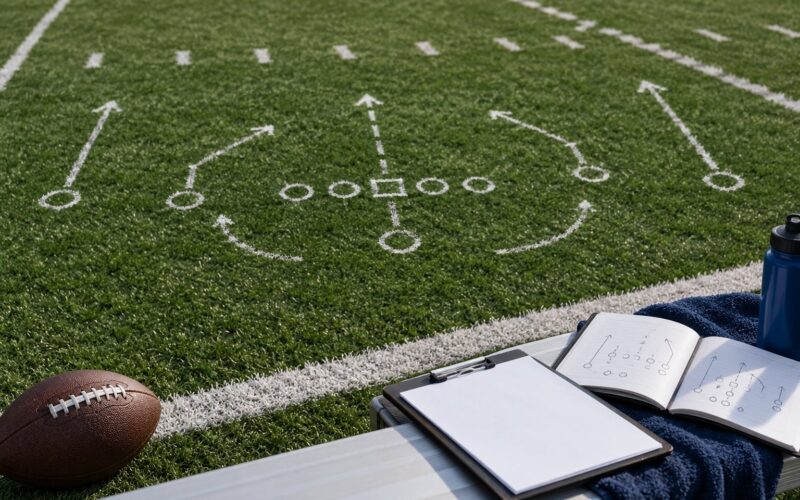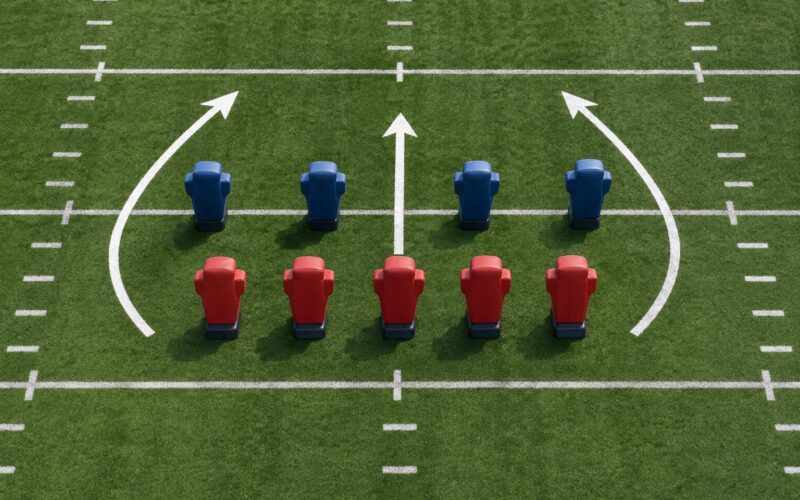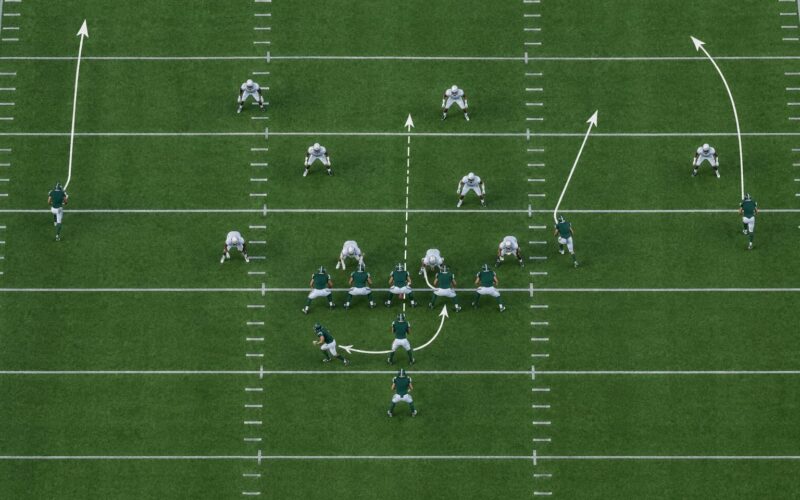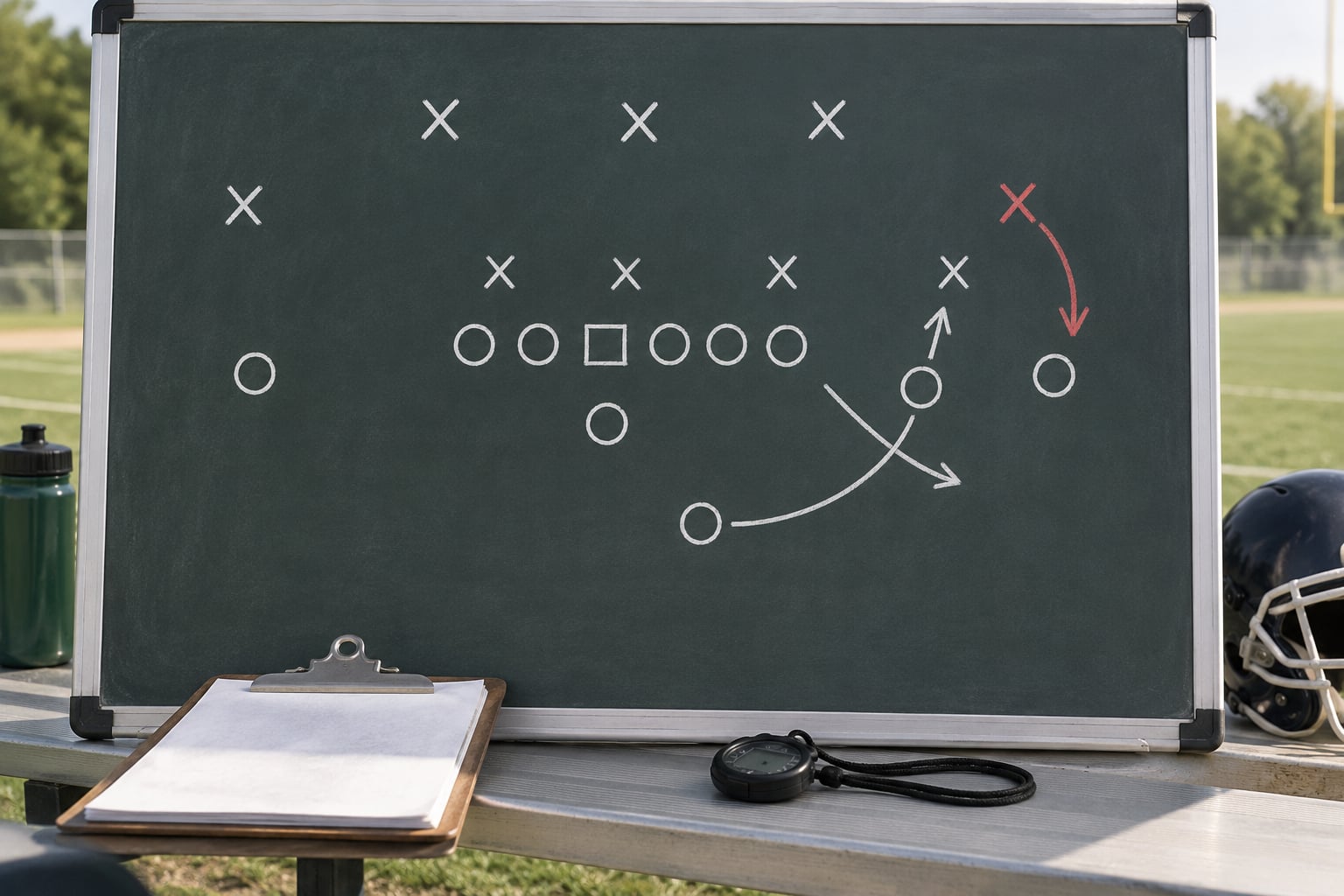
A run-pass option (RPO) is a football play where the quarterback has three real choices after the snap: hand the ball off, keep it and run, or throw it. He picks by reading how one specific defender reacts, which means that defender has to guess too. When a defender cannot be right, the offense gets an extra down.
That is the whole idea, and it explains most of what you see when a modern offense runs three or four plays a quarter and still passes 30 times a game. Fans tend to describe an RPO as a run that occasionally throws, or a play action with extra steps. Both miss the point. The ball is not decided before the snap, and it is not decided by a route pattern the quarterback predesigned. It is decided by one defender’s shoulders.
Below is how the pieces fit together: what a run-pass option is, why the conflict defender makes defenses look indecisive, how the inside zone option and outside zone option differ, and what to watch for on Saturday when the offense is in shotgun.
Table of Contents
- What Is a Run-Pass Option?
- Why Run-Pass Option Plays Create a Defensive Problem
- The Basic Timing Behind How Run-Pass Option Plays Work
- Run-Pass Options for Beginners
- Inside Zone Option
- Outside Zone Option
- How Quarterbacks, Running Backs, and Receivers Work Together
- How Defenses Beat Run-Pass Options
- Run-Pass Option vs. Traditional Run-Pass Plays
- Common Mistakes That Break an Option Play
- Frequently Asked Questions
- What is the main idea of a run-pass option?
- What is an unblocked defender in the option?
- How is an inside zone option different from an outside zone option?
- Does a run-pass option always involve a quarterback run?
- How do defenses know whether to contain or attack the ball?
- Is the run-pass option the same as the read option?
- Conclusion: Start With the Read, Then the Block
What Is a Run-Pass Option?
An RPO starts with a real run play. The blocking is not a disguise for a pass; it is a genuine run scheme with a genuine chance to gain yards. On top of that scheme, the offense adds a pass concept and gives the quarterback permission to choose.
That is the difference from a traditional run. On a traditional run, the quarterback hands off or keeps based on what he learned before the snap, and the play is dead once the ball moves. On a traditional pass, the quarterback takes the snap, turns, and executes throws that were already called. An RPO sits between those two, and the read happens after the snap is over.
The running back carries a second job. He may end up with the ball, and he must run the same route whether he takes a handoff or not. That shared path is what makes the play hard to read from the sideline and from the broadcast.
RPO concepts are not a new invention. The principle of making a defender handle two jobs comes from option football decades ago. What changed is the modern version: instead of the quarterback handing off or keeping a straightforward exchange, he reads one defender and can throw to a concept attached to the run.
Why Run-Pass Option Plays Create a Defensive Problem
Picture an inside zone run with the quarterback and running back in the backfield. Five offensive linemen block, and one defensive end on the play side is left unblocked. Before the snap, that defensive end has one job: crash and stop the run.
Now add the pass concept. The linebacker who was supposed to sit and read the run has to worry about the bubble screen drifting behind him. If he drops, the back has open grass. If he crashes, the screen is sitting there untouched.
The defensive end is in the same bind from the other side. If he crashes, he surrenders the run, but if he holds, the quarterback keeps it and the backfield gains a downfield block. Neither answer is free.
Coaches call that a no-win read. The offense does not need to know in advance which answer comes. It only needs to be right about one defender’s reaction, and then it takes the other side of the choice.
That is also why you hear the term conflict defender. It is the player whose assignment is split between two jobs, and the offense is essentially betting the play on the fact that he cannot do both perfectly.
The Basic Timing Behind How Run-Pass Option Plays Work
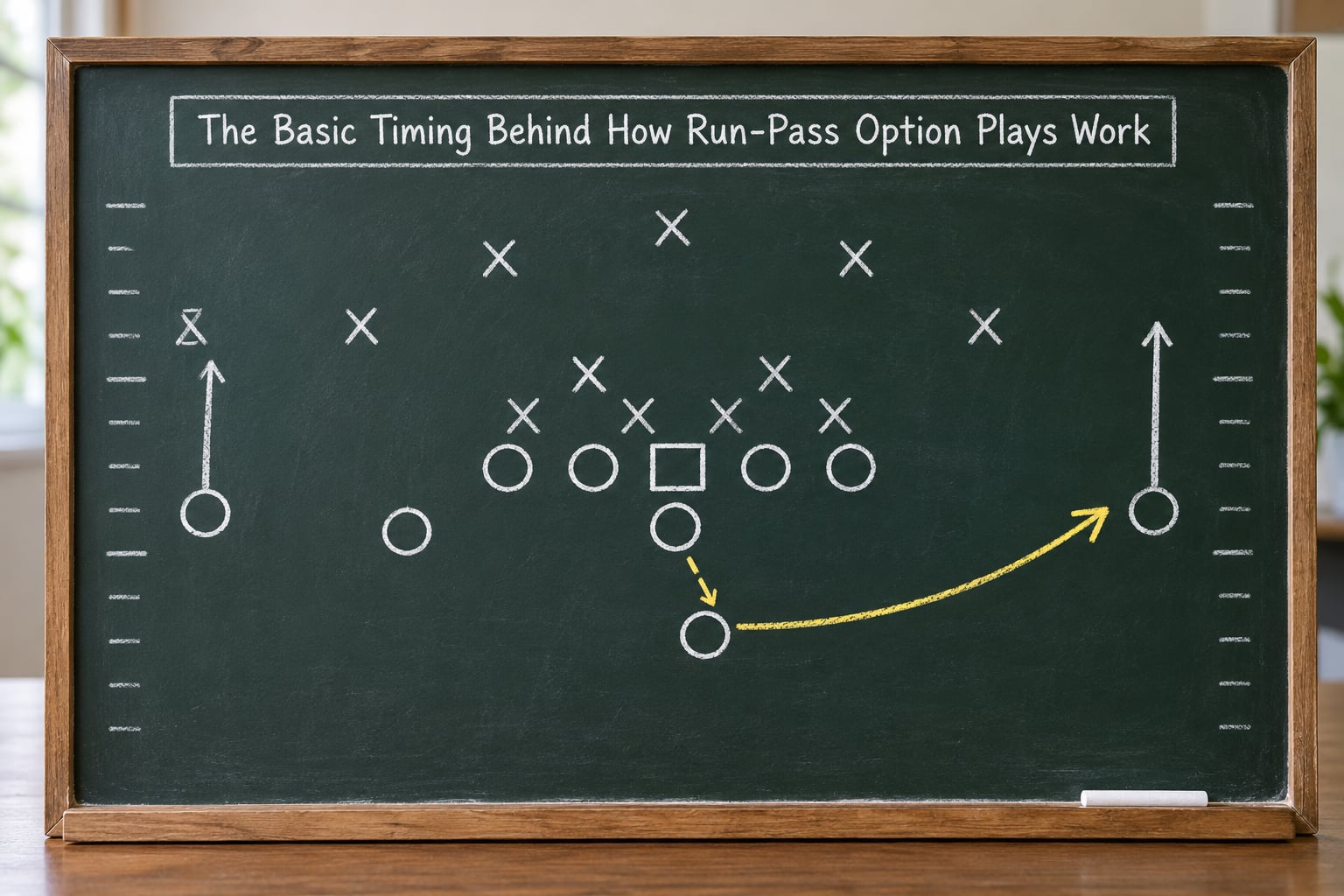
Every option play runs on a clock that starts at the snap and ends within a couple of seconds. Understanding that timing is how run pass option plays work at the level that matters to a fan.
- Formation and motion. The offense shows the run first. Split formations, tight ends, and a running back in the backfield tell the defense the run is real, and any pre-snap motion forces an adjustment before the ball moves.
- The snap. The quarterback takes the ball and looks where the running back is going. That glance is what triggers the reaction across the defense.
- The post-snap read. Within the first step, the quarterback identifies the unblocked defender and reads his hips. He is looking for one thing: has this defender committed to the run?
- The decision. Read defender goes, and the quarterback pulls it. Read defender stays, and the ball goes to the back.
- Execution. Once the decision is made, there is no second read. Everyone blocks, routes, and runs the rest of the play with total commitment.
Timing matters on the defense side too. A linebacker who waits half a second to decide has already given up the screen, and one who commits early has already given up the run. Hesitation is the failure state for the whole scheme.
Run-Pass Options for Beginners
Watch an option play with three questions in mind, and the mechanics become obvious in a couple of games.
Who is unblocked? Find the defensive end with nobody in front of him. Every lineman has a gap or a man, and the one player without an assignment is the one the quarterback is reading.
What is his body saying? A defender who widens his base and lowers his shoulders is going to attack the run. A defender whose hips stay square and whose feet keep moving backward has not committed yet. Early in a play, a half-turn of the hips tells the whole story.
What are the backup plans? A well-designed concept gives the quarterback a third choice if the read is unclear: a quick throw, a scramble, or a screen to the running back. Without that escape, an unclear read becomes a sack.
The running back has the mirror-image read. He runs to the quarterback’s depth and shoulder line, and if the ball does not arrive, he continues into the pass concept as if he were a receiver. Quarterbacks and backs who cannot sell the fake give the whole play away before the read even happens.
Inside Zone Option
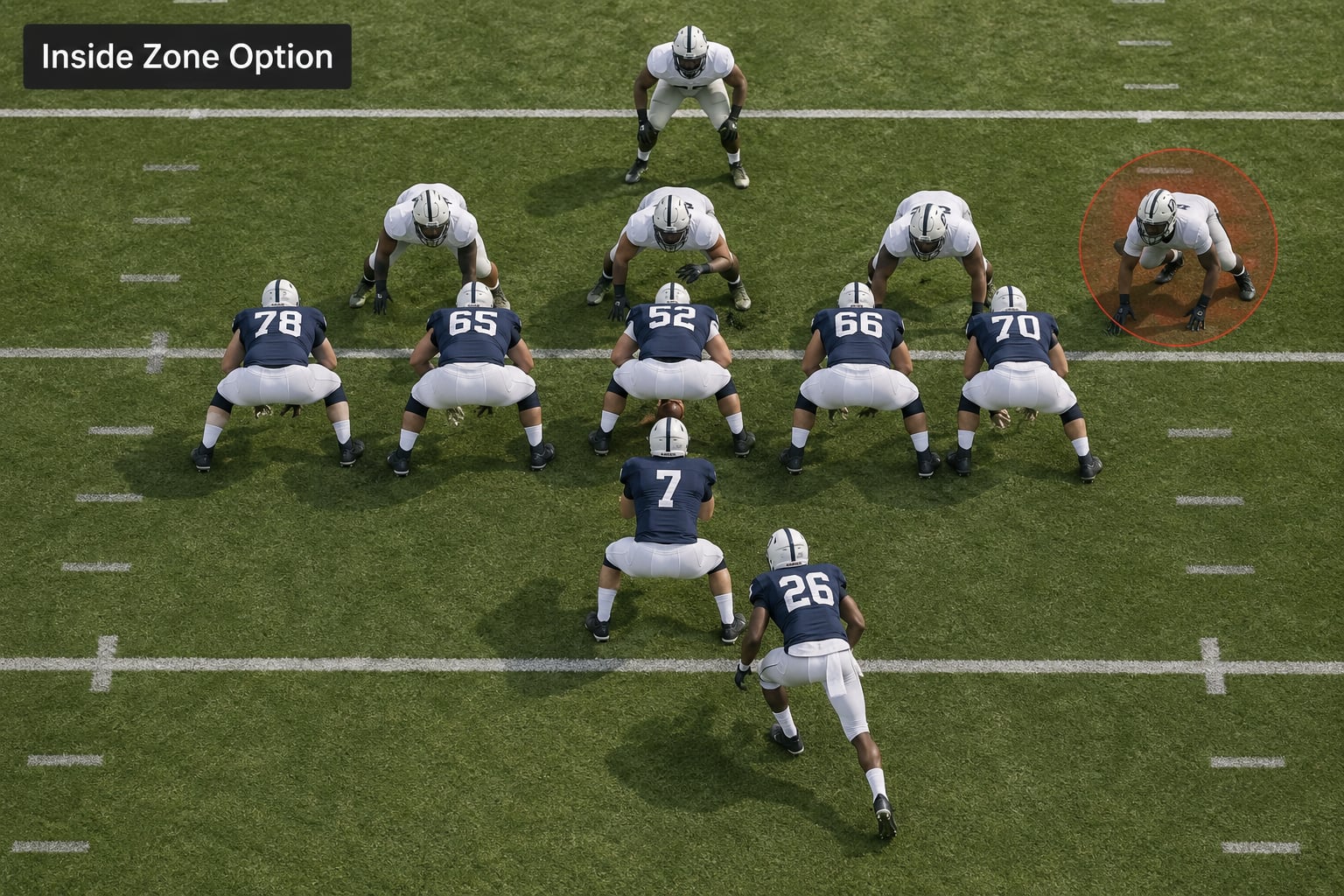
The inside zone option is the version nearly every team runs out of its base play. It is the cleanest place to learn how run pass option plays work, because every blocker has one simple assignment.
The blocking. Each offensive lineman takes an inside step, then blocks the defender in the next gap behind him. Nobody travels across the formation, and nobody makes a cross-block. That keeps the play fast and keeps the defense from guessing individual matchups.
The quarterback read. One defensive end on the play side is unblocked. The quarterback puts the ball in the running back’s belly, takes one step, and looks at that defensive end. If he goes, pull. If he holds, hand off.
The running back track. The back takes the handoff at the quarterback’s hip and runs downhill through the crease. On a fake, he never brakes. He continues his path into the bubble or the quick route assigned to him.
Because zone blocking keeps everyone in place, the quarterback can make the read quickly. That is why the inside zone is the foundation of the whole system rather than a specialty call.
Outside Zone Option
The outside zone option flips the direction. Instead of stepping inside, the offensive line steps outside together, sealing defenders away from the play side. The unblocked defender is now the edge defender on that side, and the quarterback reads him the same way.
The difference that matters is the running back’s path. On the inside version he attacks a vertical crease. On the outside version he takes an outside track, sometimes up the sideline, and the whole backfield action is wider to match.
Because every blocker moves in the same direction, the outside zone also protects the quarterback cleanly when he decides to keep it. There is no crossing traffic between him and the edge.
Read-Option and Other Run-Pass Concepts
The read option is the older relative of the run-pass option, and the terms get tangled fast online. In a read option, the quarterback reads the unblocked defender and either hands off or keeps. That is it. No pass concept is attached.
A run-pass option takes that same read and adds a throwing lane, which is why an RPO produces more first downs than a plain read option. Families of concepts also branch off differently: some build the pass concept off the running back’s route, others attach a tag route to the outside receiver, and some build the pass as protection for a quarterback keep.
Pistol and spread formations are not concepts at all. They are alignments, and they are where most of these plays live simply because they show the defense a clear backfield picture.
How Quarterbacks, Running Backs, and Receivers Work Together
The quarterback owns the read and the decision. The running back owns the deception, because his path is the first thing the defense reacts to. Receivers own the spacing that keeps the conflict defender honest.
Communication happens before the snap, not after. The offensive line knows the scheme, the quarterback knows the concept, and the back knows which route he owns if the ball is not handed to him. Any disagreement before the snap becomes a hesitation that the defense punishes.
Timing is what keeps the three of them honest. The exchange point, the depth at which the quarterback turns his shoulders, and the moment the back releases into his route all have to happen within the same two-second window the read lives in.
How Defenses Beat Run-Pass Options
Defensive coaches who stop RPOs do not solve them one play at a time. They adjust the structure so the conflict defender is never in clean conflict.
One answer is assignment football, where every defender has a job against both the run and the pass. There is no hesitation, because there is no pure run assignment to hesitate over. It is unglamorous, and it works.
Another answer is defensive structure. Defenses that play with a safety deep are harder to bubble, because the safety can cut the screen angle. Defenses that keep a linebacker on the field can spy the quarterback’s eyes, which discourages the pull.
Contain and gap techniques matter on the edges. A defender who cannot contain the quarterback cannot be cut, and that discipline usually has to be taught, because it requires winning a one-on-one without overplaying.
Communication is the last piece. When a defender hears a linebacker call an alert and knows someone else has the screen, the conflict dissolves.
Run-Pass Option vs. Traditional Run-Pass Plays
A designed run is decided before the snap. A play-action pass is decided after the fake, and the quarterback must throw a route he already knows. An RPO is decided by a live read of one defender, and the pass concept is chosen with that read in mind.
That changes the risk profile. A play action can be a wasted play if the quarterback misses the fake timing. An RPO usually has a run available behind the fake, so the penalty for a wrong read is a short loss or a check-down instead of nothing.
The defense’s answer changes too. Against play action, the win is patience. Against an RPO, the win is disciplined assignment and fast communication.
Common Mistakes That Break an Option Play
Reading too late. The quarterback takes three steps before looking. By then the defender has declared himself and the option is a normal run. One glance at the exchange point is enough.
Bad exchange timing. A handoff that floats in the air gives defenders a hand to play. The ball is placed where the back’s hand already is.
The running back braces. Anything that makes the back look like he is waiting for the ball kills the play, because the linebackers read that hesitation and sit.
Incorrect zone blocking. One lineman steps the wrong way and the whole line loses its rules, which leaves two defenders unblocked instead of one.
Missed communication. A defender who hears no call plays safe, and safe loses to an option. The fix is a system of alerts that does not depend on one player calling every adjustment.
No third option. When the read is unclear and the quarterback has nowhere to go, he eats a hit. Every good concept includes a check-down or a quick throw.
Frequently Asked Questions
What is the main idea of a run-pass option?
The main idea is that one defender cannot cover both jobs. The offense runs a real run scheme, the quarterback reads how the unblocked defender reacts to the snap, and he picks between handing off, keeping it, or throwing. If the defender attacks the run, the quarterback pulls. If he sits, the quarterback hands off. Nobody has to guess in advance.
What is an unblocked defender in the option?
It is the defensive end on the play side whom no offensive lineman has an assignment against, because zone blocking sends every blocker inside or every blocker outside. That one player is the entire decision for the quarterback. Reading him correctly is what separates a run from a pass on the same snap.
How is an inside zone option different from an outside zone option?
The inside zone has linemen step inside and block the next gap behind them, with the running back attacking a vertical crease. The outside zone has the line step outside together, sealing defenders away from the play, and the back takes a wider track. Both read the unblocked edge defender on the play side.
Does a run-pass option always involve a quarterback run?
No. The quarterback run is one of three options, and the least used one on most snaps. The quarterback pulls only when the unblocked defender commits hard to the run. On most plays the ball either goes to the running back or to a receiver on the attached concept.
How do defenses know whether to contain or attack the ball?
They decide before the snap through structure and assignment, not mid-play. Defenses built on assignment football give every player responsibility against both run and pass, so nobody has to make a live guess. Some defenses also use a deep safety to take away the bubble and a spy to discourage the pull.
Is the run-pass option the same as the read option?
Close, but not identical. A read option gives the quarterback two choices: hand off or keep. A run-pass option adds a third choice, throwing to a concept built around the read. Because the option includes a pass, it converts more downs than a plain read option.
Conclusion: Start With the Read, Then the Block
An RPO runs on one sequence: show the run, snap, read the unblocked defender, decide in a single step, and commit. Get that sequence straight and the rest of the terminology sorts itself out, because every concept in the family is built around where in the sequence the quarterback makes the read.
If you are learning to watch it, start with the defensive alignment. Find the unblocked edge defender, learn what inside zone and outside zone blocking look like on film, and then follow the running back’s path to see how the deception sells the read. That is enough to explain why a play that looks like a run ends with a completion, and in 2026 it is the fastest way to catch yourself arguing with an announcer in the right direction.