Here is how film study works in college football in plain terms: a staff pulls game video, cuts it into usable clips, hunts for tendencies and tells, turns those findings into a game plan, installs it during the week, and re-cuts its own mistakes afterward. Players watch their own snaps, grade themselves, and correct assignment errors before they ever run another rep on the field.
Understanding the mechanics matters if you follow the sport closely. It explains why a quarterback audibles on the third snap of a series, why a defensive back is playing a specific leverage, and why a coach might suddenly abandon a run game that worked all September.
Table of Contents
- Why Film Study Matters in College Football
- Who Takes Part in College Football Film Study
- How Coaches Prepare the Film Session
- What Happens During a College Football Film Session
- What Players Look For on Every Play
- How Offense and Defense Break Down Opponent Tendencies
- How Players Review Their Own Game Film
- What Tools Coaches Use to Study Football Film
- How Film Study Works in College Football, Week by Week
- What Coaches Hope Players Learn from Film
- Why Film Study Can Mislead Players and Coaches
- Frequently Asked Questions
- Start With the Assignment
Why Film Study Matters in College Football
Film study matters because it manufactures the half-second of advantage that decides snaps. A team that recognizes a formation and its answer before the snap makes more decisions per quarter than a team that reacts after the play starts.
There are five concrete returns on the time a staff spends in the film room:
- Recognition speed. Players see personnel, alignment, and motion and match it to a known answer instead of waiting for a coach’s sideline signal.
- Tendency knowledge. Coordinators learn what an offense does on third and long, or a defense does when backed up, and take that away before it becomes a surprise.
- Self-correction. Self-scouting exposes the same missed assignment three weeks in a row, which no practice rep would reveal on its own.
- Recruiting evaluation. Coaches evaluate every prospect on tape long before anyone visits, and the transfer portal turned that evaluation into a weekly habit.
- Game planning. A staff can prepare for twenty situations in a week that would take a season of game reps to see live.
Take a red-zone series. The offense lines up 11 personnel in a tight formation on first and goal, then again on second down. On third down they split two receivers wide and empty the backfield. That third-down look only happens three times in four games, which is exactly why it goes unnoticed and exactly why it needs film to find.
Who Takes Part in College Football Film Study
Film study at a college program is a staff operation with player participation at the end of it. Each role watches different footage for different reasons, and the assignments rarely overlap.
Head coach and coordinators
The head coach watches the broadest view: opponent tendencies, fourth-down decisions, situational calls, and how the game plan should change. The offensive and defensive coordinators own their side’s self-scout and build the call sheet from what the film shows.
Position coaches and graduate assistants
Position coaches watch players in their group, both on the opponent and on themselves. Graduate assistants usually do the cutting, charting, and editing that makes the rest of the room’s job possible.
Players
Players receive position-specific clips with an assignment attached. The rule most programs land on is simple: the talking belongs in the video session, so practice stays pure reps.
One piece of coaching shorthand is worth borrowing. Most staffs watch film looking for plays. Better staffs watch for structure first, following a chain of personnel, then formation, then concept, then tendency. Plays are the last step, not the first.
Video staff and recruiting coordinators
The video manager or staff keeps the libraries organized and builds the breakdowns that everyone else pulls from. Recruiting coordinators use film on high school prospects and portal players, a different cut of the same footage.
How Coaches Prepare the Film Session
Coaches prepare the session by deciding which questions need answering, then building clips that answer only those questions. Any footage that does not serve a question this week gets dropped.
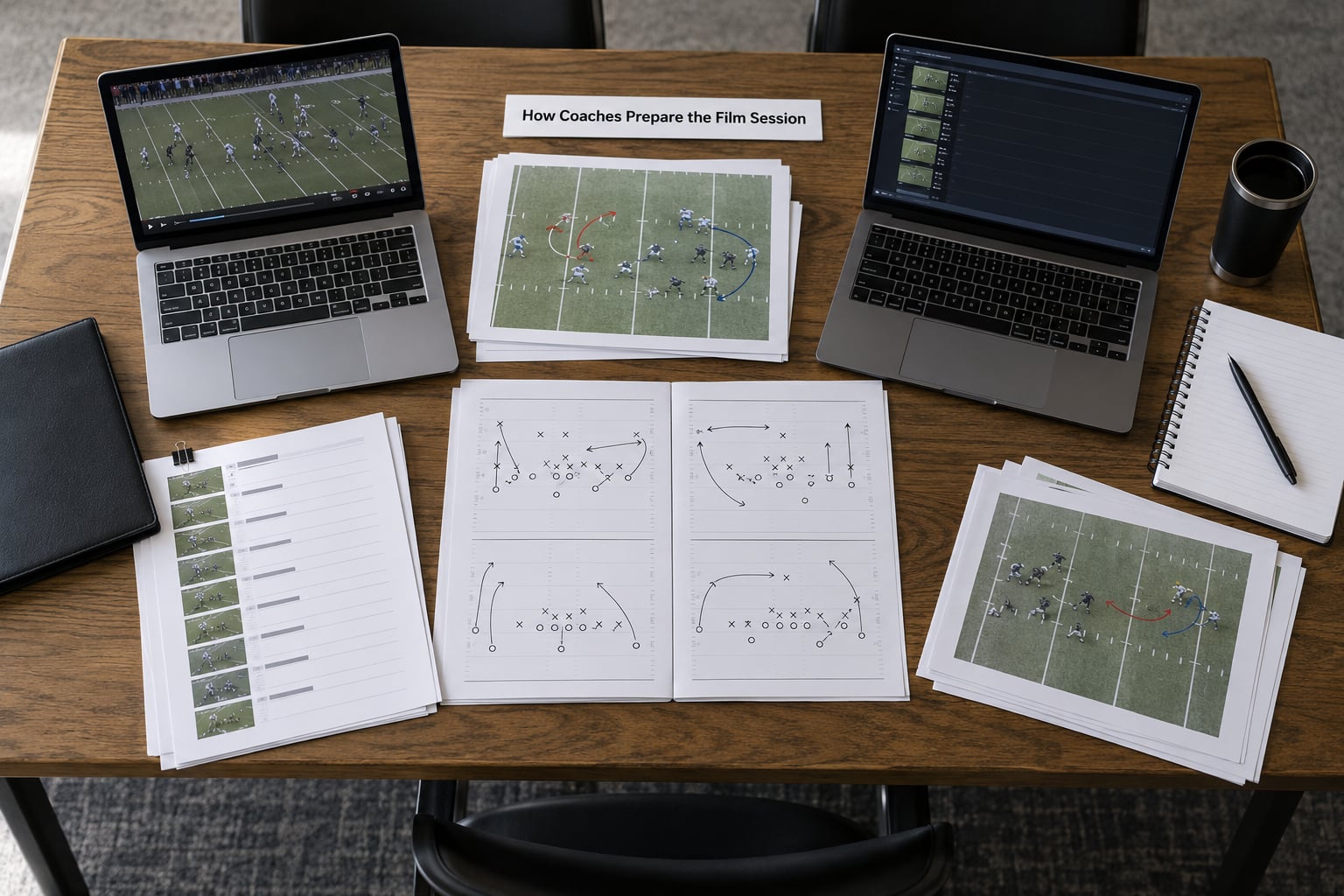
The preparation sequence usually runs like this:
- Pick the games. Two to four games that best represent the opponent, weighted toward their most recent scheme and best player.
- Set the questions first. Something narrow and testable, like whether the opponent’s motion is a play-action tell on third down.
- Choose the angle. The angle decides what you can actually see, so it gets picked per assignment rather than per habit.
- Build the cutups. Organize by personnel grouping, then by formation, then by situation.
- Assign the clips. Every player group gets a short list tied to one question, not a folder of full games.
- Strip the filler. Snaps where nothing happens relative to the question are cut.
The trimming step is the one that separates a useful session from a nap. A coach who hands a cornerback ninety clips gets a tired cornerback, and a tired cornerback stops writing notes by clip forty.
What Happens During a College Football Film Session
A college football film session runs as a sequence: opening notes, opponent tendencies, position-specific clips, then feedback on the unit’s own last performance. The order matters because the team learns the vocabulary first, then applies it.
- Opening notes (five minutes). Last week’s assignments, the correction that matters most, and the opponent’s identity in two sentences.
- Opponent tendency review. Structure first, then the specific tells the unit will see on Saturday.
- Position clips. Each group watches its own assignment from a chosen angle, usually at a coach’s pace with the film paused.
- Unit feedback. Coaches name what they saw, players name what they thought, and disagreements get resolved out loud.
- One takeaway per group. If a group leaves with three goals, it will execute none of them.
A concrete example: a quarterback and his offensive line review how they answered a pressure front. The quarterback watches the all-22 angle to see where the protection slid and whether the hot route was open. The line watches the end-zone angle, where the front’s stunts and the line’s protection rules are readable in a way the wide angle hides.
Same play, two questions, two angles, two jobs. That is normal.
What Players Look For on Every Play
Useful study is not watching. It is running a repeatable observation list on every snap, in this order, and writing the answer down as you go.
- Personnel grouping. Count the personnel before anything else. Eleven in a tight set and eleven spread are different offenses.
- Alignment. Where are the safeties, where is the slot, how far outside is the tight end.
- Motion and shift. Any movement before the snap is information, even movement that goes nowhere.
- Formation and concept. Name the formation, then the concept it belongs to, then the concept it is pretending to be.
- Down and distance context. Tendencies mean nothing without this. Third and eight is a different offense than first and ten.
- Protection and coverage. Identify what is protecting the passer and what is protecting the receiver.
- Matchup and result. Who won, and what the win cost in yardage and time.
How film study works in college football, position by position
Every position group takes the same seven questions and applies them to a different part of the field. Fans usually see only the quarterback’s version.
| Position group | Primary focus | Question they answer |
|---|---|---|
| Quarterbacks | Protection, coverage shell, timing | Where does the ball go before pressure arrives? |
| Running backs | Reading blocks, cut depth, pass protection | Which shoulder is open and when do I commit? |
| Receivers | Release, leverage, route timing | Did I win at the line and did I arrive where the ball is? |
| Tight ends | Blocking assignments, release decisions | Am I on the right person in pass or run? |
| Offensive linemen | Stunts, gap rules, communication | Who moved, and did I call it? |
| Linebackers | Fit, gap integrity, coverage obligations | Is my gap or my coverage more important on this snap? |
| Defensive backs | Technique, eyes, leverage | Did I have my hips where the receiver needed them? |
| Defensive linemen | Hand placement, first step, gap | Is my pad level winning before I reach the ball? |
How Offense and Defense Break Down Opponent Tendencies
Both sides break down tendencies by charting plays across down, distance, personnel, and field position, then looking for patterns that are frequent enough to plan against. A tendency needs frequency, context, and a reason to exist.
| Review area | Evidence a coach looks for | Takeaway |
|---|---|---|
| Offense: formation usage | Percent of snaps from each formation | A favorite set is coming more than defenders expect |
| Offense: down and distance | Run-pass split on third and fourth down | League-average splits hide a real bias until they are split by situation |
| Offense: play-action | Play-action rate by formation and backfield depth | Two-back sets can be checked for a specific play-fake look |
| Offense: pre-snap | Motion, shifts, and tempo before the snap | Motion is a tell for the line and the safety, not just a decoy |
| Defense: pressure concepts | Which blitzes appear on third down, from where | The blitzer identity is often predictable before the snap |
| Defense: coverage shell | Two-high versus single-high rate by formation | Safety alignment changes the meaning of the motion |
| Defense: third-down behavior | Man, zone, or blitz usage on third and long | A predictable pattern gives the offense a ready-made answer |
A useful example: a defense shows two-high on roughly a third of its snaps, and every one of those snaps comes with an outside linebacker tilted wide. That alignment, not the shell itself, is what the offense can attack, because it removes a body from the run fit.
How Players Review Their Own Game Film
Players review their own film individually and as a unit, usually within hours of a practice or game, and they do it in a fixed sequence that keeps emotion out of it.
- Position and alignment. Am I where the assignment said I should be before the snap?
- Assignment recognition. Did I identify the right read, and how early?
- Communication. Did I make the call in time for anyone to act on it?
- Physical execution. Technique, hand placement, pad level, footwork, independent of the result.
- One goal. A single correction carries into the next practice.
Coaches often limit a player to a handful of clips on purpose. A hundred clips produces no change; three clips with a clear correction produce a fix by Tuesday. Reviewing the whole game on your own, without an assignment attached, is closer to scrolling than to study, and that is the most common complaint players raise about their own habits.
What Tools Coaches Use to Study Football Film
The tools do one job well: they get the right snaps in front of the right person fast. They do not replace judgment, and the analysis matters more than the subscription.
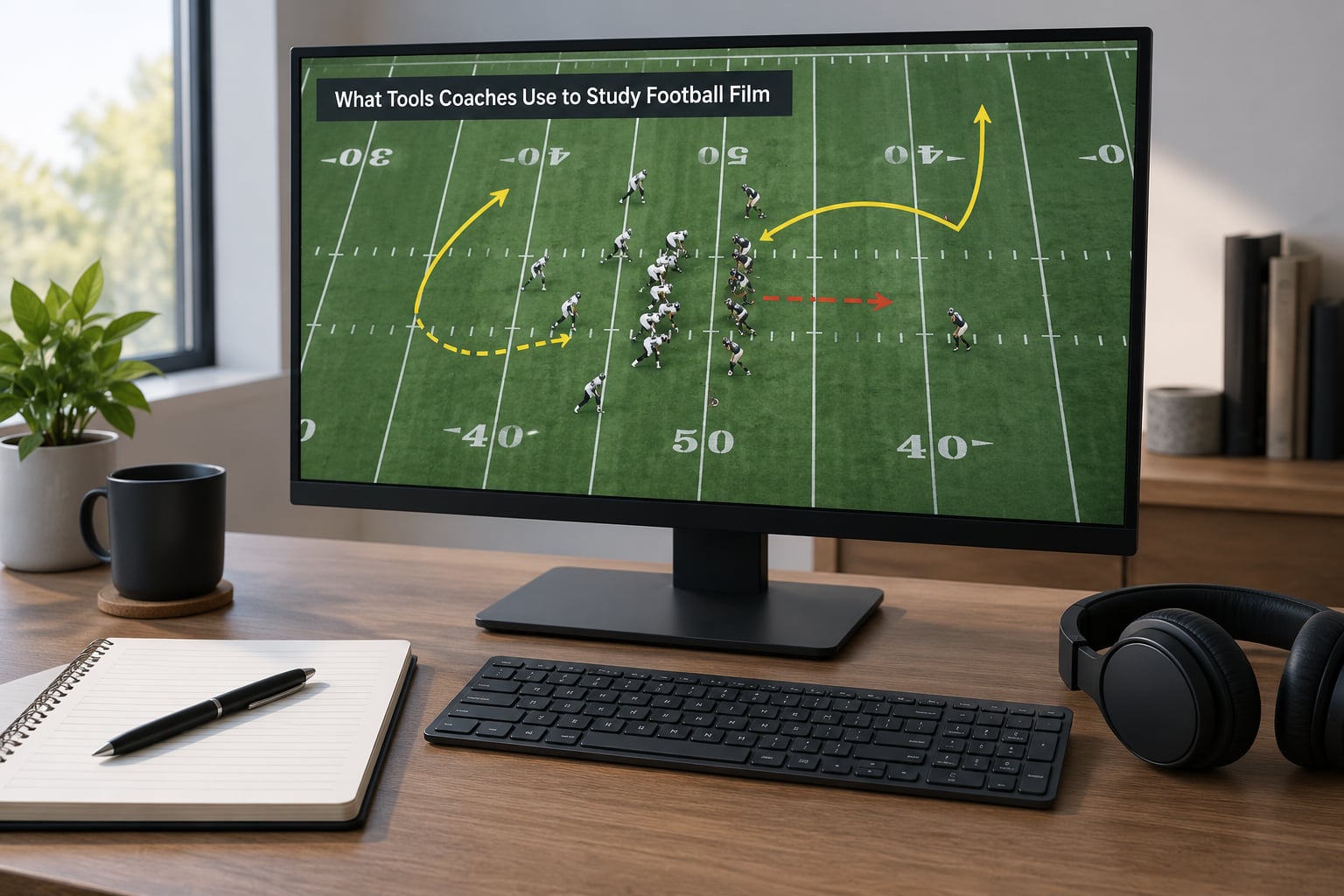
The stack usually includes a video platform that stores and clips film, telestration for drawing on a still, diagram tools for play sheets, a shared notes system for assignments, and a statistics layer for charting.
| Video angle | Best for | Weak spot |
|---|---|---|
| All-22 | Spacing, formation, wide reads | Fine technique detail disappears |
| End zone | Defensive fronts, protection rules, leverage | Hard to read laterally across the field |
| Sideline | Route depth, pursuit angles | Vertical spacing compresses |
| Broadcast | What fans and bettors see | The sideline angle is the worst one for line play |
Video and analytics answer different questions. Video tells you what happened and why it looked wrong. Analytics tells you how often it happened. A coach who wants frequency opens a chart, and a coach who wants cause opens film, and the common mistake is using one tool for a question the other answers better.
How Film Study Works in College Football, Week by Week
Here is how film study works in college football across a normal in-season week. The player task sits beside the staff task because they are not the same work.
| Stage | Typical responsibility | Useful output |
|---|---|---|
| Sunday self-scout | Coordinators review last game’s snaps by personnel grouping | Ranked list of recurring errors |
| Monday opponent acquisition | Video staff pull and cut the opponent’s recent games | Clean cutup library |
| Tuesday charting | Assistants chart by down, distance, and formation | Tendency sheets per unit |
| Wednesday position sessions | Position coaches present clips with assignments attached | Player takeaways and corrections |
| Thursday scout card | Coordinator writes the call structure for the opponent | Scout card distributed to position coaches |
| Friday install | Players learn the plan in practice; coaches talk less, reps more | Practice reps of game-plan looks |
| Saturday personal prep | Players watch their own position clips | Personal correction list |
| Postgame cut | Staff pulls the opponent’s answers before the next opponent arrives | Updated tendency library |
The self-scout is the step fans almost never hear about, and it is the one that changes a program. Every staff knows what the opponent likes to do. Knowing what your own offense does on third and eight is more useful, because that one is fixable this week.
What Coaches Hope Players Learn from Film
Coaches want five things out of film, and all five show up on the field even when the film room went badly.
- Faster recognition. Identifying the look before it matters.
- Better communication. Calling the adjustment early enough for others to act.
- Stronger technique. Correcting one habit at a time from a still frame.
- Confidence from repetition. Knowing the answer before pressure arrives.
- Shared tactical understanding. Every player knowing why the call exists.
Same formation, different assignments, different correct answer: a safety rotating downhill over a slot in a two-high shell has a different read than a safety in a single-high shell, because the deep half is covered either way. That is why film goes into a session with a question attached instead of a highlight reel.
Why Film Study Can Mislead Players and Coaches
Film study fails in predictable ways, and each failure has a fix. Check a film-room claim against these before accepting it.
- Cherry-picked clips. Six bad snaps look damning until you realize they were pulled from a full game. Fix: ask for the full count, not the highlight.
- Small samples. A tendency drawn from two games disappears against a third. Fix: require a minimum snap count before a pattern gets called a pattern.
- Judging speed from a still. Technique problems that look obvious paused often vanish at full speed. Fix: watch the clip three times before filing a correction.
- Lost context. A play out of context says nothing about the plan. Fix: include down, distance, field position, and score in every clip.
- Tendency mistaken for rule. “They never run on third and short” becomes an assumption that lasts until it does not. Fix: treat tendencies as probabilities, not promises.
- Over-installing. A plan with forty concepts beats a team that struggles to execute twelve. Fix: cut the plan until it survives a bad quarter.
One more: watching without charting. Highlights create a feeling of understanding that is not understanding. If a player cannot state the tendency in words, the film did not do its job.
Frequently Asked Questions
What is film study in college football?
Film study in college football is the structured review of game and practice video used for opponent scouting, self-scouting, and player development. A staff pulls recent games, cuts them by personnel grouping and situation, charts tendencies, writes a scout card, installs a game plan in practice, then re-cuts its own snaps to correct mistakes.
How long does a college football film session last?
Position-group sessions usually run 20 to 40 minutes because short clips held at full attention beat long ones. Staff sessions go longer, often an hour or more, because they cover opponent tendencies, the scout card, and last week’s corrections together. Individual player review is shorter still, usually three to five clips tied to one assignment.
What should players look for during film review?
Run a fixed order on every snap: personnel grouping, alignment, motion and shift, formation and concept, down and distance, protection and coverage, then the matchup result. Writing the answer down is what separates study from watching. A player who cannot describe the tendency in words after the clip has not finished the assignment.
Does film study involve statistics as well as video?
Both, in different roles. Video explains cause: why a play worked or why an assignment was missed. Statistics explain frequency: how often it happens. Most staffs open a chart when they want to know whether a pattern is real, then cut film to find out why it happens, and both get pulled into the written scout card.
How does film study improve a player’s performance?
It shortens the decision loop. A player who has seen the same alignment fifty times recognizes it pre-snap, communicates early, and arrives at the right depth instead of reacting after the catch. Because the clips come with one assignment attached, the correction carries into the next practice rather than staying in the film room.
Start With the Assignment
If you take one thing from this guide, take the order of operations. A specific question, a clearly assigned observation task, evidence you counted yourself, and only then a conclusion. That sequence is how film study works in college football, whether the person running it is a coordinator with a scouting staff or a player with a laptop and a clip list.
Video is not a replacement for practice, analytics, or coaching. It is the preparation layer that decides how many of those reps go toward the right answer.