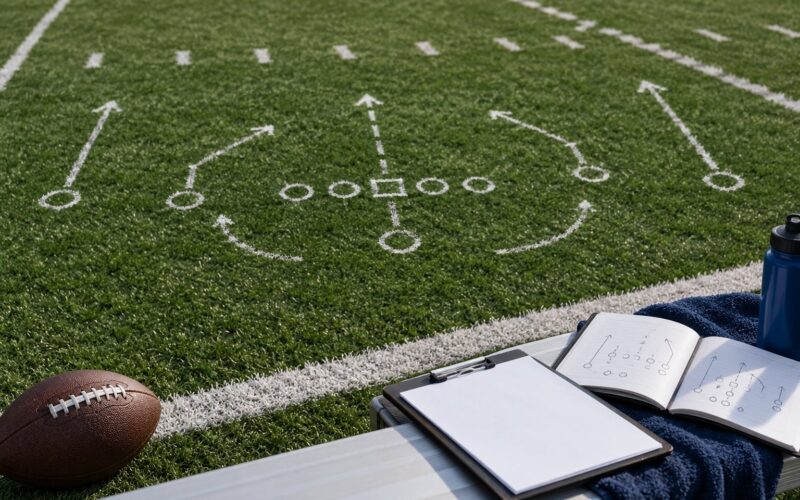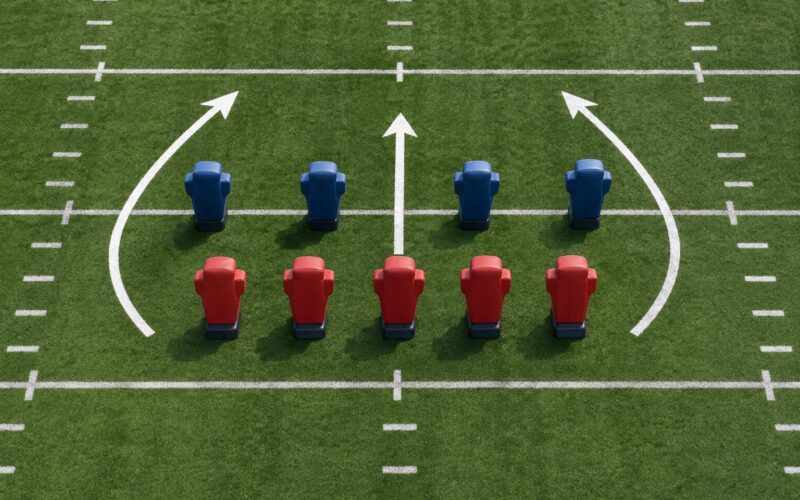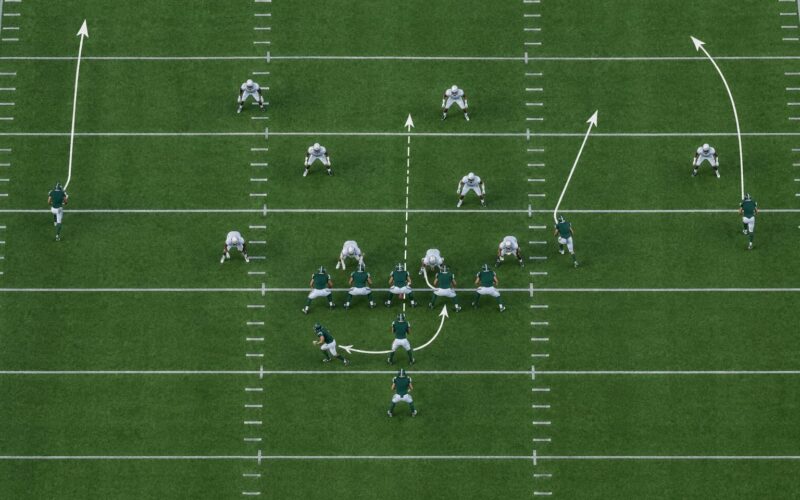
What coaches do on game day in college football runs across four phases: they arrive hours before kickoff to run meetings and finalize the game plan, split up across the sideline and press box to make in-game calls, take a short list of corrections at halftime, and then handle the locker room, media duties and self-scout review after the final whistle. The head coach oversees all of it, but most of the play calling belongs to the coordinators.
Here is the honest version of a game day, from staff arrival to the drive home.
Table of Contents
- What Coaches Do on Game Day in College Football
- How early does a college football coach start on game day?
- What happens during pregame preparation?
- What do coaches do during the game?
- How do coaching staffs divide game-day responsibilities?
- What do coaches review after the game?
- Why does the game-day routine vary by program and division?
- Frequently Asked Questions
- How long before kickoff do college football coaches arrive?
- Do all college football coaching staffs have the same game-day schedule?
- What does a football coach do on the sideline during a game?
- Do coordinators make more decisions than position coaches?
- How do coaches communicate with players before and during a game?
- Do college football coaches review game film immediately after the game?
- Conclusion
What Coaches Do on Game Day in College Football
A college football coaching staff spends game day doing four things in order: preparing the team, running the game, making halftime corrections, and reviewing what happened. What coaches do on game day in college football is far more meeting-room than football field, and most of the work is invisible from the stands.
The staff usually includes a head coach, who owns the program and the final call on everything; an offensive coordinator and a defensive coordinator, who design and call most plays; a special teams coordinator for punts, kickoffs and field goals; position coaches for each unit; graduate assistants who help with film, recruiting and the sideline; and football operations staff handling logistics, equipment, medical coverage and stats.
One thing worth clarifying early: the head coach often does not call plays. Plenty of head coaches came up on the defensive side and hand the offense to their coordinator, and most coordinators call the majority of snaps. Titles also vary by program, and smaller schools fold several roles into one person.
How early does a college football coach start on game day?
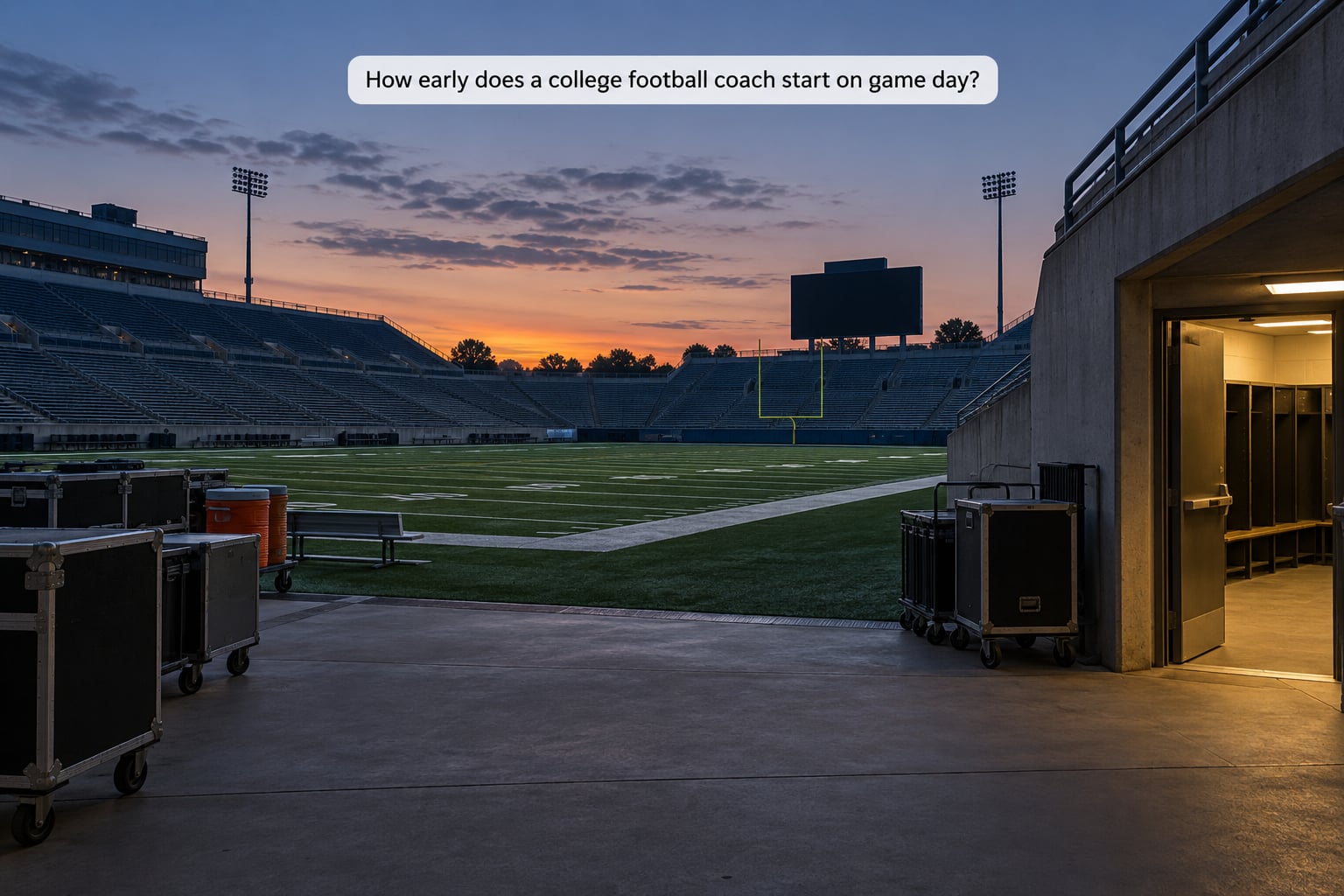
Most staffs are on site several hours before kickoff. A common pattern is a mid-morning arrival, a facility walkthrough around eight or nine, position meetings through late morning, a pregame meal, and player warmups in the early afternoon.
Head coaches frequently arrive earlier than anyone else, often before sunrise, to walk the facility and review the plan one last time with the coordinators. Kickoff might not be until seven in the evening, which means the staff is working a full twelve-hour day in some programs.
Road games compress that schedule. The bus or charter flight leaves earlier, so arrival at the stadium may be a late-morning flight followed by a hotel drop, a meal and a bus to the venue.
Treat any single schedule as illustrative. A noon start in the heat of the South, a night game in the Pacific Northwest and a home opener against a ranked opponent can each produce a completely different rhythm, and a good coaching staff adjusts the routine instead of forcing the routine.
What happens during pregame preparation?
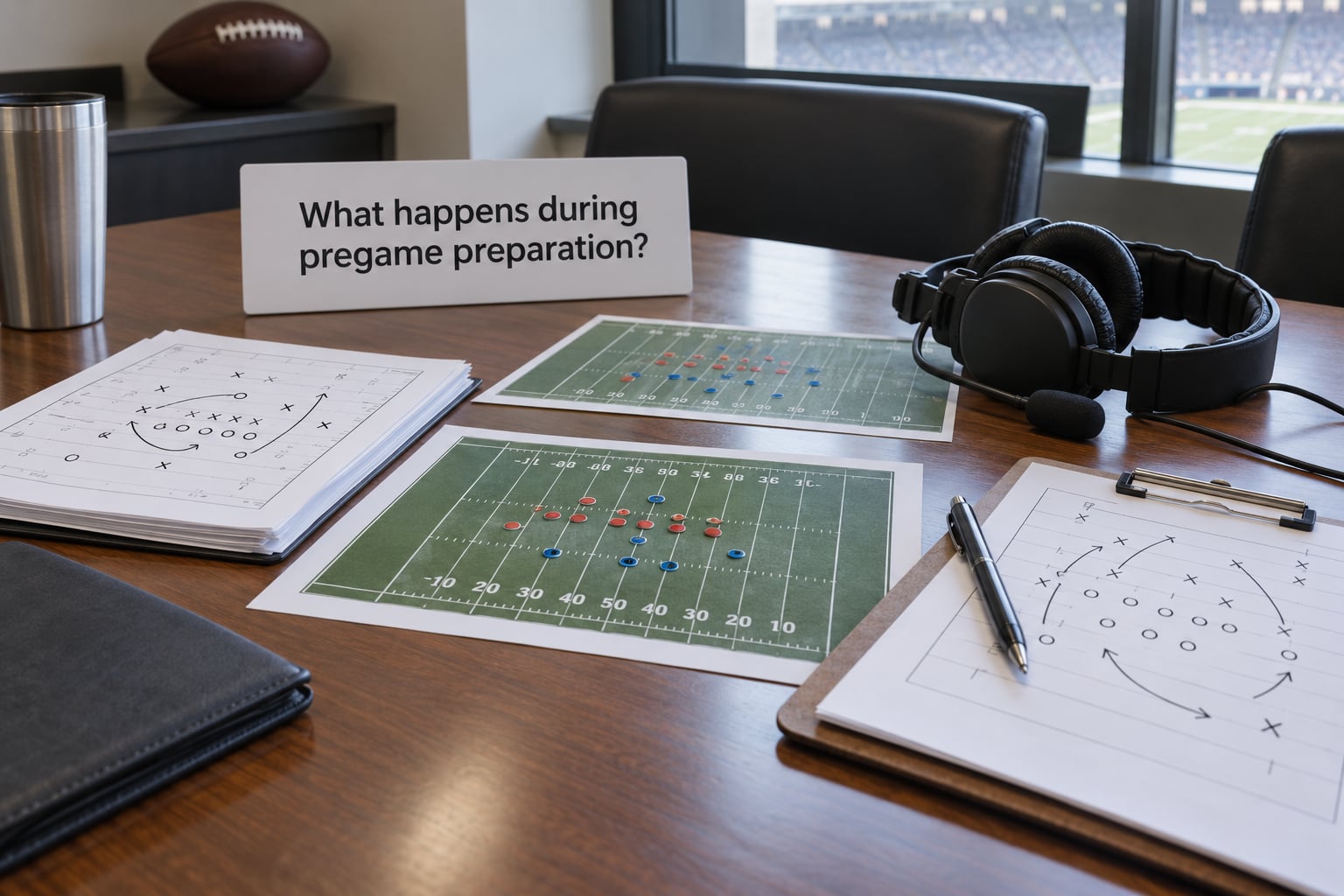
Pregame is where the game is really decided. Coaches re-watch opponent film, identify the tendencies they plan to exploit, and narrow a large playbook down to the small set of plays they actually intend to call in the first quarter.
The detail they look at is specific. Which motion the offense uses before a play-action fake. Whether the corner plays three yards off the boundary or twelve. How a safety rotates on third and long. How quickly the punter gets the ball off, and where the returner drifts when the punt is covered inside the twenty.
Weather enters the picture too. Wind direction at the goal posts decides whether a staff trusts a field goal from fifty yards, and a wet field changes how much a running back is willing to cut. The box score on a clipboard is not paperwork for its own sake; it is the reference that keeps everyone calling the same play.
A pregame timeline of what coaches do on game day
Here is a typical mid-afternoon kickoff, presented as a sample rather than a rule.
- Staff arrival and facility check. Head coach plus coordinators on site, walking the field, confirming the headset inventory and reviewing any construction or field-surface notes.
- Position meetings. Each position group meets separately. Wide receivers watch film on the opponent’s corner, offensive linemen work through the front they will face, defensive backs compare coverage rotations.
- Coordinator sync. Offensive and defensive coordinators meet with the head coach to agree on the script for the first series, including what happens on the first two or three offensive snaps.
- Pregame meal. The staff eats together, usually the one meal of the day where all the coaches are in the same room.
- Player warmups. Position coaches supervise on the field and watch how the player moves that day, not last week. A tight hamstring in warmups changes the depth chart.
- Captain check-in. Senior players meet with the head coach to preview the opponent, confirm the week’s details and answer questions the rest of the team is asking.
- Final game plan. Last adjustments to the call sheet, the depth chart and the charts that dictate decisions at the end of the game, then the team meeting and the walk to the field.
One detail fans never see but coaches argue about constantly: what the head coach physically carries. On a coaching forum thread, one longtime coach’s advice for a head coach with no play-calling duties was blunt, carry nothing and resist the urge to feel like you have to hold a folder. Another described a two-sided laminated sheet with the call sheet on one face and the offensive, defensive and special teams depth charts plus an end-of-game timeout chart on the other.
What do coaches do during the game?
Once the game starts, the work shifts from preparation to reaction. The coordinators call most plays from the sideline or the press box, working through a written call sheet and the trigger language agreed on before kickoff.
The decisions that show up in the box score are only the loud ones. The quieter ones happen between every series: what to change on first and second down after a play gets negated, whether to burn a timeout before the punt, whether to try the fourth-down conversion now or bank the points.
Position coaches handle the substitution board, count repetitions for specific players, and relay corrections through the headset or directly on the field after a series ends. Graduate assistants and analysts feed in what the offense is doing, spotting a pattern that the coordinator can exploit before the next quarter.
Clock management has its own routine. Coaches know exactly how many timeouts each side has and roughly how long one is worth in a given half, which is why a timeout sometimes gets used before it looks necessary. Once the two-minute warning arrives, the sideline becomes a special teams operation built around the next possession and the field position behind it.
Challenges and replay requests are decided by whoever the rules assign them, usually with the head coach weighing in, and getting the call wrong costs a down. Coaches also spend the game managing injuries in real time, since a trainer’s report from the third quarter often forces a substitution plan the staff did not prepare that morning.
How do coaching staffs divide game-day responsibilities?
Here is the split most programs run, roughly:
| Role | Before the game | During the game | After the game |
|---|---|---|---|
| Head coach | Final say on the plan, script and depth chart | Oversight, timeout and fourth-down calls, media if needed | Locker room talk, press conference, self-scout |
| Offensive coordinator | Installs the offensive game plan | Calls most offensive plays | Reviews series-by-series offensive execution |
| Defensive coordinator | Installs the defensive call scheme | Calls the defense, adjusts fronts and coverage | Reviews missed tackles and coverage gaps |
| Special teams coordinator | Punts, kickoffs, field goals, short-yardage and red-zone situations | Decides field-goal and punt choices | Grades coverage and field position |
| Position coaches | Small-group film and technique work | Rep counts, matchup notes, substitutions | Individual performance review |
| Graduate assistants and analysts | Film cutups, opponent tendencies, recruiting paperwork | Signals and sideline communication, next-series trends | Data entry, depth chart support |
| Football operations staff | Facilities, equipment, meals, security | Medical coverage, chain and stats crews, credentialing | Recovery plan, equipment check, travel |
Coaches on forums describe the split differently than fans picture it. The common view among practitioners is that a head coach from a defensive background rarely takes over play calling, while one from an offensive background usually does, and a head coach without play-calling duties often ends up owning special teams too.
The same coaches warn against micromanagement during the game, sometimes called joy-stick coaching. Telling a player what to do while the play is unfolding usually produces worse results than trusting the practice reps, no matter how good the idea sounded in the moment.
What do coaches review after the game?
The whistle ends the public part of the job and starts the rest of it. The typical sequence is a short recovery session for players, a brief locker room talk, media obligations, and then film work that often runs well past midnight.
Review usually means grading yourself, not grading the opponent. Coaches look at which calls worked, which ones did not, and whether the failure came from the play selection, the assignment or the player execution. On the other side, they pull clips of tendencies that the opponent will use again next time.
Injury updates come first. A Saturday night evaluation often determines whether a player is available the following week, and it shapes the practice plan before anyone thinks about the next opponent.
Then comes the next game. Some coaches review immediately because the details are fresh, others sleep on it. A 24-hour rule comes up often in coaching circles: do not relive the loss in the moment, because the reaction is not the analysis, and the real work starts the next day.
Why does the game-day routine vary by program and division?
The structure is common, but the details scale with the program. A large FBS staff can afford a full travel charter, a video department and eight graduate assistants, while an FCS or Division III staff often has the same responsibilities spread across far fewer people with more of it done by students.
Travel is the biggest variable. Some programs bus a short distance and walk through the opponent facility on arrival; others fly commercial and land near kickoff, which pushes every meeting into a compressed window.
Conference rules and facilities matter too, since venue restrictions on bench area, substitution and warmup access shape the sideline layout a staff has to work with.
Culture is the last variable and the hardest to measure. Some staffs run a loud, confrontational sideline, others a quiet one that looks like nothing is happening. Both can win, and from the stands they are nearly impossible to tell apart.
Programs keep tweaking these routines from season to season, so treat the details here as a 2026 snapshot rather than a fixed rulebook.
Frequently Asked Questions
How long before kickoff do college football coaches arrive?
Most staffs are on site three to six hours before kickoff, and head coaches often arrive first, sometimes before sunrise for a facility walkthrough and a final session with the coordinators. Programs that travel by charter add travel time to that window, which is why road game days start much earlier in the calendar day than home games.
Do all college football coaching staffs have the same game-day schedule?
No. Schedules shift with kickoff time, venue, division, travel and program culture. A noon start in the South, a night game in the Pacific Northwest and a home opener against a ranked opponent each produce a different rhythm. What stays consistent is the sequence: staff arrival, position meetings, meal, warmups, team meeting, then kickoff.
What does a football coach do on the sideline during a game?
Mostly it is called plays and managed substitutions. The offensive and defensive coordinators call most snaps, while position coaches track repetition counts, relay matchup notes and prepare substitutions. The head coach oversees the whole operation, decides timeouts and fourth-down calls, watches the injury report, and communicates with players and analysts between series.
Do coordinators make more decisions than position coaches?
Yes, in scope. A coordinator owns an entire side of the ball and makes the scheme-level decisions on every snap. A position coach owns a handful of players, so the decisions are narrower: matchup assignments, substitution patterns and technique corrections during a series. During a game the coordinator’s call outranks the position coach’s preference.
How do coaches communicate with players before and during a game?
Before kickoff it is meetings, written play sheets and small-group film. During the game it is the sideline itself, headsets to the booth, and brief instructions between series. Coaches lean on trigger words agreed on beforehand, so a single short phrase during a huddle can send a whole unit into a different alignment.
Do college football coaches review game film immediately after the game?
It varies. Some start grading themselves the same night while the details are fresh, others wait until the next morning so they are not reacting instead of analyzing. Either way, self-scout film, opponent tendencies and injury updates all get handled in the first day or two, and preparation for the next opponent starts almost immediately.
Conclusion
Game day is a coordination job more than a calling job. Coaches prepare the plan, split responsibilities across a staff of two dozen people, react to what the opponent actually does, then spend the night grading themselves before the next cycle begins.
If you want to understand the sport better, start with preparation. The next time a coach burns a timeout or goes for it on fourth down, ask what series preceded it, and the whole day stops looking like a man in a headset reacting to noise.