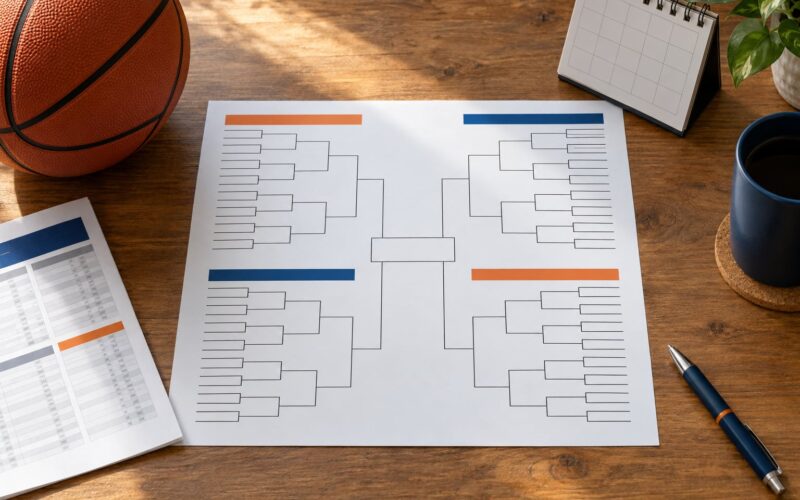
Short answer: bubble teams make the NCAA tournament by stacking the specific signals the selection committee weighs heaviest: Quadrant 1 wins, a strong NET ranking, a punishing non-conference schedule, quality road and neutral-site results, and no damaging losses. Do that before Selection Sunday and an at-large bid usually follows.
That part of the process never really changes, no matter what the season looks like. What changes is the environment around it, and 2021 changed it more than any March in recent memory.
This guide walks through both halves: how teams actually earned bids, and what happened to the teams that played inside one controlled site for six weeks.
Table of Contents
- What Does It Mean to Make the NCAA Tournament in the Bubble Era?
- How Bubble Teams Qualified for the NCAA Tournament
- Automatic bids come from winning a conference tournament, not from standing on top of the table
- At-large bids come from the committee weighing resumes against six published factors
- Quadrant wins: the part that actually decides the bubble
- Seeding and inclusion are two different disappointments
- The First Four, and what COVID did to it
- What Made Bubble Teams Different From Normal Tournament Teams?
- How Teams Built Winning Identities Inside the Bubble
- How Bubble Teams Turned Preparation Into Tournament Success
- The Bubble Tournament’s Most Important Strategic Lessons
- Frequently Asked Questions
- What does it mean to be on the bubble in the NCAA tournament?
- How did teams qualify for the 2021 NCAA Tournament bubble?
- How many Quadrant 1 wins does a bubble team need?
- How does the NCAA tournament selection committee choose at-large bids?
- What made the 2021 NCAA Tournament different from a normal tournament?
- Do the 2021 bubble-era strategy lessons still apply today?
- Conclusion: Start With Selection, Then Exploit the Conditions
What Does It Mean to Make the NCAA Tournament in the Bubble Era?
The word bubble does two different jobs in college basketball, and mixing them up is the single most common source of confusion.
The older meaning is the selection bubble. A bubble team is one with a resume good enough to be in contention and a profile close enough to the cut line that one or two results will decide whether the committee takes it. In a normal March you can name those teams in early February and watch them trade places for six weeks.
The 2021 meaning was literal. COVID-19 pushed the men’s tournament into a controlled site, largely in Indianapolis, where every team lived, practiced and played inside the same secured perimeter.
How bubble teams make the NCAA tournament in the bubble era
Qualification in 2021 worked exactly the way it always has. Sixty-eight teams, thirty-two automatic bids for conference tournament champions, and thirty-six at-large bids awarded by the committee after Selection Sunday.
None of that machinery was rewritten because of the pandemic. The games around it were. So when fans ask how bubble teams make the tournament, the useful answer separates the two: the selection rules were unchanged, and the conditions teams prepared for were not.
Everything below covers both. Start with the qualification math, because a team that never gets picked cannot exploit anything.
How Bubble Teams Qualified for the NCAA Tournament
Two thirds of the field sorts itself. The other third is where every argument you hear on Selection Sunday actually happens.
Automatic bids come from winning a conference tournament, not from standing on top of the table
A team that goes 15-3 and loses in the quarterfinal of its league tournament has not won an automatic bid. The bid belongs to the team that walked out of that tournament. This is why conference tournaments carry so much weight for bubble teams in February, and why a first-round exit can end the conversation weeks before Selection Sunday.
At-large bids come from the committee weighing resumes against six published factors
The NCAA publishes its selection criteria every season, and the language barely moves. Bubble teams live and die by how they score against it:
- NET ranking. The NCAA Evaluation Tool is the committee’s primary sorting tool, a rolling index built from adjusted efficiency, wins and losses, strength of schedule, and where each game was played.
- Wins against Quadrant 1 opponents. The most heavily weighted category on the sheet, and the one fans fixate on for a reason.
- Strength of schedule. Non-conference games get particular scrutiny, especially when a high-major team has padded its record against low-level opponents.
- Road and neutral-site performance. Winning away from home, or in a neutral-site game against good competition, is weighted differently from a home win over the same opponent.
- Head-to-head results. When two teams have near-identical resumes, the game between them often decides it.
- Balancing criteria. Injuries, close losses and other circumstances, applied after the measurable categories.
Quadrant wins: the part that actually decides the bubble
Every opponent is sorted into one of four quadrants based on its NET rank and the site of the game. A win over a top-20 team at home counts very differently from the same opponent on the road in the non-conference slate.
| Quadrant | Home site | Neutral site | Road |
|---|---|---|---|
| Quadrant 1 | Top 30 | Top 50 | Top 75 |
| Quadrant 2 | 31-75 | 51-100 | 76-135 |
| Quadrant 3 | 76-135 | 101-175 | 136-265 |
| Quadrant 4 | 136 and below | 176 and below | 266 and below |
The exact cutoffs shift with field size and the shape of the season, so treat these as the shape of the system rather than a rulebook. The principle holds regardless: beating a good team on the road is worth more than beating it at home, and a Quadrant 4 loss is treated as a genuine black mark rather than a minor blemish.
Seeding and inclusion are two different disappointments
Getting selected does not mean getting seeded where you wanted. A team can win an at-large bid and come out of Selection Sunday an eleven seed, having quietly beaten two teams that got worse seeds and a bye. Fans tend to treat those as one argument, but the committee makes them separately, and the criteria sheet is applied twice.
The First Four, and what COVID did to it
The First Four in Dayton plays the lowest-seeded teams in the round of 64, with the winners advancing to join the field proper. In 2021 the round was staged in West Lafayette, Indiana, and it nearly fell apart days before tipoff. Several teams withdrew with positive tests, forcing the NCAA to call teams up from outside the original cut and re-seed the round.
The chaos was a preview of the whole season: the field was technically set, but almost nothing about the normal postseason script applied.
What Made Bubble Teams Different From Normal Tournament Teams?
Put a normal March tournament and a bubble tournament side by side and the differences are not subtle.
- Attendance was capped and restricted. Most games were played without student sections or the general public. Some sites allowed limited family members, which changed the noise level and the feel of a postseason game more than almost any other factor.
- Testing was constant. Teams were screened before arrival and repeatedly during the run of the tournament. A positive test ended a campaign outright, and several programs were eliminated by protocols rather than by basketball.
- Schedules compressed. Regional rounds were packed tightly, so a strong team could play three games in a few days against teams that had also played two. Depth stopped being a luxury.
- Travel disappeared. Once a team was inside the site, moving between games was a bus ride. Fatigue from travel was replaced by fatigue from playing.
- Practice space was shared and controlled. Teams worked in designated facilities on a schedule, and controlled sessions with or without crowds.
- Scouting was rebuilt. Opponents were largely watched on film rather than in person, which is workable but slower and less complete.
Fan experience changed just as much. No student sections, limited walk-up access, and no alumni base showing up for three games in a row. The building was quieter than any March Madness venue fans had seen.
How Teams Built Winning Identities Inside the Bubble
Home-court advantage is worth real points, and programs that leaned on it had to find a replacement fast. The adjustments that worked had less to do with new offense than with structure.
Most coaches widened their rotations because compressed schedules punish thin benches. If your fifth man plays twelve minutes a game in the first round, a compressed bracket will find a way to expose him on back-to-back nights.
Simplified travel made preparation more normal than anyone expected. A team could scout the same opponent twice in a day, then play them six hours later. Teams that built repeatable habits in practice got more out of each session.
Communication became a measurable skill. Small gyms, loud gym noise and unfamiliar backdrops make defensive communication harder, and the groups that handled that best tended to be the ones playing on a settled rotation with fixed roles.
That points at the deeper shift: in a controlled site, outcomes leaned harder on core players and their health. A star who could play through fatigue and absorb a heavy minutes load became more valuable than a deep rotation that had to be rationed.
| Term | What it means | What it tells you |
|---|---|---|
| Last Four In | The four lowest-seeded at-large selections | Included, but they play in the First Four |
| First Four Out | The next teams down the board | Missed by roughly one good result |
| Next Four Out | The tier behind First Four Out | Needed a win or two more to be in play |
| Sealing a bid | A win that makes selection very likely | Usually a quality win or a conference tournament run |
| Bid stealing | Winning a game you needed and were projected to lose | The cheapest way to move a resume up a line |
| Wins above bubble | How many wins a team holds beyond the projected cut line | A cushion, not a guarantee |
Trackers that use these labels rarely define them, which is why fans end up reading five sites and trusting none of them. Every list is a projection from a different model, and the disagreements between them are usually about method rather than about the teams themselves.
How Bubble Teams Turned Preparation Into Tournament Success
The path runs in a fixed order, and a team usually gets stuck at one link of it.
First, evaluation. The NET and the underlying efficiency numbers tell a team whether it is anywhere close to the line. A team sitting below roughly 200 early in February is not a bubble team yet, no matter the record, and the fix is schedule construction rather than more games against the same opponents.
Second, conference play. Winning the league tournament removes all uncertainty, which is why the top four of every major conference effectively play for an automatic bid.
Third, selection. Teams with strong Quadrant 1 wins, clean records and no Quadrant 4 losses made the field. Virginia was the last team selected in 2021, and the teams immediately behind it on the board were separated by margins small enough that a single result would have reordered them.
Fourth, seeding and the first game. Selection sets the region; the bracket sets the opponent. Gonzaga, Baylor, Kansas and North Carolina held the four one seeds, and Kansas drew Davidson, a 13 seed, in the round of 64. Under normal circumstances that is a mismatch. In a compressed site with the whole field watching the same schedule, it is a test of whether a team can win one game before the next one arrives.
The Bubble Tournament’s Most Important Strategic Lessons
Most of what 2021 taught is still true in a normal building, which is why the season keeps getting studied.
Matchup preparation is the whole game. Every committee decision creates a specific problem, and the teams that solved one problem at a time advanced further than teams that hoped to out-talent their way through.
Role clarity survives chaos. When schedules shift and venues change, players who already know their job execute faster. Guesswork costs more in a compressed environment than it does in a normal one.
Depth is insurance. Back-to-back games against good teams are where thin benches break. Teams that played their ninth-best rotation minutes in February had them available in March.
Pace control is underrated. Playing two games in roughly 36 hours rewards the team that dictates tempo instead of the one that plays 40 possessions a night.
Health is a strategy, not luck. Conditioning protocols determined who was available to play at all, and the teams that managed minutes carefully got to face more opponents.
Adaptability outranks talent. The defining trait of the 2021 field was not raw ability. It was how quickly programs rebuilt a game plan when a venue, a schedule or a roster changed without warning.
Frequently Asked Questions
What does it mean to be on the bubble in the NCAA tournament?
It means a team is good enough to be in contention for an at-large bid but sits close enough to the cut line that one or two results decide it. Bubble teams typically have strong records but lack at least one signal the committee weighs heavily, such as Quadrant 1 wins or a punishing non-conference schedule. Being on the bubble is a projection, not a verdict, and it can move in either direction until Selection Sunday.
How did teams qualify for the 2021 NCAA Tournament bubble?
The same way teams always qualify. Thirty-two automatic bids went to conference tournament champions, and the committee awarded 36 at-large bids after Selection Sunday using NET ranking, Quadrant 1 wins, strength of schedule, road and neutral-site performance, head-to-head results, and balancing criteria. COVID-19 did not change the selection rules. It changed the site, the testing protocols and the First Four, which had to be re-seeded after withdrawals.
How many Quadrant 1 wins does a bubble team need?
There is no fixed number, and that is the honest answer. The committee weighs the quality of the wins, the site of each game and the rest of the resume rather than counting Quadrant 1 victories on a sheet. A team with two road Quadrant 1 wins and a strong non-conference slate can be safer than a team with four Quadrant 1 wins stacked at home in January. Quadrant 4 losses hurt a resume far more than most fans expect.
How does the NCAA tournament selection committee choose at-large bids?
The committee sorts resumes with the NCAA Evaluation Tool as its primary tool, then applies its published criteria in order: NET ranking, Quadrant 1 wins, strength of schedule with weight on non-conference games, road and neutral-site performance, head-to-head results, and balancing criteria such as injuries. After selections are announced the committee releases its reasoning, including the directional filters and secondary criteria it used, which is where most controversial omissions get explained.
What made the 2021 NCAA Tournament different from a normal tournament?
Nearly everything around the games. Teams lived and played at one controlled site, attendance was capped and largely limited to family members, testing protocols were constant and could end a season without a game being played, regional rounds were compressed into tight windows, and travel between games essentially disappeared. The First Four was relocated to West Lafayette and had to be re-seeded after positive tests forced teams to be called up from outside the original cut.
Do the 2021 bubble-era strategy lessons still apply today?
Yes, with the venue details stripped out. Matchup preparation, defined roles, rotation depth, pace control, disciplined health management and the ability to rebuild a game plan on short notice all carried into later seasons. The clearest carryover is the compressed-schedule lesson: teams that could play three games in a few days advanced further, and that remains true in a normal March when the calendar tightens.
Conclusion: Start With Selection, Then Exploit the Conditions
Here is the order of operations that survives any March. Build the resume first, because no amount of coaching matters if the committee does not pick you. Win the conference tournament if you can, since that removes the argument entirely.
Once you are in, learn the first opponent before you learn the second, play the minutes you have well, and treat every scheduled gap as a problem you solve on purpose rather than react to. That is the part the bubble season made impossible to fake.