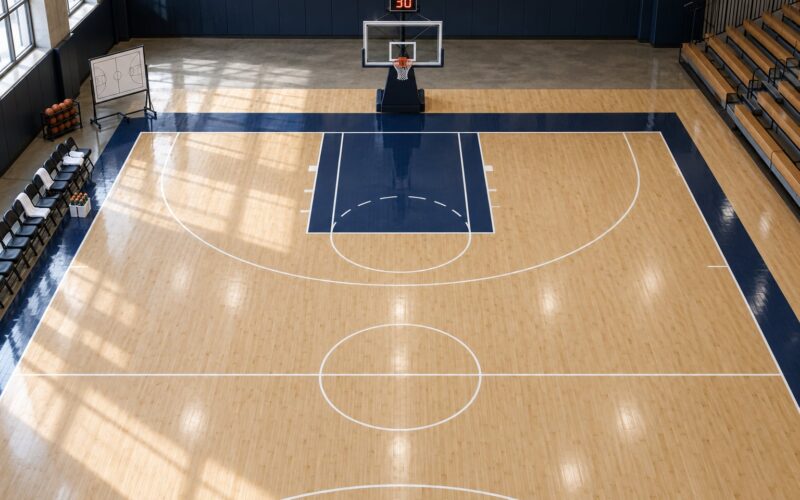
College basketball adopted the three-point line for the 1986-87 season at 19 feet 9 inches, after a handful of conferences tested it in the early 1980s. The NCAA has since moved the arc back twice for men, to 20 feet 9 inches in 2008-09 and to the international distance of 22 feet 1.75 inches in 2019-20, and once for women, in 2021-22.
Those three moves are the short version. The longer story is what the shot did to the rest of the floor: which players coaches recruit, how they space the court, where defenders stand, and how coaches treat a shot taken with the clock running down. Understanding how the three point line changed college basketball means following the arc and the tactics together, because each distance change forced a fresh round of adjustments on both ends.
- The line arrived in 1986-87, and it arrived short at 19 feet 9 inches.
- Men’s basketball moved to 20 feet 9 inches in 2008-09 and to 22 feet 1.75 inches in 2019-20.
- The current men’s arc is 22 feet 1.75 inches at the top of the key and 21 feet 7.875 inches in the corners, the same measurements used internationally.
- Women moved last, in 2021-22, which left two different lines in college hoops for two seasons.
- A shot worth three points changes expected value, and expected value is what drives shot selection.
- Moving the line back did not shrink three-point volume the way many coaches predicted.
Table of Contents
- When Did the Three-Point Line Become Part of College Basketball?
- How Does the Three-Point Line Change the Way Teams Offense?
- Why Three-Point Shooting Changes Team Strategy
- What Happens When Teams Overuse the Three-Point Shot?
- How Did the Three-Point Line Change Defense?
- How Did the Line Change the Roles of Players and Coaches?
- How the Men’s and Women’s Three-Point Lines Differ
- What Changes Are Likely to Shape the Three-Point Line Next?
- Frequently Asked Questions
- What Changed—and What to Watch Next
When Did the Three-Point Line Become Part of College Basketball?
College basketball first experimented with a three-point line in the early 1980s, when several conferences gave it a trial run. The idea was borrowed: the ABA had used a three-point arc in the late 1960s, and the NBA adopted one for the 1979-80 season. College programs tested the shot before making it permanent, and the NCAA went all in for 1986-87.
That first arc sat at 19 feet 9 inches. For more than twenty seasons that stayed the standard, which is why anyone who watched college basketball in the 1990s remembers the shot as an easy one. Yes, the three-point line was shorter in the 90s, and it was shorter than it had been in any era before. Today’s college line sits 2 feet 4.75 inches further back than the one players used during most of the 1990s.
Three separate moves followed, each one a response to the same thing: shooting percentages climbing. In 2007 the NCAA announced the line would move back a foot to 20 feet 9 inches beginning in 2008-09. A one-season experiment in 2012-13 put an even longer arc in front of fans in part of the country before the committee stopped short of adopting it permanently. In June 2019 the Playing Rules Oversight Panel approved the move to the international distance of 22 feet 1.75 inches at the top of the key and 21 feet 7.875 inches in the corners, effective for the 2019-20 season. Division II and Division III picked the change up a season later, in 2020-21.
| Seasons | Men’s line at top of key | Corner distance | What drove the move |
|---|---|---|---|
| 1986-87 through 2007-08 | 19 ft 9 in | Same measurement as top of key | Original adoption after conference experiments |
| 2008-09 through 2011-12 | 20 ft 9 in | Same measurement as top of key | Rising three-point accuracy made the short arc too efficient |
| 2012-13 through 2018-19 | 20 ft 9 in | Same measurement as top of key | One-season long-arc experiment ended without adoption |
| 2019-20 onward for men | 22 ft 1.75 in | 21 ft 7.875 in | Move to international distance to reopen the lane |
| 2021-22 onward for women | 22 ft 1.75 in | 21 ft 7.875 in | Women adopted international distance after two seasons of a split |
Women’s basketball has its own timeline. The women’s game adopted a three-point line in 1995-96, and when the men’s line moved to 20 feet 9 inches in 2008-09 the women’s line moved with it. That left the women’s arc 16.75 inches closer than the men’s for most of the following decade, until the men’s move in 2019-20 finally split the two games, with the women’s game staying at 20 feet 9 inches until it moved out to the international distance for 2021-22.
How Does the Three-Point Line Change the Way Teams Offense?
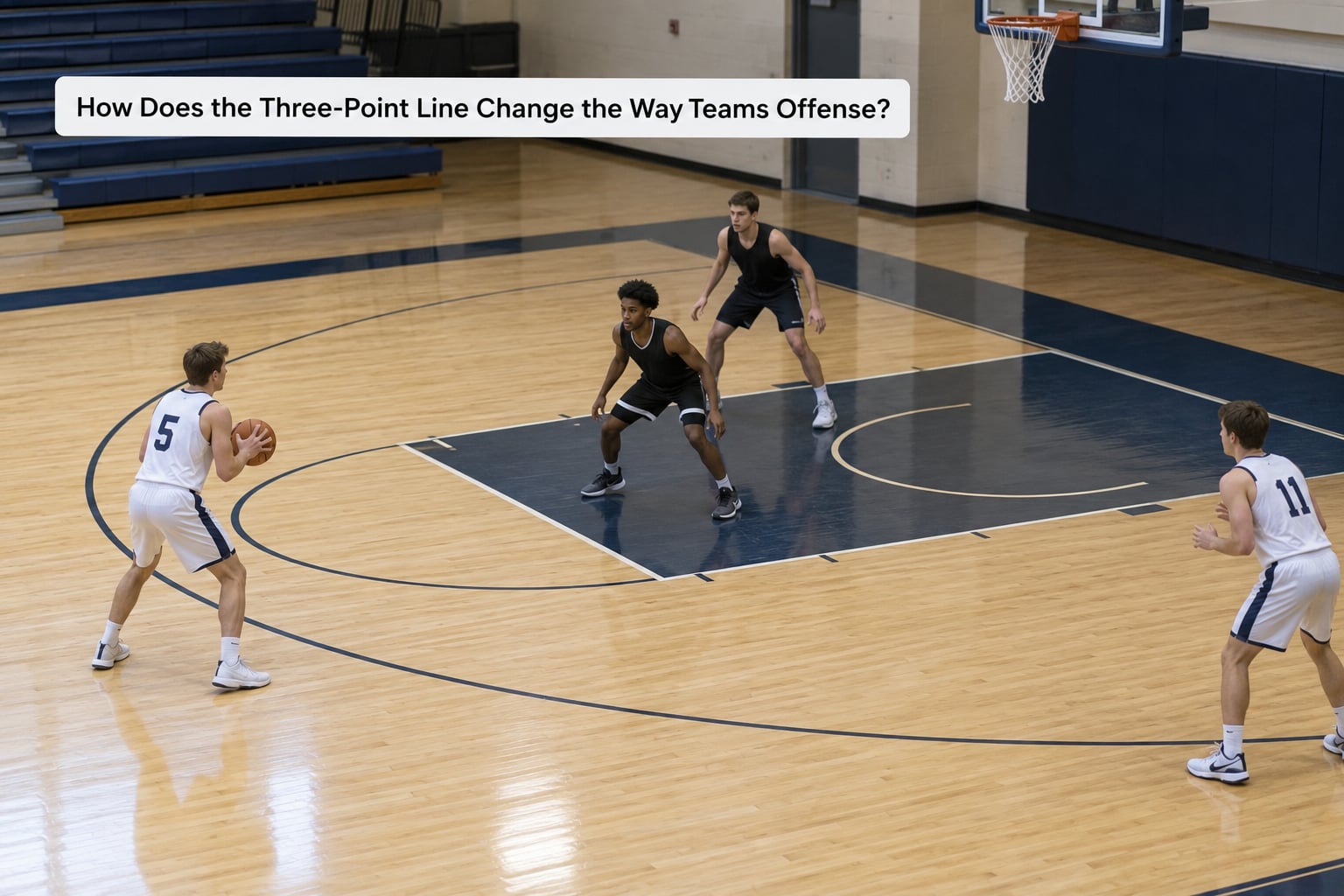
The three-point line does not simply add a shot. It changes the value of every other shot on the floor. When a perimeter player is a genuine threat, the help defender has to leave the paint, and the paint is where a team gets its highest-percentage looks.
That is the reasoning the Playing Rules Oversight Panel gave in 2019. The stated goal was to make the lane more available for drives from the perimeter and to slow the accumulation of three-pointers. In practice, a longer arc compresses the shooting area for defenders to guard, which leaves more room for guards to attack and for forwards to post up with a defender who now has a shooter attached to him.
Spacing is the other half. Five players spread across a 94-foot-wide court force the defense to make choices it cannot avoid. When two players share a side of the floor, the defense can load up. When all five are spread, the help rotation has to travel further, and a well-timed cut or a short roll gets a look that a packed paint would have erased.
Post play did not disappear when the line arrived. It changed. A big man who catches with his back to the basket and a shooter attached to the weak-side defender is a different problem from the same player facing a straight drop, and post frequency in college basketball has moved with the arc as coaches and analytics staff tracked shot value.
How the three point line changed college basketball by the numbers
The reason the arc keeps moving comes down to expected points per attempt. A three-pointer is worth 50 percent more than a two-pointer, so it does not need a much better percentage to be the better shot. A shooter hitting a third from three produces the same expected points as a shooter hitting half from two.
| Three-point percentage | Points per 100 attempts | Two-point percentage needed to match |
|---|---|---|
| 30 percent | 90 | 45 percent |
| 33 percent | 99 | 49.5 percent |
| 35 percent | 105 | 52.5 percent |
| 38 percent | 114 | 57 percent |
Read that table from the bottom up. The better a college shooting team gets from three, the less its two-point accuracy matters, and the more a coach’s attention shifts to finding shooters rather than finishers. That is the mechanism behind every arc change the NCAA has made.
Distance is the other variable, and it works in the opposite direction. Extra feet cost a shooter accuracy, roughly a point or two of percentage for each foot of arc added, which is why the committee could move the line back and expect shot quality to fall slightly. The expectation and the outcome did not match, and fans noticed. A long-running complaint in r/CollegeBasketball and on the Duke Basketball Report boards is that moving the arc back barely dented three-point volume, and Jim Boeheim’s blunt take during the debate was that the difference in the distance does not matter.
Arc mathematics explains why. A shot launched a little further back does not have to travel in a flatter, harder line to reach the rim, and a shooter who adjusts release point and dip keeps most of his accuracy. The extra distance reduces the value of the shot without removing the ability to make it, which is exactly the outcome coaches warned about in 2007, when Bruce Pearl criticized the move to 20 feet 9 inches as the announcement was made.
Why Three-Point Shooting Changes Team Strategy
Once the shot carries that value, roster construction follows. A team built for the current arc wants shooting first and size second, with just enough interior scoring to punish defenses that pack the lane. Teams built for a shorter arc could afford a different balance, and the difference shows up in recruiting lists as much as in box scores.
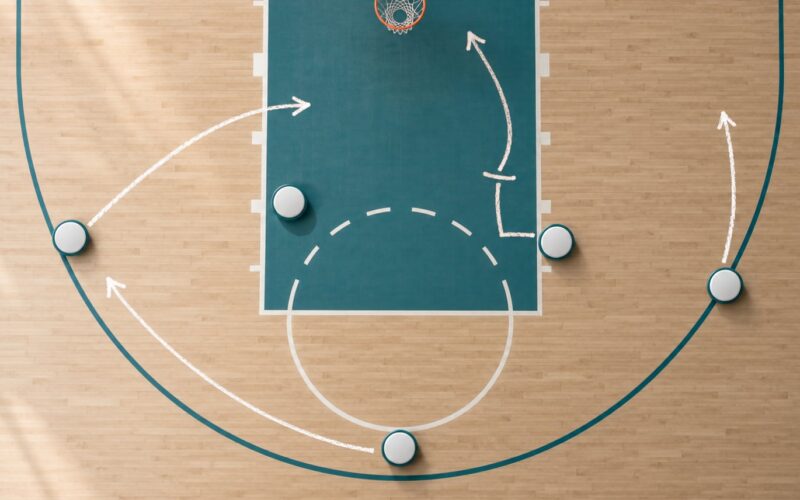
Five-out spacing is the clearest product of the arc. With every defender guarding a shooter and the next man, there is no free defender to help, so ball movement turns into penetration and cuts. High pick-and-roll usage follows for the same reason. A screen near the top of the key either traps the on-ball defender and frees the handler, or the big man slips and has an open lane, and either outcome produced a perimeter attempt somewhere in the possession.
Transition offense gets a similar boost. A corner three in early offense is the highest-percentage shot in a possession that has not even used a dribble yet, which pushes teams to rebound with numbers rather than one big man crashing the glass. The trade is offensive rebounding. Once a team decides a missed three is a live-ball loss instead of an extra chance, players stop going after it, and possession value changes.
Shot clock discipline follows the same math. A team trailing with ten seconds left has a clear answer, and it is not a free throw or a wing three. Forum posters describe the modern version of that situation with a layup, because going to the rim produces a chance at two plus a trip to the line. The decision is arithmetic before it is philosophy.
Post frequency is where coaches disagree most, and the split is mostly about roster construction. Programs with a genuinely skilled low-post scorer keep feeding him, because three points from a foot away does not work on a good defender. Programs without one are left with the choice between a contested three and a contested two, which is a smaller gap than most fans assume.
What Happens When Teams Overuse the Three-Point Shot?
A perimeter-first offense is not automatically a good one. The shot is worth more per attempt, but attempts are not free, and the costs land on the other end of the floor.
Late-clock threes are the visible failure. When a defense denies the first action and a second, a team that has planned only one answer often settles for a three that is worth less than the two-pointer it replaced. The math is unforgiving: a rushed three at 25 percent produces 0.75 points per attempt, well below a 50 percent two.
Rebounding is the quieter cost. Teams that shoot more threes get fewer offensive rebounds, and a team that wins few second chances has to generate fresh possessions instead. When those possessions come from turnovers or missed shots, transition defense gets harder, which is where extra points against tend to appear.
Interior scoring is the cost fans argue about most. Some coaches and commentators, including Len Elmore among others, have called for the three to be abolished entirely or devalued back toward a novelty. The counterargument on forums is that a shot being efficient is not the same as a shot being unfair, and that the rules committee has a working alternative: move the arc, which it has now done twice.
How Did the Three-Point Line Change Defense?
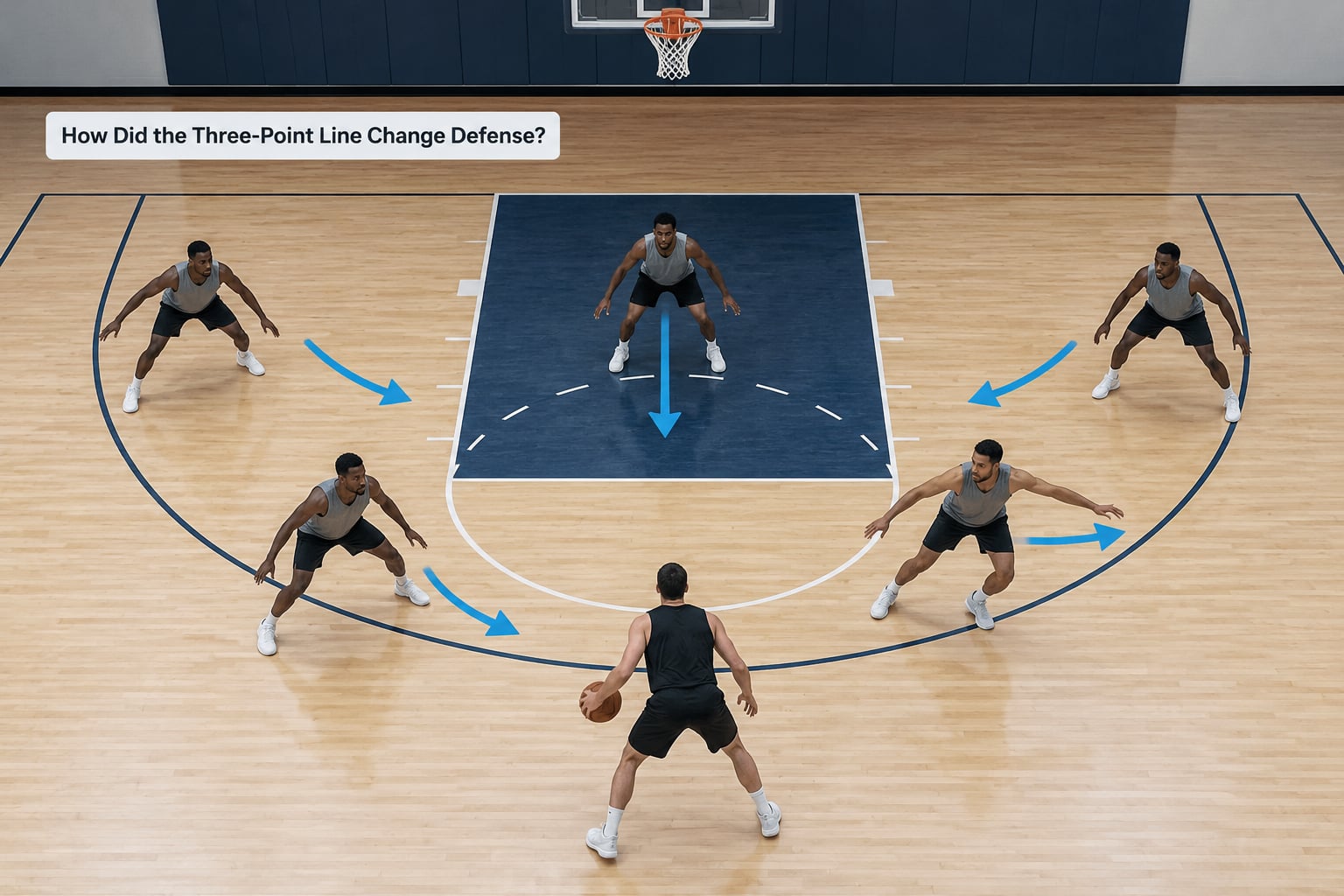
A longer arc compresses the area a defense has to cover. There is less floor between the top of the key and the baseline, which means help defenders are closer to their assignments and less able to cheat toward the ball. It is one of the quieter reasons the 2019 move gave coaches what they asked for.
Lineups followed. Because the shooter is now a threat from further out, the value of a defender who can guard one through a switch rises, and the value of a forward who cannot goes down. Screen coverage changed with it, since the pick-and-roll that dominated the shorter arc has to be handled differently when the handler can shoot over the top of the hedge.
Drop coverage is the clearest example. A big man who sinks toward the rim to cut off the drive is giving up the perimeter, which works because the shorter arc made driving the default. With the arc back, the trade has to be calculated, and defenders who used to sag unconditionally now have to decide when a good shooter gets the ball on a given possession.
Hedge and recover is the opposite approach, built for exactly that. Rather than dropping and hoping, a defender steps high to disrupt the screen, recovers to the shooter, and accepts the risk of a short roll. Which of those two coverages a team prefers comes down to how well the offense shoots from outside, which is a circular problem the arc keeps re-shaping.
Packing the lane remains a real tactic, particularly against teams with one shooter. It works until the ball rotates to the open man, and a longer arc gives the rotation more distance to cover. Defensive rebounding also matters more in this environment, because a team that contests every three has to live with the miss.
How Did the Line Change the Roles of Players and Coaches?
Positions got smaller on paper and larger in practice. A guard who can shoot is no longer a role player, and the two-way guard archetype of the last decade is a direct descendant of the arc’s extra foot. Recruiting scrimmages and high school offenses shifted first, since that is where shooting is developed, and the college game inherited the product.
Off-ball movement became a skill coaches hire for. A player who cannot create his own shot has to find one through screens, cuts, and relocation, and those actions depend on the spacing the arc makes possible. Positional size matters less as a standalone trait and more as a defensive ability, which is how the recruiting conversation about big men changed rather than disappeared.
Coaches picked up a data habit along the way. Shot quality by location became a recruiting filter and a game-plan input, and the arc itself became a variable to model, because every distance change resets the shot chart. Geno Auriemma’s complaint about women’s basketball playing with two different lines on the court in 2019-20 was really a complaint about models built on one set of numbers suddenly facing another.
None of this retires the interior game. Passing, screen setting, and rim protection decide a large share of possessions, and a team that spaces the floor without a reason to drive gives those skills nothing to work with. The arc raises the value of shooting. It does not replace the rest of the game.
How the Men’s and Women’s Three-Point Lines Differ
The two games do not always use the same arc, and the difference has been the source of most public confusion on the topic. Both adopted the three-pointer in different decades: the NCAA added it for men in 1986-87 and for women in 1995-96.
From 2008-09 through 2018-19 the women’s game played at 20 feet 9 inches while the men’s game stayed there too. When the men’s line moved out to 22 feet 1.75 inches for 2019-20, the women’s game did not follow. That produced two seasons, 2019-20 and 2020-21, in which the men’s and women’s arcs differed by 16.75 inches, with the women’s game staying at 20 feet 9 inches.
The effect was not only statistical. Recruiters and coaches cited the split as a reason to keep recruiting against different competition, and Auriemma publicly called the women’s failure to move the line back a bad decision. Women’s basketball adopted the international distance for 2021-22, reunifying the two games on the same measurements.
The reason to know all of this is straightforward. If you compare a three-point percentage from one era to another without knowing the arc, you are comparing different shots. A number recorded under the 19 foot 9 inch line and a number recorded under the current arc are not the same statistic, and the difference between them tells you more about the rules than about the shooter.
What Changes Are Likely to Shape the Three-Point Line Next?
Nobody in the research has announced another move, and the committee has shown no appetite for another change after two in a dozen years. Still, a few pressures could push the arc again.
A shot clock change is the most cited one in fan discussions. If possessions shorten, a defense has less time to recover from a switch or a scramble, and the calculus on a longer three improves. Forums have speculated for years about whether a shorter clock would eventually come with a wider court and a longer arc, since the two changes solve the same problem from opposite directions.
Portal movement and name, image and likeness payments have made the one-season-team less common, and players arrive with more developed shooting. A baseline of shooting ability that keeps rising pushes the efficiency argument each year, and the committee has shown it will act on that trend when it gets strong enough.
Television has an interest in pace and scoring, which cuts against a slower, more deliberate game built around interior scoring. Player movement rules and experimentation at a few programs may change how much of the shot is open rather than contested. None of these force a change on its own. They are pressures, not predictions.
Frequently Asked Questions
When was the three-point line added to college basketball?
The NCAA adopted the three-point line for the 1986-87 season, at 19 feet 9 inches, after several conferences tested it in the early 1980s. The arc moved to 20 feet 9 inches for 2008-09 and to the international distance of 22 feet 1.75 inches for 2019-20 in men’s basketball, and for 2021-22 in women’s basketball. Division II and Division III adopted the international distance a season later.
How far is the three-point line in men’s college basketball?
The men’s line sits at 22 feet 1.75 inches at the top of the key and 21 feet 7.875 inches in the corners, which are the international measurements used by FIBA. The NBA line is longer at 23 feet 9 inches, or 22 feet in the corners. For reference, the college line was 19 feet 9 inches from 1986-87 until 2007-08, so today’s shooters work from a little more than two feet further out than 1990s players did.
Why is shooting a three-pointer worth three points?
The three is worth 50 percent more than a two, so it does not need a much higher percentage to be the better shot. A shooter making a third of his three-pointers earns the same expected points as one making half of his two-pointers. That is why the arc keeps moving: when shooting accuracy climbs, the committee moves the line back to restore value to the shot, and teams adjust their shot selection accordingly.
Did the three-point line make college basketball slower?
No. The shot is the fastest one on the floor, and its introduction pushed teams toward transition offense and early-corner attempts. Moving the line back in 2019-20 was partly an attempt to create more drives and post opportunities, and the effect on pace was small compared with the effect on spacing. What has changed most is where the shot comes from, not how long possessions take.
Why is the women’s college three-point line different?
The two games have not always shared an arc. When men’s basketball moved to the international distance for 2019-20, women’s basketball stayed at 20 feet 9 inches, creating a split of 16.75 inches for two seasons. Coaches argued that recruiting and comparisons suffered with two different lines on the floor. Women’s basketball adopted the 22 feet 1.75 inch line for 2021-22, so the games now use the same measurements.
What Changed—and What to Watch Next
How the three point line changed college basketball can be summed up in three moves and one constant. The three moves: 19 feet 9 inches in 1986-87, 20 feet 9 inches in 2008-09, and the international distance in 2019-20 for men and 2021-22 for women. The constant is shooting accuracy, which is what pushed the arc each time and what will decide whether it moves again.
The first thing to take from this is to stop treating the line as a rule change. It is a variable that shifts everything around it. Shot value changes, then spacing changes, then defensive coverage changes, then recruiting changes, and the arc is still where you started. Watch the distance and the shot chart together, and the rest of the game tends to explain itself.