How college mascots are chosen today looks remarkably consistent: the community nominates names, a selection committee screens them against published criteria, a few finalists go to a vote, and the board or president signs off. Only after that does a designer draw it.
The old version was much looser. A show of hands at a student assembly in 1909 settled the Panther at Pittsburgh. Today the same decision can run two years, involve a 40-member committee and thousands of ranked ballots. Here is what actually happens in between.
Table of Contents
- Why Colleges Choose a Mascot
- How College Mascots Are Chosen: The Full Process
- Who Decides What a College Mascot Is?
- What Makes a College Mascot Work?
- Why Some Mascot Changes Are Controversial
- Five Real Examples of How College Mascots Are Chosen
- How Mascots Are Tested and Approved
- Frequently Asked Questions
- Conclusion: Start With the School Identity
Why Colleges Choose a Mascot
A mascot is the cheapest branding a university has. It sits on a helmet, a sweatshirt, a parade float and a recruiting brochure, and it never needs updating. Once it works, it works for a century.
Four goals usually sit behind the decision. The first is school spirit, which sounds soft but drives everything from homecoming attendance to season ticket renewals. The second is recognition, since a mascot gives fans something to say in a noisy sports market. The third is distinctiveness, meaning it should not blur into a conference full of other predators. The fourth is merchandise, because the character has to survive being printed on a hat, stitched onto a jacket and inflated outside a stadium.
One widely cited survey of US school mascots puts animals at 55.7% of the total, with eagles the single most common choice at 1,419 schools. Safe choices like eagles, bears and wildcats are everywhere, which is exactly why a school often wants something stranger.
There is also a legal layer. Ten states restrict the use of Native American mascots, a fact that shapes which concepts are even allowed onto a ballot. A committee cannot nominate a name that state law or university policy already forbids.
How College Mascots Are Chosen: The Full Process
Here is the six-step sequence most schools follow, whether the decision takes four months or two years.
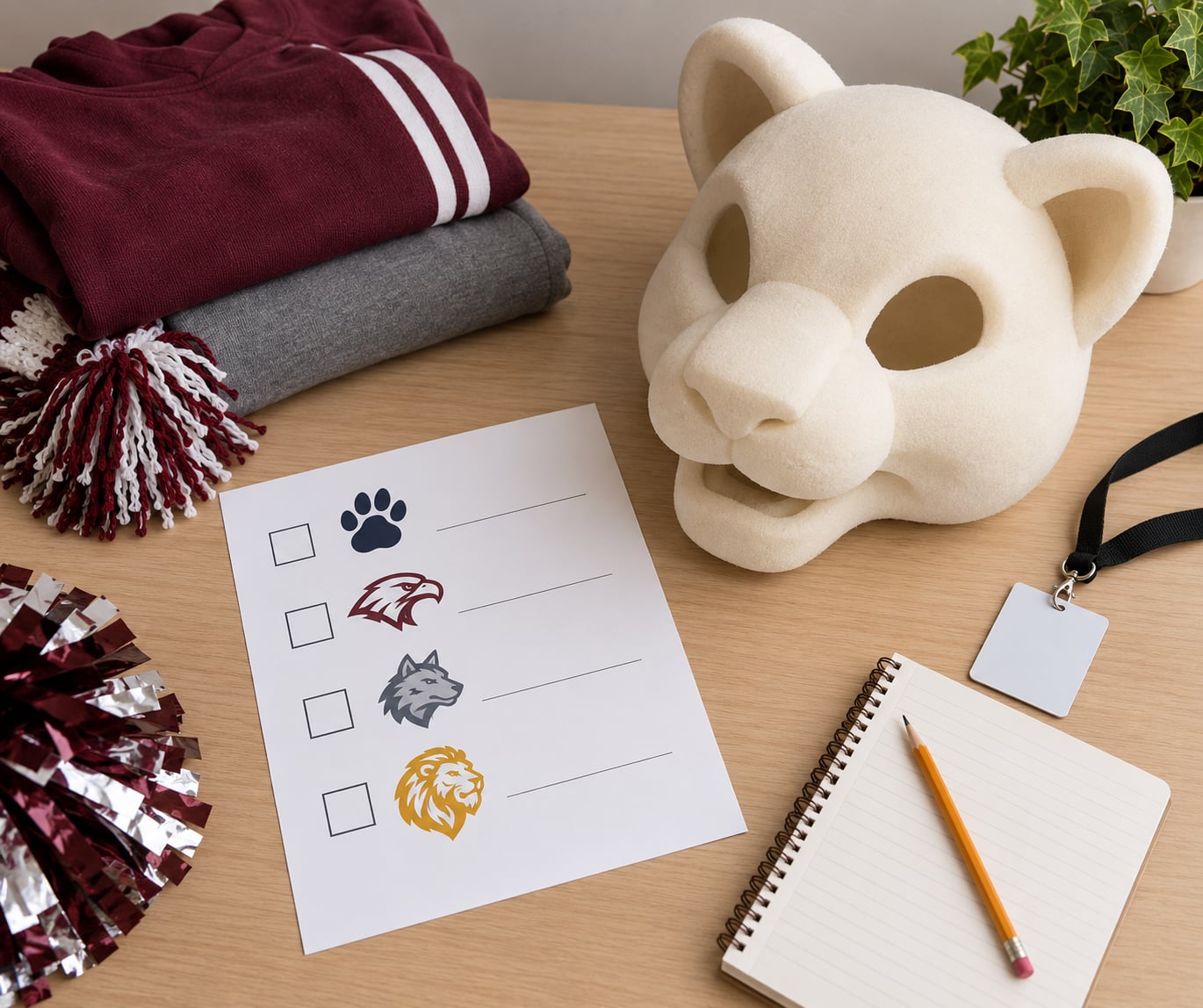
- Write the criteria first. The school publishes what a good mascot must be before it opens nominations, so the committee has something objective to score against later.
- Open nominations. Anyone in the school community can submit names, usually through a form. This is where volume shows up.
- Appoint a steering committee. A small group of students, staff, faculty and alumni filters the raw list and explains the reasoning behind the survivors.
- Screen against the criteria. The bigger committee rules out names that duplicate a regional rival, repeat a retired mascot, or fail a values and sensitivity review.
- Put finalists to a vote. Modern votes are usually ranked-choice ballots, where you rank options rather than picking one. Lowest totals get eliminated first until a winner emerges.
- Get institutional approval. The board of trustees or the president formally adopts the result before anything gets drawn or sewn.
Ranked choice matters more than it sounds. A plurality vote hands the win to whatever name has the most single votes, even if half the school hates it. Ranked choice forces a broad second choice, which usually drags the result away from the joke entry and toward something the school can live with for fifty years.
How college mascots are chosen today, in one documented timeline
Lewis & Clark College in Portland publishes its full mascot process on its own site, which makes it the best-documented modern example available anywhere. Its Pioneer mascot was retired on September 18, 2024, and the search for a replacement is a clean case study of the whole pipeline.
| Stage | What happened at Lewis & Clark |
|---|---|
| Criteria published | Named what a mascot should represent, plus an explicit list of exclusions |
| Community survey | More than 7,000 responses from students, staff, faculty and alumni |
| Steering committee | 21 members narrowed the field |
| Unique nominations | 414 submitted |
| Advisory committee | 40-member Mascot Advisory and Selection Committee (MASC) screened them |
| Finalists | 8 names, each presented with rationale and collective noun |
| Ranked-choice voting | Open September 10-19, 2025 |
| Ballots cast | 6,475 |
| Reveal | Scheduled for 2026 |
Two numbers in that table are worth pausing on. First, 414 nominations became 8 finalists, which is roughly a two percent survival rate. Second, the school retired its old mascot before it had a replacement, so the reveal comes more than two years after the decision to change.
Who Decides What a College Mascot Is?
Five groups get a say, and schools weight them differently.
- Current students. The loudest group and the one most affected by the daily reality of wearing the costume.
- Alumni. Smaller in number, far more organized, and often the largest block of raw ballots in a modern vote.
- Faculty and staff. Useful for testing cultural sensitivity and practical feasibility, but rarely the loudest voice.
- Athletics and the president. Holds brand and budget authority, and can override a community result.
- The board of trustees. Provides the final formal approval in most schools.
The tension everyone asks about is students versus alumni, and the data is clearer than the press coverage suggests. At Lewis & Clark, participation reached about 52% of students, 60% of employees and 16% of alumni. Because the alumni body is so much larger than the current student body, 16% of alumni still outnumbered the entire student vote on raw ballots.
That gap is where frustration lives. In an r/UIUC thread titled STOP SPREADING LIES AND BS ABOUT THE NEW MASCOT, users argued over exactly this, with one side claiming the student body had little real voice in a mascot decision. On r/CFB, the most common question in origin threads is still simpler: how did my team choose this?
What Makes a College Mascot Work?
Committees score finalists against a fixed list, and the list looks remarkably similar from school to school.
- Regional relevance. The animal or object should connect to the state, the terrain or an industry the region is known for.
- Symbolic fit. Committees check whether the concept matches stated values, which rules out anything reading as aggressive or exclusionary.
- Distinctiveness. If four schools in the same conference already use your finalist, it dies.
- Merchandise versatility. It has to read at small size on a hat and hold up as a full costume.
- Costume buildability. Someone has to make this thing, and it has to be animatable.
- Gender balance. Committees now look explicitly for female and non-stereotyped options.
- Rarity. The more common the animal across school mascots, the harder it is to stand out.
The exclusion list matters as much as the criteria. Lewis & Clark published what it would not consider, including the retired Pioneer name and any concept that duplicated a mascot used elsewhere in the region. Screening openly, before the vote, is what keeps a ballot from being a popularity contest on a bad idea.
Why Some Mascot Changes Are Controversial
Mascot fights are rarely about the animal. They are about who gets to decide and what the old name meant.
Familiarity is the biggest source of resistance. A mascot in place for fifty years has been on three generations of letterman jackets, and alumni treat a change as a verdict on their own years rather than on the logo.
Origins are the second flashpoint, because many school histories do not survive close reading. On r/CFB, a commenter laid out that LSU’s Fighting Tigers nickname traces to a Confederate brigade called the Louisiana Tigers that served in Confederate infantry. Nobody in the thread argued about whether the mascot looks good. They argued about whether the story was true, which is usually the actual fight.
Native American mascots add a legal and moral layer. The same pressure that pushes public school districts to retire imagery is now reaching colleges through state regulation and federal funding conditions, and schools that resist often find alumni and students split down the middle.
Design process is the newest flashpoint. A petition at r/swinburne said the college was disappointed that a mascot competition resulted in an AI-generated design being chosen without meaningful student input. The complaint is not really about the software. It is about skipping the committee stage and presenting a finished image as if the community had agreed.
Age and culture explain a pattern in the existing roster. A long thread on r/sports asked why most college mascots are male, and the top answer was straightforward: when most schools picked their mascots, college athletics was effectively a male pursuit.
Five Real Examples of How College Mascots Are Chosen
These are not ranked. They are five schools that got to a mascot by five visibly different routes, which is the point.
| Mascot | School | Year | Method |
|---|---|---|---|
| Panther | Pittsburgh | 1909 | Adopted at an autumn meeting of students and alumni |
| Razorbacks | Arkansas | 1910 | Students voted to change the mascot from Cardinals |
| Bear | Baylor | 1914 | Student vote on December 14, 1914, among several nominees |
| Tree | Stanford | Annual | Redesigned each year by the marching band during Tree Week |
| River Otter | Lewis & Clark | 2026 | Committee screening plus a ranked-choice ballot |
Pittsburgh, 1909: the assembly model. The Panther was adopted at a meeting of students and alumni in the autumn of 1909. There was no committee, no criteria document and no ballot. Decisions like this were the standard well into the twentieth century, which is why so many origin stories end with someone raising a hand in a crowded room.
Arkansas, 1910: changing an existing name. Students voted to move from Cardinals to Razorbacks. This is the less celebrated half of mascot selection, and plenty of schools are doing it right now under more scrutiny and more process.
Baylor, 1914: a dated student referendum. Baylor students voted on December 14, 1914 to adopt a bear, choosing among several other nominated mascots. Fans respond to exact dates like this one far more than to a vague long-ago origin, partly because the archive backs it up.
Stanford: the rotating mascot. The Tree belongs to the marching band and gets redesigned every year during Tree Week, yet it functions as the university’s face far beyond the band. Delta State runs a similar annual ritual, with candidates auditioning in self-constructed costumes and the winner becoming the Fighting Okra for that year.
Lewis & Clark: the modern model. Old mascot retired, criteria published, 7,000-plus survey responses, 414 nominations, 8 finalists, 6,475 ranked ballots, and a reveal in 2026. It is slow, expensive and awkward, and it is also what a contested mascot decision now looks like when a school wants the outcome to hold.
How Mascots Are Tested and Approved
After the vote, the work changes shape. What remains is legal, practical and expensive.
Trademark and licensing clearance comes next, because a promising name can already be claimed by a conference rival, a local business or a national brand. Schools check that the mascot is distinctive enough in commerce, not just on campus.
Focus groups and values reviews follow. Committees test finalists with constituency groups to catch reactions that a survey average hides, particularly around imagery that reads differently to different communities.
Then the name and the character come apart. The community votes on a name. The artwork, costume and personality are commissioned separately by a designer and a costume builder. Lewis & Clark published each finalist’s rationale and collective noun without ever commissioning a costume in advance, which keeps the vote about ideas instead of about renderings. That is the opposite of the AI-design complaint, where a finished image arrives before anyone has agreed on the idea underneath it.
Performance is hired separately again. Tryouts run through panels, and the University of Miami’s Gators use five judges to evaluate returning and new candidates. Live animal mascots carry a different weight entirely: LSU’s Mike VII lives in a habitat of roughly 15,000 square feet with a waterfall and stream, which is a permanent facility commitment rather than a costume decision.
Frequently Asked Questions
Do students vote on their school’s mascot?
Often, but not always. Some schools run an open student referendum, others let a committee narrow a list to finalists and then take it to the community, and some decide inside athletics or the president’s office. Lewis u0026amp; Clark College collected 6,475 ranked-choice ballots in September 2025 from students, employees and alumni together. Even when students vote, the board of trustees usually has to approve the result formally.
How long does it take a college to choose a new mascot?
Budget a year and a half to two years for a contested decision. Lewis u0026amp; Clark retired its Pioneer mascot in September 2024, gathered more than 7,000 survey responses, narrowed 414 nominations to 8 finalists, and scheduled the reveal for 2026. Adding trademark clearance, costume design and a merchandise rollout is what pushes a fast committee process past twelve months.
Which college has no mascot?
Plenty of institutions deliberately have none. Some universities lead with a nickname or a crest and never commission a costumed character at all, because they consider a mascot marketing rather than tradition. Others have retired a mascot and have not replaced it yet. There is no single famous answer to this question, which is why it stays a live search.
Do people get paid to be college mascots?
Usually, but the arrangement varies widely by school. Common setups include an hourly stipend for appearances, a scholarship, a tuition waiver or tuition remission, work-study hours, and in some cases a full-time university job that includes coaching, appearances and community events. Live animal mascots are cared for by staff rather than performed by a student, so that pay structure looks different entirely.
Why are college mascots kept a secret?
The secrecy protects the idea that the character belongs to the school, not to a student. Schools keep performer identities quiet so the mascot stays a symbol rather than a personality, and so the character can stay consistent across years. Alabama’s Big Al program is a commonly cited example, where a shadow squad rehearses in private to preserve the mystery.
Are any college mascots female?
Yes. Ralphie the Buffalo at Colorado and Libre the Black Bear at Liberty are the two most cited examples. Most existing mascots are male because most were adopted when college athletics was effectively a male pursuit. Modern selection committees are more deliberate about this, and gender balance now appears on published mascot criteria lists.
Conclusion: Start With the School Identity
The pattern is consistent across five very different schools. Nominations come from everyone, a committee screens against criteria the school published in advance, finalists go to a ranked vote, and someone with authority signs off before a designer touches a pencil.
If you want to understand how college mascots are chosen at any specific school, read three things: the published criteria document, the committee roster, and the turnout breakdown by constituency. The first tells you what the school values, the second tells you who actually decided, and the third tells you whether the students who attend had a real say.