A rivalry game is different from a regular game because it carries accumulated stakes that do not exist on the field: years of shared history, geographic or cultural proximity, traditions that repeat every season, and an identity both fanbases have decided to defend. Those things change the atmosphere, the tactics, and what a win means six months later.
That distinction is worth sitting with before kickoff. A rivalry game is not a harder game in some mechanical sense. It is a game carrying more memory than a regular game ever holds.
Table of Contents
- What Makes a Rivalry Game Different From a Regular Game?
- How Does a Shared Rivalry History Change the Game?
- How Do Traditions and Rivalry Stories Affect the Atmosphere?
- What Does a Rivalry Change for Players and Coaches?
- Why Do Rivalry Games Create Bigger Stakes?
- How Does the Crowd Affect a Rivalry Game?
- How Do Coaches Adjust Strategy in a Rivalry?
- What Can Change—and What Usually Stays the Same?
- Frequently Asked Questions
- Are rivalry games usually more intense than regular-season games?
- Does the home crowd really make a difference in a rivalry game?
- Why do coaches play more conservatively in rivalry games?
- Can a rivalry game be important even when neither team is ranked?
- What makes a college sports rivalry different from a professional rivalry?
- Conclusion
What Makes a Rivalry Game Different From a Regular Game?
Here is the short version. A regular game asks who is better this season. A rivalry game also asks who has been better, who is supposed to be better, and what happens to a family, a campus, or a state identity when the other side wins. The comparison below is the one I come back to when someone asks me to explain the difference.
| Element | Rivalry Game | Regular Game |
|---|---|---|
| What is at stake | Accumulated and symbolic | Standings points or seeding |
| Why it matters | Years of shared memory | One date on a schedule |
| Atmosphere | Student section, band, rituals, walkouts | A normal home crowd |
| Media treatment | Primetime window, narrative preview all week | A routine broadcast slot |
| Player preparation | Personal and emotional | Standard game plan |
| Coaching decisions | Reputation-aware, risk-averse | Baseline tendencies |
| Fan behavior | Travel, tailgates, whole families attending | Season-ticket habit |
| After the game | Defining memory, talked about for months | Next week’s preparation |
| The result | Validates an identity | One line in a record book |
Psychologists who study this treat rivalry as an identity phenomenon rather than a sporting one. The widely cited definition comes from Tyler and Cobbs, who describe rivalry as conflict with a highly salient outgroup that threatens and enhances in-group identity and esteem. Read that again: identity, not standings. That is the engine under everything in the table above.
How Does a Shared Rivalry History Change the Game?
History turns individual meetings into chapters. Michigan and Ohio State first played in 1897, and the series now called The Game carries the weight of the Ten Year War era under Woody Hayes and Bo Schembechler, when those games defined the coaches themselves. Nobody has to explain the 1897 meeting to a fan who has heard the story of the trophy war and the attempted field goal in the final seconds of the 1989 game.
That accumulation matters in a measurable way too. Fans have noticed specific statistical patterns: one r/CFB thread points out that since 2000, the team winning the rushing battle in The Game has gone on to win the game. A pattern like that only exists in a series somebody has watched closely for decades.
Rivalries also survive interruption in ways that ordinary games do not. Pittsburgh and Penn State first met in 1893, stopped playing in 2000 when Penn State joined the Big Ten, and then ran a four-game revival series across four consecutive seasons. A regular non-conference game with a five-year gap simply stops existing. A rivalry gets reactivated, because the fans never let go of the record.
So how do you check whether a matchup deserves the label? The check fans actually run is boringly specific, and it is the same one that shows up on r/CFB threads: look up the first meeting year, count the meetings, read the series record, check whether the two programs kept playing through conference realignment, and see whether a trophy or ritual grew around the series. Michigan and Ohio State pass every one of those checks. A non-conference game announced three years ago fails most of them before kickoff.
That last check explains a lot of arguing online. A one-sided series record drains the tension, and fans are blunt about it. Envy is the quieter cousin: plenty of Arizona fans will admit to admiring a rival’s traditions and pageantry while still hoping for the other result.
How Do Traditions and Rivalry Stories Affect the Atmosphere?
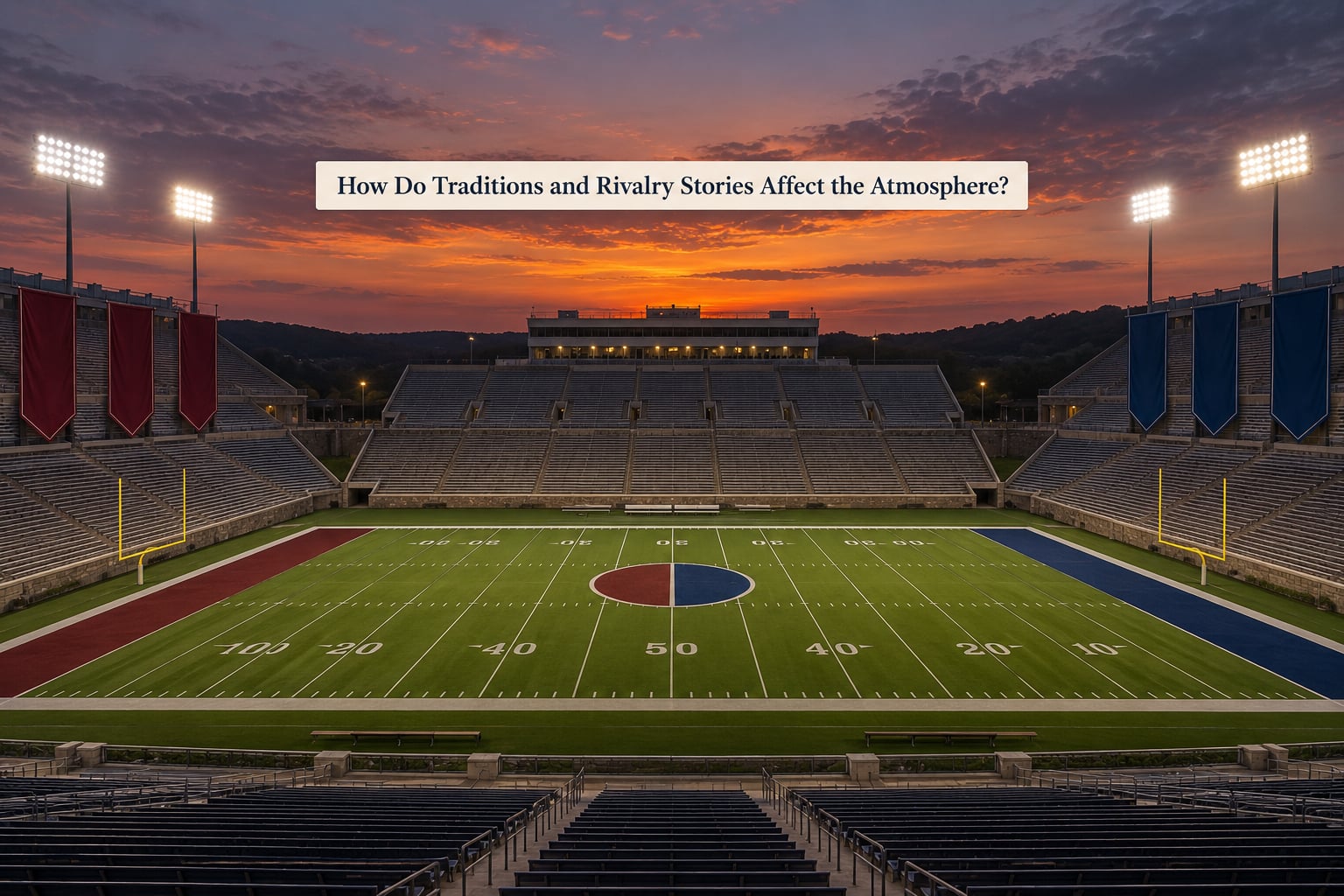
Traditions are how a rivalry gets into the body of the game. A traveling trophy that lives in a display case between meetings, a song the visiting band refuses to play, a color the student section wears on a specific Friday in October, a tunnel entrance players treat like a ceremony. None of it affects the scoreboard. All of it decides what the building sounds like in the third quarter.
Trophies are the clearest marker. Louisville and Kentucky have competed in the Governor’s Cup since the trophy was first contested in the early 1900s; it went dormant for decades, was revived in 1994, and has been played for ever since. Cal and Stanford first met in 1892, and the nickname The Big Game is tied to the 1900 Thanksgiving Day Disaster, the field-storming Stanford celebration that pushed the name into the record.
Rituals matter most because they are repeated. A team that wins a game once has an event. A team that wins the same game every November, in the same building, against the same people, has a story, and stories accumulate.
What Does a Rivalry Change for Players and Coaches?
Coaches treat a rivalry week like a different job. Opponent scouting gets an extra day, the self-scout gets an extra day, and the weekly emphasis shifts from scheme to emotion: what will rattle this specific team, what will fire this team up. On the sideline that can look like extra caution, because the coach knows that a rivalry loss is judged by people who were not in the film room.
What Makes a Rivalry Game Feel Different to Players?
Rivalry week changes the focus, not the fundamentals. Players talk about how loud it gets, how every mistake gets replayed on the sideline, how the noise makes communication harder, and how a turnover in the third quarter feels different when the opposing student section is standing up. They also talk about the reward: a signature win that outlasts a good season.
None of that makes a player faster or more accurate. What makes a rivalry game different from a regular game for the people on the field is the emotional load and the audience. Athletes still have to block, catch, and convert on fourth down the same way they did in September. The pressure only decides how much the miss will be remembered.
Why Do Rivalry Games Create Bigger Stakes?
Some rivalries genuinely carry postseason consequences: conference standing points, playoff positioning, a signature win on a résumé. Others are worth much less on a bracket sheet and still sell out and still get argued about in December. The symbolic value comes from layers that a standings table cannot show.
Recruiting is one of them. Two programs drawing from the same high school pipeline every fall turn a game into a public statement about who owns the region. Alumni interest is another, and it is a real audience rather than a slogan: a rivalry game draws families who attended the same school decades apart and now sit on opposite sides of the argument.
The last layer is bragging rights, which fans treat seriously because winning is not purely zero-sum when it comes to identity. Researchers studying fan behavior call it schadenfreude: taking a genuine pleasure in an outgroup’s misfortune. It is the honest reason a loss stings longer in a rivalry than the same loss in September.
How Does the Crowd Affect a Rivalry Game?
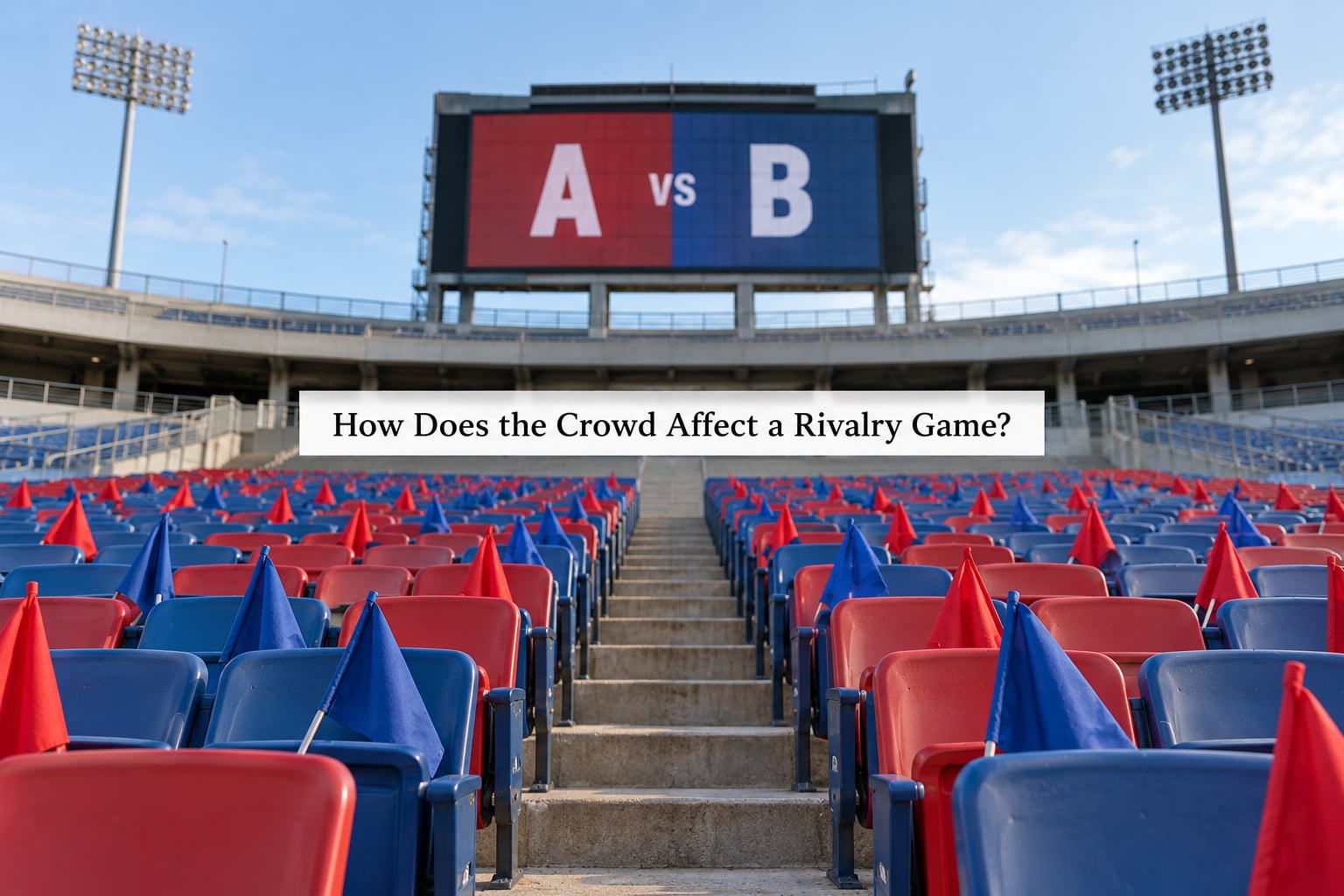
A rivalry crowd is louder than a normal home crowd for reasons that are not random. Student sections plan for weeks, bands rehearse specifically, and alumni arrive with a calendar blocked out. The noise does two things at once: it erodes the visiting team’s ability to communicate, and it raises the pressure on the home side to produce something worth the noise.
Coaches account for it in the game plan. Away teams use hand signals, built-up cadence, and specific substitution patterns for the stretch after a score, because a simple formation call can genuinely fail in a stadium that is trying to sabotage it. Home teams lean into it. The emotional cost of a rivalry loss also lands harder at home, where the building knows exactly who it was waiting for.
College rivalries hit harder than professional ones for a structural reason. A professional home crowd is made up of people who bought a ticket for this one game. A college student section is the same group of students who will sit there again in three weeks, and an alumni crowd includes people whose own rivalry game happened decades ago. The audience is a standing institution, not an event.
How Do Coaches Adjust Strategy in a Rivalry?
Watch the first quarter and you will usually see the most cautious football of the season. Coaches know that turnovers and penalties carry a doubled cost, so the tendency is to shorten the leash: fewer deep attempts early, punts on fourth down inside comfortable range, and a preference for the run that is known rather than the pass that is hoped for. It is not timidity, it is an acknowledgment that the downside is worse in this game.
Special teams get an outsized share of attention for the same reason. A blocked punt or a missed field goal in a rivalry game produces a headline that lasts a week; in a regular game it produces a box score line. Kickers get extra work, punt teams get extra meeting time, and the operation nobody watched in September becomes the story.
Basketball shows the same psychology in a different shape. Coaches are more willing to load up their best defender against a rival’s leading scorer, and more willing to pull a rotation player for the closing minutes of a game they would manage differently in November. The underlying move is identical: raise the personal stakes so the execution is sharper.
The failure mode is overcorrecting. A coach who is so cautious about embarrassment that the offense never tries anything difficult hands the game to the opponent who is willing to take the risk.
What Can Change—and What Usually Stays the Same?
The atmosphere, the stakes, and the story can all change year to year. Rivalries go dormant, coaching eras end, and conference realignment can cut a series or revive one, as it did for Pittsburgh and Penn State after the 2000 split.
What does not change is the arithmetic of winning. Turnover margin, execution on third down, rebounding, free throws, and health decide football and basketball games once the whistle blows. A rivalry game is played with the same ball on the same field under the same rules. The pressure changes who is standing at the line, not what happens when they do.
Frequently Asked Questions
Are rivalry games usually more intense than regular-season games?
Usually, yes, though intensity shows up in different places. Fans pack in, the student sections stand more, and the emotional stakes are higher. But the underlying scoring is not more explosive. Most rivalry games look more like a cautious, low-scoring chess match early on, because both coaches know the cost of a mistake is doubled.
Does the home crowd really make a difference in a rivalry game?
Yes, in two directions at once. Noise disrupts communication for the visiting offense, which is why away coaches build in hand signals and use a set cadence after scores. The flip side is pressure on the home side, since a home crowd that waited years for a rivalry win takes the loss personally.
Why do coaches play more conservatively in rivalry games?
Because a mistake costs more. Turnovers and penalties generate headlines that outlast the season, and the coach knows the game will be judged by alumni and fans who never watched the film. So you see punts on fourth down in comfortable range, extra attention to special teams, and a preference for the play that is known.
Can a rivalry game be important even when neither team is ranked?
Yes. Rankings measure recent results, and rivalries measure memory. Two programs with identical records can still be the most important date on either fan’s calendar because of history, geography, a shared trophy, and decades of attendance by the same families. Postseason consequences help, but they are not required.
What makes a college sports rivalry different from a professional rivalry?
Continuity of people. A professional home crowd is assembled for one game, while a college student section and its alumni return year after year, which means the audience remembers. College programs also share a recruiting footprint and a home state, so the opponent is a real presence in daily life rather than a name on a schedule.
Conclusion
What makes a rivalry game different from a regular game is everything that happens off the field: shared history, proximity, rituals, identity, and an audience that has been waiting for this date for years. None of that touches the rules of the sport.
So when you watch the next one, look at four things in order: how loud the building is before the game, how personally the teams take a first-quarter mistake, what is actually on the line beyond the scoreboard, and whether either side can still execute its normal fundamentals under all that weight. That last one settles more rivalry games than any of the other three.