College football has five competitive levels: NCAA Division I FBS, NCAA Division I FCS, NCAA Division II, NCAA Division III, and NAIA, with NJCAA junior colleges below that. Each level has its own scholarship rules, schedule length and postseason path.
Most confusion comes from one word. “Division I” is not a single level. Football is the only sport where it splits in two, and the split has a name most fans learn before they learn the schedule. Get that one piece straight and the rest of the sport stops feeling random.
Last updated: October 2026. Conference realignment reshuffles which schools sit in which division every cycle, so treat any static list, including this one, as a snapshot.
Table of Contents
- How College Football Division Levels Work
- What Is the Difference Between Division I and Division II
- What Does Division I FCS Mean
- What Does Division III Football Include
- How Do Scholarships and Athlete Eligibility Work
- How Do Conferences and Scheduling Fit Into the Division System
- How Do Playoffs and Championships Work by Division
- Frequently Asked Questions
- Conclusion
How College Football Division Levels Work
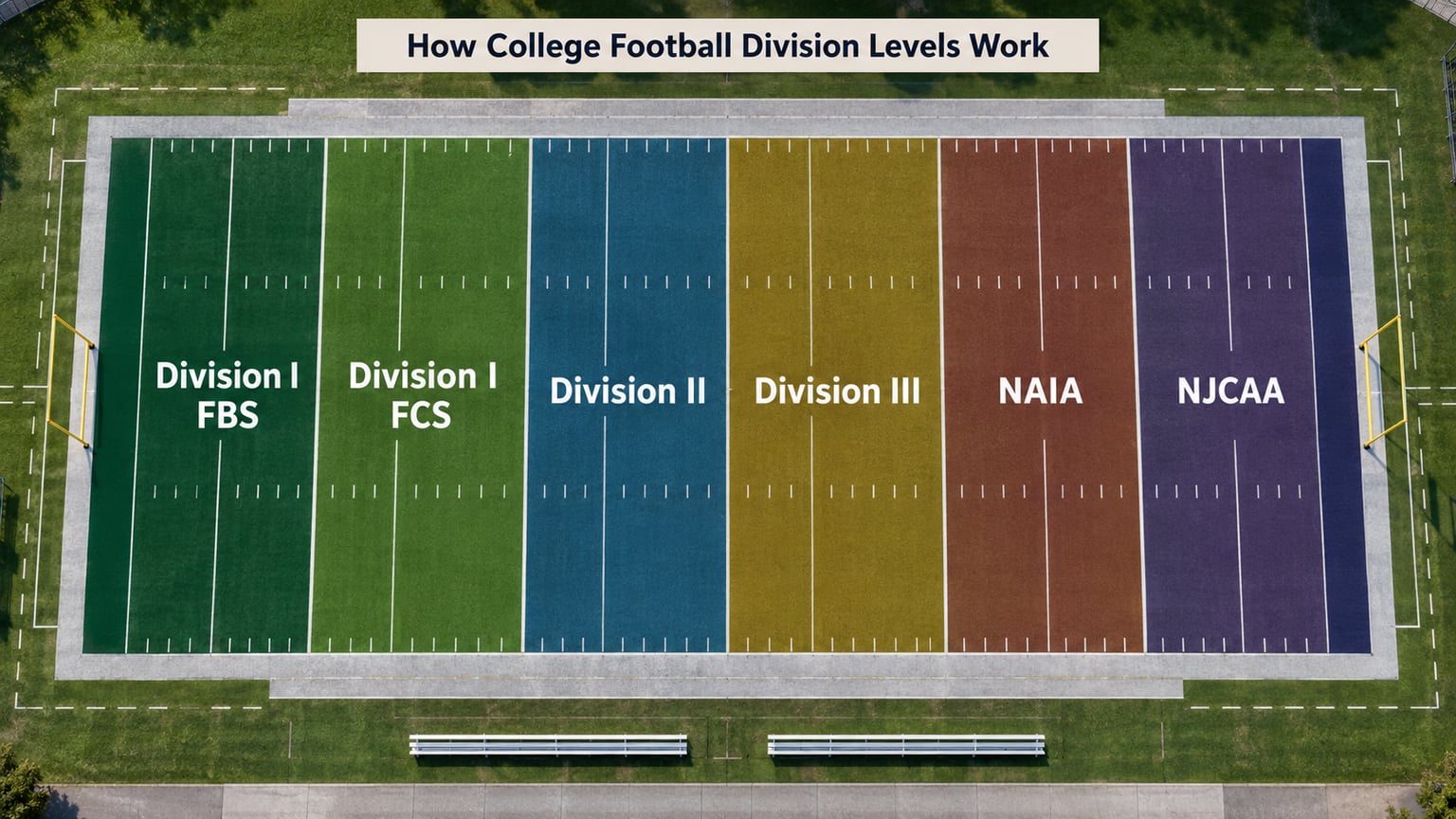
The NCAA groups its more than 1,000 member schools into three divisions based on institutional size and athletic spending. Football is then carved up further: Division I football splits into the Football Bowl Subdivision (FBS) and the Football Championship Subdivision (FCS). NAIA and NJCAA schools belong to different governing bodies entirely.
The one-sentence version of how college football division levels work
A school’s division is set by how big the school is and how much it spends on athletics, and that division then decides how many football scholarships it can hand out, how long its schedule runs, and which postseason it can reach.
| Level | Governing body | Max football scholarships | Postseason path | Typical institution |
|---|---|---|---|---|
| Division I FBS | NCAA | 85 | College Football Playoff plus bowl games | Large research university |
| Division I FCS | NCAA | 63 | 24-team playoff bracket | Regional public or private university |
| Division II | NCAA | 36 | Regional brackets into a national championship | Mid-size public or private university |
| Division III | NCAA | 0 (no athletic aid) | Regional brackets into a national championship | Small college or university |
| NAIA | NAIA | 24 | National championship tournament | Small college or university |
| NJCAA | NJCAA | Up to 85 | National championship tournament | Junior or community college |
What determines if a college is D1, D2, or D3
The NCAA does not let a school pick its division. Four signals do most of the work:
- Athletic department spending. Division I schools spend substantially more on athletics each year than Division II, and Division II more than Division III. The thresholds are set by NCAA constitutional requirements and adjusted on a rolling basis.
- Institutional research expenditure. The NCAA compares how much the school spends on research and instruction. A school pouring money into engineering, medicine and science tends to land higher in the classification.
- Enrollment size. The 1,000-plus-student enrollment rule that separates Division I from Division II is a floor, not a guarantee. Plenty of large schools sit in Division II because their athletic budgets do not clear the Division I bar.
- Awaiting a formal application. Schools that want to move up petition through the NCAA’s membership process on a multi-year cycle and are reviewed by the NCAA Executive Committee. The school does not simply declare itself Division I.
Football-specific rules layer on top. To sponsor Division I football, a school must meet the NCAA’s continuing membership standards for the sport, including minimum payroll for coaches and athletic personnel, and satisfy gender-equity requirements in the surrounding athletic program.
Where NAIA and NJCAA fit
NAIA, the National Association of Intercollegiate Athletics, covers small colleges with its own eligibility and scholarship rules, separate from the NCAA. NJCAA, the National Junior College Athletic Association, covers two-year junior and community colleges, where football is often the largest sport on campus. A junior college is not step 6 of the NCAA ladder; it is a different system that players use to finish a degree requirement or reset their recruiting before a four-year school.
A short history of how the divisions split
- Before 1973: the NCAA split schools into University and College divisions. The names described institutional prestige more than athletic budgets.
- 1973 to 1976: the modern three-division structure landed. Division I, Division II and Division III replaced the old labels, and Division III arrived with its no-athletic-scholarship model.
- 1978: Division I football split into I-A and I-AA. The driver was revenue. I-A schools wanted to keep pooling television money under their own control rather than sharing it across a division with smaller programs.
- 2006: I-A and I-AA became the Football Bowl Subdivision and the Football Championship Subdivision. The old labels were confusing for newcomers, so the NCAA swapped them for names that describe the postseason instead of the roster.
What Is the Difference Between Division I and Division II
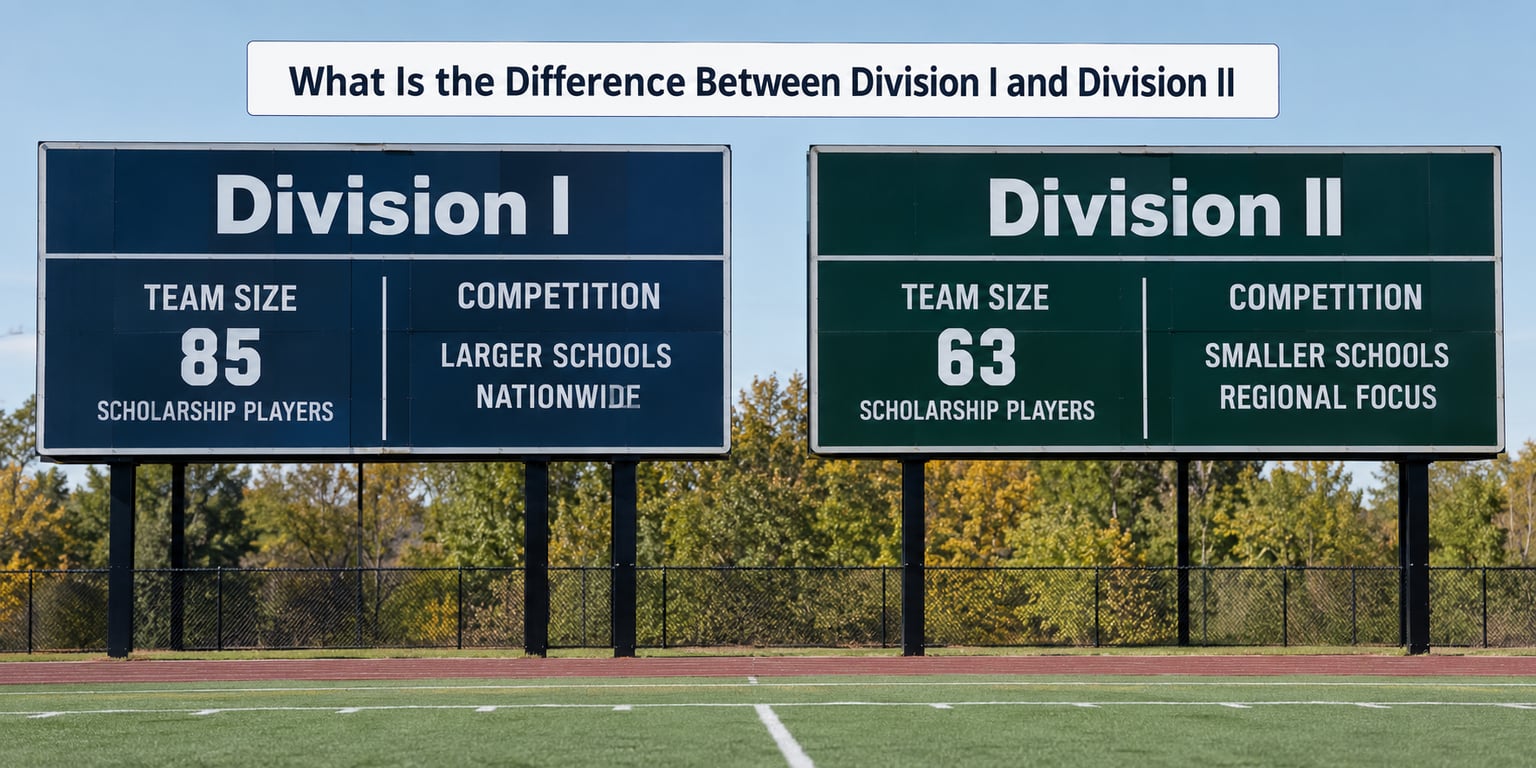
Division I offers more football scholarships, bigger athletic budgets and higher visibility. Division II offers something different: many schools there are smaller, and players get more touches per season on a roster that never reaches FBS depth.
Recruitment and scholarships
Division I FBS programs can hand out 85 football scholarships. Division I FCS programs get 63. Division II programs get 36, and those are equivalencies, so a coach can spread the money across more players by splitting a full scholarship into partial awards.
Division I FBS is the only level that does not allow partial football scholarships at all. An FBS scholarship is all or nothing, which means a walk-on at a top FBS program is genuinely paying full tuition with no offset from football.
Institutional size and competitive structure
Most Division I FBS schools enroll tens of thousands of students and draw from a national recruiting pool. Division II schools sit in regional recruiting footprints, which is why a Division II roster often holds more players from the same state than a top FBS roster does.
Why the labels are not a ranking
This is the part that trips up new fans. The divisions describe institutional scale and spending, not talent. Plenty of Division II and Division III players came from the same high school pipelines as FBS athletes; the difference is how far the recruiting tree reaches and how deep the roster is.
The reverse also holds. The best Division III players are not soft opponents. They are athletes who chose to play without athletic aid so they could keep a larger share of their scholarship money for academics.
What Does Division I FCS Mean
FCS means a school is a full Division I member for football, with all the same academic and athletic membership requirements as FBS, minus the revenue and postseason reach that come with the top subdivision. FCS teams are eligible for the AP Poll, they recruit nationally, and they win against FBS programs often enough that pretending otherwise is silly.
The playoff structure and the abstainers
The FCS postseason is a 24-team bracket: eight conferences earn automatic bids through a conference championship game, and the rest fill out the field at-large. A handful of conferences have historically opted out of the postseason entirely rather than play a championship game that would cost them a week of preparation. The Ivy League is the permanent holdout because it plays a 10-game schedule and has no postseason. The SWAC sat out for years as well.
FCS teams in the AP Poll
FCS programs first picked up AP Poll votes in 2007. The high-water mark came in 2016, when North Dakota State finished unbeaten against FBS opponents and gathered enough votes to be treated by many fans as an unofficially ranked No. 27. Being Division I means a team can appear on that list without changing what division it plays in.
The upset record, with dates
Talk in r/fcs and r/CFB is blunt about this: FBS and FCS are parallel ecosystems, not rung one and rung two. The results back that up.
- September 1, 2007: Appalachian State beat No. 5 Michigan, 34-32, in the first game of the season in Ann Arbor. It remains the single most cited result in the subdivision debate.
- 2016: North Dakota State went 12-0 including wins over ranked FBS opponents, and drew 74 AP Poll votes.
- Youngstown State holds the all-time record for wins over FBS programs, at 21.
- 2026 season: Tarleton State beat Bowling Green, and Idaho State beat Utah State.
- Montana knocked off a ranked Washington team in one of the highest-profile wins in FCS history.
What Does Division III Football Include
Division III is the NCAA’s no-athletic-scholarship level. Players get no athletic aid at all, which sounds like a dealbreaker until you look at how the aid is actually structured. Many Division III schools give their student-athletes the same academic scholarship they would offer any other student, and those awards are often stacked with need-based aid and work-study.
Where Division III athletes actually play
The division is concentrated at small liberal arts colleges, small universities and a scattering of larger schools that traded scale for the no-scholarship model. Schedules are short, usually eight to ten games, and the postseason runs through regional brackets that feed a national championship tournament.
The Ivy League anomaly
The Ivy League confuses even experienced fans because it sits in an odd corner: eight Division I institutions, no football scholarships anywhere in the league, a 10-game schedule, and no participation in the Football Championship Subdivision postseason. Ivy football is Division I by membership and Division I in recruiting reach, but on scholarship money and postseason access it behaves closer to Division III.
How Division III differs from Division II
Division II pays. It allows up to 36 equivalencies per year, which is often enough to cover a meaningful share of tuition for a walk-on at a regional school. Division III pays nothing, which means the real recruiting pitch is the degree, the campus and the playing time.
How Do Scholarships and Athlete Eligibility Work
Scholarship limits are caps, not targets. Plenty of programs across every level give out fewer than the maximum, and plenty of players at every level walk on. The number that matters is the ceiling a program could pay if it wanted to fill its roster.
| Level | Max football scholarships | Partial scholarships allowed | Typical aid structure |
|---|---|---|---|
| Division I FBS | 85 | No | Full athletic scholarships on top of academic aid |
| Division I FCS | 63 | Yes | Mix of full and partial awards |
| Division II | 36 | Yes | Equivalencies, often partial across the roster |
| Division III | 0 | Not applicable | Academic and need-based aid only |
| NAIA | 24 | Yes | Equivalencies set by NAIA rules |
| NJCAA | Up to 85 | Yes | Athletic grants plus academic aid |
The misconception worth correcting early is that every Division I program offers football scholarships. It does not. Some FCS and FBS programs award little or no football scholarship money in a given year, and Ivy League programs award none by league policy.
Eligibility rules apply at every level
Athletic aid is only half the picture. To play, a student-athlete has to clear academic standards that sit on top of the scholarship cap: a required core course set, a benchmark grade point average, and progress toward a degree measured in credits. A player can be the best recruit in the country and still be ruled ineligible because of a course they did not finish.
NAIA and NJCAA run their own academic progress rules rather than the NCAA’s, which is one of the reasons players sometimes use a junior college season to reset an eligibility problem before moving up.
Transfer rules and the transfer portal by division
Portal rules differ sharply by level, and this is where the D1 to D3 gap gets most confusing. FBS programs operate on set portal windows with dead periods around them. Division II programs do not have transfer windows in the same sense, and Division III places no portal restrictions on when a student-athlete may transfer.
That looseness is the reason Division III and NAIA show up so often in transfer chatter. A player leaving an FBS program can land at a DIII school and be eligible to play right away, which is not a realistic outcome at the top of the FBS pyramid. It also means moving up from NAIA to Division I is a normal path rather than an exception, because NAIA athletes follow their own eligibility rules and can enter the NCAA as a transfer.
How Do Conferences and Scheduling Fit Into the Division System
Conferences organize competition. They do not create divisions. A conference’s real power is scheduling, television contracts and the automatic playoff bid that comes with winning a championship game.
Power 5 and Group of 5
The Power 5 conferences, the SEC, Big Ten, Big 12, Pac-12 and ACC, hold the large media deals that separate FBS money from everything else. The remaining FBS conferences are called the Group of 5. Both groups sit inside the Football Bowl Subdivision; the difference is revenue, not division.
How opponents actually get picked
Conference membership sets most of a schedule automatically, since teams play the other schools in their league. The leftovers are filled by non-conference games chosen for three reasons: a home game that should sell tickets, a non-conference opponent that helps a team reach the 12 games now required for playoff consideration, or a matchup the school thinks it can win.
That is how an FBS team ends up on a FCS schedule. Non-conference games are the only place the subdivisions meet regularly, and they happen far more often at the Group of 5 level than at the Power 5 level.
Realignment keeps moving the map
Conference realignment reshapes the division picture more than any rule change. When conferences add or drop members, the Football Bowl Subdivision’s membership shifts with them, and schools that suddenly sit in conferences with larger media payouts change tier without changing a single rule.
Recent expansion has pulled additional programs up into FBS, and fan reaction in the r/CFB and r/fcs communities has been consistently skeptical that it improves the top level rather than diluting it. FCS programs move the other direction too, and Idaho’s run is the cautionary example: it moved up to FBS in 2013, went 19-41 over its tenure, and came back down. Moving up is not automatic promotion.
How Do Playoffs and Championships Work by Division
Postseason access is the single biggest practical difference between levels. Division I FBS teams chase a 12-team College Football Playoff, where the top conference finishers take automatic bids and the remaining spots go to at-large selections.
The paths level by level
| Level | How a postseason berth is earned | Championship format |
|---|---|---|
| Division I FBS | AP Poll ranking and conference standing | 12-team College Football Playoff bracket plus bowl season |
| Division I FCS | 24-team bracket, automatic bids plus at-large bids | Single national championship game |
| Division II | Regional tournament play | National championship game |
| Division III | Regional tournament play | National championship game |
| NAIA | Tournament qualification under NAIA rules | National championship game |
| NJCAA | Tournament qualification for two-year schools | National championship game |
None of these national championships should be read as equivalent to the College Football Playoff. The crowds, TV reach and revenue behind them are not close. What they share is the shape: regional play that narrows to a title game, so a lower-level champion had to win a real tournament to get there.
What the difference feels like for fans
FBS wins on reach. Weekly TV across multiple national networks, a playoff run most fans can follow without an explanation, and bowl season stretching into January. If you want to watch football on a Saturday afternoon with no homework, that level is built for you.
FCS and lower levels win on atmosphere. Stadium capacity in the FCS is closer to the Division II size, so the stands fill faster and the noise is closer. FCS crowds routinely rival FBS attendance figures, just in much smaller buildings. The trade is that finding the game takes more effort, since most of it is streamed through conference networks rather than the national ones.
Division III wins on access. Small venues, walk-on tryouts, a shorter season and a gameday that a player can walk to from a dorm. If you want to take a family to a college football game without planning a trip, this is the level where that is normal.
Frequently Asked Questions
What determines if a college is D1, D2, or D3?
Four signals decide it: how much the school spends on athletics, how much it spends on research and instruction, how large its enrollment is, and whether it has formally petitioned the NCAA for membership at a higher level. Football also has to clear sport-specific standards for coaching payroll and gender equity. No school can simply declare itself Division I.
Which is bigger, FCS or FBS?
FBS, by most measures. FBS programs play in the Football Bowl Subdivision, carry larger athletic budgets and share in the major television contracts that make the subdivision distinct. FCS is still Division I, with national recruiting reach and AP Poll eligibility, but it does not share in that television revenue. It is a smaller subdivision, not a lesser division.
What is the difference between D1, D2, D3 and NAIA?
D1, D2 and D3 are NCAA divisions separated by institutional size and athletic spending. NAIA is a separate association covering small colleges with its own membership, eligibility and scholarship rules. An NAIA school is not a lower NCAA division. Moving between NAIA and the NCAA is a transfer, not a promotion.
Is it better to go D3 or NAIA?
It depends on what you want from the two years. D3 gives no athletic scholarships, so players rely on academic or need-based aid and often play right away under looser transfer rules. NAIA offers up to 24 equivalencies and a national tournament, which suits players who want athletic money without the recruiting reach of FBS. Both play at a serious competitive level.
Can you go from NAIA to D1?
Yes, and it is a common route. NAIA athletes follow NAIA eligibility rules, so they usually enter an NCAA school as transfers rather than as freshmen. Once cleared by the NCAA Eligibility Center, they are bound by the transfer rules of whichever NCAA division they enter, which are stricter at FBS than at Division III.
What is the weakest D1 conference?
There is no official answer, because conferences are not ranked and the divisions do not measure strength. The AP Poll is the closest thing to a ranking system, and it changes weekly. Asking which conference is weakest says more about the teams you root for than about the structure, so fans rarely agree on an answer.
Conclusion
Start with one fact: the division the school plays in. Everything else hangs off that, from the scholarship ceiling to the postseason bracket.
Then check four things. Who governs the school, NCAA or NAIA. Whether Division I football means FBS or FCS. What the scholarship cap actually is for that level. And where the schedule and postseason run. Once those four are in hand, the level name stops being a mystery and starts being a description.