Instant replay in college football is an NCAA officiating process, written into the rulebook as Rule 12, where a replay official in the press box — or a head coach using a limited number of challenges — reviews video from fixed camera angles to correct on-field decisions that can be objectively seen. Here is how the whole thing works, from the whistle to the final signal.
One thing to clear out front: replay is not a second set of officials watching every play. It kicks in on a specific list of situations, and it only changes a call when the evidence is clear. The rest of the time, the call on the field stands and the game keeps moving.
Table of Contents
- What Is Instant Replay in College Football?
- What Happens During a College Football Replay Review?
- Which Camera Angles Are Used?
- How Does an Official Make the Final Call?
- Can Instant Replay Change a College Football Call?
- What Reviewable Moments Are Common in College Football?
- Why Does Replay Sometimes Take So Long?
- How Is Instant Replay Different From the Broadcast Replay?
- Frequently Asked Questions
- Do college football officials review every play?
- Can instant replay change a scoring play in college football?
- Why do officials sometimes keep the original ruling?
- What is the difference between replay review and the broadcast slow-motion replay?
- How long can a college football replay review take?
- What happens if the replay does not clearly show whether a play happened?
- Conclusion: What to Watch During a Replay Review
What Is Instant Replay in College Football?
Instant replay is the video review process college football uses to correct critical officiating rulings. An official on the field makes a call; if that call falls into a reviewable situation, a replay official in the press box examines video from the stadium’s fixed camera angles and either upholds the call or overturns it.
Replay exists for one reason: to fix a ruling that has a real competitive impact on the game. Whether a touchdown counted, whether a receiver caught a pass before the ground, whether a runner was down, or what the game clock should show at the end of a half. It is not a general appeal button for anything a coach or a fan dislikes.
Two other uses of the word “replay” cause a lot of confusion. The first is the television replay that broadcasters show you during dead balls; that one is a production decision, not an officiating one. The second is sideline replay, where video coaches work with a headset and a monitor to help coaches make decisions on the field. Sideline replay never changes a call, and it is a completely separate system from officiating replay.
A short history of replay in college football
Video replay aired on television long before any official reviewed it. CBS first used it during the Army-Navy game on December 7, 1963, replaying a single Army touchdown using tape decks that were enormous by any standard. The idea that an official, not just a viewer, could use video took another four decades to become a rule.
The modern version arrived quickly once conferences started moving:
- 2004: The Big Ten becomes the first conference to adopt instant replay for officiating.
- 2005: The remaining conferences follow, and replay becomes standard across college football.
- 2006: Replay is written into the NCAA playing rules rather than left to conference policy.
- 2024: Collaborative replay is added, letting conferences adjudicate from a centralized command center instead of a booth in each stadium.
- 2025: Officials stop using the old wording and announce only “upheld” or “overturned.”
- 2026: Coaches get two challenges per game instead of one, with a third available if at least one of the first two succeeds.
That last change matters more than it sounds, and we will come back to it.
What Happens During a College Football Replay Review?
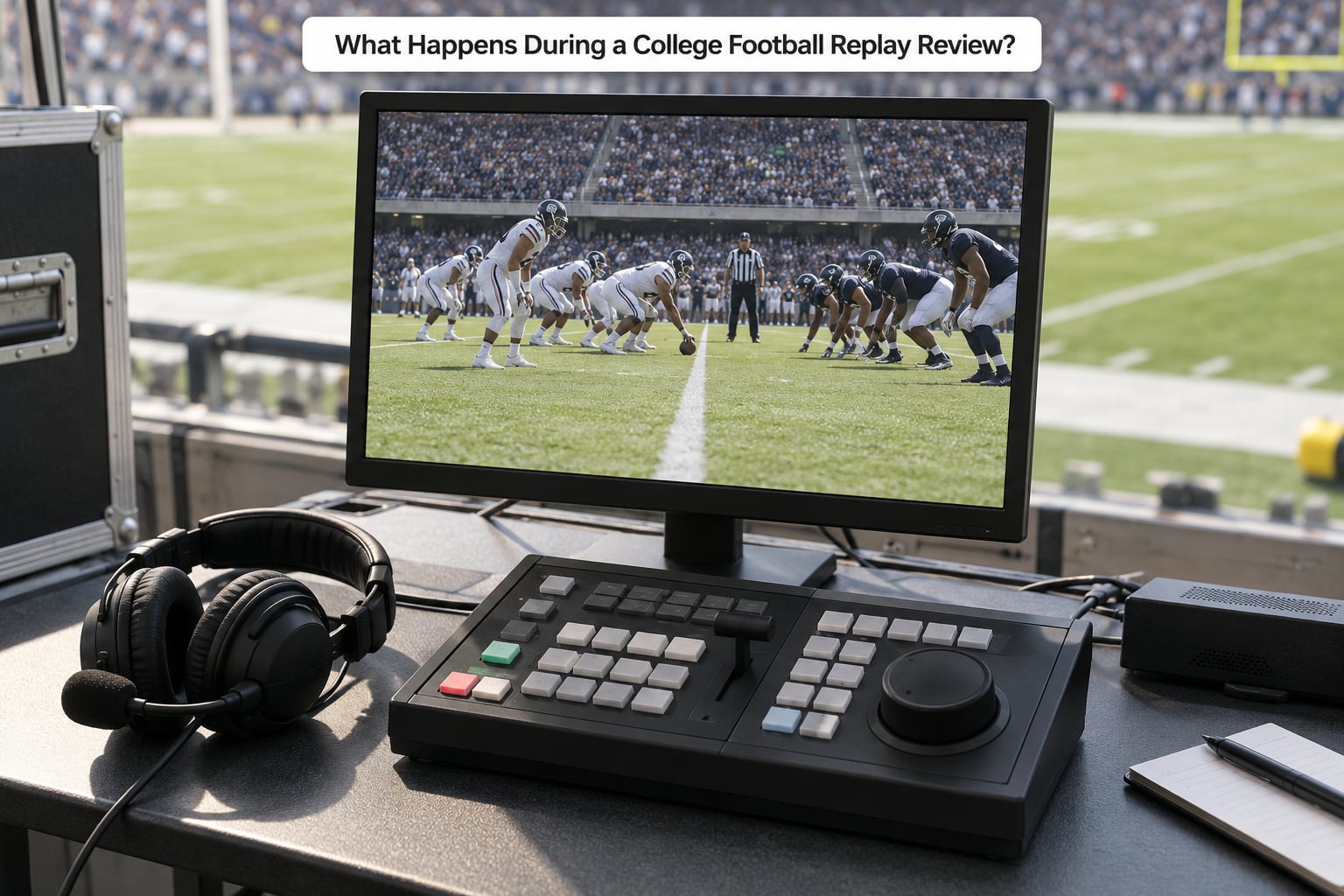
A replay review runs in a predictable order: the play is identified as reviewable, the game is stopped, the replay official pulls up the relevant angles, the officials confer, and the ruling is announced with the new spot, down, distance and clock if the call changed.
Who can start a review
Only two parties can initiate one. The replay official in the press box can open a review on their own for any situation on the reviewable list. Separately, a head coach can challenge a reviewable call, but only after calling a timeout, and only within a limited number of attempts. Nobody else, including the television production, has any authority over an officiating review.
How instant replay works in college football, step by step
Watch the next review with this sequence in your head and it becomes much easier to follow.
- The play ends and a call is made. An official on the field signals the ruling — incomplete pass, touchdown, fumble, spot, clock stoppage.
- The situation is checked against the reviewable list. If the call is not reviewable, the game resumes immediately. Nothing else happens.
- The game is halted. For an automatic review or a coach’s challenge, the ball is dead and officials move to a dead ball state while the review runs.
- The replay official selects the angle. From the press box — or a conference command center — they pull up the camera that best shows the point in question.
- The referee communicates with the replay official. The referee asks for specific information, such as whether the runner’s hand was down or where the ball was spotted.
- The rule is applied to what the video shows. The standard is high: the call changes only if there is indisputable video evidence of the correct ruling.
- The decision is announced. The announcer says “upheld” or “overturned.” No other outcome is used.
- If overturned, the new situation is supplied. The ruling includes possession, down and distance, the spot of the ball, and the game clock where applicable.
The coach’s challenge in the 2026 season
A coach’s challenge is a timeout spent on a reviewable call, and that timeout is the price of admission. Every challenge requires calling a timeout first, whether or not the challenge succeeds.
Starting in the 2026 season a coach gets two challenges per game, up from one. If at least one of those first two challenges succeeds, a third becomes available. The key change: when a challenge is successful, the team keeps its timeout. Under the previous rule the timeout was gone regardless of the outcome, which made coaches hesitant to use a challenge at all.
One more practical point. Challenges are for reviewable calls only. A coach cannot burn a timeout arguing about pass interference, a holding call, or targeting that happened on the field.
Which Camera Angles Are Used?
Officials work from a fixed set of stadium camera positions, and the angles available depend on what the stadium provides. A televised game with a full complement has the most; a non-televised game may have as few as four feeds.
- Main broadcast camera: the high sideline angle the television audience sees, useful for down and distance and general positioning.
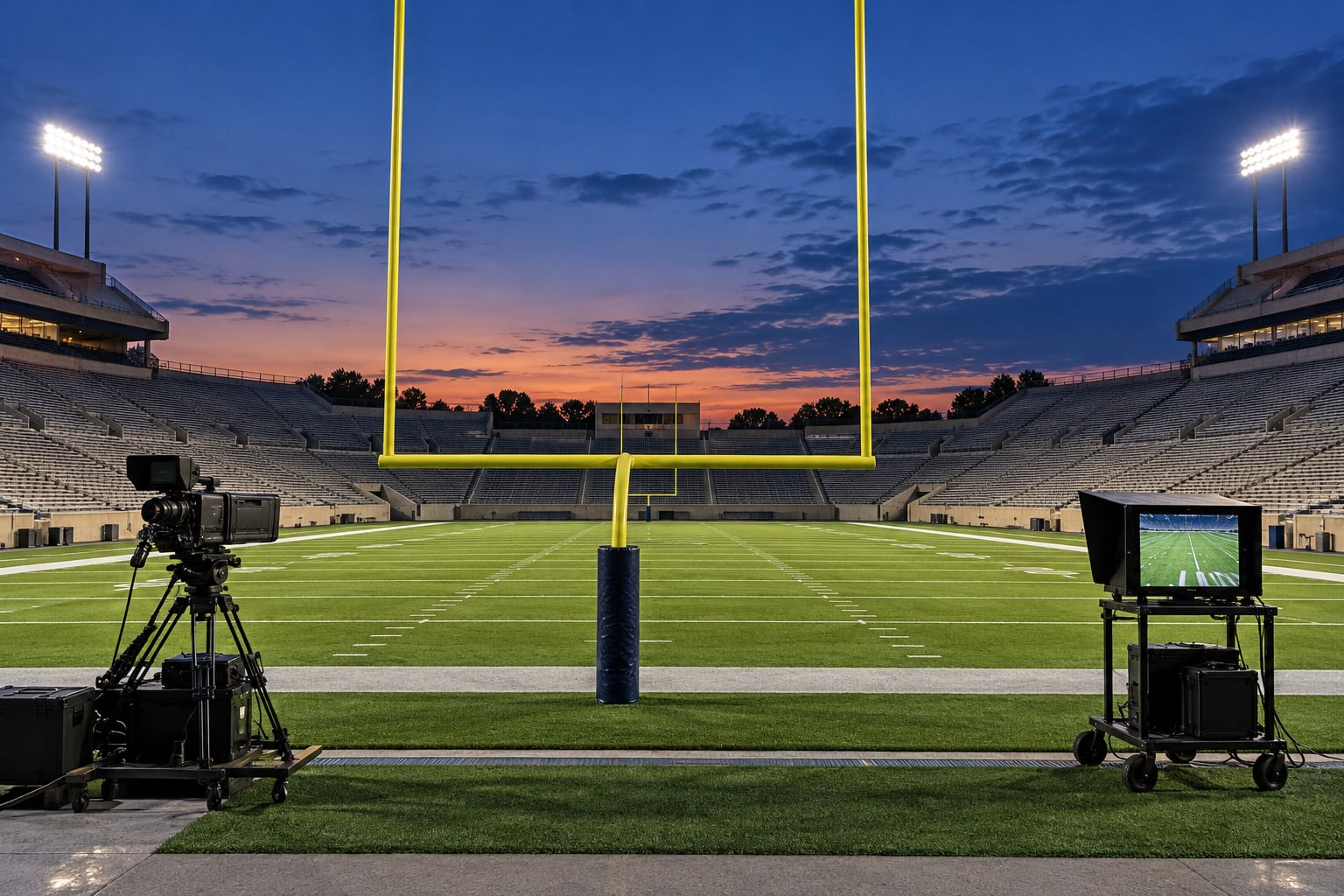
- End-zone and behind-the-goal-line cameras: the primary view for whether a pass was caught in bounds, for goal-line plays, and for scoring situations.
- Sideline and pylon cameras: mounted low at the corners, used to judge whether a foot, hand or ball touched a boundary line.
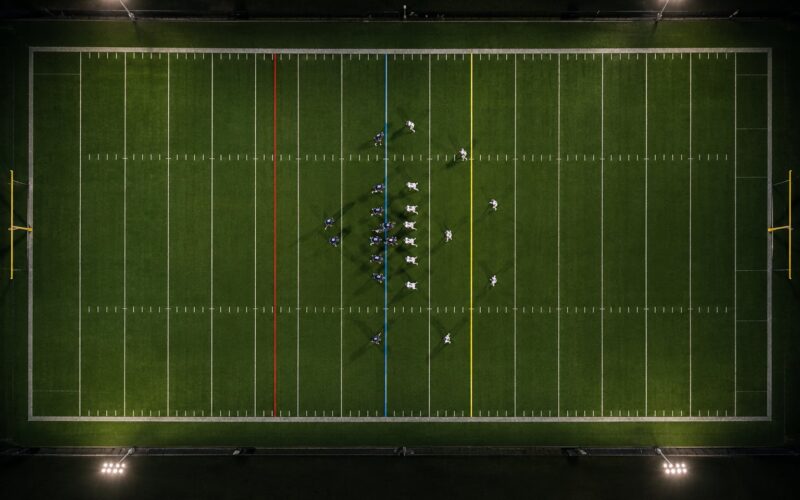
- Overhead or “all-22” style views: used to establish field position and the spot of the ball.
- Goal line camera: a low end-zone angle that helps separate a touchdown from a player going out of bounds just short of the line.
The one thing officials cannot do is request a new angle from somewhere the system does not cover. If a camera is not in the replay package, the play cannot be reviewed from that vantage point, which is a big part of why conference facilities matter.
How Does an Official Make the Final Call?
The replay official applies one test: is there indisputable video evidence of a different correct ruling? If yes, overturn. If no, uphold. That standard is stricter than it sounds, and it is the reason so many reviews end with the original call.
Indisputable video evidence, in plain English
Indisputable video evidence means the correct answer is obvious and unambiguous on the footage. It is not a question of which angle looks more convincing to you, and it is not a second opinion on judgment. If two reasonable people could watch the same clip and see it differently, the evidence is not indisputable, so the call stands.
You will hear announcers say “the monitor does not show it clearly” or “the replay is inconclusive.” That means the standard was not met, and it is the most common outcome of any review.
What an overturn actually changes
An overturn is not just a swap of one judgment for another. The announcement comes with the practical details:
- Possession — which team has the ball.
- Down and distance — the new down and the yards to gain.
- Spot of the ball — where the next snap happens.
- The game clock — the time restored, on plays where the clock is reviewable.
- Penalties and enforcement — including where a penalty is enforced from after the review.
Clock restoration is its own headache. The rules allow time to be put back on the clock when a review changes a ruling that affected the running of time, and fans have asked for a clearer, more consistent standard for years. Officials need to know when the stoppage happened and when the ball should have been dead, and that calculation often requires additional angles.
Collaborative replay and the command center
Rule 12-4-3 allows conferences to use collaborative replay, where a central official reviews games remotely instead of staffing a booth in every stadium. It is a practical response to a scheduling problem: a conference cannot put a trained replay official in thirty venues on eight Saturdays in October.
For a fan, the visible difference is smaller than you might expect. You still see the same review, the same announcement, the same delay. What changes is who is watching and how quickly they can reach the referee. What you may also see, depending on the conference, is raw audio from the replay official and the referee, which turns a black box into something you can follow.
Can Instant Replay Change a College Football Call?
Yes, but only within a narrow set of reviewable situations, and only when the video evidence is indisputable. A replay cannot change a foul that happened in real time, and it cannot revisit a judgment call simply because a coach objects.
When replay gets the process wrong
Replay is officiating by people and systems, and occasionally the process itself fails. The 2025 Michigan and Western Michigan game is the case fans still bring up: a last-second play ended the game, and the FBS Oversight Committee found that replay protocols were not followed.
Here is the part that frustrates everyone. The NCAA’s position is that it cannot overturn the result of a completed game. So even when an official body agrees the process was handled incorrectly, the outcome on the scoreboard stands. That is the single biggest source of fan anger around replay, and no rule change so far has touched it.
The same disagreement shows up in fan forums, where the argument is less about whether the play was close and more about why a long review ends with no change to a call that looked wrong to half the stadium.
What Reviewable Moments Are Common in College Football?
Most reviews fall into three broad buckets: scoring plays, possession and down-and-distance situations, and game clock situations. The table below is the quick reference for what gets looked at and what does not.
| Situation | Reviewable? | Notes |
|---|---|---|
| Touchdown or field goal attempt | Yes | Including whether the scoring act was completed before the player went out of bounds |
| Pass completion or incompletion | Yes | Whether a receiver caught and maintained control before going to the ground or out of bounds |
| Fumble or no fumble | Yes | Possession changes, so it is reviewable |
| Spot of the ball | Yes | Where the ball was placed when the runner went down |
| Whether the sideline, goal line or end line was touched | Yes | The core purpose of the boundary cameras |
| Game clock start and stop | Yes | With time restored to the game clock where the review changes the timing |
| Missed field goal or extra point attempt | Yes | Whether the ball crossed the goal line upright |
| Touching of a forward pass | Yes | The narrow exception that makes pass interference reviewable at all |
| Pass interference | No | Except for the touching-of-the-pass clause above |
| Holding and offensive fouls | No | Judged in real time by the officials on the field |
| Offside | No | Not reviewable in college football |
| Personal fouls, including roughing the passer | No | Not reviewable on the field |
| Targeting during the play | No | On-field targeting calls are not reviewed; the video process runs separately after the game |
| Off-field targeting review | Yes, separately | Routed through the conference and the national coordinator of officials, and can be initiated by a head coach with a challenge |
That targeting split confuses people more than any other entry on the list. The referee does not review a targeting call in real time. Instead, the video is sent up the chain after the game, and that process can add a penalty to a player’s record. It can affect the next game without anything changing on the field that day.
Why Does Replay Sometimes Take So Long?
Long reviews are usually a combination of too many angles, a rule question rather than a visual question, or an unresolved clock. Fans routinely see reviews that run three to six minutes, and the general complaint in fan forums is blunt: if it cannot be decided quickly, the call should stand.
The mechanics behind a slow review:
- Finding the right angle. The first camera often does not answer the question, and the replay official is working through feeds looking for one that does.
- Talking to the referee. The replay official and the referee are on a headset, and the question asked back and forth is often where the time goes.
- Applying a rule, not a picture. Some reviews are less about what you see and more about which rule governs it.
- Restoring the clock. Deciding how much time goes back on the clock requires establishing when the play ended and when the ball should have been dead.
- Re-setting the situation. Once the decision is made, the ball has to be spotted and the down and distance established before play resumes.
There have been proposals to impose a hard decision clock, with sixty seconds suggested more than once. Nothing has been adopted, so a review can still take as long as the officials and the system need.
How Is Instant Replay Different From the Broadcast Replay?
The broadcast replay exists to tell the story to viewers. The officiating review exists to change or preserve a ruling. They run on separate systems, are triggered by separate people, and can contradict each other on the same play.
That is why you can see an angle on television that makes a ruling look clear, then hear the announcer say the officials upheld it. The production chose an angle for storytelling; the officiating system reviewed the angles available to it under a higher evidence standard.
| What to compare | College football | NFL |
|---|---|---|
| Challenges per game | Two, with a third if one of the first two succeeds | Two, with a third if both succeed |
| Who can initiate | The replay official, or a head coach after calling a timeout | The replay official can trigger many situations directly; a coach must call a timeout to challenge |
| Timeout cost | Timeout kept when a challenge succeeds | Timeout charged on the challenge regardless of outcome |
| Reviewable set | Narrower; pass interference, holding, offside and personal fouls are out | Broader, covering a longer list of scoring and turnover situations |
| Where review happens | Press box or a conference command center | A central command center, plus sideline and booth review |
| Clock consequence | Time restored where the clock is reviewable | Standard ten-second runoff on many reviewable plays |
One more distinction worth keeping straight: sideline replay. A video coach on each sideline reviews footage with the head coach to help decide things like whether to challenge, how to use timeouts, or what play to call. It is a coaching tool. It cannot reverse an official’s call, and it is not part of the officiating review system at all.
Frequently Asked Questions
Do college football officials review every play?
No. Replay only opens for situations on the NCAA’s reviewable list, such as scoring plays, whether a pass was caught, a fumble, the spot of the ball, touching a boundary line, or a game clock start or stop. Fouls such as holding, pass interference, offside and personal fouls are not reviewable in real time, so most plays end with the original call and no review at all.
Can instant replay change a scoring play in college football?
Yes, if the situation falls within the reviewable list and there is indisputable video evidence of the correct ruling. Common scoring reviews include whether the receiver maintained control through the catch, whether the player was in bounds, and whether a kick cleared the goal line. The standard is high, so most scoring reviews end with the call upheld.
Why do officials sometimes keep the original ruling?
Because the rule requires indisputable video evidence before a call can be changed. If the footage does not clearly show a different correct answer, the call stands even when it looked wrong from the stands. Officials also cannot review judgment calls or fouls outside the reviewable list, no matter how obvious the mistake appeared in real time.
What is the difference between replay review and the broadcast slow-motion replay?
The broadcast replay is a production choice that re-tells the play for viewers and can use any angle the director wants. The officiating review is a rule process with a fixed set of angles and a high evidence standard, and it can change the outcome of the play. The two can disagree on the same play without either being wrong.
How long can a college football replay review take?
There is no hard time limit in the rules. Reviews commonly run a minute or two, and difficult ones involving the clock or spot of the ball have run three to six minutes. Proposals for a sixty-second decision clock have been raised repeatedly but none has been adopted, so a review can take as long as the officials need.
What happens if the replay does not clearly show whether a play happened?
The original call stands. The rule requires indisputable video evidence to change a ruling, so footage that is unclear, obstructed or open to more than one reading does not meet the standard. Officials no longer describe a call as confirmed, only as upheld or overturned, and an inconclusive result is an upheld call.
Conclusion: What to Watch During a Replay Review
How instant replay works in college football comes down to four things you can follow on screen. First, watch for the stoppage and figure out which situation is under review. Second, notice which camera angle the replay official selects, since that tells you what question they are trying to answer. Third, listen for whether the issue is the call itself, the spot, or the clock. Fourth, wait for the signal and the announcement, and then see whether the new down, distance and clock match the ruling that was announced.
And when a call does not go your way, the useful question is not whether the officials saw something you did. It is whether the situation was on the reviewable list in the first place. That is where most of the frustration comes from, and understanding it changes how a game feels.