Timeouts are the stoppages that let a college basketball coach change the defense, make substitutions and set up the next possession, and the count varies depending on whether the game is televised and which team is asking. The confusing part for most fans is that two completely different things look identical on television: a strategic timeout the coach requests, and a media timeout the network schedules.
These rules apply to the 2026 season. Game-specific competition rules, which are set by conferences and tournaments, take priority over the baseline NCAA rule book whenever they differ.
Table of Contents
- What Is a Timeout in College Basketball?
- Who Can Call a Timeout?
- How Many Timeouts Does a College Basketball Team Get?
- How the Timeout Clock and Game Clock Work
- Do College Basketball Timeouts Carry Over?
- What Is a Television Timeout?
- How Coaches Decide When to Use a Timeout
- Why a Team May Save Its Final Timeout
- Frequently Asked Questions
- How long can a college basketball team spend during a timeout?
- Can a college basketball coach call a timeout during a dead ball?
- Why does the game clock sometimes start during a college basketball timeout?
- Does a television timeout count against a college basketball team?
- Can college basketball players substitute without calling a timeout?
- Conclusion
What Is a Timeout in College Basketball?
A timeout is an officially granted stoppage in play that a team requests so its bench can coach and substitute. The game clock stops, the shot clock stops if it has not yet started, and play restarts from the point where it was interrupted.
Not every stoppage in a college game is a timeout. A dead ball after a made basket, a foul, an out-of-bounds call or an inbound play routinely pauses the action without touching a team’s timeout count. Coaches can use those moments to make substitutions and give instructions without spending anything.
The same goes for media timeouts. Those are commercial breaks requested by the television network, not by the team, so they come out of the broadcast’s schedule rather than a team’s allowance.
Free throws are a third thing again. A foul on a shooting attempt produces free throws, and the routine administration around them has nothing to do with timeout counts.
So when someone asks how college basketball timeouts work, the honest answer starts with the distinction: only a team-requested stoppage costs a team one of its timeouts. Everything else just happens.
Who Can Call a Timeout?
Any coach on a team’s sideline can request one, head coach or assistant. You will see assistants calling timeouts in nearly every game, particularly when a defense is getting shredded and the head coach is tracking substitutions rather than watching the official.
The team’s on-court captain can also request one, usually by asking an official directly. What the requester cannot do is substitute while play is live. A coach who wants a substitution during a dead ball simply signals the bench and the players change out, with no timeout charged.
The request reaches the official through the timeout signal, which in college basketball is both an audible call and a raised-arms gesture made by the coach on the floor or standing on the sideline. An official who does not see or hear the signal cannot grant the timeout, which is the mechanical reason behind a handful of scenes that circulate every season.
A referee who was not looking at the bench has no way to know a request happened, so play continues and the possession can be lost on a play that looked like a timeout call from the stands. Several threads on r/CollegeBasketball trace back to exactly this sequence, and coaches rarely get an explanation afterward. Getting how college basketball timeouts work on this point right is what separates a bad break from a non-call.
How Many Timeouts Does a College Basketball Team Get?
In a televised NCAA game, each men’s team gets four timeouts in regulation: three 30-second timeouts and one full 60-second timeout. Non-televised games use a different allowance with longer stoppages, and overtime adds to whatever is left.
| Situation | Men’s team | Women’s team |
|---|---|---|
| Televised game, regulation | Three 30-second plus one 60-second | Three 30-second plus one 60-second |
| Non-televised game | Four 75-second plus two 30-second | Four 75-second plus two 30-second |
| Second half carryover | Up to two 30-second timeouts | Up to two 30-second timeouts |
| Each extra period | One additional timeout, unused ones accumulate | One additional timeout, unused ones accumulate |
Timeouts carry one of two lengths in a televised game. A 30-second timeout is the quick adjustment: switch the coverage, pull a defender, change the matchup. The 60-second timeout is the long one, used for substitution sets, foul trouble and end-of-half or end-of-game diagrams.
One televised-game wrinkle is worth knowing about. The first team timeout of the second half is stretched to full media-break length, so the team using it gets more bench time than the rule would otherwise suggest.
Overtime works on top of everything above. The rule text, as quoted on officiating.com, reads that each team is entitled to one additional 60-second timeout during each extra period, and that unused timeouts accumulate and may be used at any time. A team that enters overtime with two 30-second timeouts and a 60-second enters the extra period with three.
The shift to four 10-minute quarters from two 20-minute halves has been debated for years, and media timeouts are the reason it keeps stalling. The 2026 season still uses two halves in men’s basketball.
How the Timeout Clock and Game Clock Work
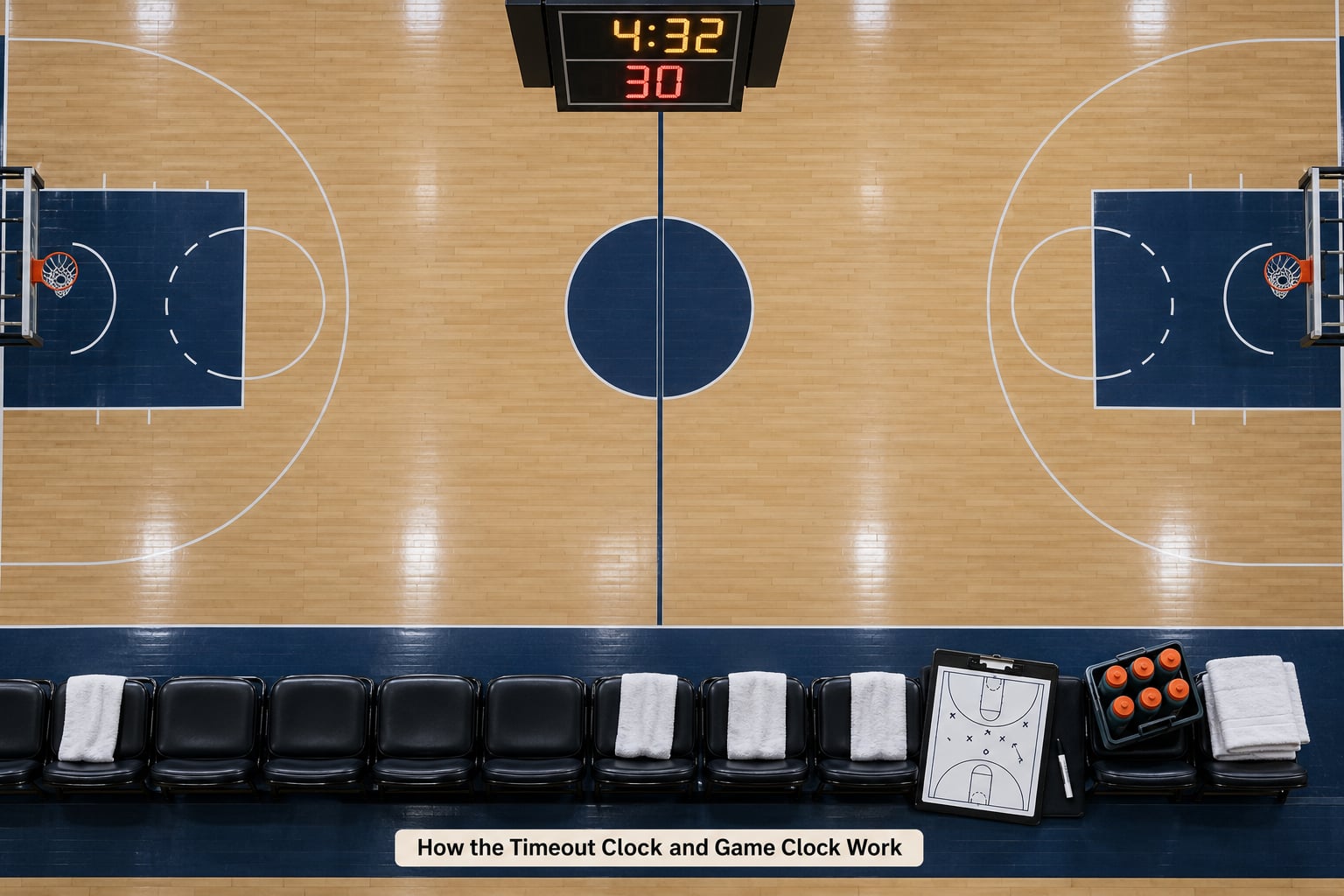
Once a request is recognized, the sequence is fixed: the official’s signal stops the clock, players head to their bench, the team has its allotted time, then everyone returns and play resumes where it left off.
The official signals the timeout and stops the game clock. If the shot clock has not started, it stops as well. The game clock warning system runs, giving teams and officials a countdown near the end of a period.
Players and coaches get a set maximum at the bench. When that time is up or the coach signals readiness, players return to the floor. The inbound or free throw that follows is the legal resumption of play, and the game clock does not move until that actually happens.
A worked example: with 6:41 on the game clock and 9 seconds on the shot clock, a coach requests a timeout. The official signals, the game clock stops at 6:41, the shot clock stops at 9 if it had not yet started, and the team has 30 or 60 seconds at the bench. When the team returns, the inbound play happens and the game clock resumes from 6:41.
If the ball became live before the inbound pass was completed, the clock starts immediately. That is why you occasionally see a coach gesturing for the bench to hurry: play can resume before the whole unit has settled in, and a mishandled inbound turns a stoppage into a turnover.
How College Basketball Timeouts Work During Dead Balls
A dead ball is any stoppage where the clock is stopped and players are not actively competing for the ball. Many dead balls are pure administration, not timeouts, and the distinction comes down to whether a team’s timeout count went down.
Dead-ball situations that cost nothing include substitutions after a made basket or foul, administering free throws, inbound plays following a violation or out-of-bounds call, and any stoppage the officials initiate on their own.
Situations that do cost a timeout include the coach’s own request, a charged injury timeout where the team cannot continue play safely, and a coach’s challenge used to review a call. The challenge rule is a recent addition to the men’s game, and its timeouts cost matters to anyone keeping count.
Reviews add confusion because they look like timeouts on the broadcast. The clock is stopped, the crowd waits, and the timeout count on the graphic often does not move at all.
Do College Basketball Timeouts Carry Over?
Partly. In a televised game, a team may carry no more than two 30-second timeouts into the second half, and those two count against the second-half allowance rather than adding to it.
That is the whole carryover mechanic. Unused timeouts are not banked as extra value for later. A coach who enters the second half holding three 30-second timeouts is not working with an advantage, because one of them is gone regardless of the game situation.
The 60-second timeout does not carry. Whatever is left at halftime in that column is simply gone.
Because of the cap, coaches rarely blow through an early first-half timeout. Four total with a two-timeout carry limit means the second half is decided early, and the last thirty seconds of a close game are often played with one stoppage left or none at all.
What Is a Television Timeout?
A television timeout, or media timeout, is a stoppage the broadcast takes for commercials. Neither team requests it and neither team pays for it from its own allowance.
Networks schedule them at the first dead ball at or under the 16-, 12-, 8- and 4-minute marks of each half. In a televised men’s game that break length is typically ten minutes. The “first dead ball at or under” language is why a scheduled break can slip: the ball has to stop before the clock reaches the mark, not after.
Some television deals use a different set of marks, commonly 15, 10 and 5. That difference explains why fans tracking the schedule occasionally see a game that seems to be running off its usual pattern.
Who confirms the break depends on the competition. Under NCAA men’s media timeout formatting, the network and officials coordinate the stoppage, and the coach’s request does not control when it happens. Media timeouts are also the stated obstacle to moving college basketball to four quarters, since shortening periods would break the commercial schedule networks sell.
One rule catches people out. A team timeout requested within 30 seconds of a scheduled media timeout gets absorbed into that media break. The team is charged the timeout and the game still stops for commercials, which is exactly why a coach asking for a timeout late in a quarter sometimes looks like nothing happened. Follow how college basketball timeouts work for a full half and the commercial pattern shows up on schedule long before the scoreboard looks tense.
How Coaches Decide When to Use a Timeout
The decision is situational, and coaches rarely treat a bad possession as an automatic trigger. The variables are the score, the clock, the foul situation, the shot clock and how many stoppages remain.
Stopping a run is the clearest case. When an opponent hits three in a row and the coverage is clearly wrong, a 30-second timeout to switch assignments is worth more than another possession of the same matchup.
Attacking a mismatch works in the other direction. A coach may want a dead ball to set up a specific shooter against a smaller defender, which is easier to arrange from the sideline than in live action.
Substitution timing is the quiet reason for a lot of timeouts. Substituting during a dead ball is free, but a dead ball at the wrong moment, such as immediately after a defensive rebound, can force a coach to burn a timeout just to get a rested player in.
Tempo control runs both ways. A team protecting a three-possession lead may take a timeout to get a clean inbound instead of dribbling out a full 30-second shot clock.
Equipment and injury problems are real stoppages too. A broken clock, a blood issue or a player who cannot continue can end play without spending a timeout, though the team may be charged depending on the circumstances and the competition’s rules.
What usually does not deserve a timeout is an ordinary empty possession with the defense intact and the bench reasonably fresh. Spending one there leaves nothing for the moment that actually matters.
Why a Team May Save Its Final Timeout
A coach holding the last timeout of a half is making a bet on the game state, not ignoring the clock. With the second-half carryover capped at two 30-second timeouts and no overtime in sight, the remaining inventory is fixed and every use has an opportunity cost.
Saving it works when a team leads late and wants the opponent to burn clock. Using it to advance the ball or set a defense can be better than letting the other team hold the ball for a final shot, and a head coach with the scoreboard in hand knows exactly which of those two situations is developing.
Saving it too long is a real risk. If a trailing team has nothing left, a possession can end without a chance to inbound deliberately, and a turnover on a pressured advance pass ends the game without another look. Holding a timeout to the buzzer and needing it two possessions earlier is the failure mode coaches dread.
Spending it early has the opposite cost. Once a team is out of timeouts, every dead ball is just a dead ball, and the coach loses the ability to shape the last two minutes at all.
Late-game stoppages are also why final minutes take far longer than a minute. Reporting on a Michigan and Northwestern overtime game noted roughly twenty-one minutes of real time for the last minute of play, with reviews, four timeouts and free throws all involved. Coaches protecting timeouts are usually reacting to exactly that kind of environment.
Frequently Asked Questions
How long can a college basketball team spend during a timeout?
A team gets 30 seconds at the bench for a short timeout and 60 seconds for a full timeout in a televised game. Non-televised games use longer 75-second stoppages. The clock for that time runs off a warning system, and play restarts when the team returns or the maximum time expires, whichever comes first.
Can a college basketball coach call a timeout during a dead ball?
Yes, a coach may request a timeout at any dead ball, and the request is granted as long as the team has one left and the official recognizes the signal. The charge is the same whether the stoppage began with a foul, a made basket or an out-of-bounds call. If the official does not see or hear the request, no timeout is granted and play continues.
Why does the game clock sometimes start during a college basketball timeout?
The clock is stopped during the bench meeting, then restarted the moment play is legally resumed, which is the inbound pass or the release on a free throw. If the ball goes live before the inbound is complete, the game clock starts immediately, even with teammates still walking to their spots. That is why a hurried inbound can become a turnover.
Does a television timeout count against a college basketball team?
No. A media timeout is a commercial break requested by the broadcast, so it does not come out of a team’s allowance. The exception is the absorption rule: a team timeout requested within 30 seconds of a scheduled media timeout is charged to the team and folded into that break, which can look like the request had no effect at all.
Can college basketball players substitute without calling a timeout?
Yes, and coaches rely on it constantly. Substitutions are allowed at any dead ball, including after a made basket, a foul or an inbound play, with no timeout charged. A team only needs a timeout when it wants to stop play in order to substitute, which is why a dead ball that arrives at an awkward moment can still cost one.
Conclusion
How college basketball timeouts work is simpler than it looks on screen: they are a finite set of clock-governed stoppages, not an unlimited supply of breaks. Once you know that a media timeout costs a team nothing, that carryover is capped, and that only a recognized coach request burns an allowance, the broadcast stops looking random.
Next game, count what each team has left, watch both the game clock and the shot clock, and check whether the stoppage you are watching came from the bench or from the network. That one habit explains most of the moments that currently look confusing from the stands.