College basketball uses a 30-second shot clock in both men’s and women’s play, and how college basketball shot clock rules work comes down to three things: when the clock starts, what makes it reset to a full 30 or down to 20, and what happens the second it hits zero without a shot. If the ball hits the rim before time runs out, the attempt is legal. Miss everything and the possession is gone.
There is a second clock running at the same time, and it confuses people far more than the shot clock does. A team gets eight seconds to move the ball from the backcourt into the frontcourt, and that count is tied to how the shot clock is started. Once you can read the two together, broadcasts make sense in a way they never did before.
Table of Contents
- How College Basketball Shot Clock Rules Work
- What Is the Shot Clock in College Basketball?
- How Long Is the Shot Clock in NCAA Men’s and Women’s Basketball?
- When Does the Shot Clock Start?
- What Happens When the Shot Clock Hits Zero?
- Can the Shot Clock Be Reset?
- What Are the Most Common Shot Clock Violations?
- How Do Shot Clock Rules Affect Strategy?
- Frequently Asked Questions
- How long is the shot clock in men’s college basketball?
- How long is the shot clock in women’s college basketball?
- Does an offensive rebound reset the men’s college basketball shot clock to 20?
- What counts as a shot-clock violation in college basketball?
- Does the shot clock stop when the ball hits the rim?
- What happens if the shot clock expires as a player releases the ball?
- Conclusion
How College Basketball Shot Clock Rules Work
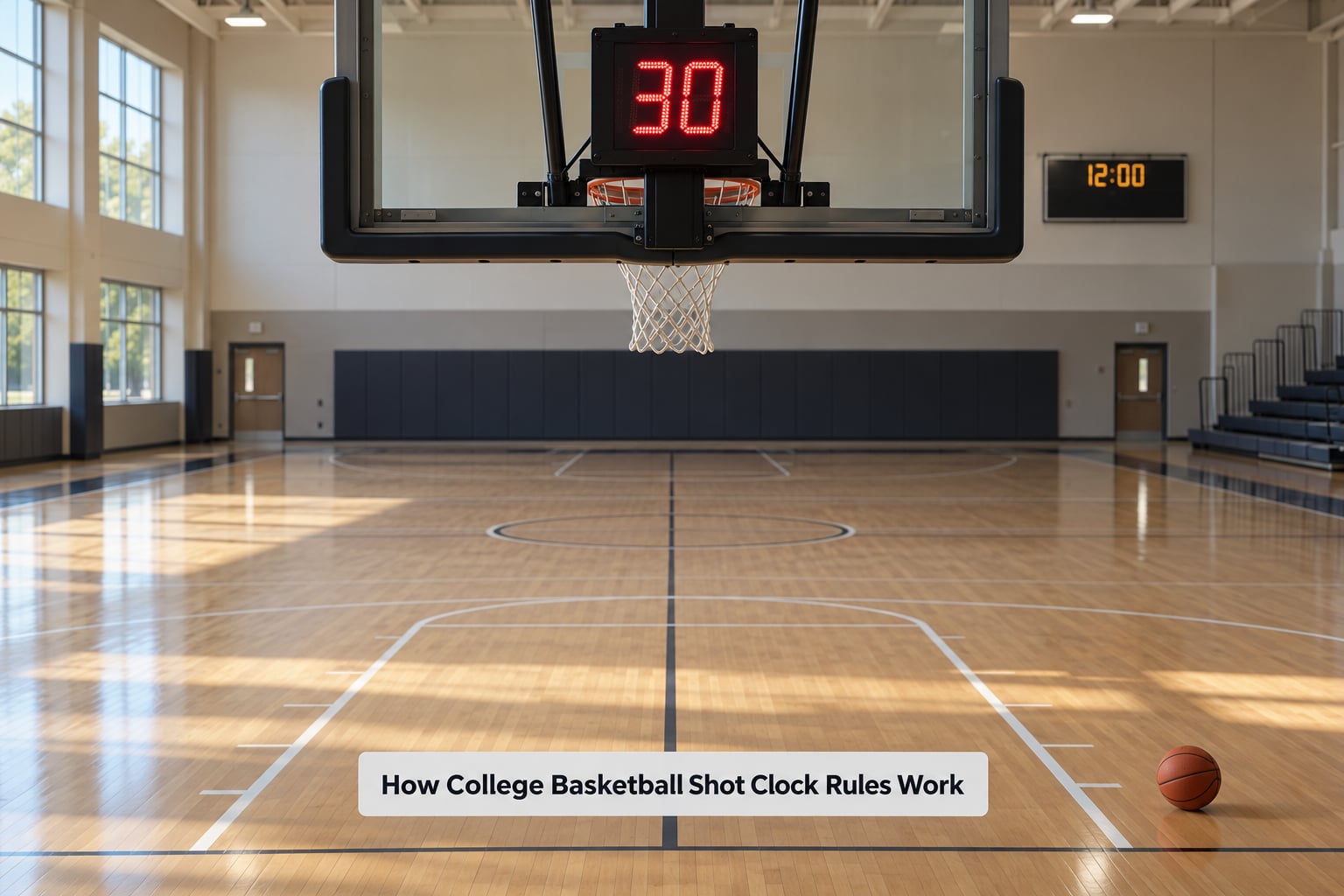
Here is the short version, and it holds for both men’s and women’s teams in NCAA competition.
- The clock is 30 seconds. Every possession, from the opening tip to the final buzzer, gives the offense 30 seconds to put up a field goal attempt.
- It starts the moment your team gains possession. Rebound, steal, jump ball, or loose ball recovered by the offense in the frontcourt.
- It stops whenever the game clock stops. Timeouts, whistles, a made basket, out of bounds. The shot clock never runs during a dead ball.
- A change of possession resets it to 30. The other team gets the full 30 seconds.
- Some frontcourt situations reset it to 20 instead. Offensive rebounds, frontcourt inbounds plays, and full timeouts where you keep the ball.
- The ball has to hit the rim to count as an attempt. An airball that touches nothing is not a shot, and the clock keeps running.
- A violation is an instant turnover. No shot, no continuation, opponent’s ball.
| Level | Full shot clock | Offensive rebound reset | Frontcourt inbounds reset |
|---|---|---|---|
| NCAA men’s | 30 seconds | 20 seconds | 20 seconds |
| NCAA women’s | 30 seconds | 20 seconds | 20 seconds |
| NBA | 24 seconds | 14 seconds | 24 seconds |
| WNBA | 24 seconds | 14 seconds | 24 seconds |
| NFHS high school | 35 seconds (state variations) | No reset, clock continues | 35 seconds |
What Is the Shot Clock in College Basketball?
The shot clock is a countdown timer, usually mounted above the backboard or on the scorer’s table, that limits how long the offense can hold the ball. In NCAA basketball it starts at 30 and counts down to zero in tenths of a second.
Its job is to stop a team from simply holding the ball until the game clock runs out. Before the shot clock existed, one team could run out the clock on every possession and win a game without ever attempting a shot. That is not theoretical: college games in the 1940s ended with a final score of 19 to 18, because the winner’s strategy was to stand still.
The distinction that trips up new viewers is between the two clocks. The game clock counts the game’s total time. The shot clock limits one possession. Because both clocks stop together whenever a whistle blows, one long possession can swallow a big chunk of the game clock, which is what announcers mean when they talk about taking time off the clock.
Here is how the shot clock behaves mechanically. It stops any time the game clock stops, so a timeout, a foul, or a whistle freezes both. It starts again the moment play resumes. And it does not reset just because the offense passed the ball around, went out of bounds, or got lucky with a deflection.
How Long Is the Shot Clock in NCAA Men’s and Women’s Basketball?
Thirty seconds. There is no difference between the men’s and women’s rules on the base clock length.
Men’s teams moved to 30 seconds for the 2015-16 season, dropping from 35 seconds. That 35-second number is still the one most people carry around, and hearing it quoted by a well-meaning fan is the single most common misconception in casual conversation about college hoops.
Women’s teams have used a 30-second shot clock since the NCAA first adopted a shot clock for women’s basketball in 1970-71. The clock was there before it was fashionable.
There is one other timing difference to keep in mind. Men’s and women’s games are both two halves in college, not four quarters, and both halves are 20 minutes. That matters because the shot clock gets switched off near the end of each half, not just at the end of a quarter.
When Does the Shot Clock Start?
The shot clock starts when a team gains possession of the ball, which covers several distinct situations.
- A rebound. Offensive or defensive, the clock starts the moment a player controls the ball.
- A steal or a loose ball recovered by the offense. Control, not just a touch, is what matters.
- A jump ball. When play resumes from the toss.
- A change of possession in the frontcourt. If the ball is loose and an offensive player touches it, the clock starts.
- A frontcourt inbound pass. It starts the moment the ball is touched in play after the inbound.
In the backcourt, the timing is different, and this is where the eight-second rule comes in. The offense has eight seconds to advance the ball across the halfcourt line. If the defense touches the ball during that advance, the ball is dead and the shot clock is set to a fresh 30.
Officials on the officiating forum point out a genuine wrinkle here: the NCAA starts the shot clock on any legal touch by any player, while the high school rule book ties the eight-second count to the shot clock’s own start. It sounds academic until you are watching a tipped ball in the backcourt and both crews would rule on it differently.
What Happens When the Shot Clock Hits Zero?
Four things can happen at zero, and only one of them is a violation.
The ball hits the rim before the horn
The attempt is legal, and play continues even if the ball drops through the net a second later. This is the ball-in-flight exception, and it is the rule fans most often get backwards. A shot released with one-tenth showing can go in, and it counts.
The ball is released but never touches the rim
This is still a violation. A field goal attempt in NCAA basketball requires the ball to contact the rim. An airball released at the horn does not save the possession, and you will see the officials signal the violation even though a shot was taken.
The ball is still in a player’s hands at zero
Immediate turnover. The game clock does not stop, and the other team inbounds where the ball was when the horn sounded.
The game clock is nearly expired
Near the end of a half, if fewer seconds remain than the shot clock would show, the shot clock is switched off. If 18 seconds are left in the half and the shot clock is at 26, the shot clock is no longer in play. From that point the offense can use the rest of the half without any possession limit.
Can the Shot Clock Be Reset?
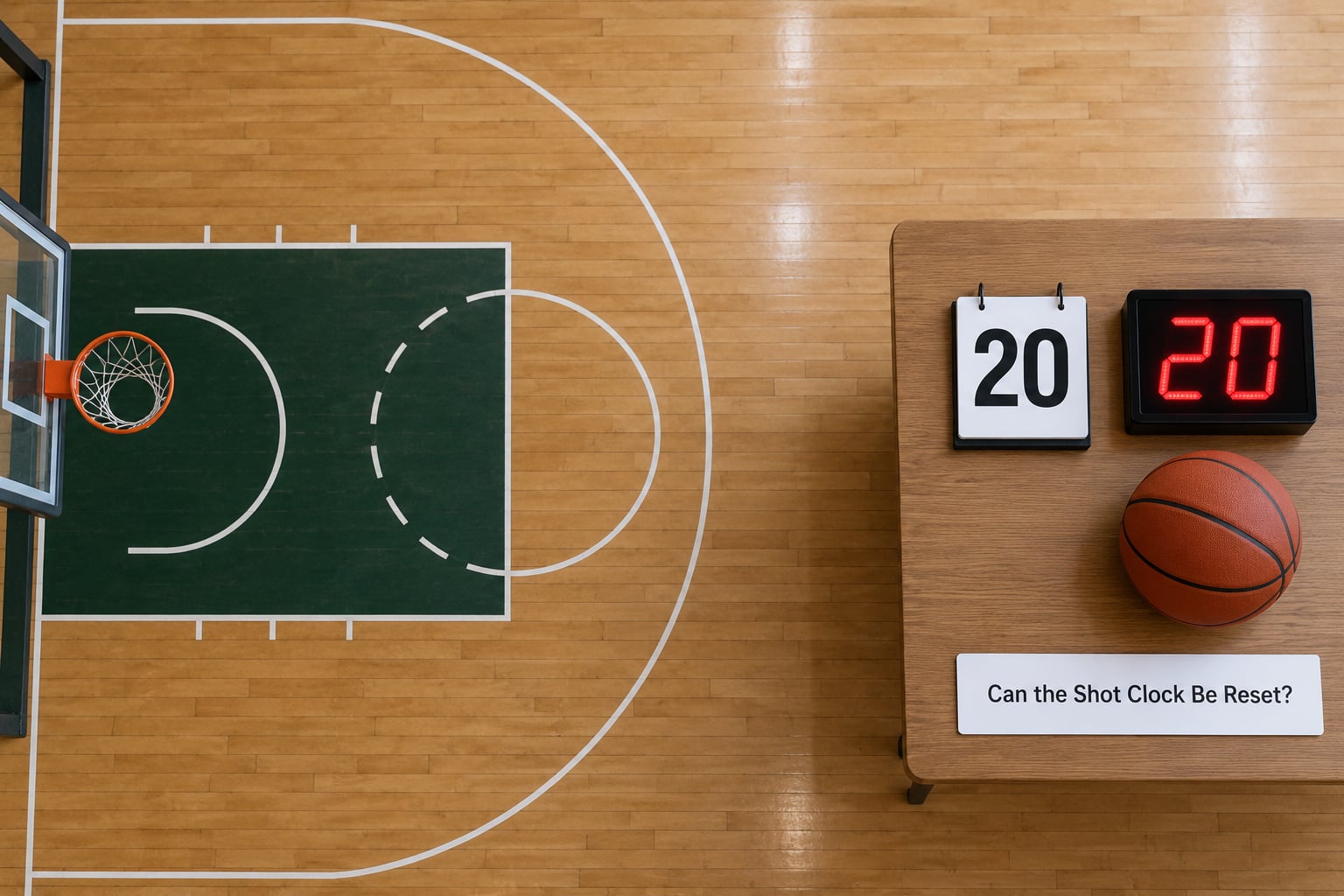
Yes, and the number it resets to is the part most people miss. A reset to 20 instead of 30 is not an error, it is the rule working as designed.
| Situation | What the shot clock shows |
|---|---|
| Change of possession (rebound, steal, turnover) | 30 seconds |
| Start of each half | 30 seconds |
| Defensive foul with no change of possession, frontcourt | 20 seconds |
| Offensive rebound in the frontcourt | 20 seconds |
| Frontcourt inbounds after a defensive foul | 20 seconds |
| Full timeout, frontcourt, possession retained | 20 seconds |
| Tipped pass the offense recovers and keeps | No change, clock keeps running |
| Airball that misses the rim | No change, clock keeps running |
| Held ball the offense retains under the possession arrow | No change, clock keeps running |
| Offensive rebound in the backcourt | 30 seconds |
The 20-second rule for frontcourt offensive rebounds is the newest piece of the puzzle. It was added by the NCAA rules panel in 2019, and until then an offensive board simply kept the clock running. Now a second-chance possession gets 20 seconds instead of whatever was left, which is why you will hear an announcer say “twenty on the shot clock” after almost every missed jumper in the frontcourt.
What does not reset the clock matters just as much. A tipped ball that your own team recovers and keeps does not start over, and neither does an airball. Nor does a defender touching the ball in the frontcourt, which is why a deflection to a teammate mid-possession is not a free possession.
There is one exception to the no-reset rule that catches people: if the defense tips or touches the ball in the backcourt during the eight-second advance, the ball is dead and the offense gets a fresh 30.
What Are the Most Common Shot Clock Violations?
Most violations are not dramatic. They come from ordinary situations where the team burned two or three seconds doing something administrative.
Dribbling out of bounds with three seconds or less
Step on the line with the clock under four seconds and the possession is over. The rule applies in the frontcourt, and it catches ballhandlers who take a bad dribble trying to save a possession.
Not inbounding promptly
The offense has five seconds to inbound after a stoppage. Let the clock get low before the pass is thrown and the offense can shoot itself in the foot.
Holding the ball past the limit
Once the shot clock reads under 10 seconds, the offense must release a shot toward the basket within three seconds of gaining control. Standing still with the ball at seven is a violation even though nothing is being held illegally in the ordinary sense.
Missing the rim on a desperation attempt
The shot gets released, the horn goes, the ball sails over the backboard and touches nothing. Because it never contacted the rim, it was never a valid field goal attempt.
The consequence in every case is the same: loss of possession to the opponents. The ball is inbounded where the violation occurred, or at the nearest hash mark if it was on an out-of-bounds play, and the new team gets 30 seconds. There is no make-or-get-a-basket exception and no free throws.
How Do Shot Clock Rules Affect Strategy?
Thirty seconds is long enough to run two or three actions, which is why elite college offenses spend much of their time attacking well before the clock gets low. The teams that play slow on purpose are usually playing from a large lead.
At the other end, a reset to 20 changes the math of a possession. Before 2019, an offensive rebound gave a team only the seconds remaining on the old clock. Now it reliably gives 20, which is enough for a quick second unit action but not enough for a reset of the whole offense. You can see the effect in the number of quick put-back attempts teams take after an offensive board.
Late in a close game, the shot clock becomes the opponent’s best friend. If the leading team can get a defensive rebound with under 35 seconds left, the game is effectively over, because a full 30-second possession plus a made free throw or two uses up the rest of the half. That is the real answer to the argument that the clock only affects pace. It affects who can safely stop playing.
Defensively, the value of pressuring the backcourt is tied directly to the eight-second advance count. Forcing a turnover there produces a fast break with a full 30 seconds and a court with nobody behind the ball. Forcing a deflection that the offense recovers instead produces a scramble in the backcourt with 25 seconds left, which is a completely different game.
The shot clock debate, then, is mostly about offense. Fans on r/CollegeBasketball have argued for years that shortening the clock just compresses possessions rather than increasing their number, pointing out that you would need roughly 30 more possessions a game to change anything. The people pushing for a shorter reset, as the NIT tested in 2018, have mostly lost that argument for now.
Frequently Asked Questions
How long is the shot clock in men’s college basketball?
Men’s NCAA teams play with a 30-second shot clock on every possession. That has been the rule since the 2015-16 season, when the NCAA dropped the previous 35-second clock to match the pace of modern offenses. Women’s NCAA teams have used 30 seconds since the clock was adopted in 1970-71.
How long is the shot clock in women’s college basketball?
The women’s NCAA shot clock is also 30 seconds, and it is one of the oldest in college sports, adopted for women’s basketball in 1970-71. Women’s college basketball is two 20-minute halves rather than four quarters, and near the end of each half the shot clock is switched off if the game clock shows fewer seconds remaining.
Does an offensive rebound reset the men’s college basketball shot clock to 20?
Yes, an offensive rebound in the frontcourt resets the clock to 20 seconds. The NCAA added offensive rebounds to the 20-second reset list in 2019. An offensive rebound in the backcourt is treated as a change of possession and gives a full 30 seconds.
What counts as a shot-clock violation in college basketball?
A shot-clock violation is any situation where the ball is live, the offense holds possession, and no field goal attempt is released before the clock reaches zero. For the attempt to be valid the ball must contact the rim. Dribbling out of bounds with three seconds or less, failing to inbound within five seconds, and missing the rim on a desperation shot are the common ones.
Does the shot clock stop when the ball hits the rim?
The shot clock does not stop when the ball hits the rim, because the game clock does not stop either. Rim contact simply converts the play into a valid field goal attempt and triggers the reset rules: 20 seconds for an offensive rebound in the frontcourt, or 30 seconds if the defense comes down with it.
What happens if the shot clock expires as a player releases the ball?
If the ball is released before the horn and goes in, the basket counts, because the shot was already in the air. The catch is rim contact: a shot released at the horn that never touches the rim is not a field goal attempt, so the violation stands even though a shot was taken.
Conclusion
Three habits make the shot clock readable in about five minutes of watching. First, know the base number is 30 for both men’s and women’s college basketball, and treat any 35-second reference as an out-of-date fact. Second, ask who gained possession, because a change of teams means a full 30 while anything the offense keeps just continues. Third, watch for the 20, which is what you get in the frontcourt after an offensive rebound or a frontcourt inbound.
Once that is automatic, the rest is detail, and the detail mostly comes down to one question: did the ball hit the rim. If it did, the possession had a shot in it. If it did not, nobody was ever trying.