Marching bands prepare for football season across roughly six months of staged work: spring auditions and section assignments, a week-long summer band camp, weekly rehearsal blocks through the fall, and a run-through before every game. Music comes first, drill is layered on top, and the whole thing gets refined set by set until kickoff.
Most of that happens where no camera ever sees it. A 14-minute show that looks effortless in the stands is the end result of hundreds of hours of counting, correcting and re-counting.
Table of Contents
- How Marching Bands Prepare for Football Season
- Choosing the Music and Developing the Show Concept
- Learning the Music Before Teaching the Drill
- Designing Drill That Fits the Music
- Rehearsing in Sections and as a Full Band
- Building Endurance, Accuracy, and Game-Day Readiness
- Handling Logistics Before Kickoff
- How Bands Refine the Show After Each Performance
- Frequently Asked Questions
- The Part You Can Actually Start This Week
How Marching Bands Prepare for Football Season
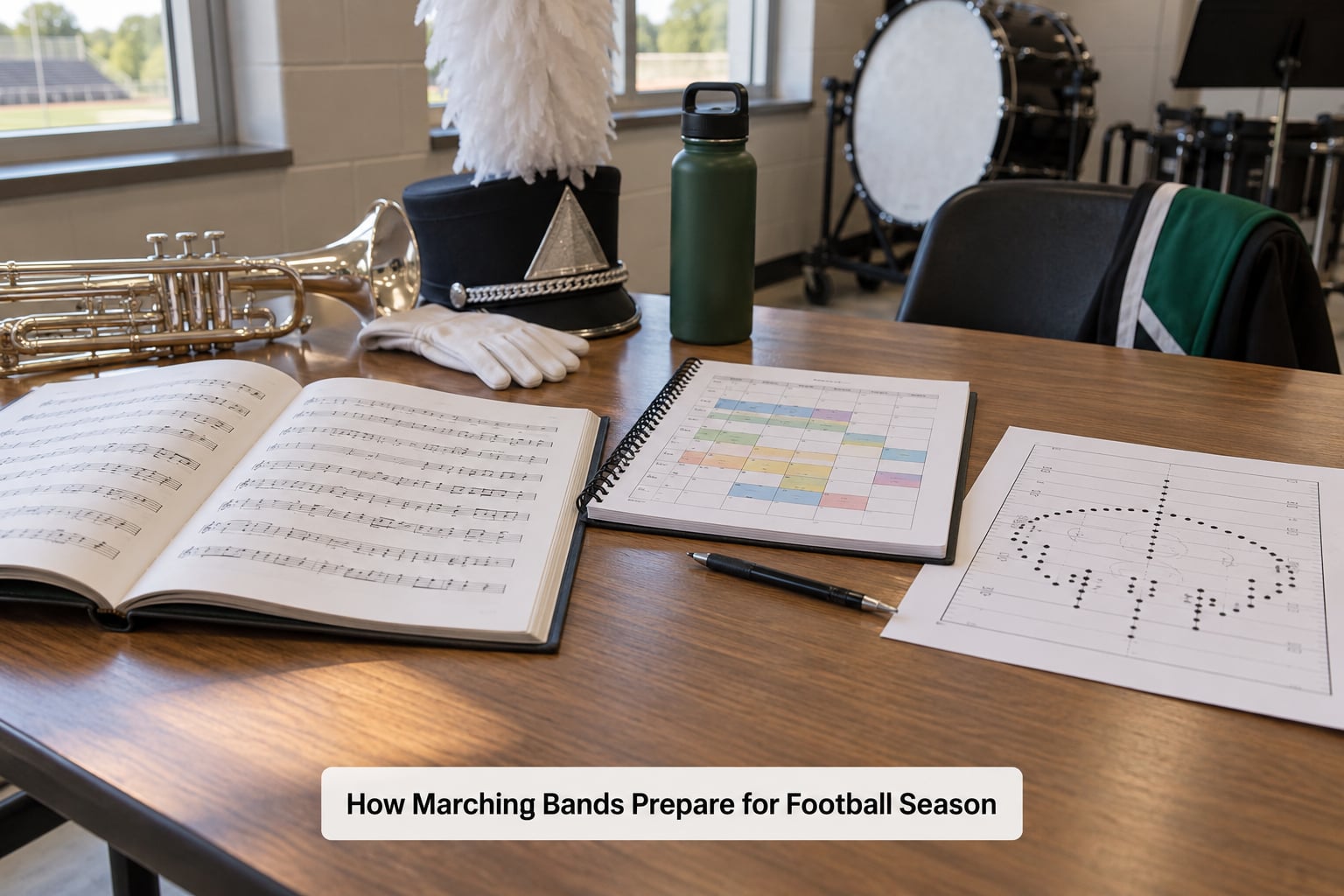
The season runs in overlapping layers rather than one long rehearsal. Creative planning starts months before anyone holds an instrument, music arrives before movement, and movement arrives before polish.
Here is the shape most college and high school programs follow.
| Phase | Typical timing | Weekly hours | What is being built |
|---|---|---|---|
| Creative planning and music selection | February to April | 2 to 5, mostly for staff | Show concept, theme, music list, drill design brief |
| Auditions and section assignments | March to April | 5 to 10 for students | Placement, percussion and drum major auditions, guard selection |
| Sectional music | May to June | 5 to 12 | Individual part accuracy, section blend, guard equipment work |
| Band camp | One week in August | 50 to 70 in one week | Fundamentals, step size, 8-to-5, conditioning, first full show run |
| Fall rehearsal blocks | August to November | 10 to 20 | Sets, transitions, visual effects, spacing, endurance, show polish |
| Game weeks | September to November | 15 to 25 | Preshow and halftime run-throughs, transitions to and from the field, performance routine |
| Stand and finals | October to November | Varies | Travel, competition runs, final performance of the season |
Two details matter more than the rest. First, the music is locked before drill is written, because every visual choice has to land on a beat the ensemble can already play. Second, the show is never finished in August. It is only ever finished for one particular game, and then the next rehearsal starts breaking it apart again.
Choosing the Music and Developing the Show Concept
Directors do not pick music because they like it. They pick it against a list of hard constraints, and the constraints do most of the work.
The first constraint is the ensemble. A show full of rapid woodwind lines is playable by a band with strong players and out of reach for a group that mostly consists of beginners. The second is the field: this is music played outdoors in front of a stadium, often unamplified or lightly amplified, so arrangements that depend on subtle dynamics fall apart at distance. The third is time. A college halftime window is about eight to twelve minutes of actual performance time, which leaves no room for pieces that need long intros or slow build-ups to land.
The fourth is the audience. The people in the stands are watching a football game and paying partial attention, so the program needs a hook inside the first few seconds. Percussion features, a recognizable melody, or an unexpected shift in tempo tend to get the reaction a slow crescendo was hoping for.
Once the theme is chosen, it stops being a theme and becomes a program. Color guard work, visual effects like flags, drops, or rifles, percussion breaks, and drill transitions are all written to serve specific musical moments. A concept that only fits the music leaves half the ensemble without a job.
Learning the Music Before Teaching the Drill
Bands that add movement to music that is not yet secure end up chasing two problems at once. Directors usually insist on the opposite order: the section plays correctly on its feet first, then movement gets added to a part that already works.
That means a lot of repetition before anything looks like a show. Individual players learn their parts from recordings and sheet music. Sections meet separately and play the same passage many times, correcting rhythm and blend. Percussion works on a separate schedule because their parts are written against a click or a metronome rather than against the wind players’ ears.
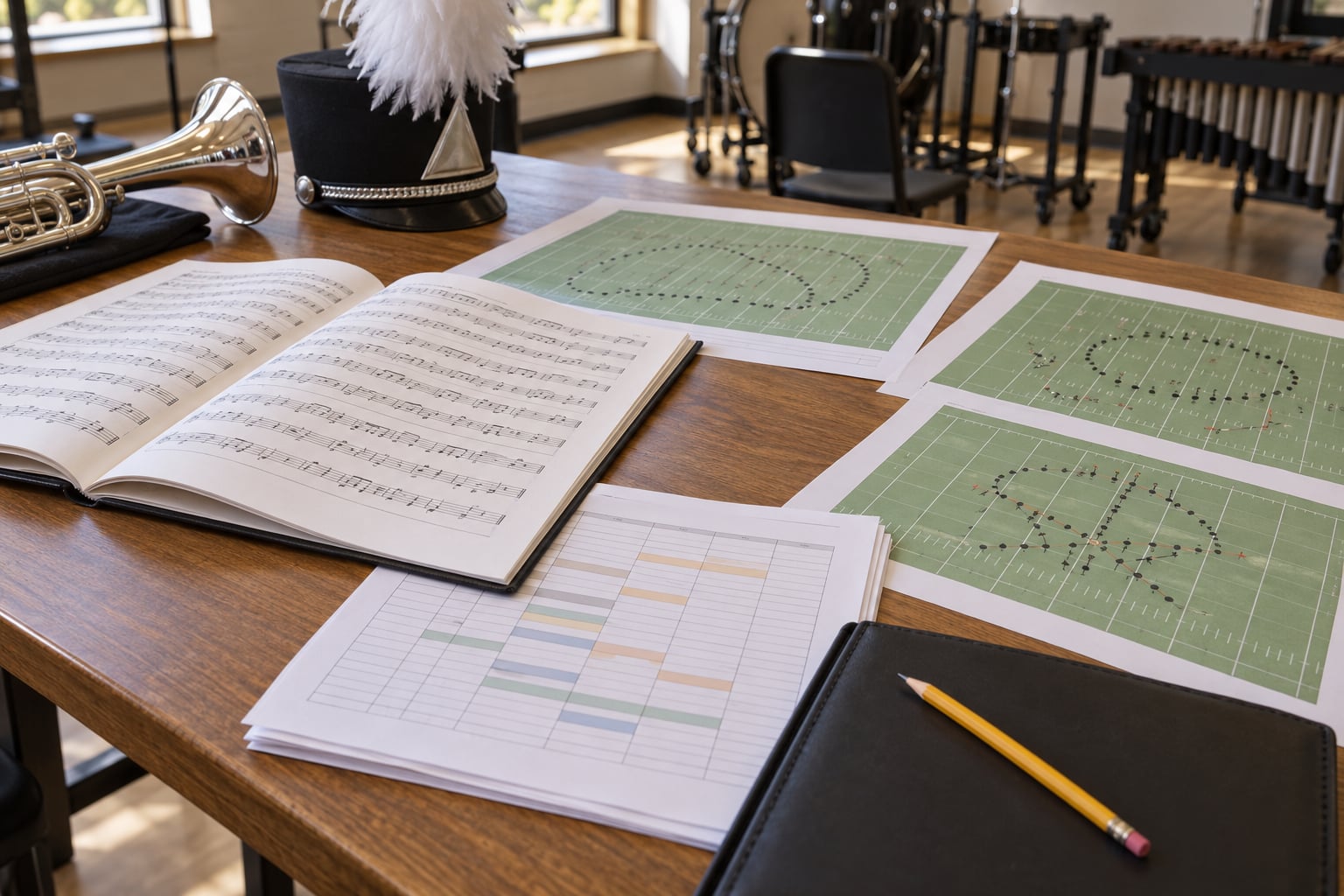
Only when a passage holds up with the full ensemble does it become drill. At that point a performer can stop thinking about notes and start thinking about coordinates, which is the only way two hundred people arrive at the same yard line at the same instant.
Designing Drill That Fits the Music
Drill starts at the most basic level and gets more demanding only once the basics are automatic. Step size and basic movement come first, followed by the eight-to-5 transition, which is the standard eight-count of forward movement that resolves into five counts of movement facing a new direction. Nearly every visual idea in marching band is built from variations on that one move.
From there, directors build sets: fixed arrangements of performers on the field that hold a shape long enough to be read by an audience. Transitions connect those sets, and transitions are where most of the difficulty lives. A transition has to keep the count flowing, keep the spacing correct, and look intentional from the stands all at the same time.
The balance is constant. A director wants effect and difficulty, but the constraint is always performers on a grass field in weather that changes without warning. Moves that look dramatic on video can be dangerous when hundreds of people are moving at once in low light or on wet turf. Anything that cannot be taught safely and repeated reliably gets simplified, whether or not it was the original vision.
Rehearsing in Sections and as a Full Band
Rehearsal comes in layers, and each layer solves a different problem. Sectionals are small-group sessions where a director can hear whether one flute section is playing the third line correctly. Percussion rehearses on its own because precision timing is the whole job. Color guard practices spins, tosses, and equipment handling, which is a technical discipline of its own.
Full ensemble rehearsals are where everything has to line up: music, drill, guard, and the people who set the coordinates that the rest of the band moves against. Most bands run a set once cleanly early in a rehearsal, then run it repeatedly and fix what breaks.
Diagnosing the problem decides the fix. If a passage fails because of one player’s mistake, that is an individual correction. If a whole section drifts, it is sectional work. If the music is fine and the transition is not, the transition gets taught on its own at half speed. Full runs get scheduled only when the parts underneath them are already sound, because running a broken show just rehearses the error.
Building Endurance, Accuracy, and Game-Day Readiness
Performing a full show on a football field takes more stamina than it looks like it should. Members march miles on grass, hold heavy instruments at shoulder height for long stretches, and stand in formation through the parts of the show that are not moving.
The load varies sharply by instrument. A sousaphone weighs roughly 20 to 35 pounds, a bass drum 15 to 25 pounds, and a snare around 15 pounds, with everything else lighter. Holding any of that at playing height without dropping your posture is a specific kind of strength work, and it is the single most common struggle new members describe.
Bands build that capacity through repetition rather than heroics. Field endurance sets keep the ensemble moving through continuous blocks. Run-throughs in full uniform expose problems that rehearsal clothes hide. Most programs add a conditioning block early in the season precisely because the physical demands arrive faster than most rookies expect.
Individual habits do as much work as the program does. Marking positions mentally, memorizing counts so you can recover when you lose sight of the person in front of you, and reviewing the feedback from the last run all matter on game day. Sleep and hydration matter more than most students expect, because a game day runs long and there is no good way to push through the third quarter on fumes and a granola bar.
What returning members can do between May and August
Members on the advice boards say the same thing over and over: daily instrument practice over the summer is what actually made camp easier. Here is a workable version of that list.
- Play every day, even twenty minutes. Daily reps rebuild the embouchure and finger memory that a few weeks off will erode.
- Play standing up and mark time with your heels. It simulates marching far better than sitting at a stand with sheet music.
- Work on holding your instrument at playing height with good posture, in short timed sets at first.
- Run scales when you cannot practice drill alone. It is the reliable fallback task and it keeps time sense sharp.
- Stay conditioned through the summer, whether that is a sport, a job, or running on your own.
- Learn to read music into a flip folder and keep your dot sheets with you, because you will use both daily.
Handling Logistics Before Kickoff
None of this is dramatic, and all of it decides whether a performance happens. Instruments get inspected and maintained before camp, valves oiled, mouthpieces replaced, and repair needs handled weeks ahead rather than the night before a show.
Uniforms are fitted and pressed, laundry runs on rotation, and shoes get checked for grip on wet grass. Staff coordinate field access with the athletic department, confirm the stadium entrance times, arrange buses for away games and competitions, and put together a communication plan so members know where to be and when.
Safety planning takes up real time. Large marching organizations run a safeties instruction before the season and require event-specific plans for the stadium, and any band playing away has to sort out how its members get back if the game ends late or gets delayed.
Weather is the contingency that every director plans around. Outdoor rehearsals move indoors, outdoor schedules compress, and hydration breaks get built into the day rather than left to individual judgment. Bands that treat water breaks as scheduled time lose far fewer members to heat than bands that treat them as optional.
What to pack and wear for band camp
The packing list that shows up most often on advice boards is short and unglamorous.
- Multiple liters of water, and a refill plan rather than a single jug
- Sunscreen, reapplied through the day
- Athletic shoes with good support, plus a spare pair
- A flip folder, loose-leaf dot sheets, and a pencil
- Your instrument and all mouthpieces or accessories
- Loose clothing you can sweat in, and a change for after practice
How long a game day actually lasts
Programs that rehearse before kickoff typically run a 90 to 120 minute rehearsal, followed by loading, travel or the walk into the stadium, meal, and the pregame, halftime and postgame performances. From a morning call time to the end of the postgame show, 14 to 16 hours is a normal day for members of a large program.
How Bands Refine the Show After Each Performance
The show gets better through a loop that looks a lot like the writing process. After a rehearsal or a game, directors review it, either from video recorded at field level or from memory and member notes, and they write down what failed.
Then they prioritize. A transition that puts eight people in the wrong spot matters more than a guard toss that is 80 percent clean, because one error can cascade into the next set. Fixes get taught in isolation at half speed, then put back into the run.
This is why the show looks noticeably different by week six than it did in August, and why bands rehearse hardest in the weeks before their biggest games rather than their first ones. Early rehearsals are for building; late-season rehearsals are for subtracting errors. By rivalry week and the championship run, the goal is not new ideas but a show that survives contact with a real crowd, real noise, and real nerves.
Frequently Asked Questions
How many weeks is a marching band season?
A college marching band season typically runs about six months, from auditions and music learning in the spring through the final performance in November or early December. High school programs follow a similar arc with fewer weeks of formal rehearsal. Band camp in August is the hinge: before it, work is mostly individual and sectional, after it the season shifts to full ensemble rehearsal on a weekly schedule.
How many hours is band camp?
Most August camps run five to seven days of full-day rehearsal, often structured as three blocks a day with an outdoor morning session, an indoor or shaded afternoon block, and an evening block. Programs with week-long camps can put members on campus for 50 to 70 hours in a single week. High school camps are commonly a few days rather than a full week.
When do marching bands choose their music for the season?
Directors usually select music in the winter and early spring, often several months before the first performance. The music has to be locked before drill can be written to fit it, and drill writing itself takes weeks. By the time band camp starts in August, the program is already chosen and members are learning parts rather than auditioning for pieces.
What should I wear and pack for band camp?
Wear athletic shoes with good support and loose clothing you can sweat in. Bring plenty of water, sunscreen, a refill plan, your instrument and mouthpieces, a flip folder, loose-leaf dot sheets, a pencil, and a spare pair of shoes. Expect to spend most of the day outdoors, so anything that protects you from sun and heat matters more than a nice uniform.
What does a marching band do before a football game?
Most bands hold a 90 to 120 minute rehearsal before kickoff, running the preshow and halftime shows in order and fixing whatever broke. Members then eat, change into uniform, move instruments and stands to the stadium, and line up for the pregame entrance. Bands also perform the fight song, a short selection during the game, and a postgame show.
What does 1A, 2A, 3A, 4A mean in marching band?
These are size classifications used in drum corps judging, and similar size tiers are used in state competition. Class A bands are the smallest, then B, C, and D in ascending size, with each step up meaning more members and more resources. High school bands are often grouped by enrollment instead, and Texas programs compete under UIL rules rather than drum corps classes.
The Part You Can Actually Start This Week
If you are new to marching band, the first thing to do is small and unglamorous: play your instrument every single day for the rest of the summer, and work on holding it at playing height with clean posture. That is the preparation step members most often skip and most often wish they had not.
Everything else follows from it. Bands spend six months turning a group of individual players into one instrument that happens to have two hundred parts, and the version of that you see on game day is just the last week of a long chain. The reason the pregame entrance feels electric is that nothing about it is improvised.