Every traveling rivalry trophy in college football started as an idea somebody had, usually about five minutes before kickoff. A student government buys a bell. An athletic director finds an old jug in a storage closet. Two cheerleaders ask a hard question after a win nobody felt. Understanding how a college football rivalry trophy tradition starts comes down to four things showing up in order: a real rivalry, a game that happens every year, an object that means something to both sides, and a ritual that repeats.
Get those four in place and fans will keep the tradition alive long after the people who invented it have left campus. Miss one and the object usually ends up in a case somewhere, which is where plenty of them already sit.
Table of Contents
- What Starts a College Football Rivalry Trophy?
- How Do Rivalry Trophies Originate?
- How Do You Verify a Trophy Origin Story?
- What Makes the Tradition Matter to Fans?
- How Does a One-Time Game Become an Annual Tradition?
- Who Maintains the Trophy and Its Score?
- How Can Arizona Fans Apply This Framework?
- Frequently Asked Questions
- Conclusion: Begin with the First Documented Connection
What Starts a College Football Rivalry Trophy?
A rivalry trophy tradition needs a rivalry that already has weight. A trophy cannot create a rivalry, but it can turn a scheduled game into the week that defines a season.
Here is the working definition most historians use: a recurring contest where the winner of an annual game takes custody of a physical object that travels between campuses, giving both sides a tangible claim to the result.
Four ingredients have to be present for that definition to hold:
- A rivalry people already care about. The game has to matter before the hardware shows up.
- A recurring contest. Annual or close to it, with a fixed date.
- A symbolic connection. The object connects to something real in the two schools’ shared history, not just to the score of one game.
- A presentation ritual. Somebody hands it over at the end of the game, in public, every time.
Two distinctions matter once you start sorting trophies. A traveling trophy changes hands, while a permanent trophy sits in one athletic department and the visiting team earns a replica or a signed certificate. And there is organic versus manufactured: an organic trophy grew out of something that happened between the schools, while a manufactured one was designed to create a rivalry where none existed.
The Nebraska-Wisconsin Freedom Trophy gets called manufactured because the game itself came first as a promotion and the trophy came after. Plenty of fans treat those two categories very differently.
How Do Rivalry Trophies Originate?
Trophies start through five main pathways, and most real traditions mix two of them. Knowing which pathway fired first tells you a lot about how the tradition will behave.
1. Student initiative
The most durable traditions usually begin with students who control a small budget and care more than anyone else about pageantry. The Stanford Axe traces to a group of Stanford students in 1899 who bought a lumberjack axe. The Victory Bell came from UNC cheerleaders in 1948 who wanted a token for a rivalry with Duke. In 1946, TCU student council raised money for a skillet to beat SMU with.
Students matter because they carry the ritual forward without being asked to. When an athletic department changes hands or a conference realigns, the students are usually the ones still defending the object.
2. Administrative or coach action
Some trophies exist because somebody in charge wanted the game taken more seriously, or wanted to fix a relationship. The Little Brown Jug between Michigan and Minnesota grew out of years of hard games and a Minnesota athletic director, L.J. Doc Cooke, who treated a battered water crock like a serious institutional asset. Floyd of Rosedale came out of 1935, when Minnesota governor Floyd Olson and Iowa governor Clyde Herring decided their states needed a peace offering after a run of ugly incidents.
3. Crisis response
Some trophies are born from a problem. The Golden Egg between Ole Miss and Mississippi State dates to 1927, when a fight involving a decorated WWII veteran turned a rivalry game into a security situation. An honorary society proposed a gold football egg as a trophy to be presented to a distinguished player, on the theory that a shared award would make the weekend about more than the fight.
4. Historical artifact adoption
Sometimes the object already existed and both schools had a claim to it. The Territorial Cup comes from a boundary marker dispute between Arizona and Arizona State that started in the 1890s over which side of a river was which. A quartzite stone was awarded as a trophy for the mining school football game, then sat in storage for decades before the two schools formalized it. The Golden Hat between Kansas and Kansas State came from a state fair association that wanted a physical border of the state.
5. External commission
Governors, state fairs, and alumni clubs commission trophies when they want the game to matter across a whole state rather than one campus. The Paul Bunyan Trophy between Michigan and Michigan State was commissioned by Michigan governor G. Mennen Williams, who picked the lumberjack theme deliberately. The Jeweled Shillelagh between Notre Dame and USC came out of the Notre Dame alumni club, which wanted something that looked like it belonged in an Irish family.
What Common Story Starts a Trophy Tradition?
Every origin story, when it holds up, has the same six pieces. Knowing them makes it much easier to spot the ones that were invented later.
- Who was involved. Named people, not “students” or “the school.”
- When and where. A specific date and a specific place.
- The original purpose. What the object was supposed to do, which is often not what it does now.
- First documented appearance. The first photograph, program, newspaper item, or record showing it.
- The first trophy game. Which game was the first one where it was actually presented.
- The evidence trail. Something that connects the origin story to later documented use.
The Territorial Cup story has all six. The Iron Skillet story has most of them, which is why people still argue about whether the 1946 student council purchase or a later revival deserves the credit.
How the Trophy Becomes Part of the Game
An object becomes a tradition through repetition, not through any single decision. Watch for these signals in order: it gets presented after a game, someone names it, someone starts keeping a series score, eligibility rules get written down, the object gets handled on game day, and then announcers start saying the name out loud.
That last one is the tell. Once broadcasters say “the winner of the [name]” as a regular sentence, the tradition is safe. Coaching changes, conference realignment, and budget cuts all threaten traveling trophies. A name in a broadcast script survives that.
Why Is It Called the Little Brown Jug?
Because it is literally a five-gallon stoneware water jug, roughly a quart short of a full gallon, that one side of the rivalry had been using as a drinking vessel and the other side refused to touch. The name comes from the object, not from any marketing decision.
How Do You Verify a Trophy Origin Story?
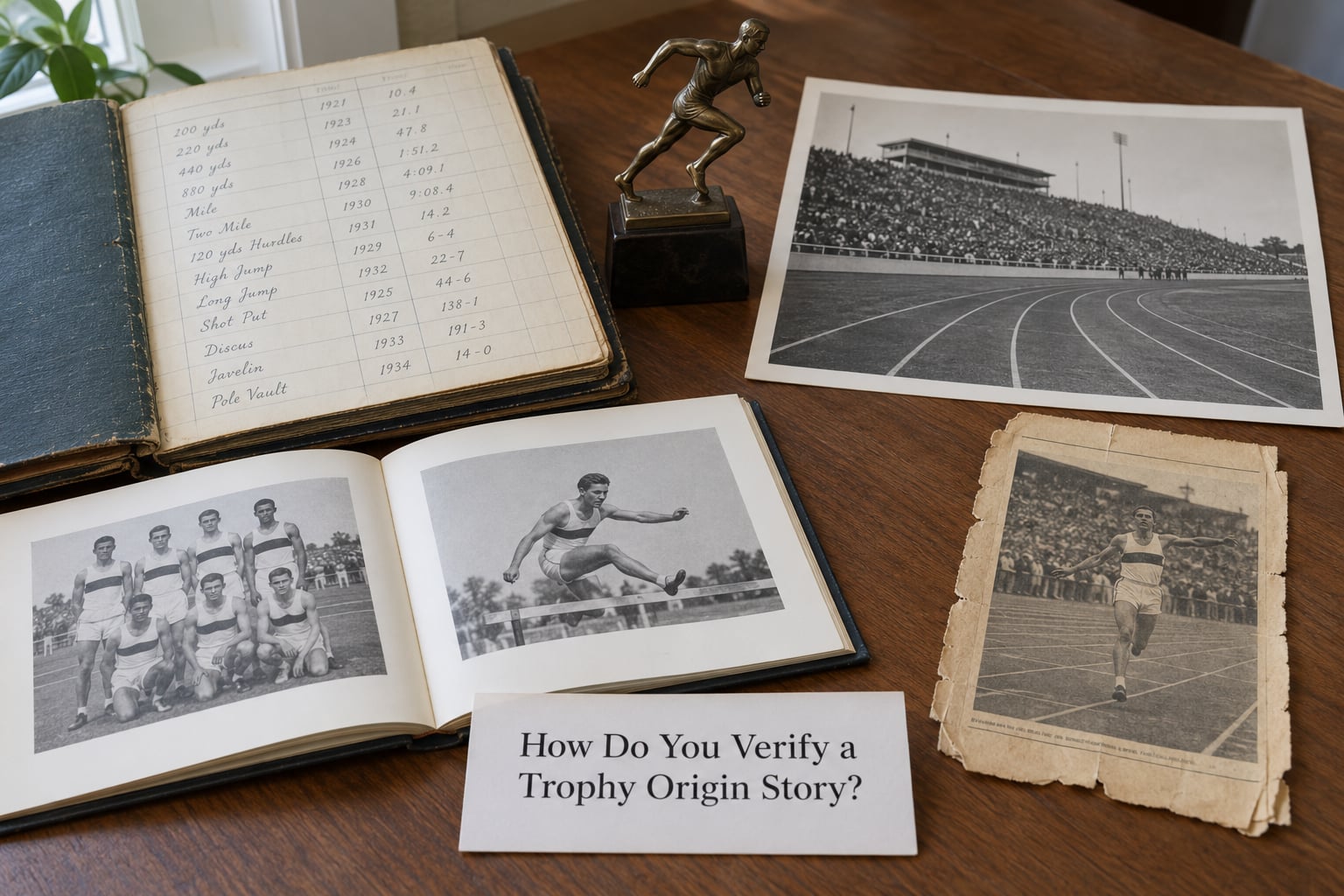
Sort every claim into one of two buckets: something written down at the time, or something written down later by somebody who wanted the story to sound good. That is the whole method, and it is more useful than it sounds.
Start with university archives and athletics record books, since those tend to be the most careful and the least dramatic. Then check newspapers from the season in question, because a local reporter covering a story that strange usually noticed it. Yearbooks and student publications from both schools show what students were already doing on game day. Interviews with longtime staff and managers help, but only when the person was there rather than when they inherited the story.
Contemporary photographs are the strongest evidence available, and this is where the Little Brown Jug story gets interesting. Minnesota athletic director Doc Cooke left a written account of the jug’s role, and archival photographs from his office around 1905 show the jug hanging in the room. Later football programs and published histories attributed the tradition to a Michigan figure, but the earliest contemporaneous documentation points elsewhere. The pattern shows up constantly: the earliest records are quieter and less flattering than the stories that come decades later.
A few habits help. Date every source, and note who had a stake in the version they were telling. Watch for language that jumps forward, like “since 1899” appearing in a source printed forty years later with no earlier citation behind it. And assume the object’s first documented appearance is not the same as its creation. Some trophies were made years before anybody thought to award them.
What Makes the Tradition Matter to Fans?
Fans attach to the ritual far more than to the object. A cheap bell matters more than a solid gold one if it gets handed over on the field every year, because the handing is the thing people remember.
Three things do most of the work. Identity comes first: the trophy is evidence that your school and that other school have a history, and history is something alumni in faraway cities can claim. Continuity comes next: the same game, the same date, the same object, year after year, which gives a season a shape. Belonging comes last: paint on a bell, a stolen axe, a goalpost chopped on camera. Those are participation tickets.
The rituals vary more than the trophies. A bell gets spray painted. An axe gets carried out and used on a goalpost after a win. A boot gets hoisted. When people ask about the traditions they remember the action, not the provenance.
There is also a practical side. Fans keep unofficial series scores long before anyone bothers to track the trophy itself, and those unofficial numbers are what people argue about in comments sections every single week.
How Does a One-Time Game Become an Annual Tradition?
Repetition does the work. The game has to be scheduled again, the object has to be presented again, and someone has to tell the origin story to a new group of freshmen who have never heard it. A tradition that stops repeating stops existing.
How a College Football Rivalry Trophy Tradition Starts, Step by Step
- The rivalry already exists. Players care about this game before any object is involved. This is the gate. A trophy built on a manufactured rivalry has to work harder for the rest of its life.
- Something happens. A wager, a gift, a fight, a find in a storage room, a student government vote. Almost every trophy has a triggering moment, and it is usually smaller than the eventual story suggests.
- Someone pays for an object. Students, an alumni club, a governor, or a foundry. The object exists now and needs a job.
- It gets presented once. The first presentation is an experiment. Almost nobody announces it.
- Custody rules get written down. First as a verbal understanding, later as a signed agreement between athletic directors. The Stanford Axe waited until 1933 for a formal student body presidents agreement. The Victory Bell took a 1942 agreement after a 1941 theft. The Territorial Cup went 83 years without being formally recorded before the schools signed in 2001.
- The score gets kept and the story gets told. Someone maintains a record, and someone repeats the origin story each season. Once those two exist, the tradition has a life of its own.
The pattern in step five is worth noting. The formalization often arrives late, decades after the first presentation. That lag is why so many origin stories are murky: for years, nobody thought the thing was worth a contract.
Traditions fade too. The Iron Skillet between TCU and SMU was discontinued after the schools stopped scheduling the game as often, and plenty of rivalry games have lost their trophy without ever losing their fan base. When a game moves off the schedule, the object usually goes into a display case within a season or two.
Who Maintains the Trophy and Its Score?
Custody usually sits with an athletics department, but not always, and knowing who holds it explains a lot about how the tradition is run.
Athletics departments handle the money, the paperwork, and the insurance. The Little Brown Jug has been a Minnesota institutional asset that the department guards closely. Student groups hold a surprising amount of authority in several cases, sometimes because the students bought the object in the first place. Alumni associations commission and fund trophies like the Jeweled Shillelagh, and they tend to care most about craftsmanship. Joint arrangements show up when both schools share custody rules, which is the healthiest sign a tradition has.
On the record side, someone has to maintain a series score, and that job is contested. Records get disputed because schools count games differently. The usual tie-breaker is a dated source: a program, a newspaper account, an athletics record book. When those disagree, the school with the documented date wins.
Storage is the other question. A fragile original that travels badly usually lives in a case, with a replica going to the field. Some fans find this disappointing. Others argue it is why the original is still around.
How Can Arizona Fans Apply This Framework?
The Territorial Cup is the cleanest local example, because its history runs through every step above. Arizona and Arizona State were two schools in the same state competing over which side of the river a piece of ground sat on, and a mining tradition gave them a stone trophy to fight over around 1900.
For local fans, the useful exercise is checking the framework against their own rivalry. Look for the earliest documented mention of the cup in athletics records or state press, then compare it to the later stories. The first trophy game date matters more than the date the object was acquired. Notice that formal written custody rules came roughly a century after the trophy first changed hands, which tells you the tradition survived on memory and repetition long before anyone signed anything.
Then check the current ritual. Who presents the cup, who keeps the series score, whether students or staff hold the actual object on game day. Arizona game weeks still get built around handing that stone over, and it lands harder for people who know it sat in a case for 83 years.
The same questions apply to any rivalry you care about, including ones with no trophy at all. A missing trophy is a good sign the ritual never found its object.
Frequently Asked Questions
Who usually creates a college football rivalry trophy?
Four groups create them in roughly equal measure. Students account for many of the most durable examples, as with the Stanford Axe, the Victory Bell, and the TCU Iron Skillet. Athletic directors and coaches commission trophies to mark a game they want taken seriously. Governors and state fairs commission objects meant to represent an entire state. Alumni clubs fund trophies built to a level of craft that outlives their founders.
Is a rivalry trophy always connected to a wager or bet?
No. Wagers are one origin story among five, and the least common of the recurring ones. Plenty of trophies started with a gift, a fight, an antique find, or a boundary dispute. The Territorial Cup came out of a boundary marker dispute rather than a bet, and the Golden Egg came out of a violent game that officials wanted to calm down. A trophy follows a wager closely when the wager itself is the memorable part of the story.
Why do college football schools keep a score for a rivalry trophy?
A series record turns an annual game into a measurable contest, and measurable contests are what fans argue about. Schools keep formal records so that claims about who leads the series are settled by evidence instead of memory. Records also protect the tradition when the game slips off the schedule, since a documented history survives a few missed meetings better than a ritual does.
How can I tell whether a rivalry trophy origin story is true?
Date your sources and separate them into two piles: written at the time, and written down later. University archives, athletics record books, contemporary newspapers, yearbooks, and photographs from the right season carry the most weight. Be suspicious of any version with a suspiciously round founding year and no earlier citation, and watch for a named person who was not involved according to the earliest records.
What turns a rivalry trophy into a lasting fan tradition?
Four things do the work: a rivalry that already mattered, a game on a fixed schedule, an object with a real symbolic connection, and a public presentation ritual that repeats every year. Once announcers say the trophy name as part of a normal sentence, the tradition is durable, because that survives coaching changes and conference realignment. Fans stay loyal to the ritual far more than to the object itself.
Conclusion: Begin with the First Documented Connection
The formula for how a college football rivalry trophy tradition starts is short. Find a rivalry that already has heat, give it an object that means something to both sides, present it after the same game every year, write down who keeps it, and keep telling the origin story to people who have not heard it yet. Do those things and the trophy outlives the people who invented it.
Start where the research starts: find the earliest dated record of the object, and see whether the story people tell matches what that record actually says.