An offensive coordinator is the coach who designs, installs, and runs a college football team’s offense. They report directly to the head coach, write the weekly game plan, run much of practice, coach a position group, and on most Saturdays they call the plays. The head coach owns the program; the offensive coordinator owns how the offense actually scores.
It is a strange job title for what is really the second-most powerful coaching seat on a football staff. “Coordinator” sounds like a scheduling or travel role. It is not. The offensive coordinator decides what the offense looks like on any given snap, and that decision follows the ball from the meeting room on Sunday to the fourth quarter on Saturday.
So what does offensive coordinator do in college football, hour by hour? Here is the full picture, from the offseason install meeting to the final huddle.
Table of Contents
- What Does Offensive Coordinator Do in College Football?
- How Offensive Coordinators Shape the Offense
- What Happens During the Weekly Planning Process?
- How Does an Offensive Coordinator Call Plays?
- What Decisions Are Made During the Game?
- How Do Coordinators Adjust After a Bad Quarter?
- How Does the Coordinator Work With Other Coaches?
- Offensive Coordinator vs. Quarterback: Who Chooses the Play?
- What Does the Offensive Coordinator Do on Game Day?
- Frequently Asked Questions
- Does an offensive coordinator call every play?
- How is an offensive coordinator different from a quarterbacks coach?
- Does the head coach have final say over offensive play calls?
- How much influence does the offensive coordinator have over recruiting?
- What skills does someone need to become an offensive coordinator?
- Conclusion
What Does Offensive Coordinator Do in College Football?
The core duties, in the order they happen across a season:
- Builds the offensive scheme and playbook. The coordinator decides the offense’s identity — how it lines up, how it moves the ball, and what it looks like on third down.
- Installs the offense in practice. Plays are taught in a sequence, and the coordinator runs or oversees the offensive practice periods.
- Studies opponent and own film. Coordinators watch game film to find what a defense does, and to see their own offense’s tendencies in the previous weeks.
- Writes the weekly game plan. Each opponent gets a document of the plays to emphasize, the situations to expect, and the answers for trouble.
- Coaches a position group. Most coordinators also coach quarterbacks or wide receivers directly, which puts them on the field during practice.
- Calls or relays plays on game day. Reading the defense and getting the right call into the quarterback’s helmet is the most visible part of the job.
- Adjusts in real time. When a defense counters, the coordinator changes the plan during the game and again at halftime.
- Handles off-field work. Recruiting, retention, fundraising, administration, and personnel decisions all sit with the coordinator as well, according to a typical university job description.
That last bullet surprises most fans. A posting from Thomas University lists the offensive coordinator as responsible for “organization, administration, coaching a position group, and practice planning, fund raising, and student-athlete recruitment, and retention.” The job posting is dry reading, but it is the clearest on-the-record list of the role anywhere, and it confirms that the OC handles a real slice of the program’s business.
How Offensive Coordinators Shape the Offense
The coordinator’s fingerprints show up in decisions fans can see from the press box. Some of the biggest are below.
Offensive identity
Every program has an offensive identity, and the coordinator usually writes it. A run-first attack that grinds out five yards and controls the clock is a different plan from a spread offense that throws 40 times a game. Most modern schemes borrow from both, and the coordinator decides how much of each to keep.
Formation and personnel
Which receivers are on the field, whether the quarterback plays under center or in the shotgun, how many tight ends show up on third down — these are coordinator calls. He knows the roster inside out, because a scheme only works if it fits the players who are actually available.
Tempo and field position
Tempo is a real strategic choice, not a personality trait. A coordinator who wants field position plays fast and takes what the defense gives. A coordinator who wants to keep a defense off the field slows it down and runs clock. That decision changes the entire rhythm of a game.
Run-pass balance
Run-pass option concepts let the coordinator present the same look as either, then let the quarterback read the defense. It is one of the most common tools in the playbook precisely because it makes the defense declare first.
Fan complaints about an offense often come down to a scheme that does not fit the talent. A coordinator working with a quarterback who throws well but is not a runner has to build a passing game that does not depend on scrambling. A coordinator with a bruising back and a weak line might lean on play-action. Adjusting to talent is a large part of the job.
What Happens During the Weekly Planning Process?
The in-season week has a rhythm, and it starts the moment the last game ends.
Opponent study and self-scout
Offensive analysts usually handle the heavy film work, charting what a defense shows, which defenders are in their rotation, and what happens on third and fourth down. The coordinator reviews that work, then adds judgment the chart cannot: which tendency is real and which is a fluke from a lopsided score.
Self-scout is the mirror image. The staff watches its own offense from the previous week and flags problems. Too many pre-snap penalties? The coordinator adds a period of hurry-up reps. A protection breakdown on third down? The line coach and coordinator rebuild the call sheet.
The game plan
The weekly game plan is usually a binder or a digital playbook, and it is built around what this defense gives up. It lists the three or four calls that must be hit early, situational packages for third and fourth down, the red zone plan, and a two-minute package for late-game situations.
Contingency work matters as much as the base plan. Good coordinators build in answers before they are needed: what to call if the defense shows pressure, what to do if the run game stalls, which routes work against a specific coverage.
Practice priorities
Practice schedule is not arbitrary. Scouting reports turn into practice emphasis — if a defense has an aggressive pass rush, the offense spends reps on hot reads and quick throws. If a team struggles in the red zone, that zone gets extra periods in Thursday practice.
Offseason install
Before any of this, the coordinator installs a base offense in the spring. That base gets added to year by year rather than rebuilt from scratch, which is why a new coordinator’s first season often looks like a mix of the old system and the new one.
How Does an Offensive Coordinator Call Plays?
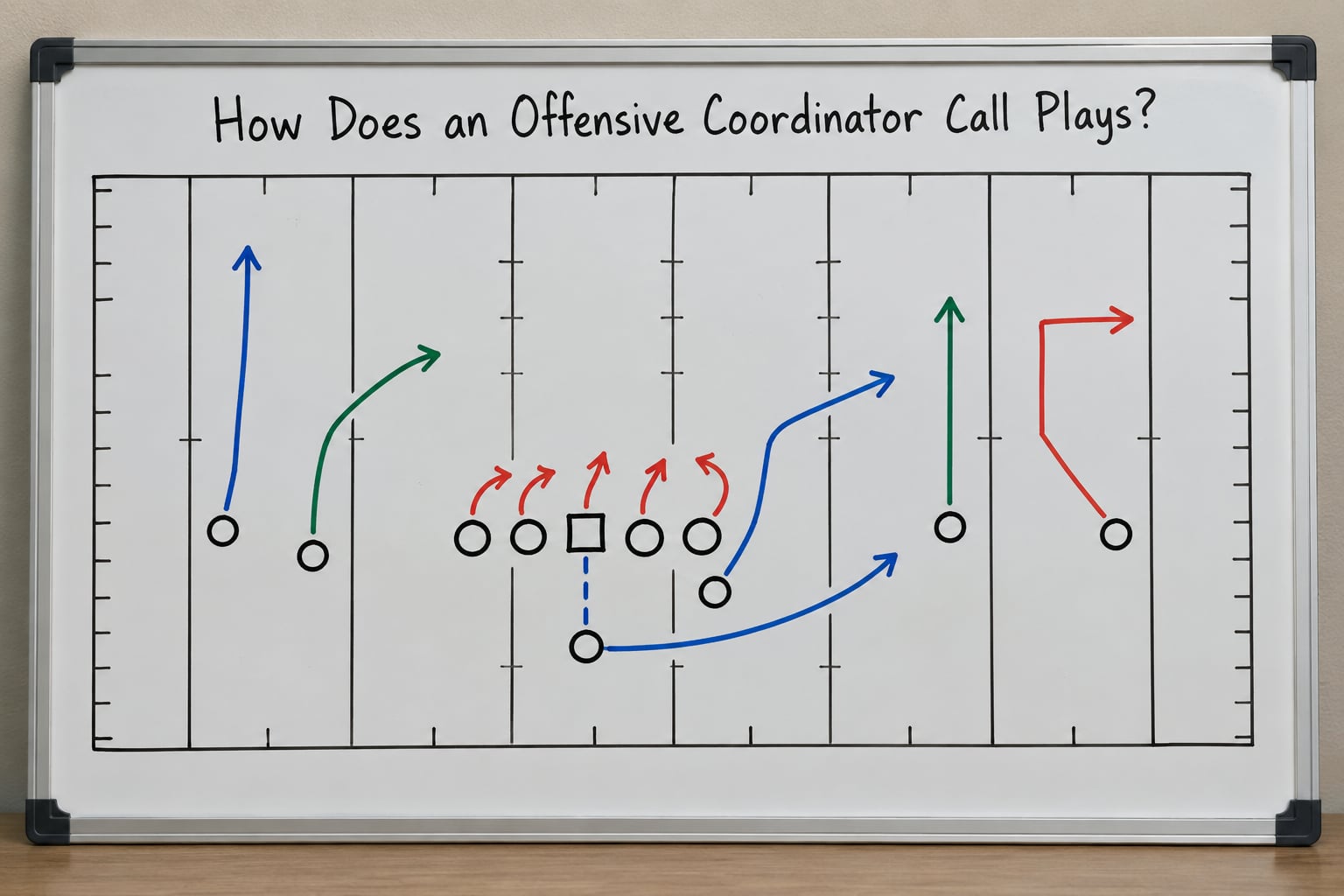
A play call is a bet. The coordinator is guessing what the defense will show, then calling the play that exploits it. The bet usually has a backup attached.
What goes into a decision
Before the ball is snapped, the coordinator is weighing down and distance, field position, the personnel on the field, what this defense has done so far, and the situation in the game. Third-and-four at the opponent’s 30 is a different play from third-and-four at your own 20, and a good coordinator knows the difference without thinking about it.
Where the call comes from
The quarterback’s protection is the starting point, because a play that cannot keep the quarterback upright does not matter. The coordinator picks the protection, then the concept, then the specific play, usually calling from a laminated card with a dozen or so options rather than the entire playbook.
Press box or sideline
Coordinators split over where they call from. The press box gives a full-field view, which makes reading defensive shifts and coverage easier. The sideline keeps the coach close to the quarterback and the linemen, which speeds up communication. A long-running thread on r/CFB shows fans routinely cannot tell which coach is calling the game from the broadcast, and the answer usually depends on the program. Some coordinators call from the box, some from the sideline, and a good number of staffs split the two by situation.
How the play actually gets called
Here is the chain most fans never see. The coordinator calls the play to the quarterbacks coach or another staffer on the headset, that coach relays it over the communication system, and the quarterback receives it in his helmet. A defense with a wrinkle at the line can force an audible to a check-down or a protection change the coordinator did not script. The quarterback has to make that call himself, correctly, in about two seconds.
What Decisions Are Made During the Game?
Here is a possession, told the way it usually goes, to show how a scripted call becomes a live one.
First and ten, own 25, tied game. The coordinator wants a designed pass to set up a later run, so the plan calls for play-action. The defense shows four down linemen and drops a safety. The quarterback checks to the bubble screen because the blitz is coming. Original call abandoned, protection saves the play, 4 yards.
Second and six. The defense is now in the same shell it showed on the previous series. The coordinator trusts the read, so the quarterback takes the check-down. 3 yards, first down.
First and ten, opponent’s 12, red zone. The plan called for a designed run up the middle, where a linebacker has shown a gap tendency all game. The coordinator checks the sideline, sees the same formation, and calls it. 6 yards, second and 4.
Second and goal, third and goal. Now the defense has adjusted to the run. The coordinator abandons the run-heavy plan and calls a quick slant, which no defense has shown an answer to. Touchdown.
Notice how much of that was the original plan. The play-action survived as a check, the red zone run worked because of scouting, and the goal-line call was a change of plan based on what the defense had already proven it could stop. That is ordinary coordinator work.
How Do Coordinators Adjust After a Bad Quarter?
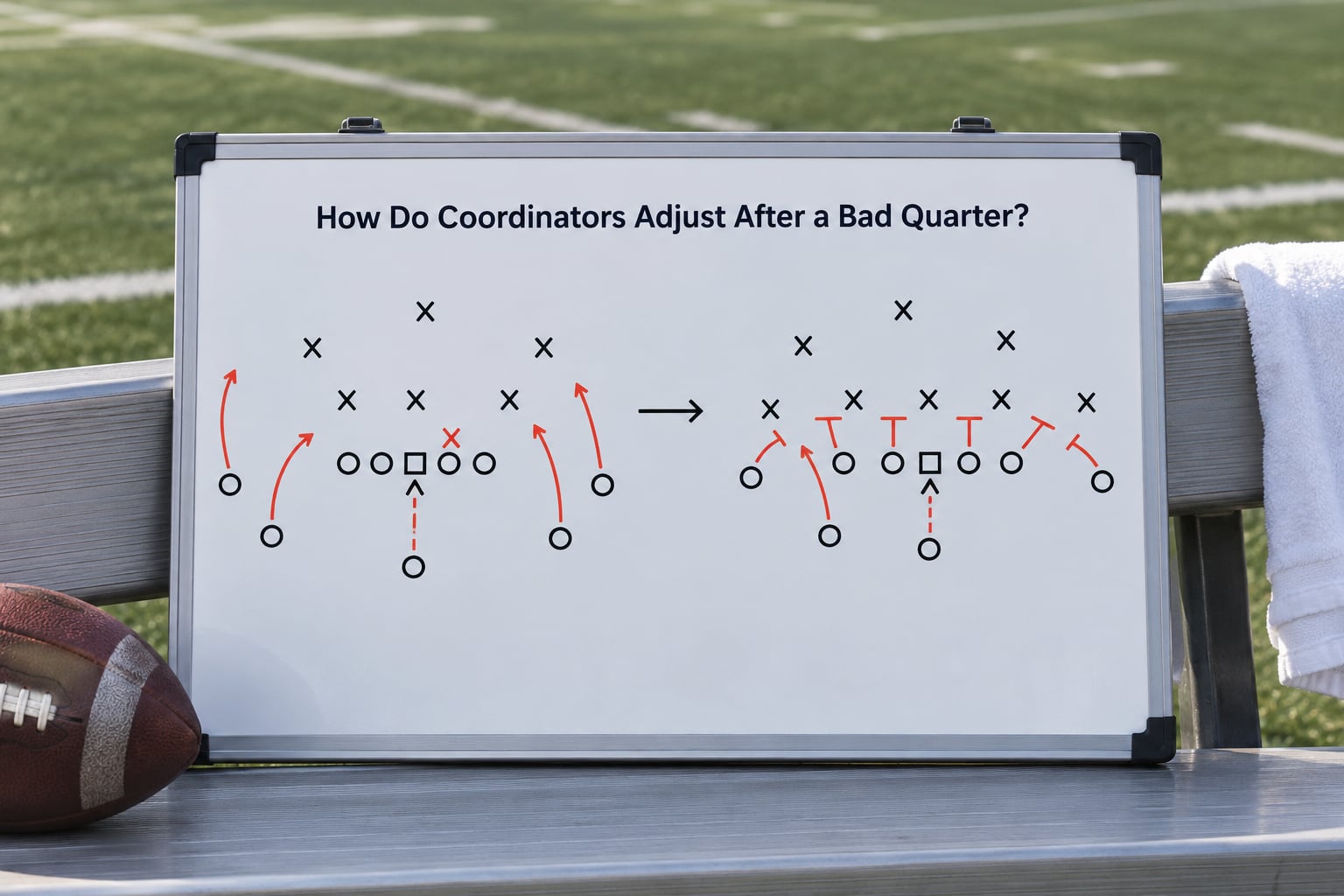
When an offense stalls, the change usually starts with film, not inspiration. Halftime is a self-scout session, and the coordinator is often the one running it.
Find the actual problem
A bad quarter is a symptom, not a diagnosis. The offense might be getting good yardage and failing on third down, or getting destroyed on early downs and having no answer. The staff separates the two before changing anything, because the fix for one makes the other worse.
Change the plan, not just the personnel
Common halftime fixes include simplifying the protection so the quarterback has more time, adding a tempo change to keep the defense off the field, shifting the formation so the defense has to show its hand, or altering which personnel group is on the field together. Some coordinators go the other way and go faster, taking more chances because the game is slipping away.
Staff input
The line coach may report that the protections are mismatched against a particular front. The running backs coach may note that the blocking assignment for a specific play is failing. The head coach may push a tempo change. A good coordinator absorbs all of it and decides which changes go into the second-half script, because the plan has to be one plan, not a committee’s list of suggestions.
One bad quarter does not usually cost an offensive coordinator his job. Two or three does, and that pressure is the part of the job almost nobody outside the profession acknowledges.
How Does the Coordinator Work With Other Coaches?
The offensive coordinator is second in command on his side of the ball and directly under the head coach. Everyone else on offense works within the system he sets.
Where the OC sits in the hierarchy
The head coach hires the roster, sets the culture, owns the schedule and the record, and can override the coordinator on any call. The offensive coordinator owns the offense. Position coaches run their units inside the scheme the coordinator built. Analysts research and brief. A defensive coordinator mirrors all of this on the other side of the ball.
| Role | Owns | Calls plays | Coaches players directly | Reports to |
|---|---|---|---|---|
| Head coach | The whole program, roster, culture | Sometimes, on either side | Special teams, usually | Nobody |
| Offensive coordinator | Offensive scheme, playbook, weekly game plan | Usually, on game day | Often quarterbacks or wide receivers | Head coach |
| Defensive coordinator | Defensive scheme and game plan | Almost always | Often linebackers or defensive backs | Head coach |
| Position coach | A position group inside the system | No | Yes, full time | Coordinator |
| Offensive analyst | Opponent research and self-scout | No | Rarely, not a head coach title | Coordinator |
That analyst row is worth pausing on, since “what does an offensive analyst do in college football” is a question people search on its own. An analyst studies film, charts tendencies, and briefs the coaches who make the decisions. Some analysts produce play suggestions. They do not coach a position group and they do not call plays, and the difference matters when a program restructures its staff.
What does the OC do when the head coach calls the plays?
Plenty of programs have a head coach who keeps the offense, and the answer to this question comes up constantly on coaching forums and in fan threads. The coordinator still designs the offense, still installs it, still writes the game plan, and still coaches the quarterback or the receivers. What changes is the final decision on the call.
Several arrangements exist. The head coach may call from the sideline while the coordinator suggests plays. Both may call, with the coordinator taking over when the head coach asks. Or the head coach may hold final authority while the coordinator runs the game plan, which means the plan is already built around a known set of calls.
On a university job posting, the offensive coordinator is still accountable for “in-game adjustments” and exploiting defensive weaknesses, so the work stays with the coordinator even when the button is not. A fan on r/NCAAFBseries framed the distinction better than most: a coordinator coaches one side of the ball, and the job that covers both sides is the head coach’s.
Offensive Coordinator vs. Quarterback: Who Chooses the Play?
Both of them, at different moments, and the distinction is about timing. The coordinator chooses the play in most offensive systems, often through a play that has one or two built-in answers. The quarterback reads what the defense actually shows, checks out of the call if the protection is wrong, changes the concept if the coverage says so, and calls an audible when the situation demands it.
Good systems plan for the check. Scripting a play with an answer attached is not a lack of trust in the quarterback. It is an acknowledgment that the quarterback sees the defense closer than any coach on the field, and the coordinator who ignores that is the one with the problem.
What Does the Offensive Coordinator Do on Game Day?
A game day runs longer than the game, and the coordinator is busy in all of it.
Pregame. Final tweaks to the game plan, a walkthrough with the quarterbacks, a check on the injury report, and confirmation of which plays are live. Some coordinators scan the opponent’s warm-up formations for last-minute tells.
First quarter. Most coordinators call the first series or two close to the script, not because it is safe but because it establishes the offense’s identity and forces the defense to declare.
Middle quarters. This is where adjustments land. The coordinator is tracking what the defense is doing, whether the protection is holding up, and which of the planned answers are being used and which are dead.
Halftime. The self-scout, the corrections, and the second-half script.
Late game. Red zone, third-and-long, and fourth-down decisions. Most fourth-down calls are made by the head coach, but the coordinator usually supplies the options and the recommendation.
Postgame. Debrief with the staff, then the first self-scout of the next opponent before anyone leaves the building.
The job title will be familiar from a head coach’s postgame press conference, where the offensive coordinator is often the one explaining why a particular call was made. Fans who learn which coach is on their staff can watch the offense much more closely once they know who is deciding what.
Frequently Asked Questions
Does an offensive coordinator call every play?
No. In most programs the offensive coordinator calls the majority of plays, but the head coach may call some or all of them. Plays are also pre-scripted with checks, and the quarterback can change the concept based on what the defense shows. A coordinator’s influence extends well past the call itself, since the plan being called was written by him.
How is an offensive coordinator different from a quarterbacks coach?
The job often overlaps, because most coordinators also coach a position group. The difference is scope. A quarterbacks coach develops one position and teaches quarterback skills. An offensive coordinator designs the entire offense, builds the playbook, writes the weekly game plan, and makes the game-day calls, so the quarterback coaching is one piece of a much larger job.
Does the head coach have final say over offensive play calls?
Always, in theory. The head coach hires the coordinator and can override any call, and at many programs the head coach calls the offense outright. The coordinator still designs the system, installs it, and writes the plan. Final authority sits with the head coach even when the coordinator is the one holding the laminated call sheet.
How much influence does the offensive coordinator have over recruiting?
More than most fans expect, because the coordinator is often the coach recruiting the players the offense is built for. University job descriptions list student-athlete recruitment and retention as coordinator duties, alongside fundraising and administration. The head coach runs the overall class, but the coordinator has a direct stake in landing a quarterback who fits the scheme.
What skills does someone need to become an offensive coordinator?
You need deep knowledge of football, a track record of developing quarterbacks, and the ability to teach concepts clearly in a very short time. Teaching matters as much as creativity, since a coordinator has to install a playbook in weeks. Coaching experience, recruiting relationships, and the stamina for long hours and public blame come with the job.
Conclusion
An offensive coordinator does three things, and the title hides none of them once you know where to look. The coordinator designs the system, communicates the plan to the players and the call sheet to the quarterback, and reacts to the defense in real time. Everything else — recruiting, retention, fundraising, personnel — sits on top of that core.
So the next time you watch a game, watch the play that does not match the down and distance. A check-down on second and long, a new formation after one bad series, a tempo shift at the end of a quarter. That is the coordinator’s fingerprint, and watching for it is the fastest way to start seeing the offense the way the coaches do.