A college football game is 60 minutes of regulation clock and roughly three and a half hours of real time. That gap comes from a 20-minute halftime, television media timeouts, instant replay reviews, and the many small dead-ball moments that stop the clock, and it is why college football games take so long even when teams run fewer plays than they used to.
The average FBS game ran 3 hours 27 minutes in the 2024 season, per CBS Sports, up from 203 minutes in 2023 by the SportSource Analytics count. A 3:30 p.m. kickoff that feels like it should wrap by 6:30 routinely ends closer to 7:00. Here is where every minute goes.
Table of Contents
- How Long Does a College Football Game Actually Last?
- Why Do Clock Stoppages Add So Much Time?
- Which Parts of a Football Game Take the Most Time?
- How Do Timeouts and Challenges Add Time?
- Why Do Instant Replay Reviews Delay Games?
- What Happens During Halftime and After the Game?
- How Much Extra Time Can Overtime Add?
- Frequently Asked Questions
- What Should a Fan Expect on Gameday?
How Long Does a College Football Game Actually Last?
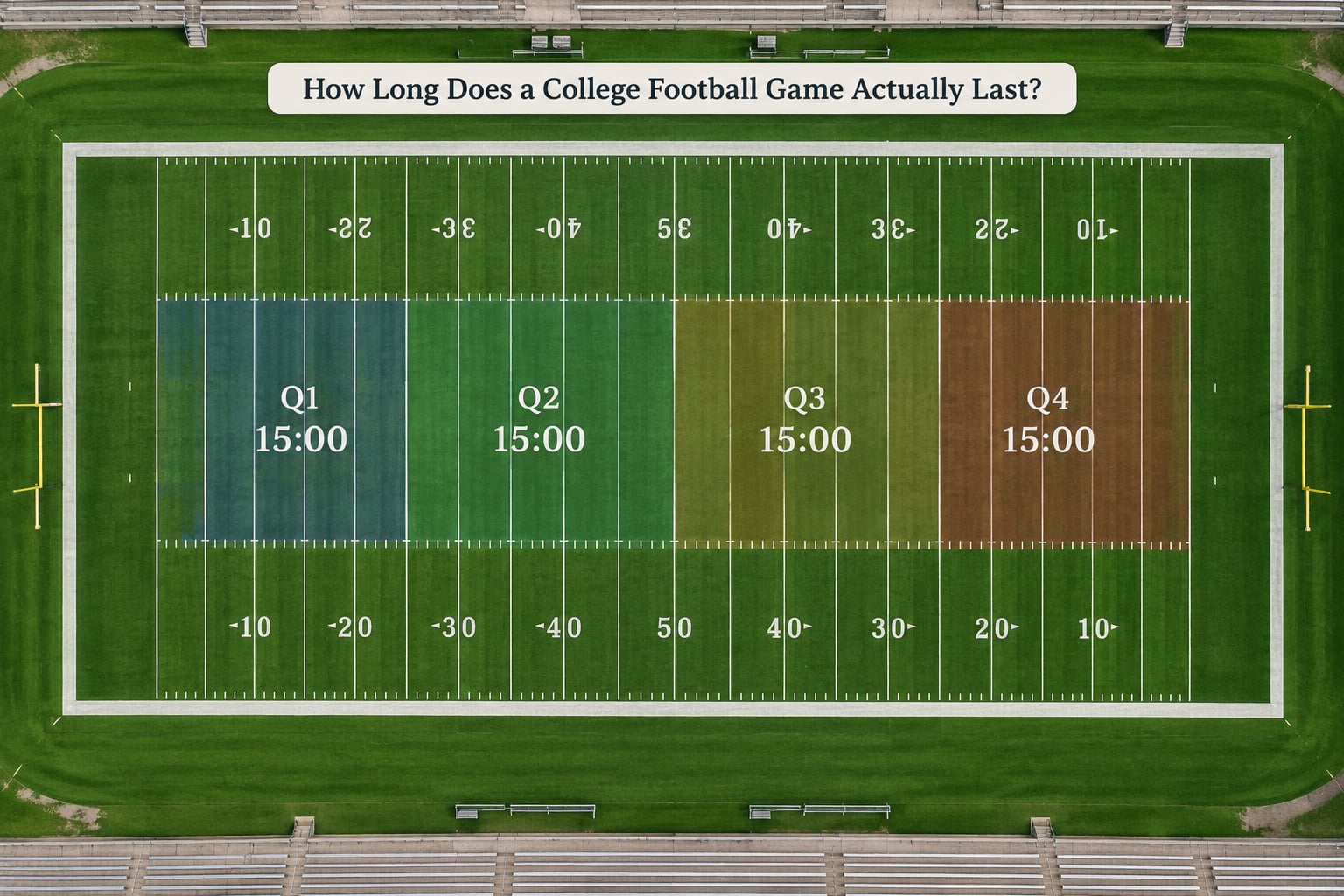
Four quarters of 15 minutes each are the nominal structure, and almost none of that clock runs continuously. The game clock stops for incompletions, out-of-bounds plays, penalties, change of possessions, the two-minute warning in each half, and every video review.
So there are two different numbers to keep straight. Game duration is what the official scorekeeper logs from the first snap to the last. Broadcast length is what you actually sit through, which adds pregame, the commercial model, and the postgame show on top.
| Measure | Typical length | What it includes |
|---|---|---|
| Regulation clock | 60 minutes | Four 15-minute quarters of running game clock |
| Average FBS game duration, 2024 | About 3 hours 27 minutes | First snap to final whistle, halftime included |
| Average duration, 2023 | 203 minutes (3 hours 23 minutes) | SportSource Analytics count |
| Change, 2008 to 2020 | Up 17 minutes, about 9% | Longest stretch of growth in the tracking era |
| Playoff games | About 3 hours 29 minutes | Higher scoring, more scoring plays, tighter finishes |
| Playoff semifinals | About 3.5 hours | Neutral-site crowds arrive later and leave later |
| Typical TV broadcast | 3.5 to 4 hours | Pregame, commercials, postgame, network teardown |
| Overtime game | 4 hours or more | Each period adds 10 minutes of clock plus stoppages |
One caveat on the trend line. The NCAA said average FBS game length fell from 3:22 to 3:16 through Week 3 of 2023, per The Athletic, which is why you will see headlines claiming games are getting shorter. Full-season numbers tell the opposite story. Early-season weeks are low-scoring and low-penalty, so they flatter the average.
Why Do Clock Stoppages Add So Much Time?
Individually, a stoppage is nothing. Four seconds for an incomplete pass, twenty seconds for a flag, a minute for officials to sort out a targeting call. Multiply those by roughly 130 plays and the arithmetic stops being cute.
The biggest routine additions to game duration are these.
- Incomplete passes. The clock stops after any incomplete pass and does not restart until the ball is spotted and the referee signals. Long completions are the point of the offense, so this one happens constantly.
- Running out of bounds. A ball carrier who steps outside stops the clock, and officials must spot it before the next snap.
- Change of possession. The clock stops at the end of a quarter and after the change of possession following a first down.
- Two-minute timeouts. Each team gets two per half. They exist to give the offense a chance near the goal line, and they add real minutes.
- The two-minute warning. The game clock stops with two minutes left in each half, then runs continuously to the end of the half.
- Penalties. The strongest measured factor. The SportSource regression put each penalty at about 1.17 additional minutes, and games with frequent flags run longest.
- Challenges and reviews. The coach’s challenge window, plus any booth review, can freeze the game for several minutes.
A useful counterpoint: plays per game have actually gone down, by about five plays per game in recent seasons. Games are getting longer with less football in them, which is the detail that irritates fans most.
Fewer plays, longer games
The 2023 clock rule change was meant to fix exactly that. Before it, the game clock stopped at the end of every first down. Under the new rule the clock keeps running after a first down unless the down ends in a scoring play, a change of possession, a penalty, the end of a quarter or the two-minute warning. Many fans expected shorter games and got the opposite, which is why the change still draws complaints.
The clock change reduced the number of stoppages but not the number of penalties, reviews or commercial breaks. It changed the shape of the problem without shrinking it much.
Which Parts of a Football Game Take the Most Time?
Here is the minute-by-minute accounting of a typical 3 hour 27 minute FBS game. The figures are approximations built from published averages rather than a single game’s clock.
| Where the time goes | Approximate minutes | Share of a 3h27m game |
|---|---|---|
| Actual play, including pre-snap and dead-ball transitions | 100-110 | About 52% |
| Halftime | 20 | About 10% |
| Media timeouts and commercial breaks | 25-30 | About 15% |
| Injury stoppages and player treatment | 8-12 | About 5% |
| Instant replay and video reviews | 5-8 | About 3% |
| Penalty administration and spot | 10-14 | About 6% |
| Two-minute timeouts | 6-8 | About 4% |
| Kickoffs, punts and other routine transitions | 8-10 | About 5% |
Read that last column again. Roughly half of what you watch is football. The rest is administration, advertising and marching bands.
Halftime is 20 minutes, not 12
College halftime is 20 minutes by rule, compared with roughly 12 minutes in the NFL. It is also adjustable: both schools can agree to shorten or extend it, which happens more often at professional games.
The reason is pageantry. A marching band, a dance team, a sponsor presentation and a halftime speech all have to fit into the same window, and the band needs setup time on the field. Fans defend the 20 minutes as part of the experience, and they have a point, but it is still eight more minutes than the NFL version.
After regulation, the event does not end at the final whistle either. Teams talk to the media for 20 or 30 minutes, the winning coach holds a press conference, and the stadium stays open so people can take photos. Fans who watch from home get none of that, which is why a broadcast feels so much shorter than the stadium experience.
How Do Timeouts and Challenges Add Time?
Three different things get called timeouts, and they behave very differently.
TV media timeouts and the 4-5-4-5 break model
Media timeouts are the clock-stopping windows the television partner uses to sell advertising. College football uses the 4-5-4-5 model: the media timeout falls after the fourth drive in the first quarter, the fifth in the second, the fourth in the third and the fifth in the fourth. Each break runs long because the commercials run long, and networks add bumpers, promos and pre-roll that push it further.
Add in short intermission breaks at other stoppages and you get roughly 25 to 30 minutes of commercial time per game. On television that is the single biggest difference from being in the stadium, where a media timeout is often just a walk back to the huddle.
Team timeouts
Each team gets three per half. Good coaching staff hold them in reserve, so many games never see all six used, but each one that is called is a full stoppage with substitutions and a huddle.
Coach challenges
Once per game, a team can challenge a specific official ruling. The replay takes time, the ruling often gets overturned, and that reversal frequently creates another stoppage afterward. It is a small number of minutes per game, but it lands in the most-watched part of the broadcast.
College football vs. NFL timing
| Timing factor | College football | NFL |
|---|---|---|
| Quarter length | 15 minutes | 15 minutes |
| Halftime | 20 minutes, adjustable | About 12 minutes, fixed |
| Average total game time | About 3 hours 27 minutes | About 3 hours or less |
| Clock after a first down | Runs by rule since 2023 | Stops until the ball is spotted |
| Timeouts per half | 3 per team | 3 per team |
| Commercial structure | 4-5-4-5 media timeouts | More evenly spaced breaks |
| Postgame | Press conference and interviews | Short interviews, earlier finish |
The 2023 clock rule is the single biggest structural gap between the two, and it is the one the NFL has not adopted.
Why Do Instant Replay Reviews Delay Games?
Instant replay did not make games faster, and the SportSource analysis named it as the largest factor missing from play-by-play duration data. Because a review does not show up in the play-by-play log in a way statisticians can count, published averages systematically understate its cost.
The pattern fans describe best: a 20-second play that takes eight real minutes to resolve. Officials review, the booth finds the camera angle it needs, the ruling gets announced, and then the teams line up again.
Reviews get triggered by a coach’s challenge, an automatic review of a scoring play, or a booth official spotting something on the drive. What the booth can examine depends on the conference, and the differences matter.
- Scoring plays. Automatically reviewed in FBS, which adds a few minutes to nearly every touchdown.
- Targeting. Some conferences review targeting on any play where the penalty is flagged, not just on a scoring play or after a challenge. The rule exists to protect players, but it means a first-down play in the third quarter can become a multi-minute stoppage.
- Disruptive plays. A similar category in several conferences, reviewing contact near the quarterback after the whistle.
- Turnover on downs. Frequently reviewed where the conference has adopted it, because the outcome changes who gets the ball.
Targeting penalties themselves are down sharply since the rule was tightened in 2021, per CBS Sports. Fewer of them means fewer flag-stoppages. It also means fewer automatic reviews, which is a quiet second-order win nobody talks about.
Another source of delay fans rarely see: officials spotting the ball and resetting formation between every play. The umpire is not rushing, and that is deliberate. A rushed spot is how penalties get missed.
What Happens During Halftime and After the Game?
Halftime is 20 minutes and, by mutual agreement of both schools, adjustable. In practice most programs keep the standard 20 because the show needs it. The band takes the field first, then a sponsor recognition segment, then the coach addresses the team somewhere in the middle.
Then the event keeps running. A typical sequence after the final snap: teams huddle briefly, the winning side speaks to the media on the field, the head coach holds a postgame press conference with a line of reporters, and the stands empty out over 30 to 45 minutes. Bands often play a second set. If you are planning your day around the game, that postgame block is real time in your life that never appears in the game clock.
How Much Extra Time Can Overtime Add?
NCAA football uses ten-minute overtime periods with a moving 25-yard line to start each one, so a team always has a realistic chance to win. A period only ends when a team scores and fails the conversion, or when the period expires.
Clock management differs from the second half. There are no two-minute timeouts in overtime, and the clock stops on every first down until the two-minute mark of the period, so possessions run longer and shorter plays become more likely. The point spread matters too, since a team down more than 14 early in overtime can stop playing for a tie.
The practical answer: one period adds roughly 15 to 20 minutes of real time, and a game that goes to a second period pushes past four hours before you count postgame. Ties at the end of regulation are rare, but when they happen the night gets long.
Frequently Asked Questions
Are college football games always four hours long?
No. A regulation college football game has 60 minutes of game clock, and the average FBS contest ran about 3 hours 27 minutes in real time during the 2024 season, per CBS Sports. Four hours is closer to a typical television broadcast, which adds pregame coverage, longer commercial breaks and postgame interviews. In the stadium you are usually there for three and a half hours before anyone speaks to a reporter.
Why is there a TV timeout in college football?
Because the television partner buys advertising in it. A media timeout stops the game clock at fixed points, following the 4-5-4-5 model, and the network fills the gap with commercials, promos and network bumpers. Those breaks total roughly 25 to 30 minutes per game. Fans who watch in the stadium often barely notice them, which is the main reason the same game feels much longer on television.
How long does an instant replay review take?
It depends on the review and the angle the booth needs. A routine scoring-play review often runs one to two minutes, while a targeting or turnover review that requires hunting for a specific camera angle can take considerably longer. Reviewers can also add a stoppage afterward when the ruling changes the down or possession. Analysts have flagged video review as the biggest factor missing from published game-duration data.
Why does the fourth quarter take so long?
Three reasons stack up. The clock stops more often as teams run conservative, clock-killing drives near the sideline. Scoring plays are reviewed automatically, and late drives produce more penalties as defenders and offenses get more physical. The final media timeout of the quarter is also scheduled for the fourth drive, and the game usually needs a full set of stops. Two-minute timeouts get used because the outcome is live.
Can a college football game last five hours?
Yes, though it is not common. Overtime games, playoff semifinals and games with long weather delays can all pass five hours end to end. Scorekeeper data has outliers well beyond three and a half hours, and any game with a lightning delay or an injury-heavy first half stretches easily. If you are scheduling around a kickoff, five hours is a safe worst case to plan for, not an average.
How long is the NCAA overtime format?
Each NCAA overtime period is ten minutes with a 25-yard line to start, so every team gets a realistic chance to win. The period ends only if a team scores and fails the two-point conversion or the period runs out. One period adds roughly 15 to 20 minutes of real time. Games needing a second period go well past four hours, and there are no two-minute timeouts in overtime.
What Should a Fan Expect on Gameday?
Plan around the finish, not the format. Kickoff time tells you when the game starts and nothing about when it ends.
| Kickoff | Likely finish | With overtime |
|---|---|---|
| Noon | About 3:30 p.m. | 4:00 p.m. |
| 3:30 p.m. | About 7:00 p.m. | 7:30 p.m. |
| 7:30 p.m. | About 11:00 p.m. | 11:30 p.m. |
Those are the numbers fans in the r/CFB and Clemson forum threads describe almost word for word, which is why a 3:30 start has become shorthand for an evening gone. Weather adds its own arithmetic, and a lightning delay can eat 30 minutes on its own.
The honest summary of why college football games take so long: halftime, the 4-5-4-5 commercial model and a long tail of small stoppages all stack on top of a clock that barely runs. Roughly half of a typical game is football. Most of the rest is the business around it.
None of that is a malfunction. Adjusting for your life means booking the tailgate for the previous morning, ignoring the announced start time of the postgame show, and not scheduling anything tight after a night game. Kickoff times also get revised late in the week by the networks, so confirm against the official listing before you drive anywhere.