How many scholarships does a college football team have? The old answer of 85 is retired. An NCAA Division I FBS or FCS program can now roster up to 105 players, and there is no NCAA cap on how many of those players receive scholarship money. Division II still works from 36 equivalencies, Division III hands out no athletic scholarships, NAIA allows 24 and NJCAA up to 85.
That shift is recent, and it is the source of a lot of confusion on message boards and recruiting sites that still quote 85 without blinking. We walk through what changed, how equivalency math actually works, and how to read a published roster without getting misled.
Table of Contents
- How Many Scholarships Does a College Football Team Have?
- What Is the NCAA Football Scholarship Limit?
- How Does Football Scholarship Equivalency Work?
- Are All Football Scholarships the Same?
- Why Can a Team Have More Than 85 Football Players?
- Does a Football Roster’s Scholarship Count Tell You the Team’s Capacity?
- How Do Position Limits Affect the Number of Scholarships?
- Frequently Asked Questions
- Conclusion: Start With the Roster Cap, Not the Scholarship Count
How Many Scholarships Does a College Football Team Have?
The short answer is that a Division I football team has room for 105 players on the roster, and how many of them are on scholarship is a decision each program makes within that 105. Under NCAA rules effective July 1, 2025, football moved from an 85-scholarship headcount cap to an equivalency model with a 105-player roster limit. Scholarship money can now sit in every one of those 105 spots.
Lower levels work differently, and the number a recruit actually competes against depends on the division:
| Level | Scholarship rule today | What it looked like before |
|---|---|---|
| NCAA Division I FBS | No NCAA scholarship count cap; 105-player roster limit | 85 headcount scholarships |
| NCAA Division I FCS | Same as FBS: 105-player roster limit, aid allowed at every spot | 85 headcount scholarships |
| NCAA Division II | 36 equivalency units per year | Unchanged |
| NCAA Division III | No athletic scholarships at all | Unchanged |
| NAIA | 24 equivalencies | Unchanged |
| NJCAA (junior college) | Up to 85 equivalencies | Unchanged |
The single most common misread is treating 105 as a scholarship count. It is a roster count. A program could fund all 105 players, fund 40 of them and leave the rest as walk-ons, or do something in between, and all three versions are legal under NCAA rules.
What Is the NCAA Football Scholarship Limit?
There is no NCAA scholarship limit for Division I football anymore. The Division I Board of Directors adopted the House settlement roster limits on June 23, 2025, and they took effect July 1, 2025. Football was one of two sports moved to an equivalency model with a roster cap, the other being basketball.
Two details from that decision matter for anyone trying to answer this question accurately. First, athletes who entered before the change keep their eligibility under the rules that applied when they signed, which is why some current rosters still carry scholarship accounting from the old system. Second, roster limits come with an opt-in structure tied to the settlement, so schools that did not opt into revenue sharing still answer to the NCAA rules while the House settlement distributions continue under the settlement terms.
Judge Claudia Wilken approved the House v. NCAA settlement after the antitrust trial, and the financial side of it is substantial: roughly 2.8 billion dollars in payments over ten years, with revenue sharing of up to about 20.5 million dollars per school. That money is what turns a scholarship from a line item into something a program can put on more positions, but it is not the same thing as a scholarship, and schools that opt out are not funded the same way as schools that opt in.
How Many Scholarships Does a College Football Team Have Under the Old Rule?
Through the 2024 season, FBS football was a headcount sport with a limit of 85 scholarships, spelled out in NCAA Bylaw 15.5.6. That meant up to 85 players on aid, including 25 initial-fee counters, which limited how many players a program could sign with an athletic grant in a single signing period.
The 85 figure was the number the whole recruiting world ran on for decades, which is why it is still everywhere on the internet. It also created the oversigning loophole coaches leaned on. A program could sign more than 85 players, print a scholarship offer for each, and count many of them as redshirts, blueshirts or grayshirts, which meant they did not consume a counter that year. Walk-ons and preferred walk-ons filled the rest of a roster that could stretch to 110 or 120 names.
The 105 roster limit is the direct replacement for that system. It is a harder cap, and it closes the gap between what a school promises on signing day and what it can actually put on scholarship.
How Does Football Scholarship Equivalency Work?
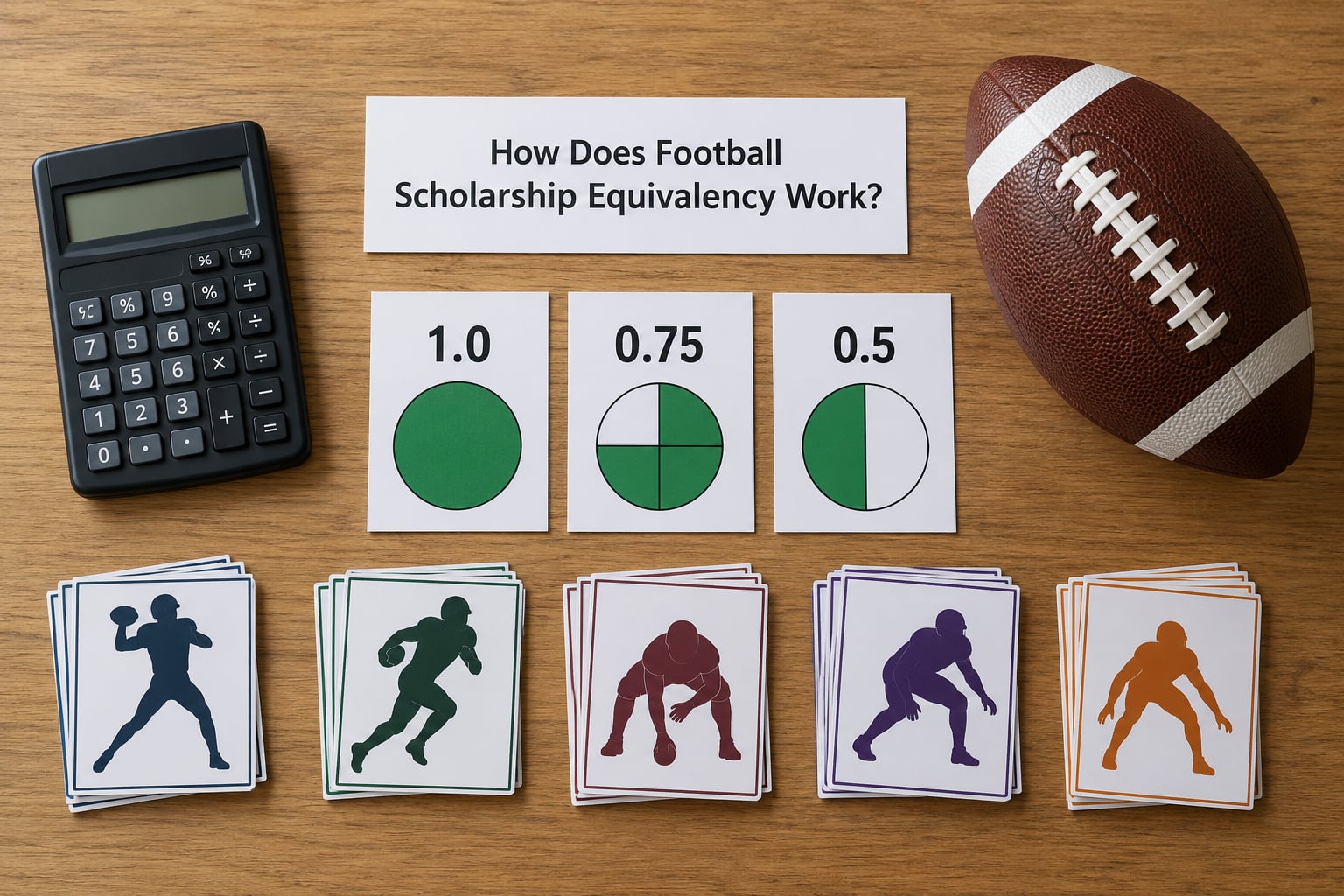
Equivalency is a budgeting unit, not a player. A full scholarship counts as 1.0 equivalent, a half scholarship counts as 0.5, and a scholarship covering three-quarters of cost counts as 0.75. A program spends its pool by dividing it among however many athletes it wants to fund.
Here is how a program working from a 36-equivalency pool, the Division II figure, would cover different numbers of players:
| Award per player | Players funded | Equivalencies used |
|---|---|---|
| Full (1.0) | 36 | 36 of 36 |
| 0.9 | 40 | 36 of 36 |
| 0.75 | 48 | 36 of 36 |
| 0.5 | 72 | 36 of 36 |
| 0.5 | 25 | 12.5 of 36 |
The last row is the one worth remembering. Plenty of mid-major programs do not spend the full 36; they fund 25 or 30 athletes at half scholarships each and carry the rest of the roster as walk-ons. That is legal, and it is why the division maximum is a ceiling rather than a promise.
For FBS and FCS the unit still exists as an accounting mechanism, just without a national total to divide. A major program might fund one quarterback at full cost, split 0.5 awards across a large offensive line class, and keep specialists at partial levels to stretch its pool across more names.
Are All Football Scholarships the Same?
No, and the differences matter more than recruits usually expect. A full football scholarship covers tuition, room, board, books and fees for one player and counts as one full equivalent. A partial scholarship covers some fraction of that cost and counts as the matching fraction of an equivalent.
An equivalency limit is the budget rule itself: the maximum number of units a program may distribute. An athletic grant-in-aid is the written agreement between school and athlete that describes what is covered, when it renews and under what conditions. A recruiting offer is none of those things yet, which is why coaches can hand out verbal offers freely and still change a class by 20 players before signing day.
Academic aid sits outside all of this. A player can hold an athletic grant and Pell Grant at the same time, and plenty of Division III players receive need-based financial aid with no athletic scholarship at all.
Why Can a Team Have More Than 85 Football Players?
Because 85 is not the roster limit, and it is not even the number of players on a game day. Eighty-five is the game-day dressing limit for FBS programs. It is how many athletes may be in uniform and eligible for a game, which is a smaller constraint than the size of the roster behind it.
Under today’s rules, a roster can hold 105 players, and the roster can include people who are not yet drawing athletic aid. Walk-ons and preferred walk-ons take up roster spots. Incoming recruits who have signed but have not arrived still count toward the 105. Players recovering from injury, and players in a grayshirt year who do not yet consume eligibility, occupy spots too.
Roster size, the scholarship count, initial-eligibility rules and transfer rules are four separate constraints, and it helps to keep them apart. Roster size is now 105 at FBS. The scholarship count is the program’s own choice. Initial eligibility still requires things like the core course and grade-point requirements, currently 16 core courses and a 2.3 grade-point average. Transfers face their own separate rules, including progress-toward-a-degree requirements.
Recruits keep asking on forums whether walk-ons have been abolished. They have not been eliminated, though the space for them has shrunk at many programs, and lower-rated signings now compete directly for the same roster spots.
Does a Football Roster’s Scholarship Count Tell You the Team’s Capacity?
Not really. A published roster tells you who is on the team and what class they are in. It rarely tells you how much aid each player receives, and it does not tell you what the program intends to spend next season. Some programs fund most of the roster, some fund the spine of the team and let depth walk, and both produce a roster of nearly identical names.
Recruiting databases and scholarship counter sites are useful for a rough picture, but their numbers are compiled, not official. They do not see a school’s financial aid agreements, they can lag a coaching change, and they often still model the old 85-scholarship world.
A practical way to read a program instead: look at how many upperclassmen are gone and how many freshmen arrived at each position, then watch which veterans were not re-signed to a scholarship offer after the roster shake-up. Those cuts are usually where the money went. For anything that matters, the NCAA and the school athletics website are the sources of record, and both update when rules change.
How Do Position Limits Affect the Number of Scholarships?
There is no separate scholarship allowance for offense or defense. A program allocates 105 roster spots across the board, and every position group competes inside that single pool. That is a change in mindset from the era when a coach protected a fixed number of counters per position group.
What drives the spread is depth of chart, and depth of chart differs wildly by unit:
| Position group | What shapes the allocation |
|---|---|
| Quarterback | Very few roster spots, so one commitment can absorb a large share of the pool; starters are commonly on full aid |
| Offensive line | The largest roster block on most teams, which is how a program spreads partial awards across many linemen |
| Wide receivers and tight ends | Middle ground: fewer linemen-scale numbers, but still depth-dependent |
| Defensive line and linebackers | Rotational by design, so partial awards are common to keep bodies in the room |
| Secondary | Closely mirrors the offensive line in headcount, with two-deep and nickel packages driving the need |
| Specialists | Small numbers, but kicker and punter spots are expensive because they are rarely interchangeable |
The practical result for a recruit is that the same word on an offer can mean different things at different schools. One program offering 50 percent to a defensive tackle may be offering it because a full scholarship is not in the budget; another offering 50 percent to a tackle may be splitting a pool it intends to grow. Ask what the percentage is based on and whether it is an athletic grant, an athletic grant plus academic aid, or something else.
Frequently Asked Questions
Does an NCAA football team get 85 full scholarships?
Not anymore. The 85 figure was a headcount scholarship limit in force through the 2024 season. From July 1, 2025, FBS and FCS programs operate under a 105-player roster cap with no NCAA scholarship count limit, so a team may fund every one of those 105 spots. Most do not, and schools and conferences can still set limits below the NCAA ceiling.
Are 18-scholarship college football teams allowed?
Yes, though such a program has to recruit almost entirely of its roster as walk-ons. A team could fund 18 scholarship players and fill the remaining 105 spots with walk-ons, and that is legal, but it is not a realistic model at the top level. Far more common is a mid-major approach that funds a large share of the roster at partial rates.
Does a football scholarship offer guarantee the athlete receives aid?
No. An offer is a recruiting commitment from the school, not a funding decision. Aid is confirmed when the athlete signs a national letter of intent and the school issues a written financial aid agreement. Amounts can change in later years, and an athlete who never signs carries no obligation to the program that extended the offer.
How can a football roster contain more than 85 players?
Because 85 is a game-day dressing limit, not a roster limit. Programs now carry up to 105 players, including incoming recruits, walk-ons and players in a grayshirt year who do not yet consume eligibility. Before 2025, oversigning and shirt tricks pushed rosters past 105 while scholarship aid stayed under the 85-scholarship cap.
Can a football player receive NIL money and a scholarship?
Yes in most cases, provided the school follows NCAA rules and any association agreement in force. NIL compensation comes from outside entities rather than the school, so it does not reduce a scholarship under the revenue-sharing model. Payments routed through a school must run through the NIL Go clearinghouse, and schools may face sport-by-sport limits.
Conclusion: Start With the Roster Cap, Not the Scholarship Count
If you take one line away, make it this: a Division I football team can roster 105 players, and the number of scholarships is the program’s own choice within that 105. Everything else you read, whether it says 85 or 36 or 24, describes a different division or an older rulebook.
Before you act on any number, check the NCAA’s current rules and the school’s own roster classifications, since eligibility rules changed again with the June 2026 age-based model and will keep moving. Fans chasing roster moves and scholarship announcements get a lot more out of the season once they know which number they are looking at.