College football signing day is the set of NCAA-sanctioned windows when high school seniors sign a National Letter of Intent, a binding agreement to play for one school for one academic year in exchange for athletic financial aid. It is not one sport-wide event on one Wednesday, and most Division I football recruits still sign in February rather than during the December early period.
That distinction matters because fans watch signing day as a competition between programs, while the paperwork behind it is a legal step most athletes finish weeks earlier. Here is how the whole thing fits together, from the first phone call to the day a recruit finally takes the field.
Table of Contents
- What Is College Football Signing Day?
- How College Football Signing Day Works Step by Step
- What Happens Before a Recruit Signs?
- What Happens During National Signing Day?
- What Is a National Letter of Intent?
- What Is the Signing Period and When Is It?
- What Happens After a Recruit Signs?
- How Signing Decisions Affect Rosters and Fans
- Frequently Asked Questions
- Conclusion
What Is College Football Signing Day?
Signing day is the name for the periods during which a college football recruit may sign a National Letter of Intent with a school. In football, the early signing period runs in early December and the traditional signing period runs from the first Wednesday in February into the first days of April.
A National Letter of Intent, or NLI, is a binding agreement between a recruit and a school. The school agrees to provide athletic financial aid for one academic year, and the recruit agrees to attend that school and to stop being recruited by everyone else once the letter is countersigned.
The ceremony you watch on television is usually the celebration. The signature is the legal act, and it often happens days or weeks before the hats go on.
How College Football Signing Day Works Step by Step
A recruit reaches signing day through a sequence of steps, and several of them get confused together. An offer, a verbal commitment and a signed letter are three different things that fans often use interchangeably.
- Contact. A college coach reaches out, usually through a letter of interest, a phone call or a connection through the recruit’s high school coach. Nothing is binding here.
- Relationship building. The coach visits the school, watches film, and gets to know the recruit and the family. The recruit visits campus and attends games and open practices.
- Verbal commitment. The recruit tells a coach, usually on the phone or in person at a school visit, that he intends to sign. Fans see this first as a commitment on a recruiting site, and it is still not a legal signature.
- Official offer. The school extends a written scholarship offer with a deadline to respond, often around an upcoming signing period.
- NCAA registration and eligibility. The recruit registers with the NCAA and the school certifies initial eligibility. Registration is a prerequisite for contacting recruits, which surprises a lot of parents.
- Signature. During a signing period, the recruit and an authorized school representative both sign the National Letter of Intent.
Only the last step is binding in the way most people imagine. Everything before it can be walked away from without penalty.
What Happens Before a Recruit Signs?
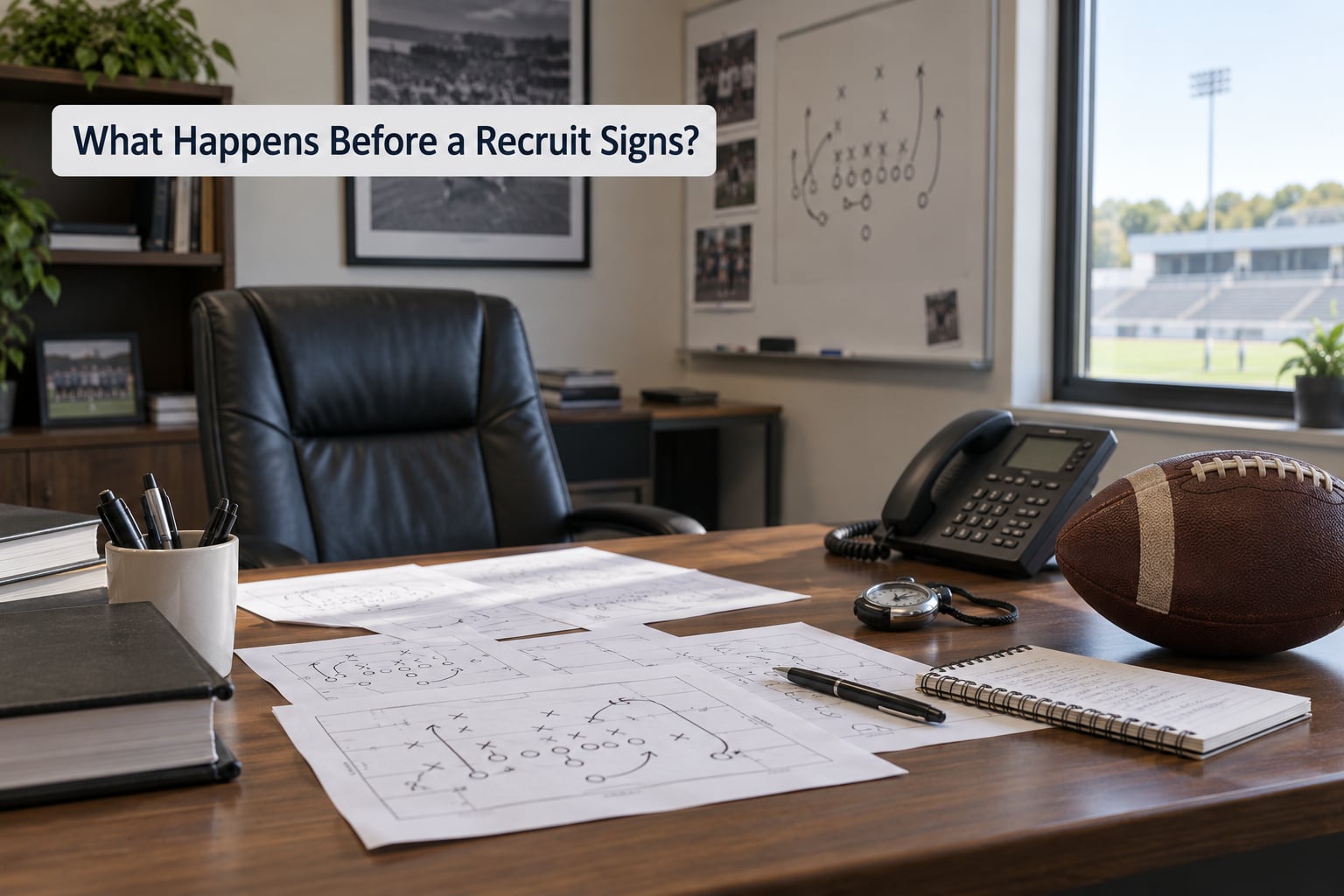
The pre-signing phase is the longest part of recruiting, usually spanning two to three years for a serious prospect. Programs spend it building relationships, evaluating film and academics, and deciding whether they want the player badly enough to spend a scholarship on him.
Coaches maintain contact with a recruiting coordinator, who handles the calendar: when visits happen, when offers go out, and when a deadline lands. Official visits, usually limited to a set number per recruit under NCAA rules, are the biggest recruiting event. Players often say the visit, not the offer list, is what decides things.
Schools also evaluate what happens after football. A recruit who is not eligible to play academically can sign a letter, but the scholarship does not matter if he cannot qualify. Programs pay close attention to transcript, test scores and course load.
Offers come with deadlines, usually a date inside a signing period. A recruit who has several offers waits, compares, and picks. Many families also watch the coaching situation, because a new head coach can rewrite the offer list entirely.
What Happens During National Signing Day?
On signing day, the recruit signs the National Letter of Intent while the program celebrates around him. The legal work is short, the ceremony is not.
The ceremony: the signature is the legal part, the rest is celebration
Typically the recruit signs in front of his family, his high school coaches and school officials. He signs the letter himself, then an authorized school representative countersigns it. That countersignature is the step almost nobody outside the room mentions, and it is what closes recruiting contact from every other program.
After that come the cap, the photos, the announcement post, and the video the school puts on social media. Some recruits wear a cap with a school logo. Some change shirts between signings to photograph themselves in several uniforms. Some sign with an entire offensive line at the table so the shot shows the whole unit.
What fans often miss is the difference between a signed recruit and an enrolled one. A recruit who signs in December may not step on campus until late summer, and a lot can change in those months. Players decommit, coaches leave, academic requirements fail, or a better offer arrives from a school that signed them earlier.
What Is a National Letter of Intent?
The National Letter of Intent is a binding agreement that commits a student-athlete to one institution for one academic year of athletic financial aid. It is not a promise of playing time, and it is not a promise that the athlete will even make the roster.
Several things follow from the signature. The school extends the offer of athletic aid for the coming year. Recruiting contact from other programs ends, and other coaches have to stop soliciting the recruit. The agreement covers one academic year rather than the athlete’s entire eligibility, so it does not lock someone into a school for four years.
It can still be undone. A school and a recruit can mutually agree to a rescission, and the recruit can then sign elsewhere in the same cycle. There are rules around when this is allowed and what a school must do to take the athlete back, plus penalties in some cases.
A grant-in-place is the accounting tool used when a school releases a recruit from an NLI without a new signing period, often because of an academic issue, a coaching change or a medical withdrawal. It frees the scholarship slot while keeping the recruit attached to the program.
Older articles also mention a letter of interest. That was a non-binding way for schools to confirm interest, and the NCAA eliminated the formal letter of interest program. You will still see the term in recruiting databases, where it does not mean what it used to.
What Is the Signing Period and When Is It?
The signing periods run in December, then February into early April
The signing period is the legal window. Signing day is the event that happens inside it. Football has two of them, and the NCAA sets the exact dates each cycle, so the dates below are the Class of 2027 cycle and are worth confirming against the NCAA calendar before you plan around them.
| Window | Class of 2027 dates | Who signs |
|---|---|---|
| Early signing period | Wednesday, December 2 through Friday, December 4, 2026 | Committed seniors, often the highest-rated recruits |
| Traditional signing period | Wednesday, February 3 through early April 2027 | Everyone else, including most unsigned recruits |
| Transfer portal window | Days set each year, typically opening in the December period | Transfers and graduate transfers, not high school seniors |
Both football windows open on the first Wednesday of the month. December is a three-day window ending Friday, which is why so many five-star recruits are done before the season ends. February opens the traditional period, and that is the day ESPN’s live tracker becomes the front page of the internet.
Basketball runs on a different calendar, with an early period in November and a traditional period in April. When people say signing day without specifying a sport, they usually mean February football, which is exactly where the confusion starts.
Junior college recruits break the pattern. A player who signs out of high school, enrolls at a junior college, and plays a season can re-enter recruiting afterward, and his signing window looks nothing like a four-year prospect’s. Some players also delay enrollment for a gap year, which moves their paperwork by a full cycle.
What Happens After a Recruit Signs?
Signing is the middle of the process, not the end. Between the pen and practice field there are five things that can still go wrong.
- Medical clearance. The school arranges a preparticipation physical and any follow-up testing. An injury found here can delay or end a recruitment.
- Academic certification. Coaches send transcripts to the NCAA for initial-eligibility certification. Missing coursework or an eligibility index can cause rescission.
- Financial aid paperwork. The athlete completes federal student aid forms and institutional aid documents. The athletic scholarship itself sits outside this process.
- Enrollment and registration. The recruit applies, registers for classes and locks in a schedule that the coaching staff will actually approve.
- Arrival. Orientation, reporting to camp, position battles and the first depth chart. This is where the recruiting class becomes a football team.
Most Division I rosters open in August, and fall camp is the first time a signed recruit is genuinely a roster member.
How Signing Decisions Affect Rosters and Fans
Signatures are the inputs to the roster, and the roster math is tighter than most fans realize. Programs have a hard cap on initial-eligibility spots, set by NCAA rules and adjusted under the House settlement through a system of conversion numbers, and a coach who over-signs one class can have the next class pruned.
That is the first thing a position group feels. Add two more quarterbacks in one cycle and the depth chart below them gets crowded, which affects who stays, who transfers and who gets cut. Fans often see the consequences a year before they see the cause.
The second thing is the untargeting. Once a class is full at a position, some committed recruits stop hearing from their own coaching staff well before signing day. Families describe it as being cut while still committed, and it is one of the least understood parts of the process.
Class rankings move on signing day because they are built from commitments. The moment a signature lands, a school loses a prospect, a rival gains one, and the composite boards built by 247Sports and On3 reshuffle within minutes. The flip of a single blue-chip recruit can shift a conference race in the rankings even before anyone plays.
The third thing is the transfer portal, which fans now watch as part of the same calendar. Programs that signed a smaller high school class sometimes have more room to add graduate transfers, and a coach who declared for the portal can replace a signed recruit before fall camp ever begins.
For context, coaches on recruiting forums point out that only a small share of high school seniors play college football at all. Signing day is a celebration of a narrow slice of a very large pool, and it is worth keeping that in mind when the hat stacks fill your feed.
Frequently Asked Questions
What do you do at a college signing day?
You sign your National Letter of Intent at a table in front of your family, coaches and school officials, usually wearing the cap of the program you committed to. After you sign, an authorized school representative countersigns the letter, which legally closes recruiting contact from every other program. Then come the photos, the announcement post and, usually, a school video the same afternoon.
Can a player decommit after National Signing Day?
Yes. A National Letter of Intent binds a recruit to a school for one academic year of athletic aid, not for the rest of his eligibility. A player can ask the school for a rescission and sign elsewhere during the same cycle, and the new school has to take him back and follow reinstatement rules. Penalties exist in some cases, but they are far smaller than most fans assume.
Is National Signing Day only for D1?
No. The National Letter of Intent program covers Division I and Division II, and football athletes at both levels sign during the same December and February windows. Division III does not offer athletic scholarships and does not use the NLI, and Ivy League schools are Division I members that offer no athletic aid either way. Players at those schools still hold signing-style ceremonies.
Can D2 coaches attend signing day?
Yes. A coach from any Division I or Division II program that has signed the recruit is allowed to attend and take part in the ceremony. The recruit’s own high school staff usually organizes the event, so a program that has not extended an offer or signed that athlete would not normally be on the schedule.
What happens if a recruit does not sign in December?
Nothing bad. The early signing period is optional, and a recruit who waits simply signs during the traditional period that opens on the first Wednesday in February and runs into early April. Some coaches use a quiet December period to hold firm on their offer until February. Programs also tend to have more roster spots left for recruits who wait, because committed December signers take up the class.
When is the next college football signing day?
For the Class of 2027, the early signing period runs Wednesday, December 2 through Friday, December 4, 2026, and the traditional signing period opens Wednesday, February 3, 2027 and continues into early April. The NCAA publishes the exact window each cycle, so confirm the dates on the association’s calendar before you plan travel around them.
Conclusion
So how college football signing day works comes down to a short chain: a coach makes contact, a recruit builds a relationship, commits, gets a written offer, registers with the NCAA, and signs a National Letter of Intent during one of two legal windows in December or February. Everything else is ceremony, paperwork and consequences.
If you are following along as a fan, watch four things. Official offers tell you what a program actually thinks. Countersigned letters tell you what is real. Roster moves tell you who survived the math, and portal activity tells you what a coach decided not to sign in the first place. And remember the gap between committing, signing and playing, because that gap is where most of the surprises come from.