The early signing period is a three-day window, usually the first Wednesday through Friday in December, when graduating high school seniors sign binding National Letters of Intent. A recruit who signs in that window is committed to that school for one academic year, well before the regular February signing period, but the signature does not promise a jersey.
That is the short version of how the early signing period works in college football. The rest of the process stretches from junior year contact, through certification and enrollment, to the day a signed recruit learns he has changed positions or been released from a roster.
One caution before the details. The calendar moves. Exact dates shift slightly by recruiting cycle and by division, so treat any published window, including this one, as a pattern rather than a fixed appointment and confirm the current dates on the NCAA’s official recruiting calendar.
Table of Contents
- What Is the Early Signing Period in College Football?
- Who Can Sign During the Early Period?
- How the Early Signing Process Works Step by Step
- Are Signed Verbal Offers Binding?
- Early Signing Period Timeline and Key Deadlines
- Can a Recruit Flip or De-Sign After Signing Early?
- Why Do College Teams Recruit and Sign So Many Players?
- What Does an Early Signing Mean for Recruiting Rankings?
- Frequently Asked Questions
- What to Watch First During Early Signing
What Is the Early Signing Period in College Football?
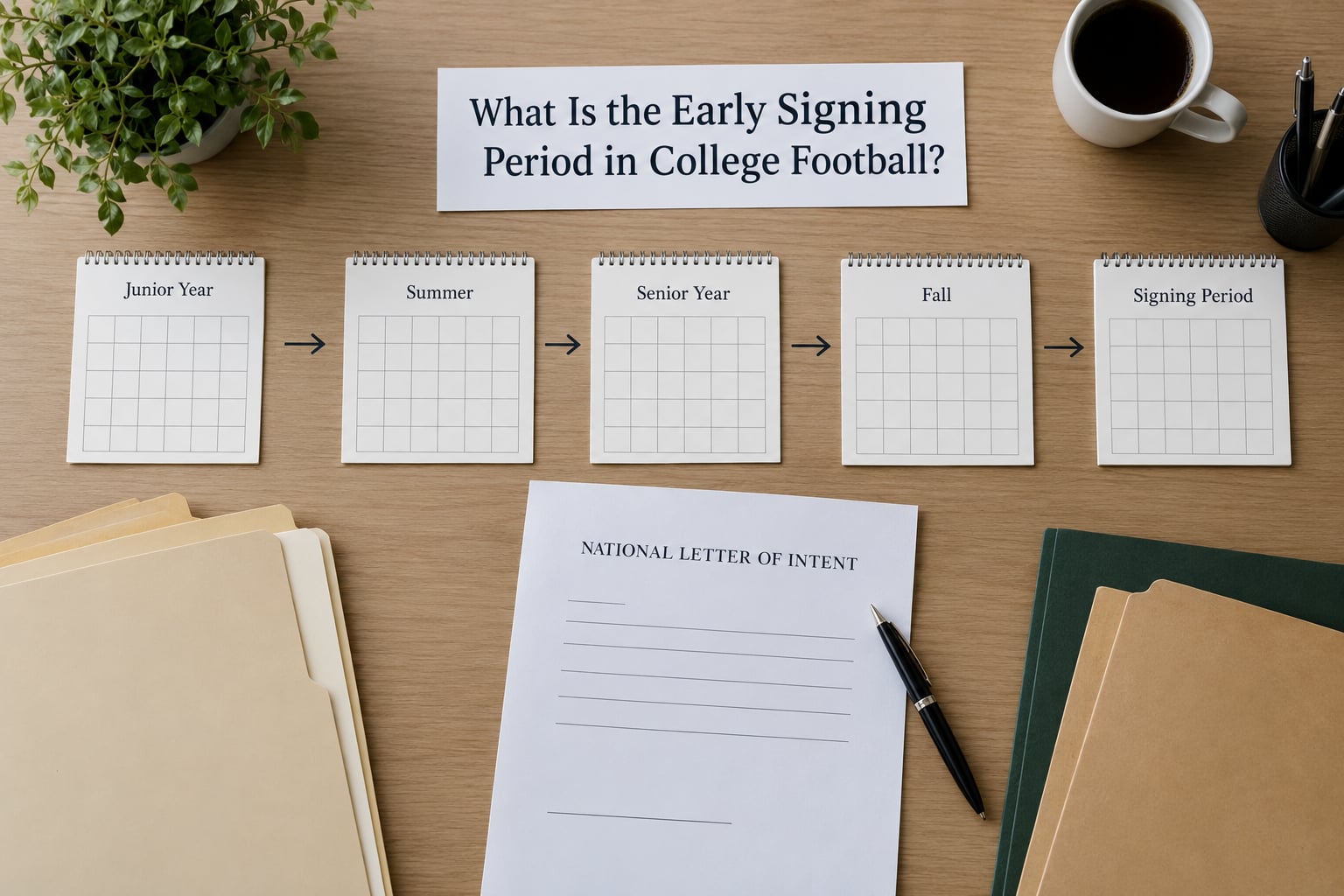
The early signing period is a three-day window in December, normally Wednesday through Friday, when high school seniors sign National Letters of Intent months ahead of National Signing Day in February. Three details make it work the way it does:
- The window is short and fixed. It opens on a Wednesday and closes on Friday, and a recruit may sign on any of the three days.
- It is for graduating seniors. Most signers are high school seniors, with some junior college transfers using the same period.
- It is not a ranking, a roster spot, or a start date. It is a signature on a one-year agreement.
The NCAA created the early window because the old February-only system forced coaches to sit on offers for months. Under that model, a program could not know who was committed until the cycle was nearly over, leaving open positions to fill with almost no time left. Letting seniors sign in December gave staffs a class to plan around before the season started.
That change also drained most of the drama out of February. So many top-ranked recruits now sign in December that the regular signing period has become a smaller event, and forum regulars on recruiting boards describe February as an afterthought for top prospects.
For Arizona fans, the practical read is simpler. December is when program news tends to land first, with signed classes, position switches and de-commitment stories all surfacing months before spring practice. If you want the Wildcats’ incoming class explained, the December window is where the story starts.
Who Can Sign During the Early Period?
Eligibility decides who signs, not the grade on a transcript. A recruit must be on track to qualify as an NCAA initial-eligibility certification case, and the school must be willing to countersign the letter, which is why unsigned walk-ons and grayshirts often skip the window entirely.
High school seniors make up the vast majority of signers. Junior college recruits are a smaller group, and their timing differs because many of them are chasing a mid-year start rather than a fall one. Walk-ons who have not yet received an offer frequently join later, during the institutional signing period that follows December.
Certification is the part families miss. Prospects can be recruited, committed and even sign a letter before the NCAA Eligibility Center finishes its work. Division I prospects connected to NCAA Division I programs also sit under a twelve-month continuous certification process, which requires an uninterrupted year of eligibility activity before certification is final. A recruit who signs and then fails to qualify loses the scholarship, which is why schools routinely ask for a transcript early and keep signing dates deliberately loose.
How the Early Signing Process Works Step by Step
Five steps cover the whole process, and each one has a moment where a deal can quietly fall apart.
- Contact and offers. The contact period opens in mid-June of a recruit’s junior year, when coaches may initiate calls, texts and emails. An offer at this stage is a verbal or written offer, nothing more.
- Offer evaluation. Visits, film sessions with the position coach, academics, the depth chart and the coaching staff all get weighed. Recruiting services assign a commitment date when the recruit announces, and that date is a bookkeeping entry, not a legal event.
- The signature. A recruit may sign on any day of the three-day window. Some hold a short ceremony at the high school or at a local home game, others sign quietly and mail the letter themselves.
- The school countersigns. The coach or athletic department signs, and the completed letter goes to the recruit’s high school or college for a signature. Until it is countersigned, nothing is official.
- Certification and enrollment. The recruit applies for admission, completes initial-eligibility certification and handles the enrollment deposit. This is the stage where otherwise signed players most often unravel.
When Do Players Formally Sign?
Players formally sign on the first three days of December, with Wednesday carrying the most announcements and the rest of the window used for ceremonies. The three-day structure is a member-school convention built on the NCAA calendar rather than a rule the NCAA enforces on each program day by day, so a program can hold a signing event on any of the three dates.
Recruits can also sign after the window closes, through the institutional signing period that runs into the spring. That is why a December class announcement is always incomplete. A coach who signs four players in December may add two more in February, and both sets of signatures belong to the same recruiting class.
Is an Early Signing Period Different From National Signing Day?
National Signing Day is the name attached to the regular signing period that opens in early February and typically runs into the first days of April. It once was the recruiting world’s only moment, and it is now the second one.
The practical difference is who is left. Highly ranked prospects have usually already signed by December, so February handles the rest of the class, late flips, junior college additions and last-minute replacements. Data cited by CBS Sports in its signing-day coverage put the share of top-ranked recruits already committed before the early window above ninety-five percent, which is the number fans quote when they wonder why the old show stopped feeling like a show.
What Happens After a Recruit Signs?
After a recruit signs, the school reviews the roster it has, certifications run, and names, numbers and positions get sorted out. A recruit can arrive on campus as a starting quarterback and spend a spring behind a different starter, and a letter that listed one position on the depth chart rarely prevents that.
It is worth holding onto one fact. A signature locks a recruit into the recruiting relationship for a year, not into a starting job, a specific position or a coach’s plan. Programs also release signed recruits before or shortly after enrollment when the roster math changes.
Are Signed Verbal Offers Binding?
A verbal offer is not binding. Nothing is, until it appears on paper. The four stages of a commitment look similar from the outside and differ enormously in weight.
| Stage | What it is | How much weight it carries |
|---|---|---|
| Verbal commitment | A coach’s public or private word | None. Recruiting forum regulars treat it as meaningless until paperwork exists |
| Written offer | An official letter from the school stating an offer of athletic financial aid | Real, but the school can still withdraw it before a letter is signed |
| Scholarship agreement | A school document detailing the aid for the coming year | Binding for the aid it describes, for that year |
| National Letter of Intent | The NCAA letter the recruit and school sign together | Binding for one academic year in both directions |
The letter works as a two-way promise. The recruit agrees to enroll and to report to that school. The school agrees to provide athletics financial aid for one academic year. It is not a promise of a starting job, and it is not a promise that the same amount of aid follows the recruit for all four years.
One confusion deserves clearing up, because families hit it every cycle. Early signing has nothing to do with early enrollment. Signing in December does not mean starting classes in January. Early enrollment, where a recruit arrives in the spring before the senior year is finished, is a separate request made directly to the school and most common among quarterbacks and skill-position recruits who want extra reps.
Early Signing Period Timeline and Key Deadlines
The calendar below shows the typical sequence in a Division I cycle. Dates move from year to year, and some divisions publish different windows, so verify the current cycle on the NCAA calendar before planning a signing event around any of them.
| Stage | When it typically falls | What it means |
|---|---|---|
| Contact period opens | Mid-June of the recruit’s junior year | Coaches may initiate calls, texts, emails and direct messages |
| Dead period | The days around the early signing date | Schools cannot initiate contact; only the recruit may reach out |
| Early signing period | First Wednesday through Friday in December | Seniors sign letters of intent; the loudest three days of the cycle |
| Institutional signing | After the early window, through the spring | Schools may sign recruits who did not sign in December |
| Eligibility certification | After signing, before enrollment | The NCAA Eligibility Center confirms the recruit qualifies; a signed recruit can still be denied |
| Regular signing period | Early February, typically into early April | The traditional National Signing Day window, open to the rest of the class |
Two practical notes for families. First, a recruit can sign in December and still have a signing period available later, so the December date is a choice rather than a deadline. Second, a signed recruit is not finished: the binding obligation starts on the signature, and everything that follows, including the deposit and the transcript, can still undo it.
Can a Recruit Flip or De-Sign After Signing Early?
Yes, in the sense that a binding letter for one year is not permanent, and no in the sense that the recruiting position has already changed. There are three ways a signature comes undone, and one reason people assume the third is the first.
- The recruit asks for a release. A signed recruit can request that the school release them from the letter. The school decides, and if it refuses, the letter stands and the recruit’s options narrow sharply.
- The school withdraws the offer. If the program rescinds the aid, the letter is void and the recruit is immediately free to sign elsewhere.
- The school changes the recruit’s status. Programs have a process for asking a signed recruit to step aside before enrollment, which voids the letter and reopens the player’s recruiting.
Then there is the case forum discussion keeps coming back to: signing under a coaching staff that gets fired. The letter does not follow a person out of a job. A signed recruit whose staff changes can end up with a new position coach, a system they did not buy into and very little room to negotiate, because the negotiating position moved to the school the moment the letter was signed.
Admissions can break a signing too. A signed recruit who has committed to one school and then files an enrollment deposit at another has a problem the athletic department cannot solve, which is why deposit dates and letter dates get checked against each other by advisers every December.
Why Do College Teams Recruit and Sign So Many Players?
A program’s class looks enormous next to a roster limit, and the arithmetic explains why. Scholarship counting, attrition and the transfer portal all add numbers that never appear on the depth chart.
| Number | Typical value | Why it exists |
|---|---|---|
| Scholarship spots, Division I FBS | 85 | The NCAA cap on athletic scholarships for a Division I FBS football roster |
| Signees in a class | 20 to 30 or more | A class replaces a graduating class that itself included transfers and early enrollees |
| Total roster | 85 to 100-plus | Scholarships plus walk-ons, who sign later and carry little or no aid |
| Attrition | Several players a year | Transfers, dismissals, medical withdrawals and academic exits |
| Position battle | 2 to 4 signees per position | Coaches hedge against injury, a starter leaving early or a recruit not developing |
So a class announced at December signing can hold thirty names and still feed twenty players into a program. Recruiting coaches sign depth on purpose, because the alternative is discovering in August that the position is empty. It also explains why a school chasing a No. 1 composite ranking is often competing on volume rather than on talent alone.
What Does an Early Signing Mean for Recruiting Rankings?
An early signature ranks a class well, and it ranks a roster not at all. The distinction is worth holding onto while reading December news.
There are four separate states in recruiting, and services track them differently:
- Commitment. A public pledge, often dated by a recruiting service, with no paper signed.
- Signature. A countersigned letter of intent, which happens inside the December window.
- Enrollment. Arrival on campus and certification, which is where recruits who signed can still fail.
- Roster status. The depth chart, decided by a coaching staff that may not be the one that signed the recruit.
Composite rankings from services such as 247Sports and On3 count commitments, and some also assign a signing date to recruits who have not signed yet. A No. 1 class in December is therefore a projection built on pledges, not a measured roster. Forum threads make the same point: the class ranking is a headline, and the depth chart is the season.
Frequently Asked Questions
Can a high school junior sign a National Letter of Intent?
Generally no. The December early signing period belongs to graduating high school seniors, though a junior can be recruited, receive offers and commit verbally during the junior year. The signed letter normally comes in the December window of the senior year or during the regular February period, and any mid-year start has to be approved separately by the school.
Does signing early guarantee a scholarship?
Not in the way most families hear it. The letter obligates the school to provide athletics financial aid for that academic year and obligates you to enroll, but it is not a promise of playing time, and aid is renewed year by year. Rosters change, staffs change, and recruits who sign are sometimes released before their first season.
Is an early National Letter of Intent permanent?
It is binding for one academic year, not forever. A recruit can ask the school for a release, a school can rescind the letter, and institutions have a limited window after enrollment in which they may withdraw the letter in writing. If the recruit enrolls elsewhere, the letter is void and the original school loses contact rights for a period.
Do early signers have to enroll immediately?
No. Signing in December has nothing to do with starting classes in January, which is the most common mix-up in this whole process. Enrollment normally begins the following fall semester. Early enrollment, where a recruit starts in the spring, is a separate request made directly to the school and is most common at quarterback and skill positions.
What does a decommitment after signing mean?
It means the recruit is trying to reopen recruiting after a signature, usually because the recruit asked for a release, the school declined, or the school asked to change the recruit’s status. Recruiting forum regulars treat a verbal commitment as nothing until a letter is signed, which is why the signature is the exact moment the negotiating position changes hands.
Can a college switch a recruit’s position after they sign?
Yes. Letters of intent are not position-specific, and schools routinely move signed recruits, especially among skill positions, where a roster reshuffle can leave a quarterback or receiver competing for a new job. Position changes are easiest for athletes who played multiple spots and most likely when a new coaching staff arrives before the recruit enrolls.
What to Watch First During Early Signing
Four things carry more weight than the announcements themselves. First, pull the current NCAA recruiting calendar for your division and confirm the actual dates, because guides published in earlier cycles are still ranking well and are still out of date.
Second, separate an offer from a signature. A coach’s word, a public commitment and a countersigned letter are three different things, and only the last one changes the recruiting position. Third, watch what happens after the announcement: certification, the enrollment deposit and roster movement at the position the recruit will play.
Signing early is the start of the process rather than its end. A recruit who treats the signature as the finish line tends to be the one caught off guard by a position change or a new coaching staff in the spring.