To plan a game day menu for cold weather, pick one hearty hot main, one melted dip, one handheld, one make-ahead snack, and one dessert, then do almost all of the cooking the day before. Slow cookers and insulated carriers do the work on game day so the food stays hot for the three-plus hours a cold-weather game actually lasts.
Cold weather breaks the standard party menu. Dips turn to cement in a parking lot, fried food goes limp, and a tray of sandwiches leaves fans hungry by the third quarter. The fix is not more complicated food. It is warmer food, prepared earlier, served in a place where people can reach it without standing around in gloves.
Here is how to plan a game day menu for cold weather, whether you are tailgating in a parking lot, firing up a backyard firepit, or hosting a dozen people indoors with no kitchen at all.
Table of Contents
- What You Need to Plan a Game Day Menu for Cold Weather
- Step-by-Step
- Frequently Asked Questions
- What food is best for a cold-weather game day menu?
- How much food should I prepare per person for a game day gathering?
- What are the easiest dishes to make before guests arrive?
- How can I keep hot food warm until everyone is ready to eat?
- What should I serve for guests who do not eat meat?
- How long can leftovers from a game day party safely be kept?
What You Need to Plan a Game Day Menu for Cold Weather
Most of what you need is equipment you probably already own, plus one or two things that solve the cold-weather problem specifically.
- A real guest count. Count heads, not invitations. Add two for walk-ins.
- Slow cookers. One large, one small. They are the single most useful cold-weather tool you can own because they cook, hold, and reheat on the same dial.
- Insulated thermal carriers. Grocery bags with foil lining, a cooler with a hot water jar, or a genuine insulated carrier. All three work.
- Disposable or sturdy serving containers. In a parking lot, serving pans that slide into a carrier beat a ceramic dish every time.
- A make-ahead ingredient list. Saturday markets and Sunday shop means the main is already bought and trimmed when game week starts.
- Fuel or a power plan. Charcoal, firewood, or a heavy-duty extension cord if the carrier or slow cooker needs power at the lot.
- Plates, cups, forks, and a serious stack of napkins. Cold-weather food is saucy, and gloves make a mess harder to clean.
- A notebook or group chat. Write down dietary needs when people confirm, not when they arrive.
Step-by-Step
Choose a Simple Menu Structure
One main, two or three sides, a snack, and a dessert. That is the whole menu, and it is more than enough for a crowd.
Games run long and people graze. Four well-chosen dishes get eaten; eight dishes get picked at, go cold, and end up in the bin. Decide the menu before you shop, and write it on one card so the store trip stays short.
Fan forums tend to rate tailgate meals like players, and the recurring complaint is the same one: too many half-finished dishes and nobody gets a real meal. One pot, done well, beats a buffet of five.
Plan What Can Be Made Ahead
The cold-weather rule is that roughly 90 percent of the cooking happens before kickoff day. Chili, soups, stews, pulled pork, and chili mac all taste better the next day anyway, so make-ahead cooking is not a compromise here. It is the upgrade.
Chop vegetables, brown meat, and combine the dry parts of a soup or chili the night before and refrigerate the base. Reheat it on game morning, and you are looking at one pot and about an hour.
Refrigerate make-ahead food promptly and use it within three to four days. When reheating, bring the whole portion to 165°F for poultry and 160°F for ground meat, stirring and checking in the middle, not just the edges.
Build a Warm and Easy-to-Serve Cold Weather Game Day Menu
Here is what each part of the menu contributes to the spread, and why it works when it is 28 degrees at kickoff.
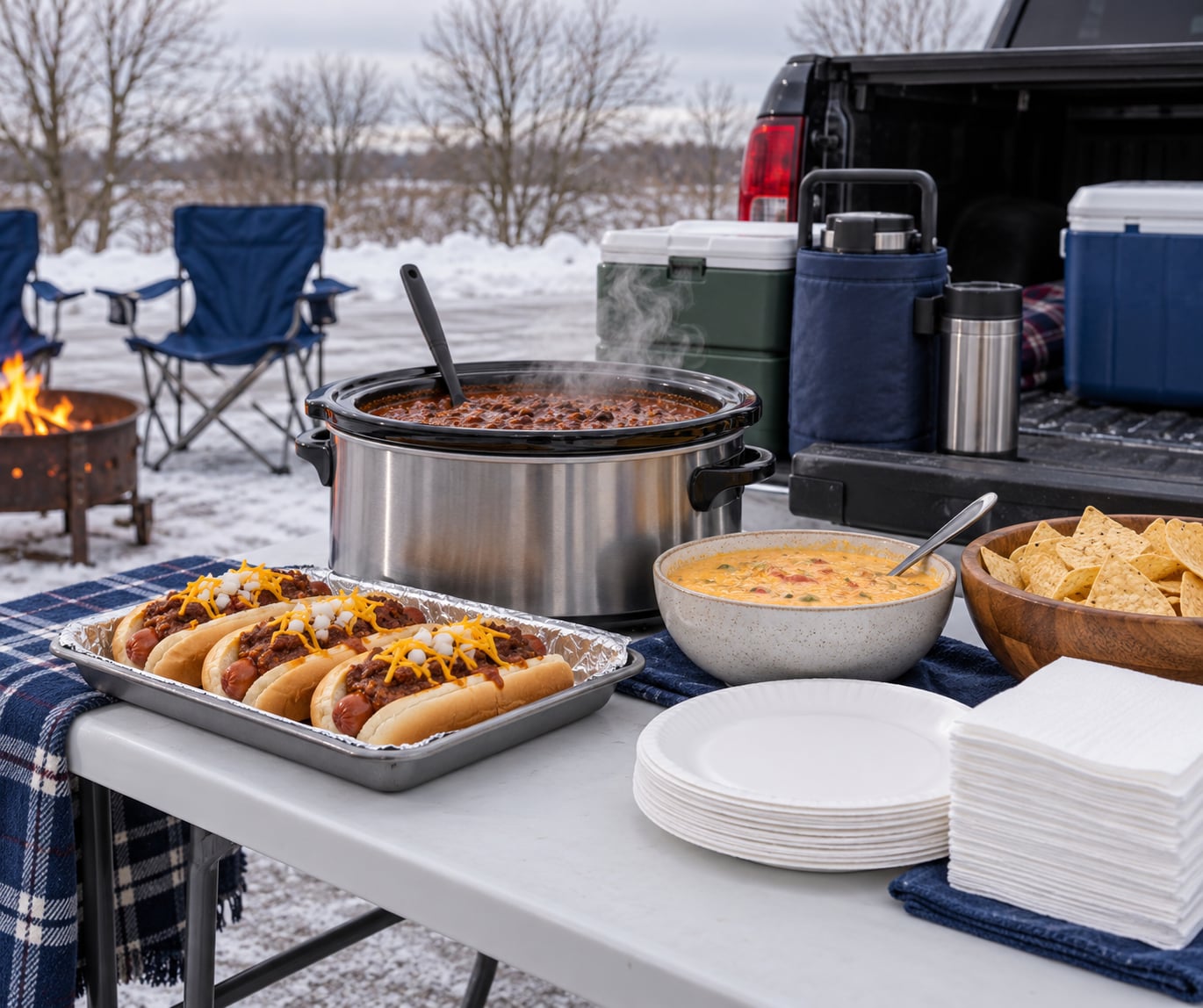
- Chili. The consensus cold-weather answer. It travels, it holds heat for hours, and it scales in a slow cooker without turning to paste if you stir it.
- Soup or stew. Better than chili for an early kickoff, because it can start in a crockpot before sunrise. Chicken tortilla soup, potato soup, and beef stew all hold for a full afternoon on low.
- Pulled chicken or pulled pork sandwiches. Assemble with a slaw and a bun, and guests build their own. Pork can start early or the night before, which most hosts treat as non-negotiable for anything slow cooked.
- Warm dips. Buffalo chicken dip, queso, or a hot cheesy bean dip. Keep the crockpot on low with a tight lid; steam escaping is what thickens a dip in a parking lot.
- Handhelds. Chili dogs, hot dogs, brats with grilled onions and peppers, smoked links, or smash burgers. These are the one-handed foods, and one-handed food is what people eat while actually watching the game.
- A make-ahead snack. Nachos with all the toppings set out separately, a cheese and cracker tray, or a bowl of candied or salted nuts. Something people can pick up standing up.
- One dessert. See the last step below.
Regional traditions travel well here. Gumbo and jambalaya get the highest marks in cold weather, and a bowl of chili with the Bojangles 4Bs on the side is a whole tradition in itself.
Set Up a Simple Serving Station
You want guests to serve themselves, because self-service means you are not running a line of hungry people while a game is on.
Put the hot main closest to the heat source and far from the drinks, so nobody backs into a crockpot while carrying a cup. Drinks and ice go at one end of the table, condiments and toppings in the middle, plates, cups, forks, and napkins at the other end. That single line, plates to food, cuts the traffic.
Pre-portion dips into small containers so each one gets a fresh crockpot or a fresh spot, and never restock a bowl that has been sitting out. Put lids and a spoon or two with every container, and put a trash bag within easy reach of the plates.
Outdoors, set up so nobody has to walk back to a car to get a refill. Fill a clean jug with hot tap water for refills rather than hauling the whole coffee maker outside.
Keep Food Safe and at the Right Temperature
Cold weather makes people think safety stops mattering. They still matter, because food cools slower, not faster, in a parked car, and because sun on a foil pan works against you fast.
Follow the USDA minimum internal temperatures. Poultry reaches 165°F, ground meat reaches 160°F, and whole cuts of beef, pork, and lamb plus fish reach 145°F. Use a thermometer on at least one piece per dish; guessing is where people get sick.
Keep hot food at 140°F or above. If you cannot hold something hot, serve it later rather than parking it out, and use a slow cooker on high as a warmer once the food is cooked through, not as a way to cook it from cold.
Outdoors, use the two-hour rule. Perishable food that has been sitting out longer than two hours, in any temperature, goes in the trash. When it is below 40°F outside, cold food can sit out longer, but plan on a generous margin, and do not count on a cold day to make you safe. Refrigerate perishable food within two hours, and use shallow containers so it chills fast.
Finish the Menu with Drinks and Easy Desserts
Cold-weather drinks should do two jobs: warm the hands and last a long time. Hot cocoa with a shot of something for the adults, spiced cider, and coffee in insulated mugs all work. For people who are not drinking alcohol, a big insulated pot of cocoa and a jug of cold drinks matter just as much.
Dessert should be the opposite of everything else: no heat, no assembly, and no utensils. Brownies cut into squares, a sheet cake, cookies, or make-ahead dessert bars travel well and can be eaten one-handed. If you want something warm, baked apples or a bread pudding done earlier in the day is about as much effort as you should spend.
Skip anything that needs a plate and a fork at the end of a game unless you have a plan to sit down. Most people eat dessert standing at the counter anyway.
Common Mistakes
Cooking too many dishes. Fix: one main, one dip, one handheld, one snack, one dessert. Everything else can be a swap for next week.
Forgetting the equipment. A great chili with no slow cooker sits in a pot going cold in a parking lot. Fix: write the gear list beside the menu, and pack it the night before.
Crowding the menu. Every extra dish competes for space on one folding table. Fix: use a second table for drinks and dessert so the food table stays clear.
Letting hot food cool unsafely. Fix: keep it at 140°F or above, hold a backup portion warm, and stop putting out refills after two hours outdoors.
Forgetting dietary needs. One vegetarian chili in the slow cooker covers the table without becoming a separate project. Ask about restrictions when people confirm, and ask again in the group chat the day before.
Skipping food that works without refrigeration. If you are tailgating with no cooler, put your plan on the shelf-stable list: nuts, crackers, dried fruit, unopened canned goods, and packaged cookies, alongside a hot dish you can keep above 140°F.
Ignoring leftovers. Plan one extra portion on purpose. Cold-weather chili, pulled pork, and soups all make honest lunches for the rest of the week, which is the cheapest part of the menu.
Frequently Asked Questions
What food is best for a cold-weather game day menu?
Chili is the most popular answer because it scales easily, travels well, and holds heat for hours in a slow cooker. Add one melted dip, one handheld such as chili dogs or brats, and a make-ahead snack. Soups and stews win for early kickoffs because they can start cooking before sunrise.
How much food should I prepare per person for a game day gathering?
Plan on roughly one cup of the main dish per person and add about 10 percent, because game day portions run larger than normal. Two or three sides per guest works, and desserts can be smaller. For a group of 20, a large slow cooker plus a smaller batch usually covers a full main without a second pot.
What are the easiest dishes to make before guests arrive?
Crockpot chili, soup, pulled pork, and chili mac are the easiest make-ahead game day food because they cook unattended and improve overnight. Refrigerate the base the night before, then reheat on game morning to 165 degrees for poultry or 160 degrees for ground meat. Desserts like brownies and cookie bars can be baked a full day ahead.
How can I keep hot food warm until everyone is ready to eat?
Use a slow cooker set to high as a warmer for food that is already cooked through, and an insulated carrier for anything traveling. Keep dip lids tight so steam does not thicken the dip. Hot food should stay at 140 degrees or above, and any perishable food left out longer than two hours should be discarded.
What should I serve for guests who do not eat meat?
Make the main dish vegetarian rather than serving a side dish as an afterthought. Lentil chili, vegetarian chili with beans and corn, mushroom pulled pork, buffalo cauliflower bites, and a bean and cheese dip all sit in the same crockpot-and-carrier setup as the meat dishes. Ask about restrictions when guests confirm, then again the day before.
How long can leftovers from a game day party safely be kept?
Refrigerate perishable leftovers within two hours of serving and use them within three to four days, or freeze them for longer storage. Store them in shallow containers so they cool quickly, and reheat to 165 degrees for poultry and reheated leftovers, 160 degrees for ground meat, and 145 degrees for fish and whole cuts.
If you take one thing from this, start with the main tonight. Pick a chili or a soup, buy the ingredients, and put the whole thing together before game day so all that is left is turning a dial on kickoff morning.
Everything after that is arrangement: one dip, one handheld, a snack that needs no utensils, and a table set up so people can serve themselves and stay warm. Host after hosting, the part people remember is not the menu. It is being able to stand outside and watch the whole game without going back to the car.