
A name image likeness collective is a third-party organization, separate from the university, that pools money from donors, alumni, fans and local businesses and uses it to pay student-athletes for agreed-upon promotional work. How name image likeness collectives work comes down to five moving parts: who pays in, who decides, what the athlete delivers, what the collective deducts, and how the rest is split.
If you follow the sport but not the paperwork, that sentence raises more questions than it answers. Who signs the check? Can a walk-on make real money from this? Is a collective just a polite word for boosters buying players? Those are the questions fans ask most, and they are the ones this guide answers.
A note on scope: NIL rules, state laws and tax treatment shift often, and what follows is a general explanation of how the structure works, not legal or tax advice. Anyone signing actual paperwork should have an attorney read it first.
Table of Contents
- What Is a Name Image Likeness Collective?
- How Name Image Likeness Collectives Work Step by Step
- How the Money Is Calculated and Shared
- What Rights Does an Athlete Give to a Collective?
- Who Can Join and How Are Members Selected?
- What Risks Should Athletes and Families Check?
- How Name Image Likeness Collectives Differ from Individual Deals
- What Questions to Ask Before Joining a Collective
- Frequently Asked Questions
- Do college athletes get paid automatically when they join an NIL collective?
- Can an NIL collective make a profit, and where does that money go?
- Is joining a name image likeness collective the same as signing a long-term contract?
- Can a collective require an athlete to accept every sponsor offer?
- Are NIL collective earnings taxable, and who is responsible for reporting them?
- Can a high school athlete join an NIL collective before college?
- Conclusion
What Is a Name Image Likeness Collective?
A NIL collective is an independent organization that sits between donors and athletes. It is not part of the athletic department, it is not a booster club in the traditional sense, and it does not belong to the school.
The idea is simple. Supporters who want to fund athletes cannot write checks directly to players, because the NCAA still bans schools from paying athletes for playing. So a collective stands in the middle, negotiates with sponsors, sets the terms, and pays athletes for promotional services they can prove were delivered.
Collectives came into being in a hurry. Before the Supreme Court struck down parts of the NCAA’s compensation rules in 2021, boosters pooling money for players had no clean legal path at all. The collective format was the workaround supporters built around that ruling, and a lot of the confusion fans still feel traces back to it being an invention rather than a settled system.
How a collective differs from an individual NIL deal
An individual NIL deal is one athlete contracting directly with one brand or business. The athlete decides whether to sign, negotiates the fee, and owes deliverables to that single counterparty.
A collective deal routes the same kind of work through an organization. A brand pays the collective, the collective picks which athletes take part, and payment lands with each member after the organization takes its cut and clears compliance. The athlete’s counterparty is the collective, not the brand.
That difference matters more than it sounds. Individual deals put the athlete in control of price and terms. Collective deals put the athlete in control of access to a pool of money that already exists, plus whatever negotiating leverage the organization brings to a sponsor.
Who can establish and join a collective
Any group of eligible student-athletes can form one. The NCAA’s interim policy allows schools to support collectives, and schools have in fact helped create them, but the organization operates outside the university once it exists.
Membership generally requires current eligibility. That is the line that matters: a collective may pay participating student-athletes at the school it represents, and it cannot pay recruits, alumni or athletes at other schools under the same arrangement. Any structure that starts paying athletes for showing up, starting, staying or recruiting runs into the pay-for-play rules, which remain in force.
How Name Image Likeness Collectives Work Step by Step
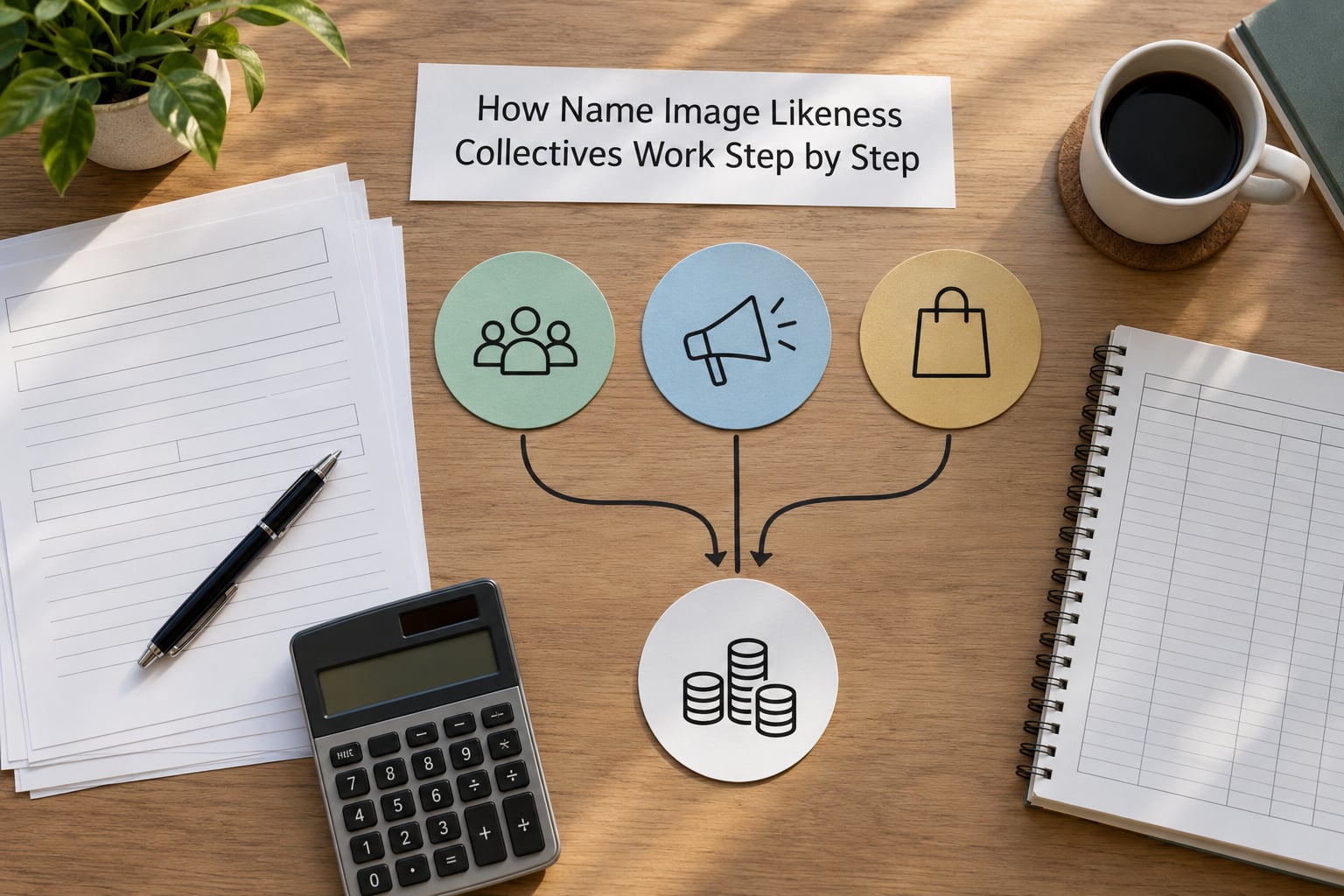
Every collective runs the same pipeline, even when the branding and the split formula differ. A dollar given to a collective travels like this.
The six-step money flow
- Money comes in. Donations, booster contributions, alumni gifts, local sponsors, brand partnerships, membership fees or subscription-style revenue. Some collectives run on a single donor pool; others are built to sell sponsorship inventory to businesses.
- The collective sets a budget and eligibility rules. Governing members decide how much of the incoming money is available for athlete compensation, what expenses are permitted, and who qualifies for a share. These rules live in bylaws, and they are the part athletes should read first.
- Deals get negotiated and approved. A sponsor signs with the collective. The collective decides which athletes take part and signs each one to an agreement listing deliverables, dates and payment amounts.
- Compliance review happens before the work starts. The school reviews the arrangement against its own policies and NCAA rules. A collective is separate from the school, but disclosure is not optional, and deals that look like inducements can be rejected.
- The athlete delivers the promotional services. Social posts, autograph signings, personal appearances, community events, retail store visits, content. Anything the contract promised, with proof attached. Many collectives require receipts, photos or platform analytics.
- Money moves and taxes follow. The collective deducts permitted expenses and any agreed percentage, then distributes the rest to participants. The athlete reports the payment as taxable income, because compensation for services is income to the person who did the work.
Two details in that list cause most disputes. Deliverable tracking decides who actually gets paid, and the deduction policy decides how much survives to be paid. Everything else is bookkeeping around those two questions.
How the Money Is Calculated and Shared
Collective payouts are not salary. They are revenue minus expenses, divided by whatever formula the membership approved. A simple illustrative example, using round numbers only, shows how that plays out.
A worked example
Say a local business signs a sponsorship for four quarters at USD 120,000 per year, so the collective receives USD 120,000 in gross revenue. Permitted expenses come out first: legal and administrative costs of USD 18,000, and a compliance review fee of USD 6,000. That leaves USD 96,000 in net proceeds available for athletes.
If the collective’s formula pays an equal share across all eligible members at the school, and 40 athletes are eligible, each receives USD 2,400 for the year. If the deal covers only the four athletes who actually made appearances, each receives USD 24,000 and the other 36 receive nothing from that particular sponsorship. Neither number is wrong. They answer different questions about what the organization promised.
That gap between the two outcomes is exactly what drives the arguments you see online. A college football thread summed up the equal-split version bluntly: the collective pays every player the same amount, which critics read as donors paying players above the board rather than paying for services. Whether that criticism lands depends on whether the bylaws say equal split or deliverable split, and whether the equal payment comes with real obligations attached.
Four ways collectives divide the money
| Distribution model | How it works | Common criticism |
|---|---|---|
| Equal split | Net proceeds divided evenly among all eligible athletes | Walk-ons and starters receive identical amounts, which some fans read as pay-for-play |
| Need-based split | Larger shares go to athletes with greater financial need, sometimes with no deliverable attached | Closest to the line the NCAA drew, and the model most often criticized as a direct payment |
| Position-based split | Revenue is allocated by roster slot, with quarterbacks and skill positions carrying more weight | Hard to defend publicly, and it invites the accusation that money follows reputation |
| Deliverable-based split | Each athlete is paid against services actually delivered under a signed agreement | Requires tracking and enforcement; athletes without appearances can end up with nothing |
Most well-run collectives land somewhere between the third and fourth option. The position-based framing sets who gets asked to appear, and the deliverable-based agreement determines who gets paid for showing up. Structuring it that way keeps the compensation tied to promotional services, which is the defensible position.
What Rights Does an Athlete Give to a Collective?
The word rights hides four very different things. Knowing which one you are signing for is the difference between a one-event autograph session and handing over your identity for three years.
Four different things you might be signing for
Organizing. Permission to use your name in a collective’s materials, such as a roster or a donor thank-you list. Low risk and short-lived.
Appearing. Showing up at a specified number of events, signings or store visits, on terms the agreement sets out. This is the most common deliverable in collective deals.
Endorsing. Appearing in advertising for a brand or product, including your likeness in a campaign or on packaging. This carries reputational risk and usually triggers disclosure obligations.
Licensing. Granting broader, standing permission to use your name, image and likeness across channels and over time, sometimes with sublicensing rights. This is the one to read twice.
The five words to look for in the contract
- Scope. Which channels are covered: social accounts, print, broadcast, retail, or all of them.
- Duration. How long the permission lasts, and whether it survives the end of your eligibility. A term that outlasts college deserves a second conversation.
- Territory. Whether the rights are worldwide, national or limited to a region.
- Approval rights. Whether you can reject content you did not approve, and who holds final sign-off.
- Exclusivity. Whether you are blocked from competing sponsors in a category, and for how long. Exclusivity in NIL is legal when it attaches to the endorsement and is reasonable in scope.
The clause that causes the most trouble is usually not the money. It is a term that quietly follows you to a new school, combined with a broad exclusivity list that limits the deals you could sign next.
Who Can Join and How Are Members Selected?
Collectives are athlete-governed, at least in principle. Membership bylaws usually define who is eligible, how members are admitted, who votes, and how decisions get made. Some organizations are open to every currently eligible athlete; others require an application or an invitation.
Equal-access rules are the model most collectives use because they are the easiest to defend. Under that structure, any eligible athlete can join, and money is distributed by a published formula rather than by individual negotiation. The upside is predictability and a much simpler answer to the question boosters get asked constantly: why this athlete and not that one.
Closed or selective models do exist, usually built around a specific sponsor relationship or a smaller group of athletes at a position. They are harder to explain publicly, and selective access is exactly what triggers pay-for-play accusations, because the pattern looks a lot like buying particular players.
Two constraints apply no matter how the bylaws are written. Participation rules cannot condition payment on playing, starting, recruiting or remaining at the school, and they have to stay consistent with NCAA guidance and with the state law where the school sits. Those state laws are a patchwork, and some of them reach further than the federal rules.
What Risks Should Athletes and Families Check?
School conflict. Some schools disliked the collectives they helped create, and coaches have publicly argued that booster-funded payments are recruiting inducements in everything but name. Athletes can find themselves caught between an organization that signed them and a program that controls eligibility.
Taxes. Collective payments are compensation for services, so they are taxable income to the athlete and are reported to the IRS. Non-cash benefits raise their own questions, and international student-athletes face extra complications tied to visa status and extra work rules.
Unequal distribution. A formula that looks fair on paper can pay a walk-on the same as a starting quarterback, or the reverse depending on who wrote the bylaws. Read the formula, not the mission statement.
Exclusivity and long terms. Narrow exclusivity lists and multi-year terms limit your freedom to sign other deals, sometimes past the end of your eligibility.
Sponsor compliance. Some sponsors cannot legally associate with a particular school or with alcohol, gambling or other restricted categories. State law differs here, and a collective that does not check can put an athlete in a compliance problem.
Unvetted counterparties. The organization is handling your money and your likeness. Verify that it exists, that the funds are where they say they are, and that someone qualified is reviewing contracts.
On that last point, the honest advice is short. Families routinely spend more time comparing a laptop than an agreement that can commit an athlete’s likeness for years. Independent legal advice is not optional in any deal where you do not fully understand the language.
How Name Image Likeness Collectives Differ from Individual Deals
Both routes pay for the same underlying asset: your name, image and likeness. They differ in who controls the relationship, how the money arrives, and who carries the downside.
| Question | NIL collective | Individual brand deal |
|---|---|---|
| Who negotiates | The organization, on your behalf | You, or your agent |
| Who signs | Athletes in the group, for shared or individual deliverables | You alone |
| Payment timing | After deliverables are verified, minus collective expenses | Per the contract schedule, usually less agency commission |
| Certainty of payment | Depends on revenue and split formula; not guaranteed | Contracted amount is known once signed |
| Ceiling | Limited by the size of the donor and sponsor pool | Limited by your own marketability |
| Effort required | Often shared; lower per-athlete burden | All yours |
| Exit | Governed by membership rules and deal terms | Governed by the contract, which may still run |
The most common mistake is treating a collective payment like a paycheck. It behaves more like a piece of freelance work with an organization handling the invoicing, and in the years when deals were plentiful that difference did not matter much. As booster giving has pulled back and schools have gained the ability to pay athletes directly, the pool a collective divides has become the constraint rather than the deal itself.
What Questions to Ask Before Joining a Collective
Read the bylaws before you read the offer letter. These questions cover what a serious athlete and their family should be able to get answered in writing.
- Who governs it? Who holds the voting rights, who appoints the director, and who can remove them? If the board cannot be identified, there is no governance to examine.
- What are the actual numbers? What came in last year, what was deducted, what reached athletes? Ask for historical figures, not projections.
- What is the fee and expense schedule? A percentage taken off the top, a flat administration fee, or audited third-party costs. Know which, and know whether expenses are capped.
- How is the split decided and can it change? Get the formula in writing and check whether the membership can amend it and by what vote.
- Who approves sponsors? Look for a process that reviews each deal for compliance before athletes are asked to sign.
- What does the athlete agreement say about duration, territory, exclusivity and approval rights? Have a lawyer read this specific document, not the organization’s marketing summary.
- What happens if you transfer or leave? Confirm whether payment stops, whether unearned obligations are released, and whether any clause follows you.
- Can you leave the collective? Withdrawal terms, notice periods and what happens to money already earned but not yet paid.
You would be surprised how many of these questions get vague answers. Vagueness on the expense schedule and the withdrawal terms is where most of the trouble sits.
Frequently Asked Questions
Do college athletes get paid automatically when they join an NIL collective?
No. Joining a collective makes an athlete eligible for whatever the bylaws say, which may be nothing until revenue arrives. Payments usually follow verified deliverables under a signed agreement, so unpaid membership and unpaid participation are two different things. Ask for the split formula and the expense schedule before you sign anything.
Can an NIL collective make a profit, and where does that money go?
It depends on the structure and the paperwork. A collective operated as a nonprofit may reinvest surplus into programs, scholarships or expenses rather than distributing it to members, and nonprofit status comes with its own rules. A for-profit group can retain revenue under its ownership terms. Read how the specific organization handles surplus before joining.
Is joining a name image likeness collective the same as signing a long-term contract?
Not necessarily. A collective membership agreement and the individual athlete agreement that covers a sponsor deal are separate documents with different terms. One covers your rights inside the organization, the other covers the services you owe a specific sponsor. Read both, and pay attention to duration and exclusivity in each.
Can a collective require an athlete to accept every sponsor offer?
It depends on the bylaws. Some organizations route all sponsor commitments through the collective, which can mean mandatory appearances. Others require an athlete to opt into each specific deal. If participation is mandatory, check what the obligations look like and whether they are compensated, because unpaid appearances are a common source of complaints.
Are NIL collective earnings taxable, and who is responsible for reporting them?
Payments for promotional services are taxable income to the athlete who earned them, and the athlete is responsible for reporting them even when an organization handles the paperwork. Reporting requirements can differ from W-2 treatment, so athletes should confirm the details with a tax professional. International student-athletes should raise the extra visa implications early.
Can a high school athlete join an NIL collective before college?
Almost never through a college collective. These organizations serve currently eligible student-athletes at a specific institution, and high school athletes fall outside that definition. High school NIL activity depends on the law where the athlete lives, since state rules differ widely and some carry penalties for schools or vendors that participate. Check the specific state law first.
Conclusion
A name image likeness collective is an athlete-governed business structure, not a paycheck and not a promise. It works because donors and sponsors pay for promotional services, athletes deliver them, verified expenses come off the top, and whatever remains is split by a formula somebody voted on. That structure is legal and compliant as of 2026, and it guarantees nothing.
If you are an athlete or a parent, do three things before signing anything: read the bylaws, ask for the last two years of financial figures, and have an independent lawyer review the athlete agreement itself. Those three steps take an afternoon and they will tell you more than any marketing page, including this one.