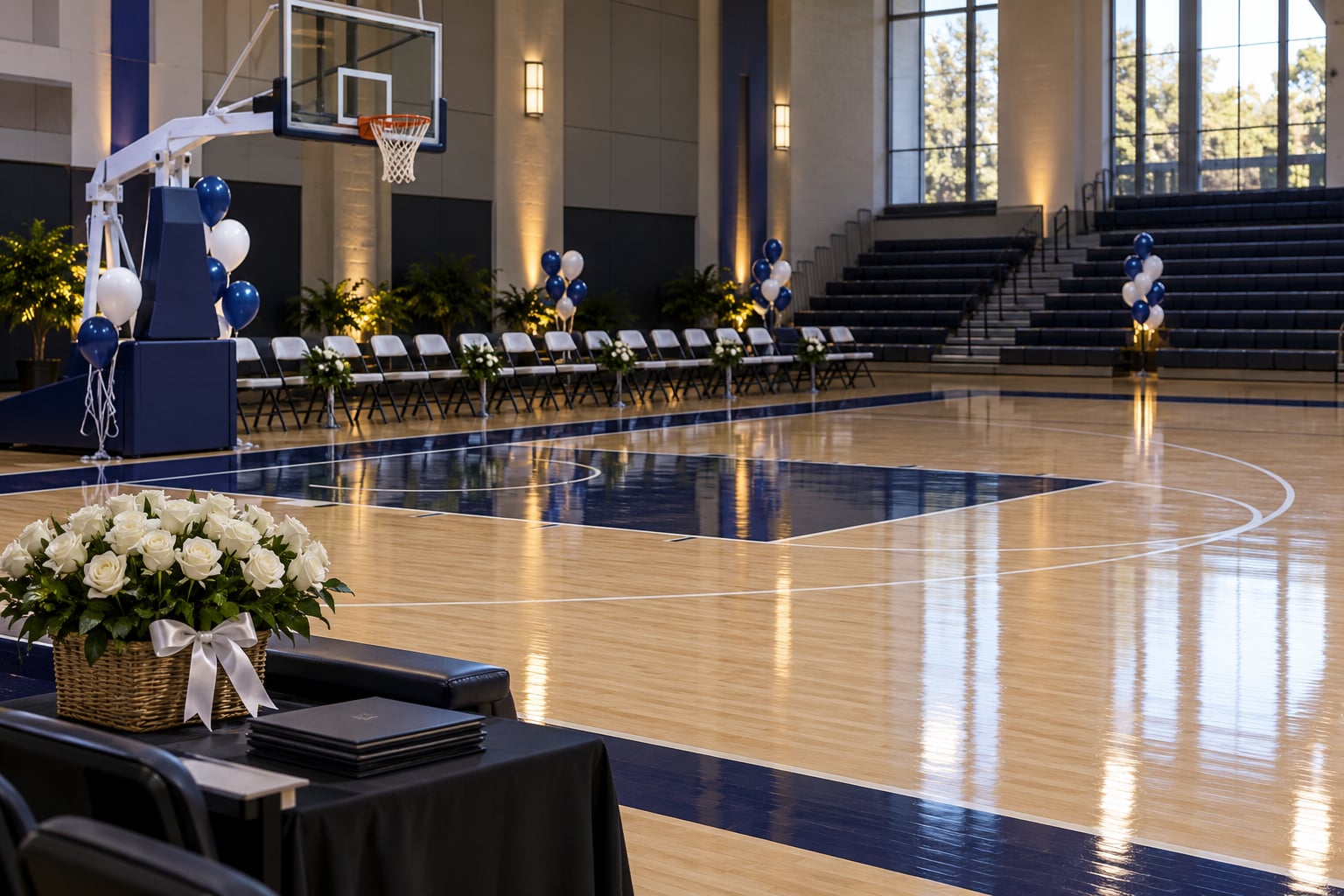
Here is how college basketball senior nights work: it is a pregame ceremony at a player’s final regular-season home game where the public-address announcer calls each senior’s name, the player walks out from the baseline with family members, the crowd recognizes them, and the coach says a few words before tipoff. Every program runs its own version of it, so timing and details change from school to school.
Most fans know the moment when it happens. Far fewer know who is being honored, why some players are called twice, or why their program calls it a ceremony instead of a night. That confusion shows up in every fan forum of a basketball season, especially in the two weeks when schools are scheduling everything around conference play.
I have watched enough of these, from packed major arenas to small-campus gyms where the ceremony runs longer than the timeout before it. The mechanics are consistent even when the scale is not. Here is the whole thing, step by step.
Table of Contents
- What Is a College Basketball Senior Night?
- Why Do Teams Hold Senior Nights?
- Who Is Honored During Senior Night?
- What Happens Before the Game?
- What Happens During the Senior Night Ceremony?
- How Does Senior Night Affect the Team and Game?
- How Is a College Basketball Senior Night Different From a Final Home Game?
- What Can Fans Do at a Senior Night?
- Do All College Basketball Programs Use the Same Tradition?
- Frequently Asked Questions
- Conclusion
What Is a College Basketball Senior Night?
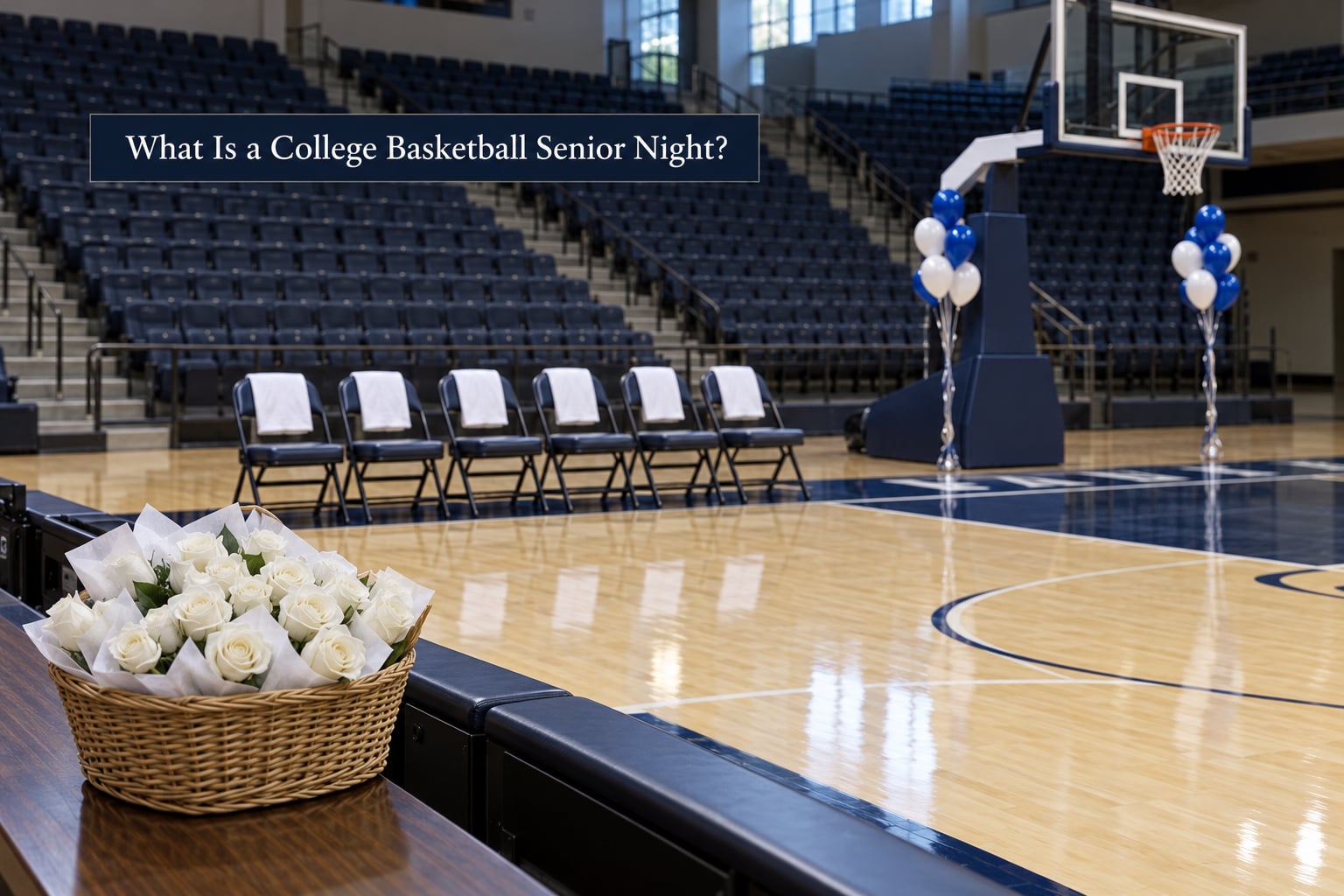
A college basketball senior night is a ceremony held before a team’s final regular-season home game. Each senior in the eligible class is introduced by the public-address announcer, walks onto the court with family members, is recognized by the crowd and the coaching staff, and receives a commemorative gift.
That definition holds across NCAA Division I, and most Division II and III programs run the same ritual in a smaller building. The two things that genuinely vary are when the ceremony happens and how much the program does around it.
Some schools stage it before tipoff with introductions and a midcourt photo. Others hold a short recognition at halftime and leave the speeches for after the game. Indiana is the famous outlier: the speeches tradition there dates to 1973, when Bob Knight brought his senior class back onto the floor after the final home game rather than doing a pre-tip walkout. Fans who have watched a ceremony at one school often assume every school works the same way, and it is worth asking before you buy a ticket.
Why Do Teams Hold Senior Nights?
The obvious reason is recognition. College basketball careers happen in front of a few thousand people most weeks, in buildings where the loudest voices belong to the student section. Senior night is the one night a player is introduced by name, with a career summary read aloud, and applauded by the whole arena.
There is a second layer underneath it. The families absorb most of the cost of a college career in time, money, and missed weekends, and they rarely get public credit for any of it. The ceremony hands them ten minutes in the middle of the court.
Coaches also use it as a program tool. Underclassmen watch what recognition looks like, and the message to a sophomore is simple: this is what you are working toward. Forum threads about the tradition are full of parents describing it as the first time their child’s teammates’ families really saw the years behind the minutes.
Who Is Honored During Senior Night?
Eligibility rules differ by institution, but the common pattern is that every senior on the roster is recognized, not only the starters. A player who averaged six minutes a night walks out the same night as a first-team all-conference center.
That principle extends further than most people expect:
- Walk-ons. They are announced with the same ceremony as scholarship players, often with a longer list of years on the roster. Forum posts about walk-on recognition are the most emotional ones in most communities.
- Managers, trainers, and equipment staff. Programs that do this well introduce them alongside the roster, since the ceremony is the only moment when that work is visible to a crowd.
- Injured seniors. A player who tore an ACL in October is still a senior. The ceremony happens; the game they were supposed to play in it does not.
- Fifth-year players. A senior with eligibility left who plans to return is frequently honored again the following season. Coaches call this an eligibility multi-year, and fans find it confusing because it looks like the same player being celebrated twice in one year.
Why a Fifth-Year Player Gets Honored Twice
NCAA rules let a student-athlete use a fifth year of eligibility in basketball when specific conditions are met, and some players take it. If that player has already been honored as a senior, they are typically honored again the following season as they leave for good.
The practice varies. Some programs note the repeat recognition out loud during the announcement so the crowd understands. Others ask the returning player to keep the ceremony brief. The confusing part for fans is that the ceremony honors a moment of closure, and a returning player has not reached one yet.
What Happens Before the Game?
The build-up is where most fans get caught out. Programs start the ceremony roughly twenty minutes before scheduled tipoff, and the public-address announcement that tells spectators to be in their seats often happens earlier still.
On a St. John’s fan board, a thread on the senior night page put the festivities at 8:40pm for a 9pm tip and asked patrons to be seated so the players were not walking out to an empty lower bowl. That is the standard pattern: the ceremony starts near the scheduled tipoff time, not after the national anthem and definitely not at halftime.
So if you want to watch it, plan on being in your seat fifteen to twenty minutes before tip. Warmups run as usual, the announcer reads the starting lineup for the night, and the teams clear the lane and the key. The visiting team usually stands along the sideline or stays in the locker room, and schools that have a tradition of this put the visiting fans on their feet for the walkout too.
What Happens During the Senior Night Ceremony?
The ceremony is a fixed sequence that most programs run in the same order:
- The lane clears. Both teams move out of the paint so there is a straight path from the baseline to midcourt.
- The announcer reads the introduction. The public-address script gives the player’s name, hometown, years on the roster, and often the parents’ or escorts’ names and what happens after graduation.
- The senior walks out from the baseline with family. Both parents usually escort, sometimes with siblings, a girlfriend, or children. The jumbotron follows the walkout.
- The midcourt photo. The family poses at center court, then joins a growing line of seniors and escorts along the sideline.
- Flowers and the commemorative gift. Roses for a player’s mother are the classic presentation, and flowers go to other escorts as well. The team-signed basketball is the keepsake coaches describe as the one every player expects.
- Coach remarks. The coach says a few words about the senior, sometimes with a story the rest of the team has never heard.
- Tipoff. Play starts, and in most programs every senior is in the opening lineup regardless of rotation role.
Programs with more seniors take longer. A class of eight can push the pre-tip ceremony past ten minutes, which is the most common complaint in fan threads about the night.
What Seniors Actually Receive
The team gives a gift, and the family often gives one too. Across programs the standard package includes:
- A basketball signed by the entire team and coaching staff.
- A framed jersey, or a shadow box holding a jersey and a ball.
- Flowers for the escorts.
- A photo collage, printed team photo, or a short video tribute shown on the arena screen.
- Sometimes a scholarship fund donation in the senior’s name, announced during the ceremony.
Family gifts are a separate question, and the etiquette is unsettled. Some parents buy a watch or a small piece of jewelry; most buy nothing at all and let the program handle it. The fear of out-spending another family comes up constantly in coach and parent groups, and the general advice is to keep it small or skip it, because the ceremony is about the player, not a competition.
How Does Senior Night Affect the Team and Game?
The game stays competitive. Senior night is not an exhibition, and coaches are not going soft on the opponent because their seniors are being introduced.
What changes is personnel. Most programs start their seniors regardless of who would normally get the opening nod, which alters the first minutes of the game more than fans sometimes expect. A coach who uses a small rotation may also plan to close the game with seniors on the floor, so the last five minutes belong to the people being honored.
Some schools add a commemorative element to the court or the uniforms, though many programs now reserve those for rivalry games, so it is not universal. Coaches frequently report that the ceremony leaves the team energized rather than distracted, with seniors coming out of it ready to play.
How Is a College Basketball Senior Night Different From a Final Home Game?
The two overlap often, which is why fans conflate them. Senior night is the ceremony. The final home game is the schedule event. Here is how they differ:
| Factor | Senior night | Final home game |
|---|---|---|
| Core purpose | Recognize seniors and their families | Close out the home schedule |
| Typical timing | Twenty minutes before tipoff | Any game on the schedule |
| Who is recognized | Seniors, plus walk-ons, managers and trainers | Nobody by default |
| Speeches | Usually brief coach remarks, sometimes a full senior speech | Normal postgame media duties |
| Keepsake | Team-signed ball, framed jersey, flowers | None |
| Plays a final home game | Usually, but not always | By definition |
The “usually, but not always” line matters more than it sounds. Senior night is not required to sit on the last home date. Conference scheduling conflicts, a late postseason clincher, or a rescheduled opponent can push the ceremony to an earlier home game. Bentley, for example, shifted its men’s senior night from one February home date to the next to fit its conference schedule. If you are building a trip around the ceremony, check the specific game rather than assuming it is the finale.
What Can Fans Do at a Senior Night?
Sitting in the arena is most of the job, but a few things help:
- Arrive fifteen to twenty minutes early. Programs ask the crowd to be seated, and the walkout happens once, quickly.
- Stand when the senior walks out. The applause is the point of the ceremony, and visiting fans are usually invited to join it.
- Cheer the coach’s words, not just the player’s name. The remarks are often the part families remember.
- Check arena rules on signage and photography. Most schools restrict signs to hand-held poster board and limit where you can stand in the lower bowl.
- Respect the speeches. If a senior is emotional or speaks about a hard season, an attentive room is worth more than noise.
- Stay for the end. When seniors close out the final minutes, the arena noise is different, and it is the part fans miss when they leave early.
What Parents Do and Bring
Parents are the ones walking onto the court, so they dress for an occasion rather than a game. School colors are the safe choice, and many programs ask escorts to wear white or a designated color so the line of seniors looks coordinated.
Roses for the player’s mother are traditional at many schools. Check the school’s own page, because some programs hand out flowers at the door or ask families to collect them, and others leave it entirely to the family. Bring a phone, keep the umbrella at home if you are seated on the floor, and plan on standing up and down for twenty minutes.
Do All College Basketball Programs Use the Same Tradition?
No, and the differences are wide enough that an experienced fan can identify a program from its ceremony. Some schools run individual introductions with a biographical video for each senior. Others walk the whole senior class out together with the coach and hand out flowers at the scorer’s table before the game. A few hold a parent-and-senior introduction where the player escorts a parent rather than the reverse.
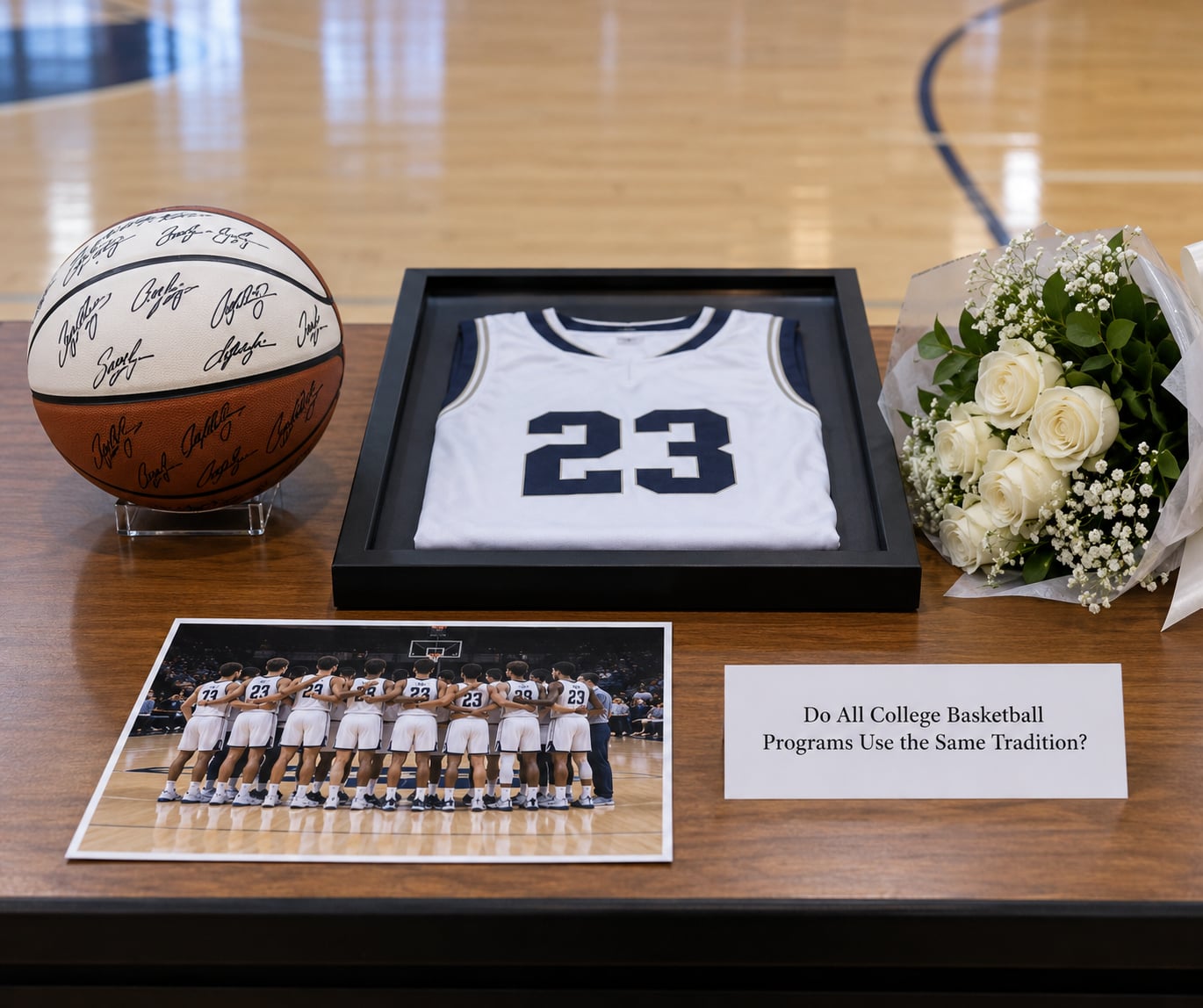
Beyond format, there are structural differences:
- Men’s and women’s teams often celebrate separately. Programs frequently hold two ceremonies in the same season, sometimes on the same weekend, with the women’s team going first.
- Alumni attendance varies widely. Bigger programs invite former players back to the floor, and it can add several more minutes.
- Smaller schools improvise. A Division II or III program may do the whole thing in five minutes with no gifts and no video, and still make it count.
- Multi-sport schools have to schedule around each other. Football, volleyball and basketball ceremonies can collide, which is a common source of forum confusion in February.
The one near-universal element is the name being called over the public address system with a family member walking beside the player. If a school does that, it is doing senior night.
Frequently Asked Questions
Are senior players guaranteed to start on college basketball senior night?
Usually, yes. Most programs open the game with every senior in the starting lineup regardless of rotation role, and several plan to close the game with seniors on the floor too. Coaches treat senior night as the one night where normal minutes decisions give way to recognition. Some schools are more relaxed about it, particularly when a senior has barely played, so treat the opening lineup as tradition rather than guarantee.
Does every college basketball team have its own senior night?
Every NCAA program holds one, though the name and format vary. Most call it senior night. Others use senior ceremony, senior day, or a formal recognition at the final home game. Coverage varies too: a Division I program might run a ten-minute ceremony with video tributes, while a smaller program keeps it to introductions and a team photo. The tradition itself is standard.
Are parents and other family members part of the ceremony?
Almost always. Parents are the usual escorts, walking onto the court from the baseline behind the player during the introduction, and both parents typically go together. Some programs add siblings, a spouse, or children, and a few reverse the script and have the senior escort a parent. The announcer usually names the escorts as part of the introduction.
Is senior night always a player’s final home game?
It usually is, but not always. Conference scheduling, postseason clinching, and rescheduled opponents sometimes push the ceremony to an earlier home date. Programs also split ceremonies between the men’s and women’s teams, so one team’s senior night may not be its last home date. If you are traveling for the ceremony specifically, confirm the date and the tipoff time on the athletics site.
Why do some teams introduce seniors with their families?
Because the families carry the invisible part of a college career. Practices, travel, injuries, and schoolwork all fall on parents and guardians long before anyone in the arena sees them. Walking out together puts that on public display for the length of a ceremony. It also gives the announcer something to say: hometown, years on the roster, escorts, and what the player plans to do after graduation.
Conclusion
Senior night is a school-specific celebration, not a standardized ritual. The common core is simple: the announcer reads the name, the senior walks out with family from the baseline, the arena applauds, the coach says a few words, and the game tips off with the seniors on the floor.
If you have never been to one and you are still working out how college basketball seniors nights work in practice, check the program’s official schedule page and athletics site before you go. Look for the ceremony start time, confirm whether the game is televised, and plan to be in your seat about twenty minutes before tipoff. Everything else you can pick up as it happens.