How college athletes balance classes and practice comes down to one weekly schedule: practice, strength training, film, meetings, travel and sleep get locked in as fixed blocks first, and coursework gets fitted into what is left. The athletes who manage it well are not studying longer — they are protecting a few high-quality hours, telling professors early, and treating recovery as part of the academic plan.
That answer sounds tidy until you look at a real in-season week. A Division I basketball player can face a 40-hour practice schedule in January, a 50-hour one in February under new NCAA limits, and a class schedule that does not move. Add travel, mandatory study hall and eight credits, and the margin for error is thin.
The good news is that the crunch is predictable. Once you know the rules that shape it and the few systems that absorb the surprises, the schedule stops being a source of constant stress and starts being a tool.
Table of Contents
- What Time Do College Athletes Have for Class and Practice?
- How Do Student-Athletes Build a Weekly Schedule?
- How Do College Athletes Manage Classes During a Busy Season?
- How Do College Athletes Study and Recover at the Same Time?
- What Support Do College Athletes Need to Stay Balanced?
- What Changes During Finals, Travel, and Competition Week?
- Frequently Asked Questions
What Time Do College Athletes Have for Class and Practice?
Very little, and none of it is free. In-season, athletic time is capped by NCAA rules rather than by preference, which is exactly what makes it plannable. Here is the shape of a typical fall in-season day for a Division I athlete with morning classes:
- 6:00 a.m. — Wake, breakfast, gear, travel to the facility or the river.
- 7:00 a.m. – 9:00 a.m. — Practice, or a lifting block on a non-practice day.
- 9:30 a.m. – 11:30 a.m. — Breakfast recovery meal, treatment, class.
- 12:00 p.m. – 1:00 p.m. — Lunch, then a short film or scouting session.
- 2:00 p.m. – 4:00 p.m. — Practice.
- 5:00 p.m. – 6:00 p.m. — Weight training.
- 6:00 p.m. – 7:00 p.m. — Dinner. The window most athletes waste.
- 8:00 p.m. – 9:30 p.m. — Study hall or homework. This is the academic hour.
- 10:30 p.m. — Lights out, if the 6 a.m. start tomorrow allows it.
Add in that NCAA practice limits exist precisely so the schedule has edges. The 10/7 rule caps a Division I athlete at a maximum of 10 hours per week of on-field or on-court activity and 7 hours per week of weight training and conditioning during the season. The 4-2-1 rule governs the periods between seasons: no more than 4 hours of athletic activity in a day, at least 2 days off per calendar month, and at least 1 day off per week.
The third number people ask about, the 40-60-80 rule, is a planning framework rather than an NCAA requirement. It splits a Division I athlete’s week into roughly 40 hours of class, study and travel, 60 hours of sport, and about 80 hours total. Athletes and advisers use it as a reality check, and the interesting part is how little discretionary time the remaining hours contain.
One more scheduled item catches new athletes off guard: study hall. A mandatory supervised study block is common even at high-profile programs, frequently around eight hours a week, and it sits on the calendar like any other class.
How Do Student-Athletes Build a Weekly Schedule?
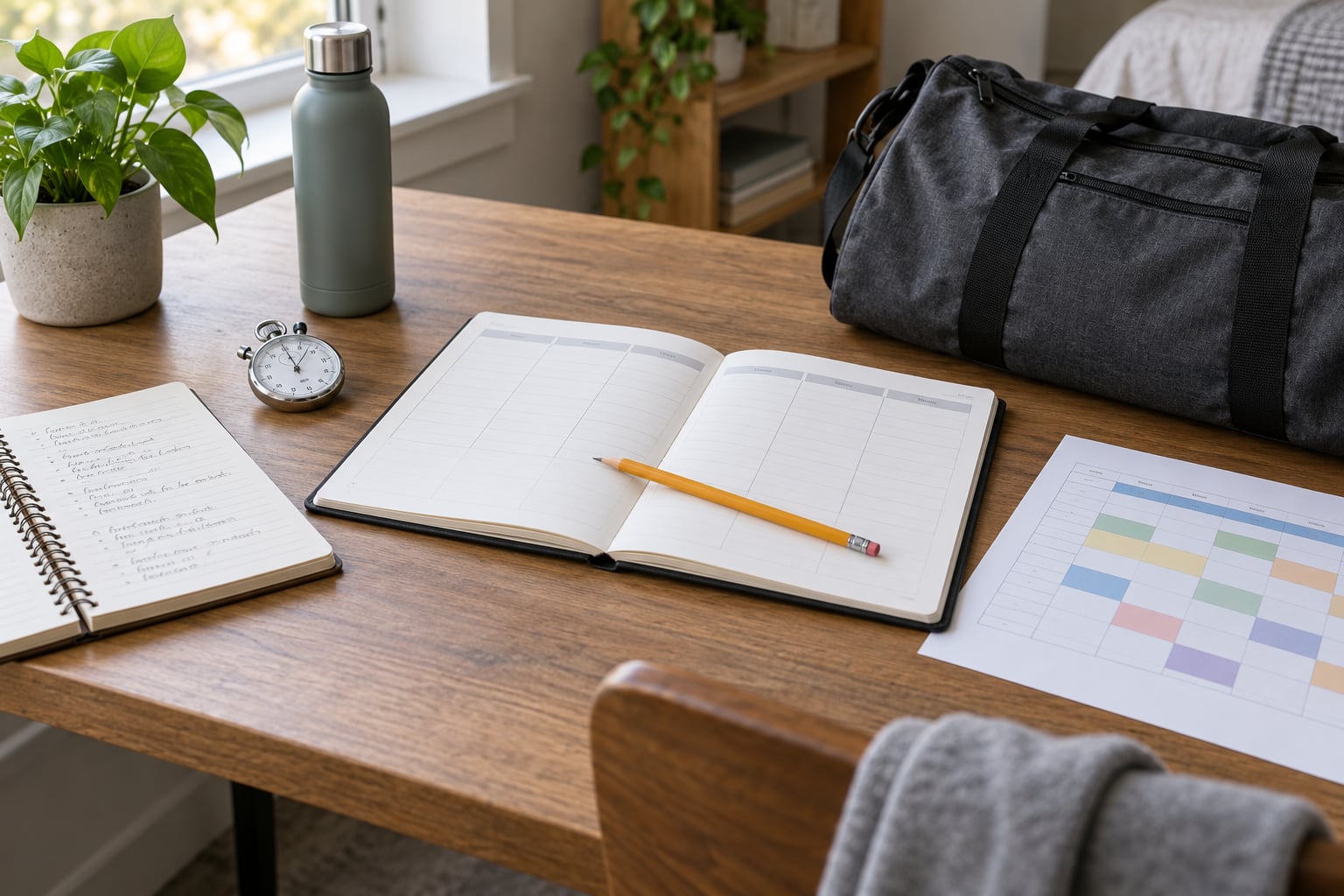
They build it in a fixed order, every week, and the order matters more than the tool. First, put every obligation with a clock on it into one calendar: classes, practice windows, lifts, team meetings, treatment appointments, study hall, travel. Then protect sleep. Then find the gaps that are actually usable, and only then add coursework to them.
How college athletes balance classes and practice without losing sleep
Most athletes lose sleep because they schedule the recovery time last. Blocking the hours after practice for study is the tempting move and the wrong one — you will sit at a desk at 8 p.m. with poor focus and call it two hours of work when it was closer to forty minutes. The better pattern is a 45-to-60 minute study block after eating, then training or lifting, then a second shorter block if the evening is open, then lights out at a consistent time.
Then use one weekly ritual. On Sunday, spend ten minutes confirming every block for the week: any travel shift, any missed class, any deadline that moved. Athletes on Reddit’s r/college and r/getdisciplined describe the same thing — a static schedule is the enemy, and a ten-minute weekly reset is what catches the change before it catches you.
Compare the same athlete across three very different weeks and the difference in study strategy is obvious:
| Week type | Athletic load | Class time | Best study strategy |
|---|---|---|---|
| Football practice week | Early practices, long meetings midweek, travel on Friday and Saturday | Afternoon-heavy schedule to free mornings for training | One weekday evening block, plus study hall and the bus |
| Off-season week | Strength and conditioning in the morning, afternoons free | Full normal load, sometimes a heavier course | Two or three daytime blocks, class ahead by two weeks |
| Academic-period week | Practice trimmed or moved to early mornings | Unchanged, often with several midterms in the same week | Full days, planned ahead, professors notified weeks in advance |
Division matters here too. Division III athletes are under NCAA limits of 20 hours a week and many compete in more than one sport, so the load can be heavier. Division II sits between the two, and NAIA programs set their own practice limits. A D1 football player’s week and a D3 multi-sport athlete’s week are not the same problem.
How Do College Athletes Manage Classes During a Busy Season?
They manage it with notice and paperwork, not goodwill. What matters most is doing the work before the conflict happens, because catching a missed class after the fact is the version that ends in a bad grade.
Before a scheduled absence, three things help more than anything else:
- Tell the professor early — at registration when you can, or in writing the week before. A short email with the specific dates and a request for a plan is far easier to answer than an apology afterward.
- Know the published policy — attendance thresholds, make-up work, whether participation is graded. Most professors have a process; very few will invent one for you on request.
- Pick a subset of priority courses — two or three classes where the material is hardest or the syllabus is heavy get your best hours, and you tell the academic adviser which ones those are.
After a missed class, close the loop the same week: get the notes from a teammate, ask about the make-up, and confirm in writing that you understand what was covered. Athletes describe the guilt of missing practice to study and the guilt of missing class for practice as one of the most consistent pressures of the whole experience, and the fix is procedural. Ask, get the answer, submit the work, move on.
What you cannot assume is an automatic accommodation. A missed class for athletics is a real conflict, but the accommodation is a conversation with that professor on that course, and it goes more smoothly when the request is specific: which dates, which sections were missed, what you need to make it up.
How Do College Athletes Study and Recover at the Same Time?
They shorten the sessions and stop treating rest as the leftover. The CDC recommends 7 or more hours of sleep for adults and 8 to 10 for ages 13 to 18, and in-season athletes regularly report six or seven. That gap is where grades and performance both quietly slip, and it is the easiest place to make a large gain by moving study earlier rather than later.
For a low-energy evening, six steps work better than one long session:
- Eat and hydrate before you sit down, not after.
- Run one 40-minute active recall pass: close the notes, write what you remember, then check.
- Break for five minutes and move around.
- Do one spaced repetition set on the material that will be on the next exam.
- Close the session by writing the two things you still cannot explain.
- Stop at the top of the hour, even if the room is still open.
Use lighter training days as an academic day rather than an extra one. Midterms and finals often shift practice to early mornings or lighter sessions precisely so athletes have daytime study blocks, and athletes who take those blocks get more out of them than athletes who bank on evening hours every day. Orientation week is the one to protect hardest — it is the only stretch where nothing is due yet, and it is where a first-year athlete quietly falls behind.
And use the practice-to-class transition for food and recovery. A 20-minute post-practice meal and a shower does more for the next study block than pushing through hungry does. If there is a 45-minute gap before an evening class, that is a real study block, and a workable one.
What Support Do College Athletes Need to Stay Balanced?
Athletes do not fail at this alone, and the ones who ask early are usually the ones who handle it well. Each part of the system has a different job:
- Coaches and staff — practice times, travel logistics, and the flexibility to move a lift or a meeting when an exam lands badly.
- Academic adviser — course sequencing, choosing priority classes each term, and confirming Satisfactory Academic Progress (SAP) benchmarks for GPA and earned credit hours.
- Tutors and the learning center — targeted help in one subject rather than three vague hours.
- Athletic trainers and strength coaches — managing treatment time, and adjusting load when a body is not recovered.
- Teammates and family — the people who notice you are not sleeping before you do.
Two institutional facts are worth knowing, because they explain why any of this is protected rather than optional. Your school must certify your eligibility every term against SAP requirements — annual GPA and credit-hour benchmarks — and the Academic Progress Rate (APR) is a team-level score that rewards eligibility and retention, with penalties at the institutional level. A failing grade is not just a bad mark. It can trigger an eligibility review, a redshirt year, a scholarship change, or the end of your season.
Make the ask specific: name the date, the course, and what you need. “I have a conflict on the 14th” gets a shrug. “I have a conflict on the 14th with two classes, could I get the lecture slides and a make-up quiz by the 16th” gets a plan. The same goes for your coach and your adviser.
What Changes During Finals, Travel, and Competition Week?
Pressure weeks compress the same week into fewer usable hours, so the strategy shifts from scheduling to triage. Midterms usually mean trimmed practices and daytime study. Bowl games and conference tournament runs mean travel days and a compressed week, where the coursework does not stop and the calendar stops cooperating. Road trips are the hardest case: a bus is three hours of dead time with unreliable connectivity and no proper desk.
On travel days, athletes who keep up download lectures, do flashcards and read on the bus, and accept a lower ceiling. The realistic goal is a small number of focused repetitions rather than a full study session.
A short checklist for finals and competition week:
- Notify every professor before the week starts, with specific dates.
- Decide in advance which two classes get your best hours and let the others take what is left.
- Submit work early wherever the syllabus allows it, even if the deadline is later.
- Arrange make-up quizzes and assignments in writing before the trip.
- Keep the sleep window where the schedule allows it, and treat a shortened night as a one-off, not a new baseline.
- Adjust the goal for the week. A light week is a plan; a missed week is a problem.
An injury or a redshirt semester reshapes everything, and it is worth planning for. Fewer athletic hours mean a fuller class schedule, which is an academic advantage with a real mental cost. Filling those extra hours with something structured — a second major, a trade, an internship — is what keeps the year from feeling like a waiting room. Reducing the training load on your own, or pushing through pain to keep up with teammates, is not a balancing strategy.
Frequently Asked Questions
Can college athletes miss class for practice?
Sometimes, and the outcome depends entirely on the professor and the course. Missing class for a practice or a game is a real scheduling conflict, but the accommodation is a conversation with that instructor, not an automatic right. Athletes who do best tell professors well ahead of time, in writing, with the specific dates and a clear request for make-up work. Some faculty have no make-up option at all, which is why the conversation needs to happen before the conflict, not after.
How many hours a day do college athletes spend on sports?
In-season, an NCAA Division I athlete can be scheduled up to 10 hours a week of practice and team activity plus 7 hours a week of weight training, which works out to roughly 2.5 to 4 hours on a training day. Add required meetings, film, treatment and travel, and a normal weekday runs 5 to 8 hours from the facility door to the door. Division III and NAIA limits are different, and many athletes add a second sport or a full off-season training block on top.
Do NCAA athletes get extra time to study?
There is no rule granting extra study time. What exists is supervised study hall, which most programs require and schedule like a class, frequently around eight hours a week, plus academic advising and tutoring. The bigger adjustment is structural: athletes often register for fewer credits, take exams outside the normal window where the school allows it, and build the week around fixed practice blocks. The real time gain comes from scheduling, not from an accommodation.
How do student-athletes study after practice?
Short and early beats long and late. Most athletes eat and recover first, then do one 40-to-60 minute block using active recall and spaced repetition rather than re-reading notes, then stop at the top of the hour. Studying at 9 p.m. after a two-hour practice produces poor focus and low retention. A better pattern is a short evening block plus daytime hours on lighter training days, which many programs build in during midterms and finals.
What should a college athlete do if class and practice conflict?
Tell your coach first, as early as possible, because a practice change takes one message while a grading change takes several. Then email the professor in writing with the exact dates, the sections you will miss, and what you need to make it up. Follow up the same week to confirm the plan. If the conflict repeats, tell your academic adviser, who can help with course sequencing, Satisfactory Academic Progress benchmarks and whether a different section exists.
Start with the weekly calendar, not with study techniques. Block practice, lifts, meetings, travel and sleep first, find the gaps, and put your hardest coursework in them. Then tell your professors the schedule you are working with before something collides with it. Athletes who build the calendar in advance and communicate early handle the same load far better than the ones trying to absorb it week by week.