College football players train in the offseason in four or five blocks, not one long grind. They recover from the season, rebuild general strength and muscle mass in early summer, shift to speed and power in the middle of the summer, then taper the volume down in the last two weeks before fall camp.
The reason you never see most of it is that the interesting work happens when there is no game, no crowd and no broadcast. Fans see a team’s public practice in August. The June and July blocks run behind closed doors, which is exactly why threads on r/CFB keep asking somebody to explain what happens in the gap.
Here is the whole cycle, phase by phase, followed by what strength, speed, conditioning and recovery actually look like inside it.
Table of Contents
- What Is the College Football Offseason Training Cycle?
- How College Football Players Train in the Offseason for Strength
- How Do Players Build Speed, Agility, and Explosiveness?
- What Does Position-Specific Offseason Training Look Like?
- How Do College Football Players Do Conditioning Work?
- How Much Recovery Do Offseason Programs Prioritize?
- How Does Football Training Fit Around Classes and Team Meetings?
- What Can Fans Learn From a Player’s Offseason Routine?
- Frequently Asked Questions
- What are the NCAA rules for off-season practices?
- Are college football offseason workouts really voluntary?
- Do college football players lift weights in the offseason?
- How is the college football offseason different from high school?
- When does college football offseason training actually start?
- What should college football players eat during the offseason?
- Conclusion
What Is the College Football Offseason Training Cycle?
The college football offseason is roughly the seven months between the last bowl game and the first day of fall camp, and it is planned as a periodized year rather than a list of workouts.
Each block has one job. The post-season block heals and rebuilds. The early summer block adds muscle and general strength. The mid-summer block converts that strength into speed and power. The late summer block holds what has been built and gets a player ready for contact.
| Phase | Typical window | Main focus | Volume and intensity |
|---|---|---|---|
| Recovery and rehab | January to mid-February | Healing, pre-hab, light aerobic work | Low volume, low intensity |
| Spring ball | Mid-February to mid-April | Position technique, installations, spring game | Moderate volume, moderate intensity |
| General strength base | May to early July | Hypertrophy, movement quality, work capacity | High volume, moderate intensity |
| Speed and power peak | Early July to late July | Acceleration, max velocity, plyometrics, max strength | Lower volume, high intensity |
| Pre-camp taper | Last 10 to 14 days before camp | Freshness, position work, speed maintenance | Lowest volume of the summer |
What surprises fans is the dead stretch between spring ball ending in April and summer sessions starting in May or June. There is often no team-organized training, no pads and no coach presence. Players train on their own, travel home, work a summer job, take classes or sit in rehab.
That gap is where a lot of a player’s mass gets added, and it is also where habits get lost. Programs counteract it with mandatory lifting sessions and optional field work, because nothing official happens for weeks at a time.
How College Football Players Train in the Offseason for Strength
College football players train in the offseason for strength using percentage-based loading on the primary lifts, olympic lift derivatives for power, and accessory work for the muscles that carry a football season.
Volume, intensity and the muscle-versus-max-strength split
The main lifts are the squat, deadlift and bench, plus the clean and snatch or their power-cleans and hang variations. Loads are set as a percentage of the one-rep max, so the same number shows up all summer while the reps move. A heavy day might be three to five reps at 85 to 90 percent, and an acceleration day might be six to eight reps at 60 to 70 percent with a deliberate speed bar.
The loudest argument in coaching forums is whether that summer block should chase muscle or maximum strength. On r/FootballCoach and r/footballstrategy, strength coaches argue it both ways, usually over the same three weeks. Most programs split the difference with a general strength phase first and a power phase later, which is why the volume in June looks nothing like the volume in July.
Accessory work fills the gaps. Unilateral lifts, rows, pull-ups, trap-bar work, carry and sled work, and anti-rotation core training all show up. So does pre-hab, the rehab work done before an injury happens, aimed at the areas that fail most often in a season of contact.
Published program materials give you a decent idea of the menu. Penn State’s strength and conditioning site has listed things like flexibility and mobility work, shoulder and scapular strength, footwork and ladder drills, cone drills, core training, upper and lower body mass builders, extra conditioning sessions and metabolic complexes. That is a reasonable sketch of what most Division I rooms run.
How Do Players Build Speed, Agility, and Explosiveness?
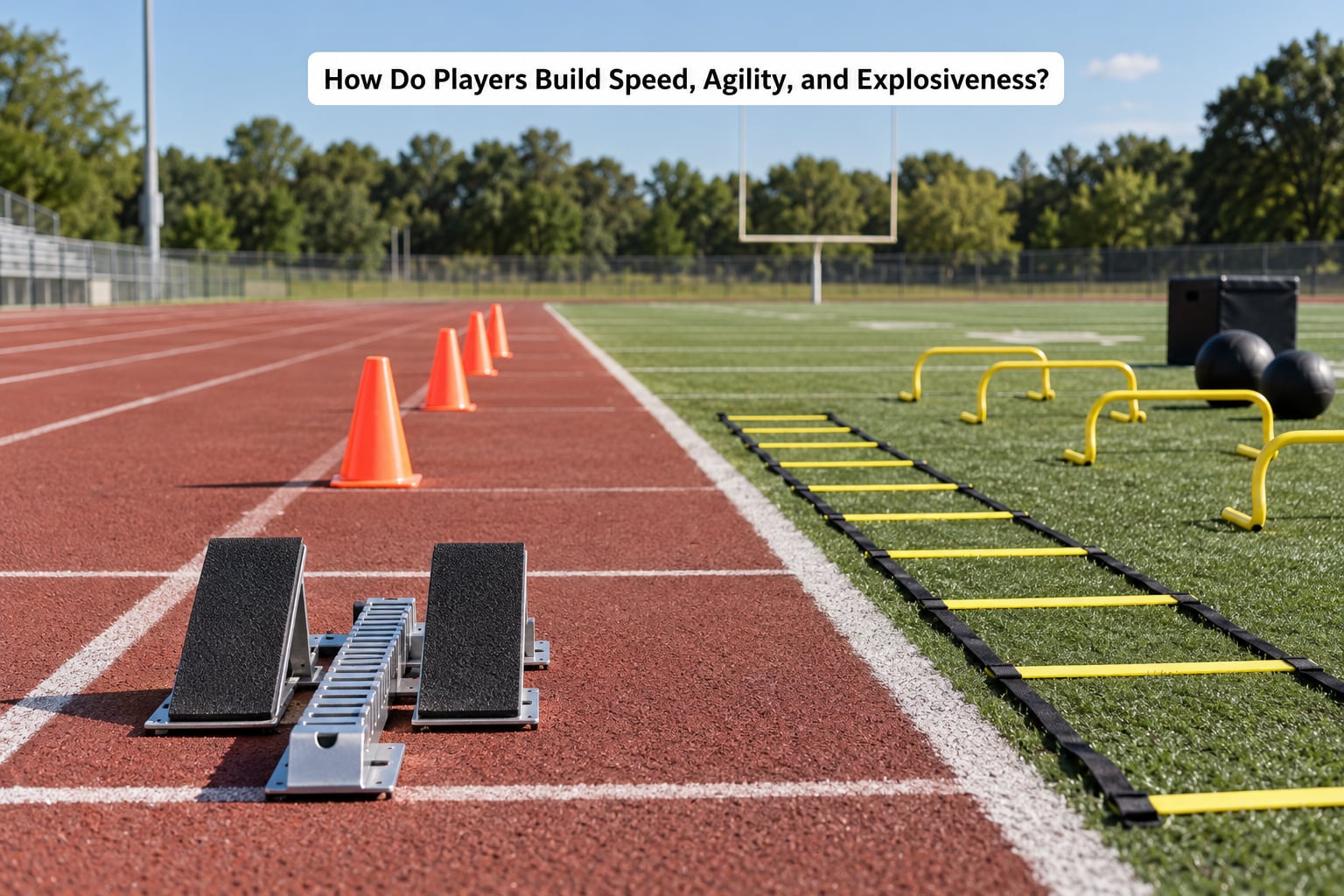
Players build speed in the offseason by separating three different qualities, training each one with its own reps, rest and volume, and then layering in plyometrics and change-of-direction work.
Acceleration, max velocity and the part everyone skips
Acceleration is the first ten yards. It is trained with short sprints from varied starts, plenty of rest between reps, and full recovery, because the phosphagen system that powers it does not tolerate fatigue well.
Max velocity is the ten-to-thirty-yard range and the fastest running a player can produce. It needs full recovery, relaxed mechanics and a genuinely flat surface. Programs drop this work when fatigue creeps in, and they drop it on purpose, because a slow rep teaches a slow pattern.
Deceleration is the piece that gets skipped and the one most worth knowing about. Braking from top speed takes more force than accelerating to it. Cut drills, drop-jump landings and braking mechanics all train the hamstrings and calves to absorb contact instead of tearing.
Plyometrics sit on top of that: box jumps, bounds, broad jumps and lateral hops, kept in low volume because the nervous system pays for them later. Change-of-direction work, short-footwork drills and reactive drills handle the cutting that defines a modern defense.
What Does Position-Specific Offseason Training Look Like?
Position-specific offseason training exists because a tight end and a defensive tackle need different bodies, and a program that trains them the same way is wasting a summer.
| Position group | Offseason emphasis | Why it differs |
|---|---|---|
| Quarterbacks | Rotational power, throwing volume, single-leg strength, deceleration, shoulder work | Needs arm and core resilience more than raw mass |
| Offensive and defensive linemen | Highest volume of hypertrophy, heavy squat and deadlift work, leverage and grip | Body mass and joint durability for constant collision |
| Skill positions | Acceleration, cutting, unilateral lower-body work, relatively lower mass | Speed and change of direction decide the job |
| Front seven defensive players | Explosive power, bench emphasis, tackling and force-production drills | Short bursts of very high output, repeated for 12 weeks |
| Specialists | Limited total volume, kick or throw mechanics, hip and hamstring work, single-leg control | Training is kept fresh because it is so specific |
Linemen and specialists are the clearest examples. One group is deliberately built heavier and more durable, the other kept leaner and fresher. Specialists at major programs often train on a reduced volume because the specific movement they need is hard to load without getting sore.
How Do College Football Players Do Conditioning Work?
College football players do conditioning in the offseason to build a general aerobic base and football-specific endurance, and almost never in a way that damages the speed work sitting next to it in the weekly plan.
Why speed work is not conditioning
These are two different adaptations and they are usually scheduled on separate days. Sprinting trains the phosphagen system, which needs long rest between efforts. Conditioning trains the aerobic and glycolytic systems, which tolerate repetition and a faster heart rate.
Fatigue left over from a hard conditioning session shows up in the next sprint session as slower mechanics. Programs that understand this put conditioning at the end of a lifting day, on a field day, or on its own lower-priority day, and they keep it simple.
The offseason menu usually includes longer tempo runs at conversational-to-moderate pace to build the base, tempo runs at a hard sustained pace for a threshold effect, shuttle and repeated-sprint work to match the demands of a game, and short metabolic finisher sessions at the end of lifting.
Volume shifts with the phase. Work capacity peaks in May and June when volume is highest, then drops as the speed block arrives. Positions that run more, like defensive backs, receivers, running backs and defensive ends, usually get more of it, and specialists get the least.
How Much Recovery Do Offseason Programs Prioritize?
Offseason programs treat recovery as a training variable rather than leftover time, because the summer is where a player rebuilds the body that takes a season of hits.
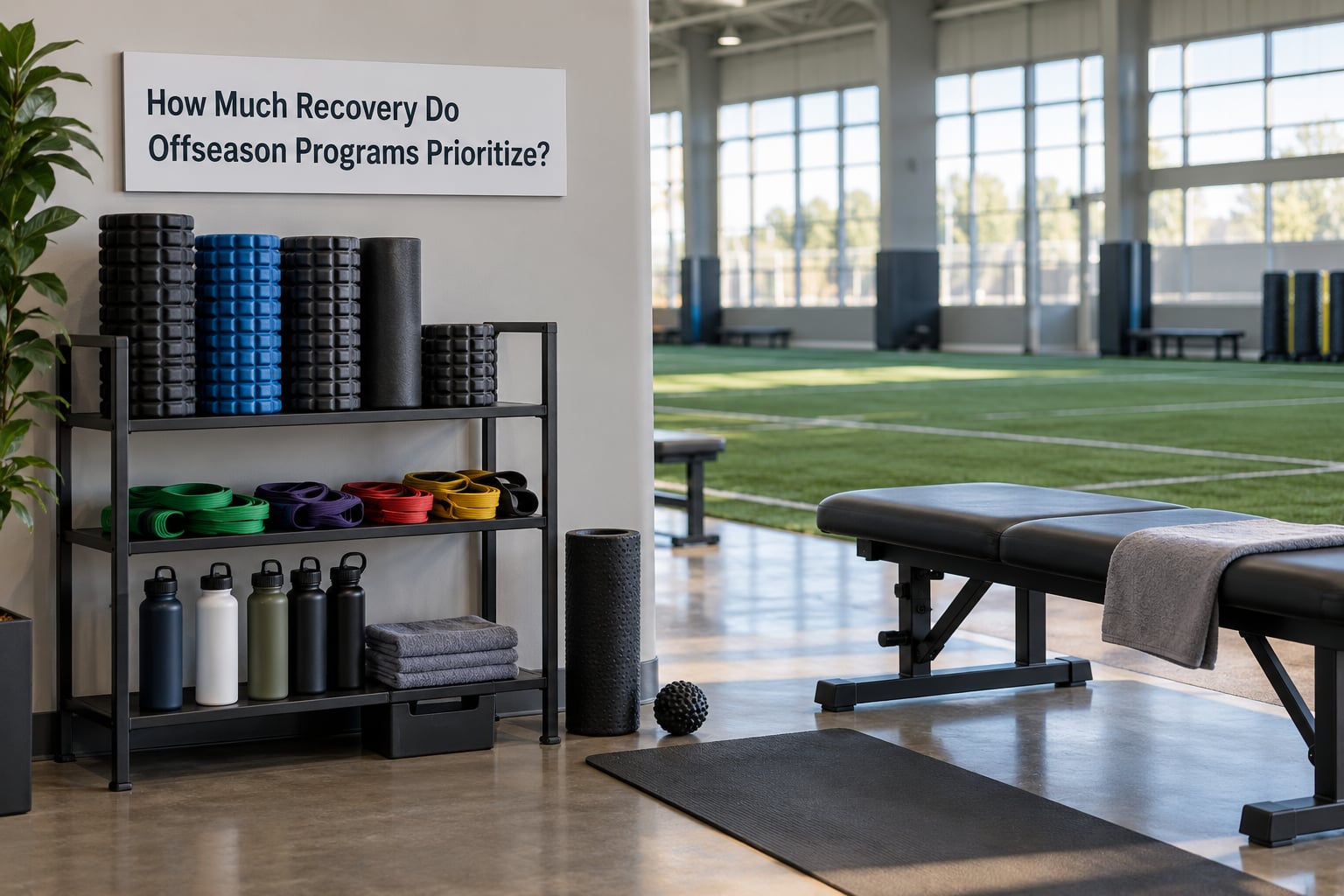
Sleep is the first item. Most programs set a target and treat it as part of the plan, and strength and conditioning staff watch for the pattern where a player’s output drops before the athlete admits they are tired. General guidance for adults points to seven or more hours, and college athletes usually need more than that.
Nutrition follows the phase, not the calendar. During a hypertrophy block a player eats more, with adequate protein spread across meals and enough total energy to support the training. During the speed block and taper the same player eats for fuel and recovery rather than for gain. Programs weight in during the mass phase and check body composition on a schedule rather than weekly.
Hydration matters most in July and August, where sessions start early to dodge the heat. Electrolyte replacement, fluids available at every station, and planned breaks in the shade are normal details.
Mobility and pre-hab work is built into the warm-up rather than left to the end of the session, and one or two active recovery days a week are non-negotiable in most rooms. Workload is monitored with simple things: session times, jump testing, sprint times and how a player reports soreness. Anything individual here belongs with that athlete’s own medical or nutrition professional, not with a general article.
How Does Football Training Fit Around Classes and Team Meetings?
College football offseason training fits around classes because a player is a student first, with training built into whatever the academic calendar allows rather than replacing it.
Summer sessions mean a compressed schedule, morning lifts before class and afternoon position work. Players who go home for part of the summer have a self-directed plan and a required check-in when they return. Position meetings, film study, travel days and community events all move the schedule around. Final exams week is the most common pinch point, and most programs plan lighter training around it.
| Day | Session focus | Typical content |
|---|---|---|
| Monday | Max strength | Lower body primary lift, accessories, conditioning finisher |
| Tuesday | Speed and field | Acceleration and max-velocity work, plyometrics, position drills |
| Wednesday | Recovery | Pre-hab, mobility, light aerobic work, optional position meeting |
| Thursday | Upper body and power | Bench, rows, olympic lift derivative, change of direction |
| Friday | Field and speed | Tempo work, repeated-sprint drills, position work |
| Saturday | Optional | Extra lifts, recovery session, academics catch-up |
| Sunday | Off | Full rest |
This is an illustration of a common shape, not a real schedule. Different positions group differently, and coaches reorder the week constantly to fit around meetings and camp logistics.
What Can Fans Learn From a Player’s Offseason Routine?
The transferable part of a college offseason is the structure, not the weights. Consistency, progressive overload, rest days and a real warm-up are habits anyone can use for general fitness, and they are the part most often missing from a bad training block.
What does not transfer is the volume. A Division I athlete trains under sports scientists, nutrition staff and medical staff, and often a position coach watching every rep. Copying the loads on a published program without that support is not the same thing, and neither is adding a two-a-day to an ordinary week.
If you want general fitness, use the same logic: build up slowly, keep one or two hard days a week rather than five, get to the lifts you enjoy, and skip anything that hurts. For anything involving injury, pain or a medical condition, talk to a doctor or a qualified trainer first. If you are a high school player, follow your own coach and the high school rules, not a college template.
There is one more thing worth noting for recruits. NIL money, the transfer portal and summer jobs all change how much free time a player has, which is why two players on the same roster can have very different summers.
Frequently Asked Questions
What are the NCAA rules for off-season practices?
NCAA rules cap football-related activity at 8 hours per week in the offseason and 20 hours per week in season. A 2022 change also allows two coach-led hours per week in June and July, which is the summer window most schools use for position work. Everything outside those limits counts as a voluntary workout, where a coach may not be present, attendance is not required and there is no penalty for missing one.
Are college football offseason workouts really voluntary?
They are supposed to be. Voluntary workouts cannot be scheduled by coaches or required, and players may skip them without consequence. The dispute is what counts as voluntary in practice. Coverage of the 2009 Michigan investigation focused on how much time players actually spent in self-directed sessions, and players have publicly complained about lost study time since.
Do college football players lift weights in the offseason?
Yes, and the lifting block is the core of the offseason. Players train the squat, deadlift and bench at percentages of their one-rep max, add power cleans and hang cleans, then fill in with accessories, unilateral work and pre-hab. The summer usually shifts from higher volume in May and June to lower volume and higher intensity in July.
How is the college football offseason different from high school?
A college program has full-time sports scientists, nutrition staff and medical staff, plus an eight-month calendar and near-continuous team-organized training. A high school program has shorter seasons, a much narrower calendar, fewer staff and closer rule limits. Most of the overlap is the periodization itself, not the volume.
When does college football offseason training actually start?
It starts in January for returning players, mostly with rehab, pre-hab and conditioning after the season. Spring ball runs from about mid-February to mid-April. The heavy lifting block usually starts in May, and the speed and power peak lands in July before the pre-camp taper in early August.
What should college football players eat during the offseason?
Eating follows the phase rather than the calendar. In the mass phase players take in more total energy with protein spread across meals to support hypertrophy. During the speed block and taper the focus moves to carbohydrate for training quality and enough protein for recovery, with hydration managed for hot summer sessions.
Conclusion
College football players train in the offseason as a periodized year: recover in winter, build muscle and general strength in early summer, convert that into speed and power in July, then taper down before camp. Recovery, food and sleep are treated as training, and the schedule bends around classes, meetings and exams rather than replacing them.
If you want the first useful takeaway, take the structure rather than the numbers. Pick a consistent routine, progress it slowly, keep real rest days, and get any questions about pain or injury to a doctor or qualified trainer before you add weight to the bar.