What college football strength and conditioning looks like is simpler than the highlight videos suggest. It is a phased, year-round training system built to develop speed and explosive power in the offseason, hold those gains through a twelve-game season, taper before each game, and rehab injured players on a separate track. The lifts are explosive rather than maximal, and speed is trained as a skill, not a byproduct.
I have read enough published training notes and talked to enough people around these programs to know where the confusion comes from. Fans see a gleaming facility on Instagram and assume the work inside is either extreme or mysterious. Usually it is neither. It is a carefully scheduled, boring-on-paper system that changes shape every few weeks.
Here is how the year actually breaks down, what a normal week looks like, and what the training staff is watching the whole time.
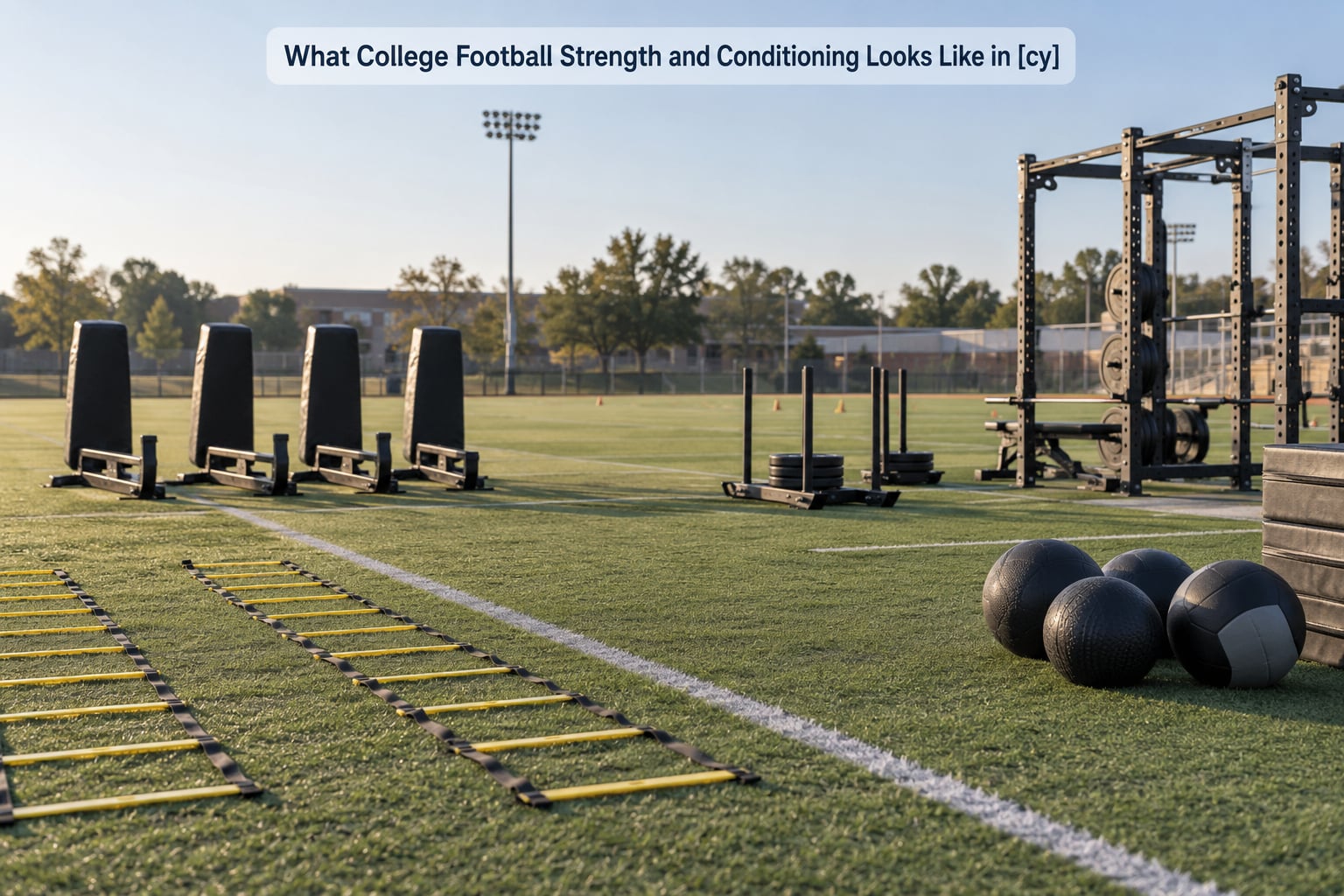
Table of Contents
- What College Football Strength and Conditioning Looks Like
- How a College Football Training Week Is Structured
- Strength Training for Football Players
- Speed, Agility, and Football-Specific Conditioning
- Warmups, Recovery, and Athlete Monitoring
- How the Program Changes Across the Football Year
- What College Football Strength and Conditioning Does Not Look Like
- Frequently Asked Questions
- How many times a week do Division I football players lift?
- How hard is football conditioning at the college level?
- Do college football players lift weights during the season?
- What does a college football player do during the offseason?
- What strength and conditioning workouts are good for football?
- What college has the best strength and conditioning program?
- Conclusion
What College Football Strength and Conditioning Looks Like
A college strength and conditioning program is a performance system, not a bodybuilding program. Its output is acceleration, top-end speed, the ability to absorb contact, and staying available to play. Raw squat and bench numbers matter only as far as they support those outcomes.
The calendar runs in four blocks that repeat on a yearly loop: an offseason build, an in-season maintenance period, a short taper before each game, and a continuous rehab track that runs alongside all of it. Sprinting and position-specific work sit on top of that structure rather than replacing it.
| Season and phase | Main focus | How the work changes |
|---|---|---|
| Offseason build | Adding muscle and learning movement patterns | Heavier volume, three to five lifting days, frequent field speed work |
| In-season maintenance | Keeping strength while practice demands rise | Fewer heavy sets, shorter sessions, heavier emphasis on recovery |
| Game-week taper | Arriving Saturday fresh | Volume drops, intensity stays light, no soreness for three days out |
| Return-to-play | Easing a player back after injury | Individualized running, lifting and field work alongside the athletic trainer |
Nobody in a good program is trying to add weight to a squat every week of the year. That would leave players sore through the middle of the season.
How a College Football Training Week Is Structured
In-season, most programs run three lifting sessions a week, split across six training groups of fifteen to twenty-five players so the floor stays manageable. Sessions are short, usually under an hour, because they sit inside a day already loaded with practice meetings, film, classes and travel.
A representative week looks like this, and it is only representative. Every program adjusts around its practice schedule, class times, position needs and injury list.
- Monday through Friday: early morning lift, then practice, meetings and film in the afternoon.
- Speed and field work: two to four short sessions a week, often right after practice when the athletes are already warmed up.
- Saturday: the game, which is why nothing hard gets scheduled on Thursday or Friday.
- Sunday: recovery. No lifting for most players, no conditioning blocks.
- One mid-week rest or active recovery slot: pool work, mobility, massage, or an off.
Coaches talk about training groups constantly. Splitting ninety players into smaller sessions means more coaching touches per athlete and less standing around on a platform. Position coaches often work the floor alongside the strength staff, which is how a lineman’s block-specific exercise ends up next to a lineman’s squat day.
Before a player’s first lift, there is usually onboarding: medical history review, musculoskeletal screening, injury reports, sometimes a thirty-minute one-on-one meeting and a call to a player’s previous high school coach. Kansas wrote publicly about doing this with a large transfer class, and the point of the process is simple. A program cannot program around an injury it has not been told about.
NCAA limits shape everything here. Practice, meetings and required conditioning are capped, so the strength staff competes for the same hours as academics and film. When the calendar compresses, lifting volume is the first thing that shrinks.
Strength Training for Football Players
The exercise selection in a college weight room follows movement patterns rather than novelty. Every lift serves a force production goal that shows up on a Saturday.
| Pattern | What it trains | Common exercises |
|---|---|---|
| Squat pattern | Leg drive, hip and trunk strength | Back squat, front squat, split squat, box squat |
| Hinge pattern | Posterior chain, hamstring and glute power | Trap-bar deadlift, conventional deadlift, single-leg RDL |
| Horizontal push | Upper body pressing force | Bench press, push press, landmine press |
| Horizontal and vertical pull | Upper back, grip, shoulder stability | Chest-supported row, pull-up, face pull |
| Trunk control | Rotational and anti-extension strength | Pallof press, cable chop, plank variations, carries |
| Explosive force | Rate of force development | Power clean, push press, jump squat, med-ball throws |
Read that table as a description of a room, not a prescription for you. The loads, reps and rest intervals a college staff uses are set for athletes who are also playing football eleven times a season, and they change with the phase.
Two things separate a serious program from a generic one. First, the explosive work is trained as power, meaning intent to move an object fast, not just lifting it. Second, plenty of light dumbbells and small plates sit unused or get removed entirely. Texas stripping out low-weight plates drew plenty of discussion from fans, and the reason is that coaches worry light training teaches sloppy bar speed. Whether a specific program does it is a coaching preference, not an NCAA rule.
Speed, Agility, and Football-Specific Conditioning
Speed gets its own block of training time and its own testing, because sprinting is a trainable skill rather than a side effect of lifting. Players work on acceleration mechanics, maximum velocity mechanics, and change of direction, and they get re-tested so progress is measured in feet per second rather than adjectives.
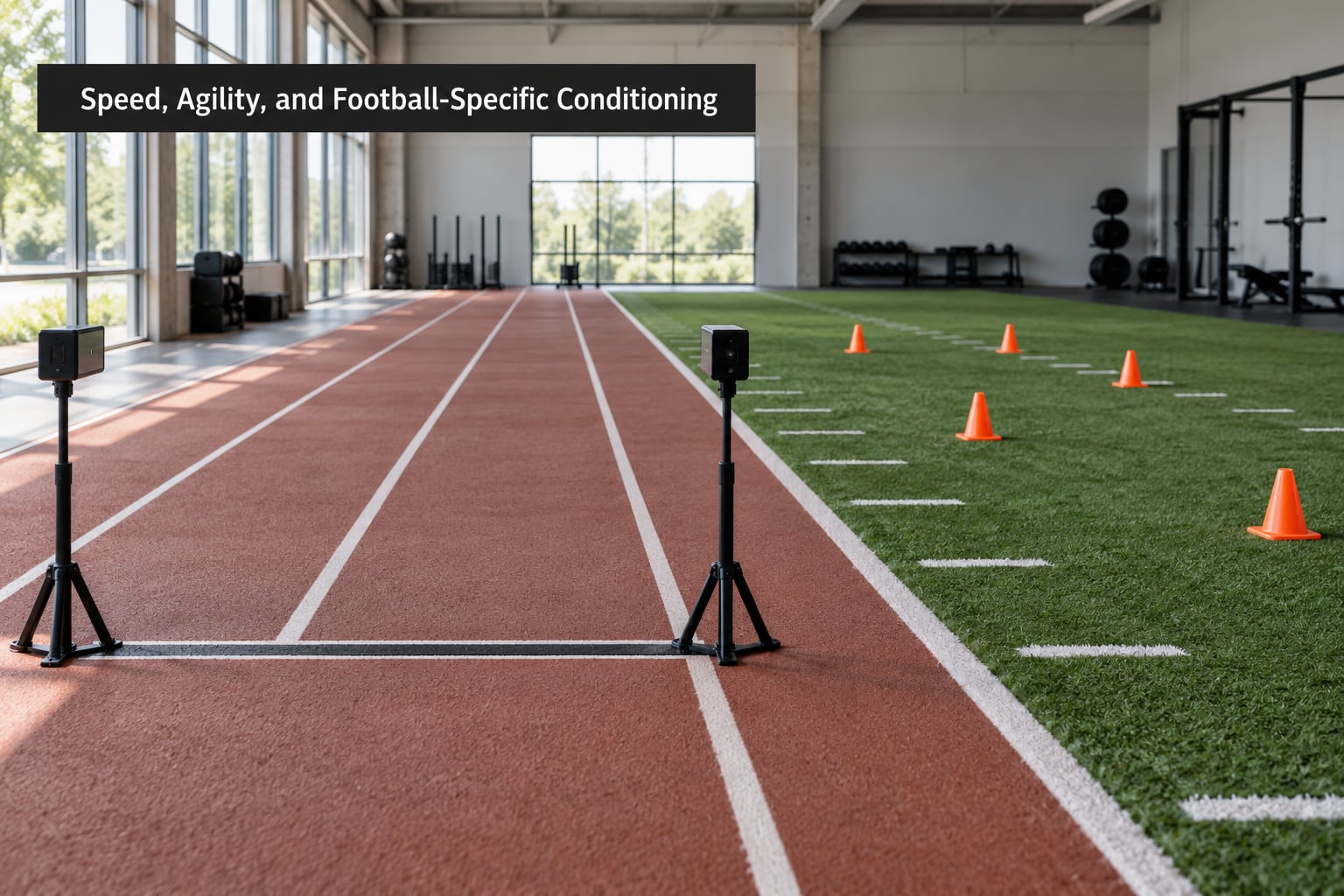
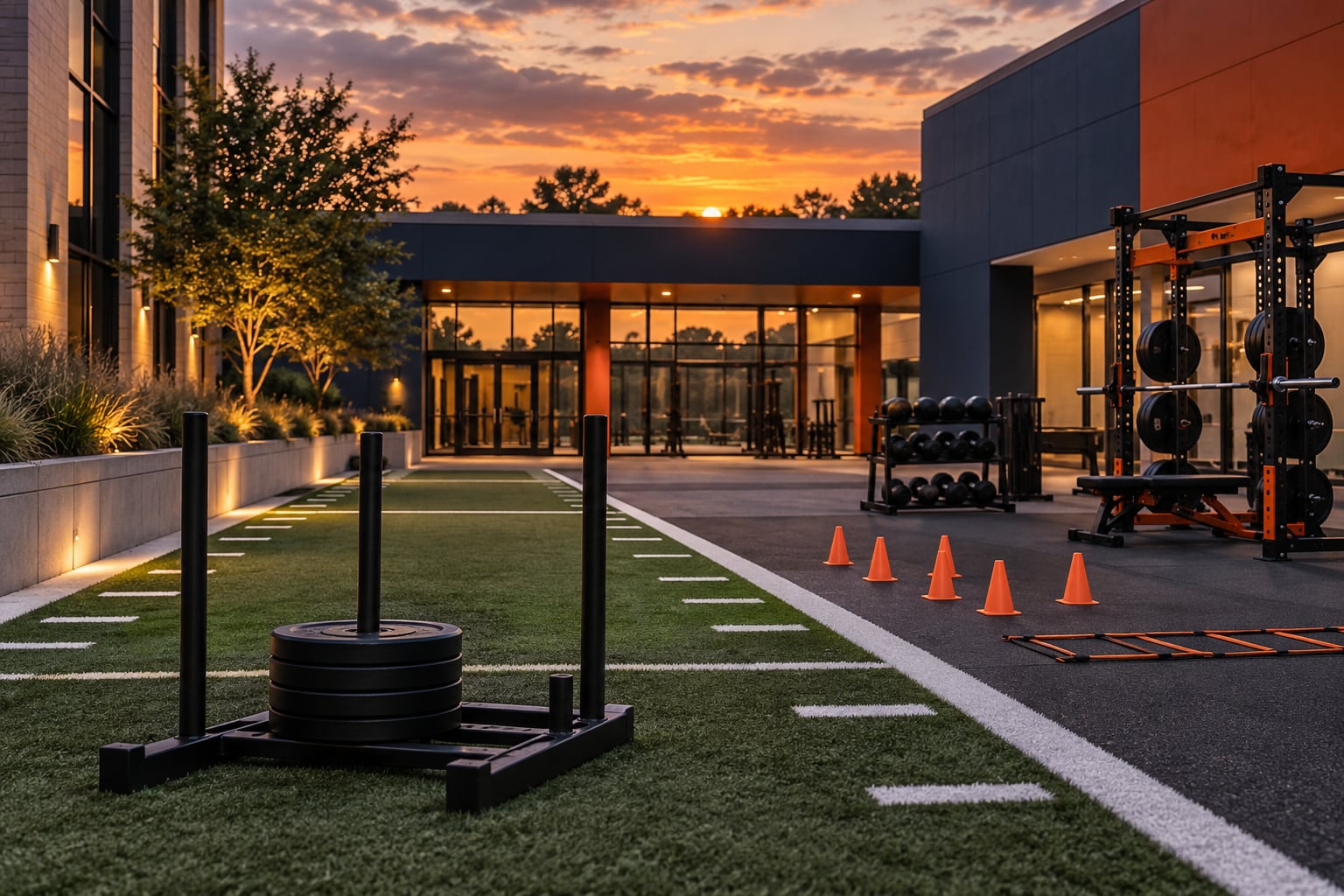
The work usually includes resisted sled pushes, plyometric jumps, broad jumps, lateral bound drills and short shuttle runs. Resisted sprinting gets heavier than most people expect, because the point is to force mechanics at a higher intent without slowing the athlete down too much to waste the rep.
Position groups get different conditioning. Linemen do more sled work, more collision-style contact drills and shorter maximal-effort sprints. Skill players get more repeated acceleration and agility work, because they change direction far more often. Defensive backs live in the shuttle and reactive-response world.
This is also where the old idea of football conditioning gets corrected. Most programs dropped long steady-state running long ago. The trending version is repeated short sprints with full recovery, and short metabolic intervals mixed with strength circuits. It looks far less like punishment than the movie version and hurts athletes considerably less.
Warmups, Recovery, and Athlete Monitoring
The unglamorous parts of the program are where most of the injury prevention lives. A session opens with a dynamic warmup that gets specific to what follows, mobility work where an athlete has a restriction, and activation before anything heavy.
Monitoring happens every day and looks like a short conversation: how is the hip feeling, how did yesterday’s session go, any pain worth reporting. Soreness scores, jump testing and sprint times feed into the strength staff’s plan for the following week. Fatigue is treated as data, not as a character test.
On the recovery side, programs coordinate sleep expectations, nutrition and eating windows around practice, hydration during hot-weather sessions, and access to athletic trainers. Massages and cold or contrast therapy are normal in-season tools. So is honest reporting, which usually means athletes are required to speak up about pain rather than hide it to protect a spot on the roster.
If you are an athlete dealing with a specific injury or a training program you are not sure about, talk to a qualified coach or a healthcare professional. Nothing in a general article should substitute for that.
How the Program Changes Across the Football Year
January through April is where the work gets heavy. Players arrive needing more muscle, and the calendar has the most free hours of the year. By June, strength work drops to maintenance doses while speed and conditioning volume climbs toward the first scrimmage.
August and September are the hardest conditioning stretch of the year, and that is deliberate. Preseason pads sessions build contact tolerance and general fitness for a season that requires both. In-season from October on, the weight room shrinks to maintenance work and the emphasis shifts to recovery. The days before a game are the lightest of the week on purpose, since soreness on Saturday is a program failure, not a badge.
Position-specific programming follows the same phase logic. A quarterback’s offseason work emphasizes lower-body force and shoulder health. A running back’s blends that with hypertrophy and collision tolerance. Offensive and defensive linemen get the largest mass gains and the heaviest sled volume. Linebackers split the difference between field coverage work and power production.
| Position group | Offseason emphasis | In-season priority |
|---|---|---|
| Quarterback | Lower-body force, single-leg stability, shoulder durability | Maintain force, throw volume, mobility |
| Running back | Mass gain, hinge strength, contact tolerance | Speed maintenance, hamstring care |
| Offensive / defensive line | Largest mass gains, heavy sled and squat volume | Maintain heavy patterns, joint care |
| Linebacker | Power production plus repeated acceleration | Field coverage work, recovery |
| Defensive back | Max velocity, agility, hamstring strength | Short sprints, reactive drills |
When programs publish numbers, they tend to be speed and mass figures rather than tonnage. Kansas reported after one offseason that its group averaged up from 19 to 20.23 mph in testing, with a deadlift gain of 11 pounds across the group, plus position-group numbers of 9 pounds for offensive linemen, 15 for running backs and 10 for safeties, and a six-inch improvement on the vertical. That is the kind of report that tells you something real about a program, and it is a good model for what to ask for.
What College Football Strength and Conditioning Does Not Look Like
It is not a maximum-strength contest. Sit in on a session and nobody is grinding a one-rep max while a spotter counts inches. Explosive intent at submaximal loads is the goal, because a bigger squat number does not add a yard after contact.
It is not one program for everybody. The same block of training looks different for a quarterback and a nose tackle, and a walk-on in January and a five-star arriving in June can be on opposite ends of the volume range for the same reason. Their bodies arrived in different places, not because anyone treats them differently on purpose.
It is not more fatigue every session. Sophomore weight rooms full of guys gasping on the floor were not a badge, they were a programming failure. Good programs build in rest, and the forum complaints about soreness showing up on Saturdays come from schedules that got rushed, not from lifting itself.
It also does not make injuries impossible. Strength work builds tolerance and prepares tissue for load, but nothing guarantees a player stays healthy, and programs that imply otherwise are selling something.
How to judge a strength program on a campus visit
Five questions get you a real answer faster than any tour. Ask whether the strength staff is separate from recruiting, since conflating the two is the single most common marketing move on a college tour. Ask how often the program re-tests speed rather than just the bench press. Ask what happens to a player’s training volume after an injury, and who owns that decision. Ask how many athletes the staff supervises per session, because a good program is small enough to coach. Ask what a player should have done in high school to arrive ready.
The honest answer is that any single college rarely wins this category outright. Staff turnover matters more than facility size, and continuity is the thing fans should care about most.
Frequently Asked Questions
How many times a week do Division I football players lift?
In-season, most Division I programs lift three times a week in short sessions of under an hour, split into training groups of fifteen to twenty-five athletes. In the offseason, when the calendar has more open hours, the number can rise to four or five days before camp and preseason practice begin. The count matters less than the phase: heavy build work early, maintenance work later.
How hard is football conditioning at the college level?
Hard, but structured. Most programs now use short repeated sprints with full recovery, plyometrics and strength circuits rather than long steady-state running. Preseason weeks with double practices and pads are the toughest stretch of the calendar, usually in July and August. Difficulty comes in waves tied to phases, and the hardest conditioning of the year happens well before anyone can vote on the schedule.
Do college football players lift weights during the season?
Yes, on a reduced schedule. In-season sessions are deliberately light on volume so athletes maintain force without carrying soreness into a Saturday game. The days immediately before a game are the lightest of the week, because arriving fatigued is treated as a programming error rather than proof of hard work.
What does a college football player do during the offseason?
Mostly lifting, sprinting and eating. The offseason build phase is the heaviest strength period of the year, focused on adding usable muscle and cleaning up movement patterns, with frequent acceleration and plyometric work alongside it. Onboarding happens first, including medical history review, injury screening and sometimes a call to a player’s previous coach. Academics and recovery still fill the calendar.
What strength and conditioning workouts are good for football?
The core patterns are squatting, hinging, horizontal pushing, pulling, trunk control and explosive lifting. In practice that means variations of the back squat, trap-bar deadlift, bench press, rows, power cleans and med-ball throws, plus sprinting and plyometrics. Programming for yourself is a different problem from describing a college room, and it deserves a qualified coach rather than a copy of a roster’s workout sheet.
What college has the best strength and conditioning program?
There is no consistent answer, and anyone who ranks them by facility tour is selling something. Judge a program on staff continuity, how much supervision athletes actually get, whether speed is tested and re-tested, and how injury return decisions are handled. The most useful number to ask for is usually sprint testing data rather than a bench press total.
Conclusion
So what college football strength and conditioning looks like comes down to four things: a phased calendar, explosive lifting instead of maximal lifting, speed trained and tested as its own discipline, and a rehab track that never stops running.
If you are evaluating a program, look first at the least photogenic part. Who supervises each athlete, what happens to a training week after an injury, whether speed gets re-tested, and whether the same strength coach is still there in year three. Those answers tell you more than any facility tour, and they are the ones programs rarely volunteer.