
A medical redshirt is what fans hear called an NCAA hardship waiver: a request that restores a year of eligibility to a student-athlete who lost most of a season to a documented injury or illness. Because the June 2026 approval of the five-for-five age-based model, most of these waivers are being phased out, so understanding how medical redshirts work means understanding both the long-running rule and the replacement now taking effect. Here is the whole picture, as of October 2026.
Everything fans read about redshirts on a roster is built from two separate ideas that get blended together constantly. One is the choice a school makes about how many games a healthy player appears in. The other is a formal request to restore eligibility after an injury. Only the second one involves paperwork, medical documentation and a decision from the NCAA.
How medical redshirts work is simpler than the noise around them suggests. Our breakdown covers what the designation actually does, who files the paperwork, what football and basketball rules differ on, what it costs financially, and how the five-for-five rule change alters the answer for athletes starting in the 2026-27 season.
Table of Contents
- What Is a Medical Redshirt?
- How Medical Redshirts Work Across NCAA Sports
- The Medical-Redshirt Approval Process Step by Step
- Step 1: The injury is documented and evaluated
- Step 2: The school determines whether a waiver is worth filing
- Step 3: The school submits the request to the conference
- Step 4: The conference files with the NCAA by the deadline
- Step 5: The NCAA waiver desk issues a decision
- Step 6: An appeal or legal action, if necessary
- How athletes and families know it worked
- What Medical Redshirt Rules Apply to Football Players?
- What Medical Redshirt Rules Apply to Basketball Players?
- Does a Medical Redshirt Cost a Scholarship or a Season?
- What Happens During the Athlete’s Medical-Redshirt Year?
- Medical Redshirt vs. Ordinary Redshirt: Key Differences
- Why Can a Medical Redshirt Request Be Denied?
- Frequently Asked Questions
- Can a medical redshirt be used more than once?
- Does a medical redshirt have to be decided before the athlete plays?
- Can a medical-redshirted athlete still practice and travel with the team?
- Does a medical redshirt always provide a scholarship?
- Can a college appeal a denied medical-redshirt request?
- What happens if an athlete is healthy before the medical redshirt year ends?
- What Medical-Redshirt Details Fans Should Verify
What Is a Medical Redshirt?
A medical redshirt is not an official NCAA term. The association calls it a hardship waiver, and the distinction matters because the phrase fans use casually covers several different things that operate under different rules.
The definition in one sentence: a medical redshirt restores a year of eligibility that an athlete lost because a season-ending injury or illness kept them from reaching the participation threshold in a given sport.
The official NCAA terminology
The NCAA document is a hardship waiver request. The school submits it, the conference passes it along, and the NCAA waiver desk rules on it. Fans say “medical redshirt,” reporters say “hardship waiver,” and a third common phrase, “fifth year,” describes what the athlete gets if the request is approved.
That last distinction trips people up. The fifth year is the outcome, not the process. An athlete can lose a year, have it restored, and still be described by the media as a “fifth-year senior.”
How it differs from an ordinary redshirt
An ordinary redshirt is a strategic choice. A freshman who never takes the field spends that year gaining weight, learning the playbook and working on technique, then plays four seasons with a built-in fifth year ahead of them. Under the rules that applied through the 2025-26 season, a redshirt freshman in football could take part in up to four games without using a year of eligibility.
A medical redshirt is a response to damage. Nobody sits out a season by choice and calls it a medical redshirt; the year is lost, and the waiver asks for it back. One forum poster described the arrangement plainly as the eligibility ladder of five years with a fifth for training and a possible sixth after a medical redshirt, sometimes nicknamed “workman’s comp.”
Grey shirting is a third thing again. A high school senior sits out a season before college enrollment. Parents on the boards confirmed in 2026 that it is still happening and that grey-shirting athletes are generally grandfathered in under the previous rules.
How Medical Redshirts Work Across NCAA Sports
How medical redshirts work comes down to five moving parts: the participation threshold, the documentation, the filing chain, the discretion of the NCAA review, and what the restored year does to the roster.
The participation threshold
To keep a year of eligibility, an athlete generally has to stay under a limit set as a share of the team’s schedule. The widely cited version is 30 percent of the team’s dates of competition, or three games, whichever is greater. Because the floor is three games, an athlete hurt in the first week of the season can sometimes miss most of a year and still qualify, which is why early-season injuries draw far more waivers than late ones.
The documentation
Someone has to establish that the injury or illness was real, serious and outside the athlete’s control. That typically means records from the treating physician or specialist, an imaging report, surgical notes where relevant, and a letter from the institution’s athletic training staff describing what participation was lost.
The filing chain
The athlete or the family does not file anything. The school files with the conference, and the conference submits the request to the NCAA. That two-step is the single most misunderstood piece of the process, and it is also why the timeline runs in months rather than days.
The review
A designated NCAA official reviews the file and issues a decision. The standard considers the athlete’s prior participation history and whether the condition was disabling rather than inconvenient. This is where discretion enters, and it is why two athletes with similar-sounding injuries can receive opposite answers.
The effect on the roster
An approved waiver adds a year back to the athlete’s eligibility clock. It does not reserve a starting job. The restored year is spent competing for a role again, often against players who just finished a full season of starts, and sometimes against returning starters who have not had an injury at all.
The Medical-Redshirt Approval Process Step by Step
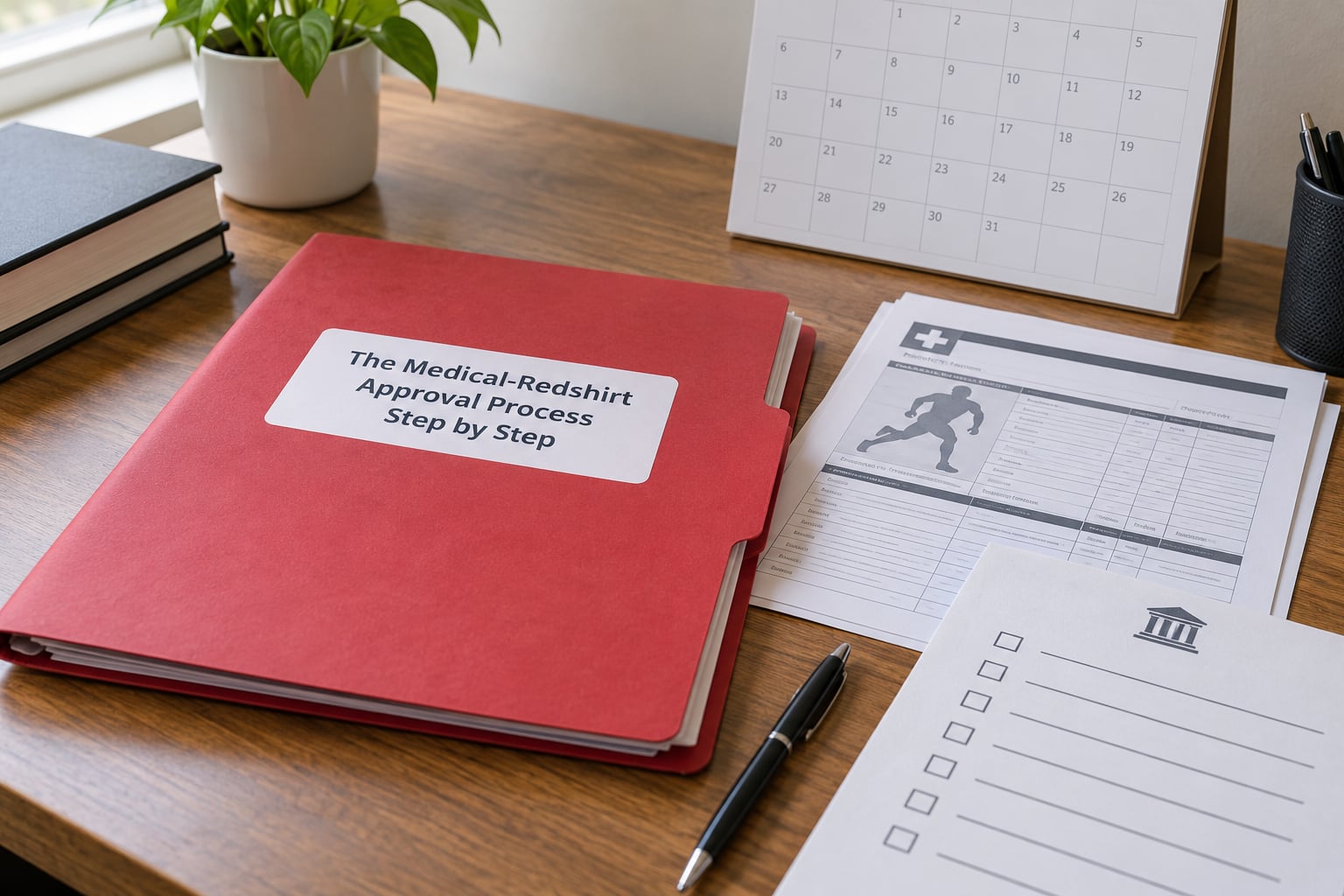
The sequence runs from diagnosis to decision in a fixed order, and the order matters more than most fans realize.
Step 1: The injury is documented and evaluated
Treatment begins with the athletic training staff, and the evaluation is written down as it happens. The closer the documentation sits to the date of the injury, the stronger the file. Records assembled years later carry far less weight, which is one reason retroactive filings struggle.
Step 2: The school determines whether a waiver is worth filing
Compliance staff at the school calculate participation against the governing threshold and decide whether the file is worth the effort. Programs with a strong compliance operation tend to move early; programs that react tend to be slower, and speed counts once deadlines are in play.
Step 3: The school submits the request to the conference
For NCAA Division I, the request goes to the conference first. The conference reviews it, attaches its own assessment and forwards it to the NCAA. Conferences have their own internal deadlines that fall earlier than the NCAA’s.
Step 4: The conference files with the NCAA by the deadline
Under the rules that ran through the 2025-26 season, waivers had to be submitted by schools and conferences by July 31. That date is the one number fans should remember, because a complete file filed one day late is an incomplete file.
Step 5: The NCAA waiver desk issues a decision
The NCAA reviews the medical documentation alongside the participation history and returns a ruling. Approval restores the year of eligibility. A denial usually comes with an explanation, though the reasoning behind individual decisions is not always published.
Step 6: An appeal or legal action, if necessary
A school can seek reconsideration through the association, and athletes have gone outside the NCAA entirely in some cases. Those routes are slow, expensive and rarely predictable, which is why programs treat a denial as the start of a negotiation rather than the end of a conversation.
How athletes and families know it worked
A public announcement from the athletic department is the usual signal, and it often follows a coach mentioning it on a radio show. Athletes in publicly reported cases learned the outcome the same way everyone else did, through a school statement. Until that statement appears, a “medical redshirt is on the table” phrase in a press conference means a waiver has not been filed, let alone granted.
What Medical Redshirt Rules Apply to Football Players?
Football ran the most generous redshirt framework in college sports through the 2025-26 season, and it is the sport where the old rules are most accurately remembered.
The four-game allowance and what it meant
Under the long-standing football rule, a healthy redshirt freshman could take part in up to four games in a season without burning a year of eligibility. The 2018 change made the framework far more permissive after a wave of midseason injuries, and later expansion removed the game cap for first-year players altogether. By the final seasons of the old model, a football redshirt meant not playing at all rather than playing a set number of snaps.
For medical waivers in football, the practical question is participation against the schedule. Because a Division I FBS team plays 12 regular-season games, the 30 percent share and the three-game floor produce a relatively forgiving threshold. That is why an offensive lineman who misses most of a season is a strong candidate for a waiver, while a quarterback who starts eight games is not.
What changes under five-for-five
The NCAA Division I Cabinet approved the five-for-five age-based eligibility model in June 2026, and the changes begin with the 2026-27 season and apply to 2026 high school graduates. Under it, athletes get five years of eligibility to use within a continuous five-year period, replacing four years spread across five years. The practice of redshirting no longer exists, and for the most part the NCAA will no longer grant medical or hardship waivers to preserve a year.
What remains is narrow: waivers tied to military service, religious mission and pregnancy.
Who keeps the old rules
Athletes who exhausted four years of eligibility in 2025-26 receive no additional eligibility. Athletes enrolled with eligibility remaining after 2025-26 can opt into five-for-five or stay under the previous rules, whichever benefits them. That grandfathering is why you will see veteran players in 2026 still pursuing waivers under a framework most incoming freshmen will never know.
Football-specific details shift with every NCAA and conference implementation decision, so verify any season-specific number against current NCAA guidance and your conference’s own rules before relying on it.
What Medical Redshirt Rules Apply to Basketball Players?
Basketball’s medical framework runs on the same basic mechanics as football but produces different answers, mainly because the schedule is about three times longer.
Physician certification sits at the center
A basketball medical hardship requires certification by a physician that the condition was disabling and prevented the athlete from participating for an extended period. The certification has to address participation specifically, not general health, because a player who missed a handful of games while healthy and recovering has not met the standard.
Permanent versus nonpermanent hardship
A permanent hardship ends the athlete’s career at that institution, and a nonpermanent hardship is one the athlete may overcome. The distinction shapes whether the player has any path back onto a roster, which is why coaches frame it as a career-ending declaration in serious cases.
Why the game math is harsher
Division I basketball teams play roughly 32 games, so the 30 percent share of dates of competition lands far higher than in football. The three-game floor still exists, but the percentage threshold does more of the work. Missing ten games out of thirty-two is a very different waiver file than missing three out of twelve.
The practical consequence shows up in the games that get left on the table. In a publicly reported case, a Kentucky point guard suffered a foot injury in December with a short initial recovery estimate, and the coverage noted that returning and playing that season would have damaged his chances for a waiver. Choosing health over a waiver is a real and recurring decision.
Scholarship counting is different too
Basketball programs operate under scholarship limits rather than the football roster framework, so a restored year affects both the eligibility clock and the aid count. That is a separate conversation from eligibility and one most families have to raise with the compliance office directly.
Does a Medical Redshirt Cost a Scholarship or a Season?
No, a medical redshirt does not cost a scholarship or a season. It restores the season. The money question is more complicated, and it is worth separating national rules from what an individual institution actually decides.
What the rules set and what the school controls
Tuition and fee payment rules are set at the national level, and they treat an eligible student-athlete who is not participating in intercollegiate athletics differently from one who is. Whether the institution makes that gap up, and how generously, is the school’s own decision.
| Question | Who decides | What fans should expect |
|---|---|---|
| Is the year of eligibility restored? | NCAA, on a granted waiver | Yes, the year comes back with the approval |
| Does tuition still get billed? | NCAA rules set the baseline | Aid rules treat a non-participating athlete separately |
| Does the scholarship or grant aid continue? | The institution | Varies by program and by aid-equivalency rules |
| Do benefits like tutoring, housing and meals continue? | The institution | Often yes, sometimes at a reduced level |
| Is a starting role guaranteed next season? | Nobody | No. The restored year is competed for like any other |
| Does the athlete compete in games this year? | NCAA participation rules | Only if participation stays within the threshold |
The aid-equivalency wrinkle
Scholarship counting in several sports runs on an equivalency system, where a partial scholarship can be worth a full one in budget terms. How that interacts with a non-participating year varies by sport and division, and it is exactly the sort of detail that turns a family call with compliance into a multi-week exercise.
The cost nobody lists
The real price is competition. A year restored on paper is a year of practices, film sessions, strength work and weight gains that the athlete’s competitors already had. A position player coming off a full season of snaps is a different prospect in the room than the same player arriving after rehab.
Is being redshirted good or bad? It depends entirely on the year. A cleared athlete who used the time well arrives stronger, more polished and, for the NFL draft, better prepared. A player who treated the restored year as a formality can lose a starting job to the underclassman who spent the same stretch logging reps.
What Happens During the Athlete’s Medical-Redshirt Year?
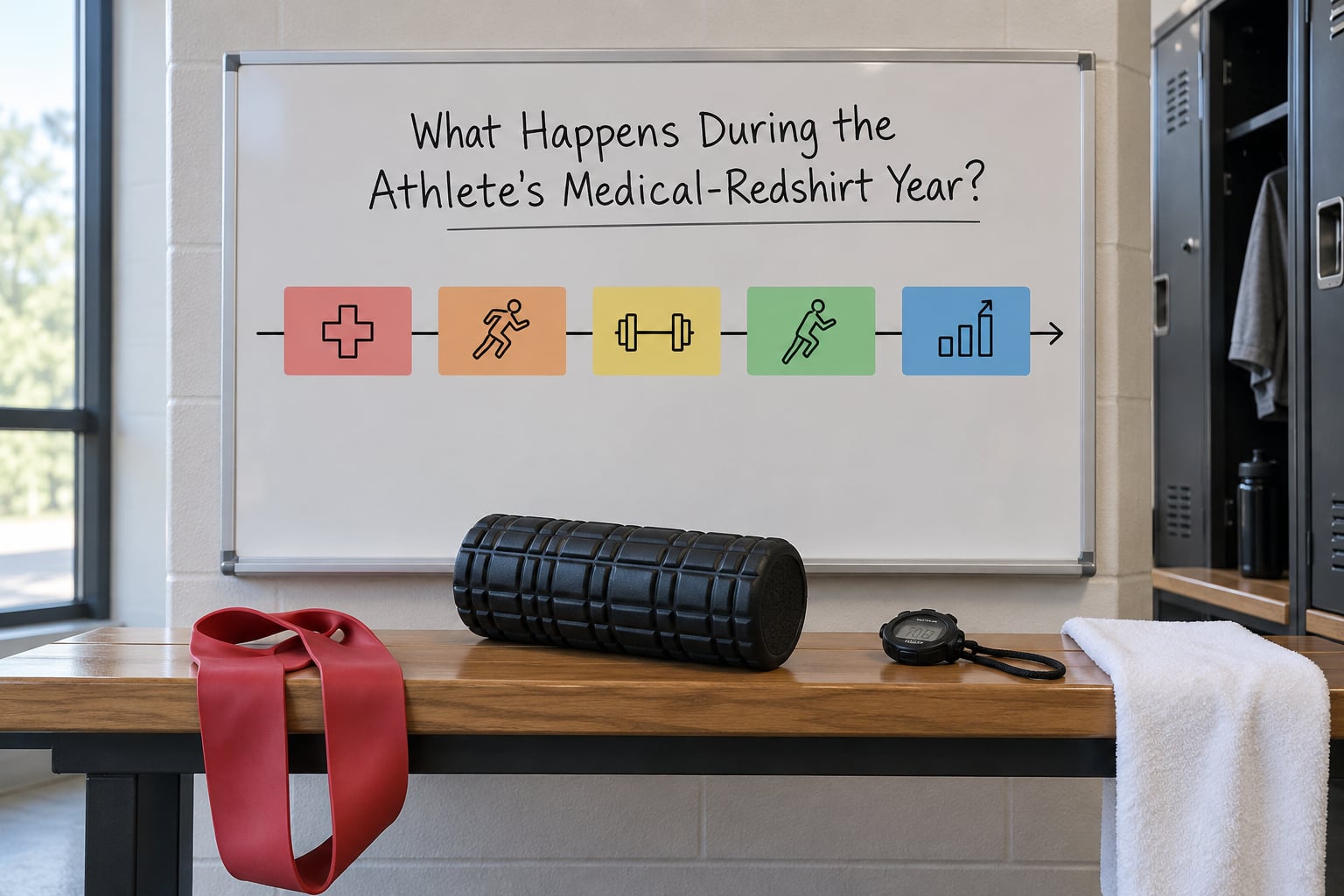
The restored year runs on two clocks at once: a rehab timeline that starts on the day of the injury and an eligibility calendar that already knows the athlete is playing.
The first months
Rebuilding from a season-ending injury is slow and measured in phases rather than weeks. The early work is about restoring range, strength and confidence in the injury itself, and everything after that is sport-specific work layered on top.
The middle months
Conditioning and position work resume in stages, usually alongside strength training built around the specific demands of the position. Academics continue in parallel, and since the athlete is still a full-time student, a course load that was manageable can become a serious problem during a rehab that runs long.
The competitive months
This is where most fans never look closely. The athlete is healthy enough to compete and now competing for a job that the roster filled last season. Coaches describe an open competition in which returning starters hold an edge until the new player proves otherwise, and that framing is repeated often enough to be a pattern rather than an accident.
| Activity during a restored year | Typical situation | What it depends on |
|---|---|---|
| Team practice | Usually permitted | Program policy and NCAA limits on non-participating athletes |
| Travel with the team | Often permitted | Program decision and scholarship status |
| Strength and conditioning | Usually permitted | Rehab stage and athletic training staff |
| Team dress and travel roster | Varies | Program practice and scholarship status |
| Games and competition | Restricted | Participation limits governing the waiver |
| Academic enrollment | Continues | Progress toward degree requirements |
The risk nobody mentions out loud
A player who enters the restored year healthy can still leave it without a starting role. Coaches describe the competition as open because an empty jersey looks like an opportunity to everyone at once, including athletes who never missed a game. The designation preserves eligibility; it does not preserve a job.
Medical Redshirt vs. Ordinary Redshirt: Key Differences
The distinction fans ask about most often is between the two, and a side-by-side comparison is clearer than any description.
| Factor | Ordinary redshirt | Medical redshirt |
|---|---|---|
| Reason | A strategic choice by the program | A season-ending injury or illness |
| Governing rule | Participation limits on first-year players | A hardship waiver filed and reviewed by the NCAA |
| Who approves | The coaching staff decides | The NCAA rules after the conference files |
| Evidence required | None | Medical documentation and participation history |
| Participation | Limited under old rules, then eliminated under five-for-five | Limited by participation thresholds |
| Effect on eligibility | The year is preserved by design | The lost year is restored on approval |
| Scholarship effect | Counts against the scholarship total in most sports | Depends on institutional aid and equivalency rules |
| Strategic purpose | Development and draft preparation | Recovery and a genuine second chance |
| Status in 2026 | Ended for athletes under five-for-five | Phased out for most athletes beginning 2026-27 |
A related confusion worth clearing up: a voluntary sit-out before entering the transfer portal is not a medical redshirt. One is a choice the athlete makes for roster reasons, the other is a request for restored eligibility after an injury. Fans routinely equate them because both involve a player not playing that season.
Why Can a Medical Redshirt Request Be Denied?
Denial is common enough that knowing the reasons is more useful than assuming approval. A request can fail on paperwork, on the threshold, or on the standard the condition has to meet.
Incomplete or late documentation
If the file lacks physician certification, imaging, surgical notes or a participation record, the request cannot be evaluated properly. Filing after the July 31 deadline is the same problem in time form, and athletes who discover late that they need a waiver often find no path under the current rules.
Participation above the threshold
An athlete who exceeded the percentage share of dates of competition, or who played more games than the floor allowed, has usually lost the year on the numbers alone regardless of how serious the injury was.
A condition that does not meet the standard
The standard is a disabling condition, not a difficult one. An illness or injury that a reviewer concludes was manageable through modified participation can fail even when it cost the athlete real games.
Late or retroactive filings
Retroactive requests get treated far more skeptically than contemporaneous ones. Forum users in 2026 noted denials of retroactive medical redshirt filings, including one case described as a player claiming illness and attempting to file after the fact.
Existing eligibility complications
Prior participation history, prior redshirt use and any transfer-related questions can complicate an otherwise straightforward file. Multi-sport athletes in particular face stacking questions, which is how a wrestling case became a well-known sixth-year scenario.
Discretion, and what athletes did next
Two publicly discussed cases show what happens after a denial. Reddit users reported that NC State offensive tackle Jai’Lun Hampton had his waiver denied and was ineligible to play, and Tennessee fans discussed Joey Aguilar pivoting to suing the NCAA in Knoxville after years of fighting over extra eligibility. A third thread asked why Trinidad Chambliss would receive a sixth year at all if the framework no longer provides one. Each of those cases turned on facts specific to the athlete, and none of them settles what will happen to anyone else.
Veteran posters on the boards offered the most practical read: the NCAA frequently grants waivers covering most of a lost year when the injury happens in the first week or two, and far less often when it happens late. Timing is doing more work in these decisions than the public discussion suggests.
Frequently Asked Questions
Can a medical redshirt be used more than once?
Under the rules that applied through the 2025-26 season, an athlete could theoretically request more than one hardship waiver, though each request was evaluated on its own facts and the participation threshold. Multi-sport and multi-year eligibility cases sometimes produced what looked like stacking, such as the wrestling sixth-year scenarios discussed publicly. Under the five-for-five model approved in June 2026, most medical waivers end beginning with the 2026-27 season, so repeat use is far less likely to arise.
Does a medical redshirt have to be decided before the athlete plays?
No. A school can file a waiver after a season has already concluded, which is exactly how retroactive requests work, and how injuries discovered late in a season get handled. The catch is evidence and timing: documentation assembled after the fact carries far less weight, and current-rule waivers had to be filed by schools and conferences by July 31. Practically, athletes learn the outcome when the school issues a statement.
Can a medical-redshirted athlete still practice and travel with the team?
Usually yes, though program policy and scholarship status decide the details. A medically redshirted player commonly practices, lifts and travels with the team while remaining limited in games. Dress and roster inclusion vary by program. The binding restriction is on competition, not on attendance, and schools with scholarship rules attached may treat a non-participating athlete differently for benefits and aid.
Does a medical redshirt always provide a scholarship?
No. The waiver restores a year of eligibility; it does not promise money. National rules treat tuition and fee payment differently for an eligible student-athlete who is not participating in intercollegiate athletics, and whether the institution covers that gap is a school decision. Scholarship counting also depends on the sport’s aid-equivalency system, so families should raise aid and benefits questions with compliance early, not after the waiver is granted.
Can a college appeal a denied medical-redshirt request?
Yes, a school can seek reconsideration through the association, and in some cases athletes have pursued action outside the NCAA entirely, as with the publicly reported lawsuit filed in Knoxville over extra eligibility. Both routes are slow and expensive, and neither has a predictable outcome. Programs usually treat a denial as the start of a conversation, resubmitting documentation or arguing the participation record rather than accepting the first answer.
What happens if an athlete is healthy before the medical redshirt year ends?
Nothing automatic. The designation restores eligibility; it does not obligate anyone to play. If an athlete returns to competition early and exceeds the participation threshold, the waiver request can be withdrawn or denied, and the school may be left reporting games already played. That risk is real enough that medical staff and compliance offices generally advise against a rushed return, which is why the coverage around a December injury with a short recovery estimate focused on the waiver implications.
What Medical-Redshirt Details Fans Should Verify
If you want the real story behind the phrase in a news headline, five checks get you there quickly.
Confirm the official designation
Find out whether the school actually filed anything. “A medical redshirt is on the table” is a coach’s phrase, not a decision. A school statement announcing a granted waiver is the confirmation you want.
Check which rule set governs the athlete
Players enrolled with eligibility remaining after 2025-26 can stay under the previous rules or opt into five-for-five, whichever benefits them. That choice determines whether a waiver even exists for them.
Verify participation status, not just eligibility
Eligibility restoration and game participation are separate questions. A player can hold a restored year and still be limited in games that season by the participation thresholds.
Ask how scholarship and aid were handled
Whether the institution covered the tuition difference, and whether benefits continued, is a school-level decision that varies by program. For families, this is the question worth asking first.
Check division and conference implementation
Division II, Division III, NAIA and junior community college rules are not identical to Division I’s, and each association issues its own guidance. Verify against your own league’s rules rather than a Division I summary.
The short version for 2026 fans: under the rules that ran through the 2025-26 season, how medical redshirts work means a school files a hardship waiver through the conference with the NCAA before the July 31 deadline, and an approval restores the year. From the 2026-27 season, the five-for-five model approved in June 2026 gives athletes five years inside a continuous five-year window, ends redshirting, and phases out most medical waivers while grandfathered athletes keep the old path. Check the specific athlete’s filing status and rule set before drawing any conclusion from a headline.