College coaches grade offensive linemen in a deliberate order. They look at technique first (first steps, pad level, hands), then anchor and recovery, then angles and strike timing, then power, and only then size, length and speed. Size is treated as a floor and a ceiling, not a decision.
Understanding that order explains a lot that confuses families. A 6-5 lineman with elite measurables who plays with a bent waist and no punch gets passed over, and a slightly smaller prospect who strikes on time and holds his anchor gets offered by a power offense. Recruiting is not a measurement contest, even though the public version of recruiting looks like one.
This guide walks through what college coaches look for in an offensive lineman, how film review actually works, where measurables fit, what differs at each position, and how a player can improve their own evaluation stock before a coach ever shows up.
Table of Contents
- What do college coaches look for in offensive linemen?
- How do coaches evaluate offensive linemen on film?
- How do recruiting coaches measure an offensive lineman’s athleticism?
- What technical traits do coaches value at each offensive line position?
- How do coaches evaluate blocking technique and power?
- How do coaches evaluate football IQ and assignment recognition?
- How do coaches evaluate an offensive lineman’s character and work ethic?
- What do coaches notice during a recruiting visit?
- How do combine numbers fit into a coach’s decision?
- How can players prepare for an offensive line evaluation?
- Frequently Asked Questions
- What do college coaches look for in an offensive lineman?
- What are red flags for college coaches recruiting linemen?
- How important is the 40-yard dash for offensive linemen?
- How tall should an offensive lineman be?
- Is technique or strength more important for an offensive lineman?
- How can a lineman get noticed by college football coaches?
- Conclusion
What do college coaches look for in offensive linemen?
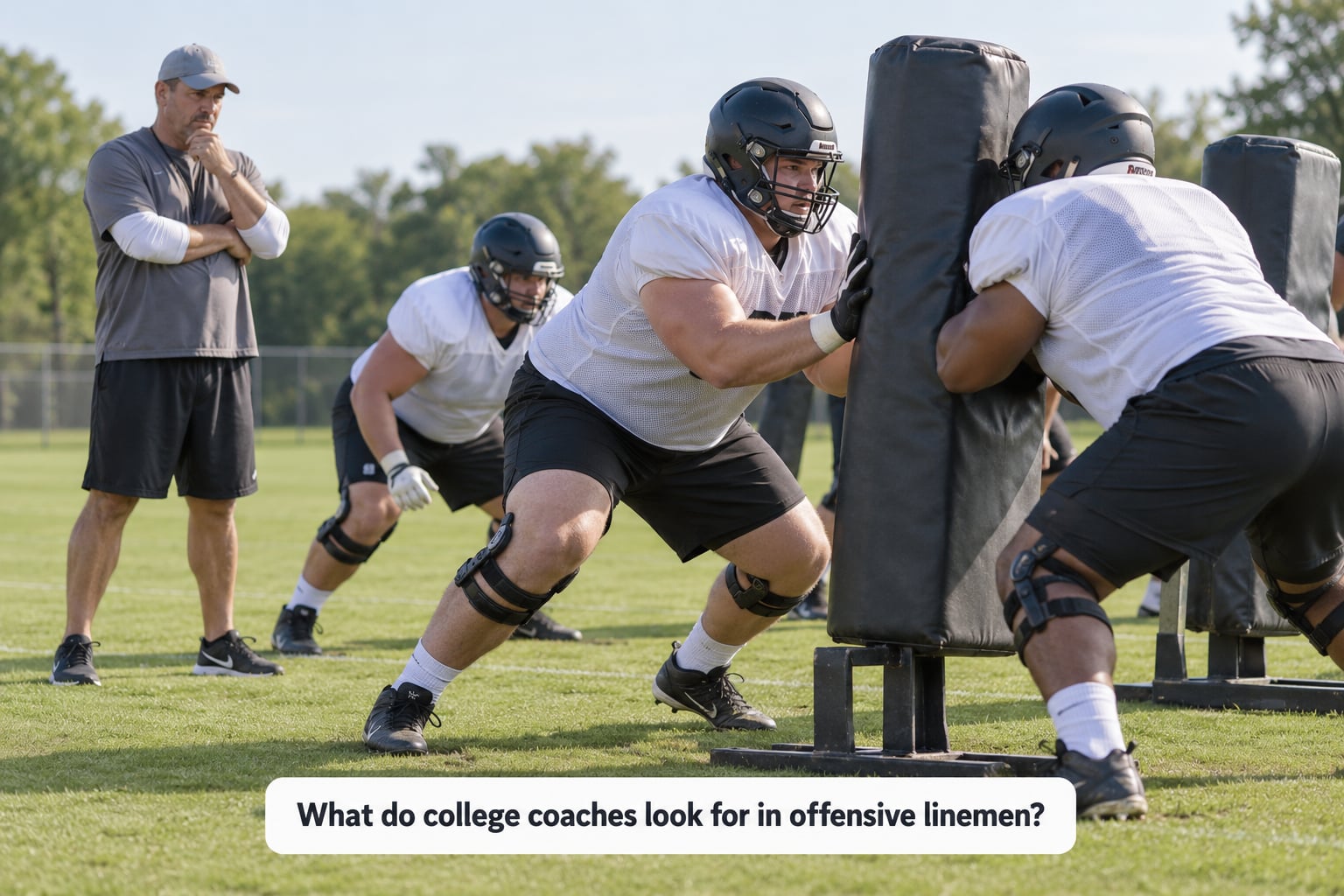
The short answer is a repeatable sequence of traits that show up on almost every down. Offensive lineman evaluation is not a search for one dominant trait; it is a search for a player who does the same handful of things correctly, rep after rep, without thinking about it.
Coaches work down the list in roughly this order, and the order itself matters more than any single item.
- Technique — how the player starts: stance, first step, strike, pad level, hand placement. This is the foundation and the item coaches spend the most time on.
- Anchor and recovery — what happens when the defender wins the first exchange. A player who holds his ground or re-repels the defender is coachable in a way that raw power is not.
- Angles and strike timing — whether the player gets his body between the defender and the ball carrier on time, rather than reaching or grabbing after the fact.
- Power and physicality — the ability to move a defender, sustain the block, and make a second effort at the second level.
- Size, length and speed — the floor and the ceiling. These open or close doors; they rarely decide the room.
- Football intelligence and character — communication, assignment recognition, work habits, and how the player responds when a coach corrects him in front of the group.
Long-tenured offensive line coaching has repeated the same priorities for decades: good position, hands and feet, sustain, range, recovery, and the willingness to be coached. That consistency is not an accident. It reflects the reality that line play is won in inches and by the most prepared player on a given rep.
Why technique outranks talent for line coaches
Talent degrades. A 6-5 prospect who lived on natural strength can be figured out by a defensive front that plays low and fast. The prospect who has spent years rebuilding his base, his first step and his strike can be slowed down by a great deal more than talent.
There is a practical test coaches apply: can this player be taught something new this week, and will he do it on Saturday? Offensive line rosters are small and the reps are precious. A player who needs a month of one-on-one work to correct one bad habit becomes a recruiting liability at the position, because there simply are not enough practice reps to fix everyone.
How do coaches evaluate offensive linemen on film?
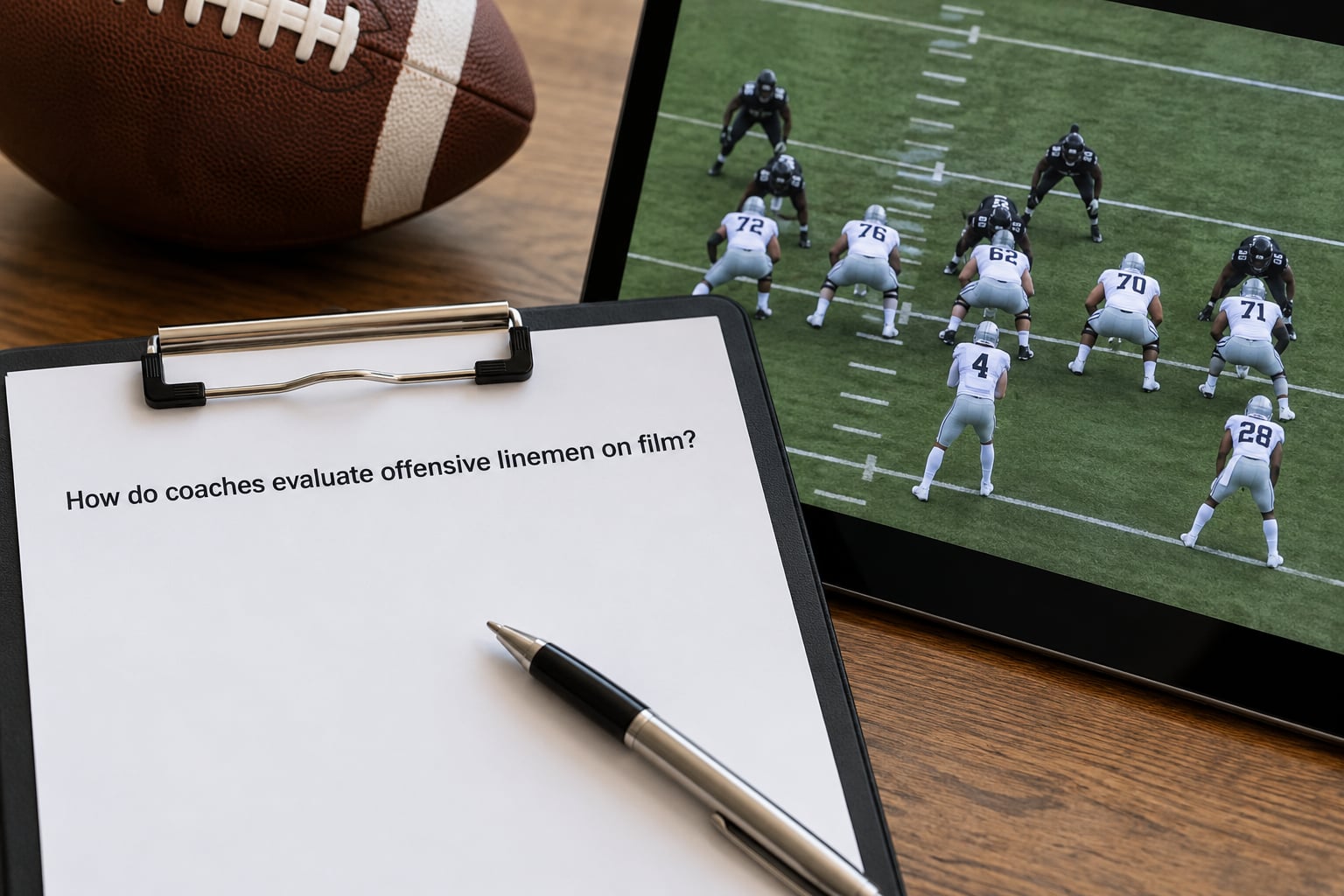
Film work is where most evaluations are actually decided. A coach will watch a full game before writing anything, because a lineman’s grade built on two or three isolated reps tells you almost nothing.
Here is the sequence most linemen graders use when they sit down with tape.
First they check the player’s role in the offense. Is this a down-block player in a gap scheme who never turns his shoulders? Is he a zone-blocking puller asked to travel? Judging a player outside the assignment his coach gave him is the single most common grading mistake, and it happens constantly with guards who are sent on backside blocks that any run blocking scheme produces.
Then they watch the first step. The initial movement tells a coach whether the player is technique-driven or reacting to the ball. A player who waits to see where the football goes has already lost the exchange, no matter how strong he is.
Next comes pad level and hand placement. Pad level means the head and hips end up in front of the defender’s chest rather than at his waist. Hand placement means hands land in the chest and inside pads, under-over, with elbows inside. When pad level drops, power disappears, which is why coaches watch it so closely.
Then the anchor. Anchoring is holding your position against a drive without being moved backward. Coaches count how long the player holds, whether his base stays wide, and whether his feet stay under his hips.
Then recovery. Recovery is the reset after losing a rep: get back to balance, get back under the defender, re-engage. A player who is beaten, turns around, and stands still has shown a coach more than the player who is beaten and re-repels. Forum coaches in the Scouting Academy line discussion have made this point repeatedly. Losing a block is normal. Not recovering from it is a grade.
Then second-level effort. Does the player look for work after the primary block is done? Successful second-level blocking is mostly timing, angles, play design and willingness, not raw acceleration. That is one of the easier things for a coach to see and one of the more revealing habits on tape.
Coaches take notes in a simple shorthand and grade consistently across the game rather than reacting to individual plays. They also watch practice film when they can get it. Practice tape shows habits without the pressure of a stadium, which is often where the honest version of a player appears.
How do recruiting coaches measure an offensive lineman’s athleticism?
Coaches measure athleticism as a supporting signal, not a score. The tests exist because they are cheap, standardized and comparable across thousands of recruits who will never step on that program’s campus.
- 40-yard dash — the most discussed and least decisive number on the line. It measures straight-line acceleration, which matters for pulling, screening and second-level work, but says nothing about technique.
- Vertical and broad jumps — often used as a rough proxy for lower-body explosiveness and hip drive, especially for interior players who need to explode off the ball.
- Strength tests — bench press and squat, usually to confirm that a prospect’s listed size is real and that the program is not signing a frame that cannot hold.
- Position drills — the one-on-one drill, the three-step drive, the mirror drill, and quick-punch sequences coaches use to see technique under resistance rather than in space.
- Arm length and frame — measured in the same session and factored into scheme fit, particularly for tackles protecting the edge.
Coaches read the results together, not as a single gate. A slower lineman who wins the one-on-one drill with correct technique is more interesting to a coaching staff than a faster lineman who cannot keep his pad level down. Athletic prospects who played on natural talent often show the most dramatic improvement once technique finally clicks, which is exactly the kind of curve coaches like to bet on.
Wrestling or grappling background is worth a sentence here because it shows up visibly. Athletes who have spent years controlling body weight shifts in a sport tend to read leverage intuitively and rarely have to be taught what an anchor feels like. Coaches notice.
What technical traits do coaches value at each offensive line position?
The same traits get weighted differently at every spot. An offensive tackle is graded on pass protection and edge-setting; a guard is graded on combination blocks and short-yardage power; a center is graded on communication and getting the quarterback what he needs under pressure.
| Position | Base technique | Primary responsibility | Heaviest evaluation weight |
|---|---|---|---|
| Left / right tackle | Vertical set, long stride, punch and recover | Edge protection, setting the edge in run fits | Pass sets, length, recovery after being beaten |
| Left / right guard | Bucket step, cut-off and combination work | Down blocks, pulling, combination blocks in traffic | Footwork in traffic, sustaining through contact |
| Center | Open stance or two-point stance, midline and reach | Exchange calls, protection calls, snapping under pressure | Communication, awareness, play-calling knowledge |
Scheme changes the weighting again. A gap-scheme team asks its linemen to identify a defender and attack him, so technique diagnosis and aggressiveness matter most. A zone-scheme team wants one-handed reach blocks, patience and the ability to track a moving defender across the line, so range and spatial awareness matter more.
Pass-protection sets add a separate layer. Kick sets demand a controlled one-step slide with the inside hand, jump sets demand patience and balance until the defender commits, and 45-degree sets force a decision in the first moment. A player who has only been taught one set will be graded as limited by a staff that plays another.
This is why the same lineman can be a top-50 prospect at one program and a depth chart prospect three states away. The traits travel. The grading scale does not.
How do coaches evaluate blocking technique and power?
Technical evaluation is about repeatable mechanics, and power is what those mechanics produce. Coaches separate the two on purpose, because a player with poor mechanics can have great power in a workout and a coach will still not trust it in a game.
Hand placement is where power comes from. Hands in the chest, thumbs up, elbows inside, knuckles down. Bad hand placement creates a grip fight instead of a drive, and the player ends up pulling an arm rather than moving a defender.
Pad level is the single most-watched item. It is developed with a low stance, a short first step and an attack angle that keeps the head below the defender’s shoulders. Coaches with wrestling backgrounds will tell you a player who cannot get his hips under his own center of gravity will lose the exchange to anyone who can.
Strike timing is the difference between a block that lands on the count and one that lands after the ball carrier is already past. It is trainable and coaches track it rep by rep because it does not show up in any measurable.
Balance decides whether a player can recover. If the feet go outside the body on the first step, or the head dips, the player is off balance before contact even finishes. Practitioners describe linemen with feet outside their body as needing habits rebuilt from the ground up rather than adjusted.
Drive and sustain separate good linemen from great ones after the initial block. Can the player keep the feet moving, hold the anchor through the second wave, and then pursue to the second level? Sustained blocks are the unglamorous evidence that separates a prospect from a highlight reel.
How do coaches evaluate football IQ and assignment recognition?
Line play is the noisiest, busiest communication environment on the field, and coaches judge how a lineman handles that pressure. Communication is one of the few lineman traits a coach can assess in a single conversation.
Coaches look for four things: whether the player can call a protection in the scheme the offense actually runs, whether he recognizes defensive looks and stunts before the snap, whether he adjusts when protection breaks down, and whether he diagnoses his own mistakes.
That last one is a mature skill. A lineman who watches his own film, notices he was late on a reach block against a specific look, and adjusts the next time is demonstrating exactly the learning pattern a coach wants. A lineman who repeats the same mistake across four games has answered the question.
Pre-snap communication is where this shows up most easily. Does the lineman repeat the call back correctly, does he check in with the quarterback, does he make an adjustment on his own when he sees a mismatch, or does he wait to be told? Guards and centers are graded harder on this than tackles because they have more traffic and more decisions per snap.
How do coaches evaluate an offensive lineman’s character and work ethic?
This part of an evaluation is less discussed publicly and matters at least as much, because a coaching staff is essentially hiring a person to spend three or four years in a difficult, unglamorous position.
It is judged through observable behavior rather than a conversation about character.
- Punctuality and practice habits — early arrival, staying late, whether the player is a regular in the voluntary work. Offensive line practices are where linemen separate.
- Response to correction — a player who fixes one thing between a session and the next is the single most reliable predictor a coach has.
- Accountability — does the player own his mistake, or does the team hear him blaming the scheme or the assignment?
- Competitiveness — how the player behaves in a drill when nobody is watching or when the scoreboard is visible.
- How they carry themselves — concussions and academics both come up in this conversation. A staff wants to know a recruit is managing the demands of the position and the classroom at the same time.
Coaches talk about coachability more than anything else outside the technical film. Talent they can teach around. Arrogance and low accountability they cannot, and the replacement cost of a bad roster culture is enormous.
What do coaches notice during a recruiting visit?
A recruiting day is an evaluation, and prospects who treat it as a social call lose the most valuable data they will get all cycle.
At camps and showcases, coaches watch warm-ups before the first drill. Stance depth, how the player moves into a stance, whether he stays locked in during long waits between periods. Then they watch the one-on-ones, where most grading happens because the one-on-one removes the scheme variable entirely and shows pure technique.
During school visits, the interaction with the high school coach carries surprising weight. Players who coach up, ask specific questions about the program, and treat the high school staff with respect get recommended. Players who argue with their own coach on a live visit are being reported on within hours.
Interviews cover academics, support structure, how many miles from home, and how the player handles a bad week. The questions are not filler. A lineman who is far from home in January is a different retention projection than one who can drive home, and coaches think about retention.
How do combine numbers fit into a coach’s decision?
Combine numbers do two jobs. They establish a floor, meaning the prospect has a frame the program can build around, and they establish a ceiling, meaning there is some athletic upside worth developing. Between those two lines sits technique, and that is where the offer is usually decided.
Listeds height and weight for a lineman typically run in recognizable bands: tackles in the 6-4 to 6-7 range, guards closer to 6-1 to 6-4, centers around 5-10 to 6-3, with weights climbing from the low 280s for tackles into the 300s and occasionally beyond for interior players. Programs at the top of the sport run larger, but those numbers describe the ceiling rather than the requirement.
Coaches treat a number as a flag for more scrutiny, not a conclusion. A 6-7 prospect who cannot reproduce his listed weight or who shows no athletic testing profile is a data problem to solve. A 6-2 prospect with a 4.9 and a strong vertical gets looked at longer, because the athletic profile suggests a faster learning curve even if the frame is modest.
What does not survive the process is a combine score with no film behind it. Recruiting services rank thousands of linemen on measurables alone, and a program’s position coach is the filter that decides how many of those names actually get watched.
How can players prepare for an offensive line evaluation?
The useful preparation is the same work that makes a player better, done deliberately enough that a coach can see it in a short window.
Build a self-scout file. Cut three full games and grade yourself. Note every rep where your pad level dropped, every time your feet went wide, every block you gave up early. Bring three specific questions to your position coach. Players who arrive with a written question get a different conversation from players who ask what they should work on.
Drill the fundamentals until they are boring. One-on-ones, three-step drives, mirror work, quick punch, and finishing to the second level. Coaches can spot a habit within a handful of reps, so the reps that matter are the ones where you are tired and still keep the strike inside.
Work on recovery as a drill, not a hope. Get beaten on purpose, reset your base, re-engage, and count the reps. Recovery is trainable and it is one of the first things a coach looks for.
Learn your assignments out loud. If your scheme has names for protection calls and checks, use them. Being able to explain a call is the cheapest way to look like a football player.
Get honest film feedback from someone who will not be nice to you. Coaches across the coaching forums make the same point. Over-analysis kills evaluation because if you look hard enough you will find something wrong on every play. Choose one or two priorities, get them corrected, and get back to playing.
Frequently Asked Questions
What do college coaches look for in an offensive lineman?
Coaches look for technique first, meaning first steps, pad level and hand placement, then anchor and recovery, then strike timing and angles, then power, then size and length. Football intelligence and coachability sit alongside the technical traits. A prospect who keeps his feet under his body and re-repels defenders is graded higher than one with bigger measurables and a bent waist.
What are red flags for college coaches recruiting linemen?
The most common red flags are a base with the feet outside the body, lunging at the defender, bending at the waist, striking late, no initial punch, giving up on a block when beaten, and not resetting after a rep. Coaches also watch for the same mistake repeated across four games, which reads as a player who does not study film.
How important is the 40-yard dash for offensive linemen?
It matters, but it is a differentiator rather than a gatekeeper. The 40 helps coaches project pulling, screening and second-level work, and an unusually fast lineman on an unusually good prospect earns extra film review. It cannot offset a bad base or late strike, because those traits decide actual snaps.
How tall should an offensive lineman be?
There is no single number, and coaches frame it as a floor rather than a target. Rough bands are 6-4 to 6-7 for tackles, 6-1 to 6-4 for guards and 5-10 to 6-3 for centers, with top programs running larger across the board. Inside those bands, movement quality and technique decide the grade.
Is technique or strength more important for an offensive lineman?
Technique, clearly. Strength produces power only when pad level and hand placement are correct, and offensive line rosters have too few practice reps to rebuild a bad foundation in a season. A smaller prospect who already plays with control and can be taught something new this week is the safer bet, and coaches draft toward that risk.
How can a lineman get noticed by college football coaches?
Show technique work, keep film clean, and build a relationship with the coach who runs your position. Coaches at camps watch one-on-ones closely, and they notice the player who stays locked in between periods rather than only the one who wins the drill. Staying current on your own measurables helps, but a corrected habit helps more.
Conclusion
College coaches evaluate offensive linemen in a fixed order. Technique comes first, then anchor and recovery, then angles and strike timing, then power, with size, length and speed acting as a floor and a ceiling rather than the deciding voice. Everything else, film habits, football intelligence and coachability, tells a staff whether the player can be developed.
If you take one thing from this guide, pick the weakest link in that order and fix it in isolation for a month. Cut three full games of your own film, count the reps where your pad level dropped or your feet went wide, and fix one pattern. Bring that question to your position coach and see what changes when a player arrives with evidence instead of a question.
Nobody on a college staff is grading your ceiling on the first visit. They are grading whether you got better this week, and whether the version of you they see in three years is the version they can build a program around.