College coaches evaluate high school quarterbacks as projections, not report cards. A staff watches full game film for decision-making and accuracy under pressure, checks verified combine measurables, interviews the player, then weighs the whole package against scheme fit and roster need before deciding whether the traits survive the jump to the next level. Nothing in that list is a highlight reel.
Families usually get this backwards. They optimize for the things a coach has already decided to discount, then wonder why a 4.8-second verified 40 did not move the needle. Here is the rubric, stage by stage.
Table of Contents
- What Do College Coaches Look for in a High School Quarterback?
- How Coaches Build the Initial Quarterback Evaluation
- How Film Reveals Quarterback Mechanics and Processing
- What Statistics Help Coaches Evaluate Quarterbacks?
- How Does the Recruiting Combine Change the Evaluation?
- How Coaches Account for Scheme and Opponent Quality
- How Do Coaches Compare a Quarterback’s Ceiling and Floor?
- What Do Coaches Ask During Recruiting Interviews?
- What Common Quarterback Prospect Mistakes Can Mislead Coaches?
- Frequently Asked Questions
- What do college coaches look for first in a high school quarterback?
- Are combine numbers more important than game film for quarterbacks?
- How do college coaches evaluate a quarterback’s decision-making?
- What throwing stats should a high school quarterback focus on?
- Can a quarterback recruit well without elite physical measurements?
- What to Fix First
What Do College Coaches Look for in a High School Quarterback?
The short answer is that coaches grade a quarterback against a list of traits, and every trait has a way of being measured and a way of being proven false. Roughly eight things get weighed, and they do not carry equal weight at every program.
- Decision-making. Whether the quarterback made the right read before the ball was snapped, not whether the pass was completed.
- Accuracy under pressure. Where the throw goes when a defender is closing, not on empty grass.
- Arm talent. Enough velocity and strength to make the throws the offense actually calls.
- Pocket presence and command. How the quarterback controls the huddle and the tempo of a drive.
- Mobility. Escapability and whether the quarterback is a real running threat or a liability on designed runs.
- Football intelligence. Retention, learning speed, and understanding of concepts rather than assignments.
- Character and competitive toughness. Response to mistakes, practice habits, and behavior around coaches.
- Competitive context. What the player was up against, which is where scheme fit lives.
Accuracy and decision-making carry more weight than raw arm strength at almost every level, and this trips up a lot of families. A Southern California quarterback coach put it plainly on the footballstrategy forum: velocity differences among top-level quarterbacks are not material because very few big deep balls are thrown in a game, and accuracy and footwork when the scheme breaks down are the real separators.
| Criterion | How a coach measures it | What disproves it |
|---|---|---|
| Decision-making | Full game film, every snap, including throws the coach abandons | Turnover rate in the same game situations the offense will face in college |
| Accuracy under pressure | Charted accuracy by field zone and down, compared against a live defense at a camp | Accuracy that disappears once defenders are faster than high school ones |
| Arm talent | Throwing velocity and distance on verified long throws at a combine | Low velocity paired with an offense that requires intermediate and short throws |
| Pocket presence | Footwork and platform on film, behavior when the protection breaks down | Freezes or drifts once a defender arrives unblocked |
| Mobility | 40-yard dash, pro agility shuttle, escapability on film | Speed that comes from a track background with no football agility |
| Football intelligence | Interview questions, concept calls at a camp, retention of a new install | Answers that repeat a highlight clip instead of explaining a concept |
| Character | Coach interview, high school coach calls, observation at a showcase | Entitlement in the room, or a dismissive answer about a mistake |
| Competitive context | Opponent quality, offensive scheme, supporting cast around the quarterback | Production that disappears when the supporting cast thins out |
How Coaches Build the Initial Quarterback Evaluation
A staff does not start on a combine. It starts with a screen that costs almost nothing: recruiting-service rank, the prospect’s high school, the opponent schedule, and a first cut of film. The question at this stage is only whether the quarterback is worth an hour of anybody’s time.
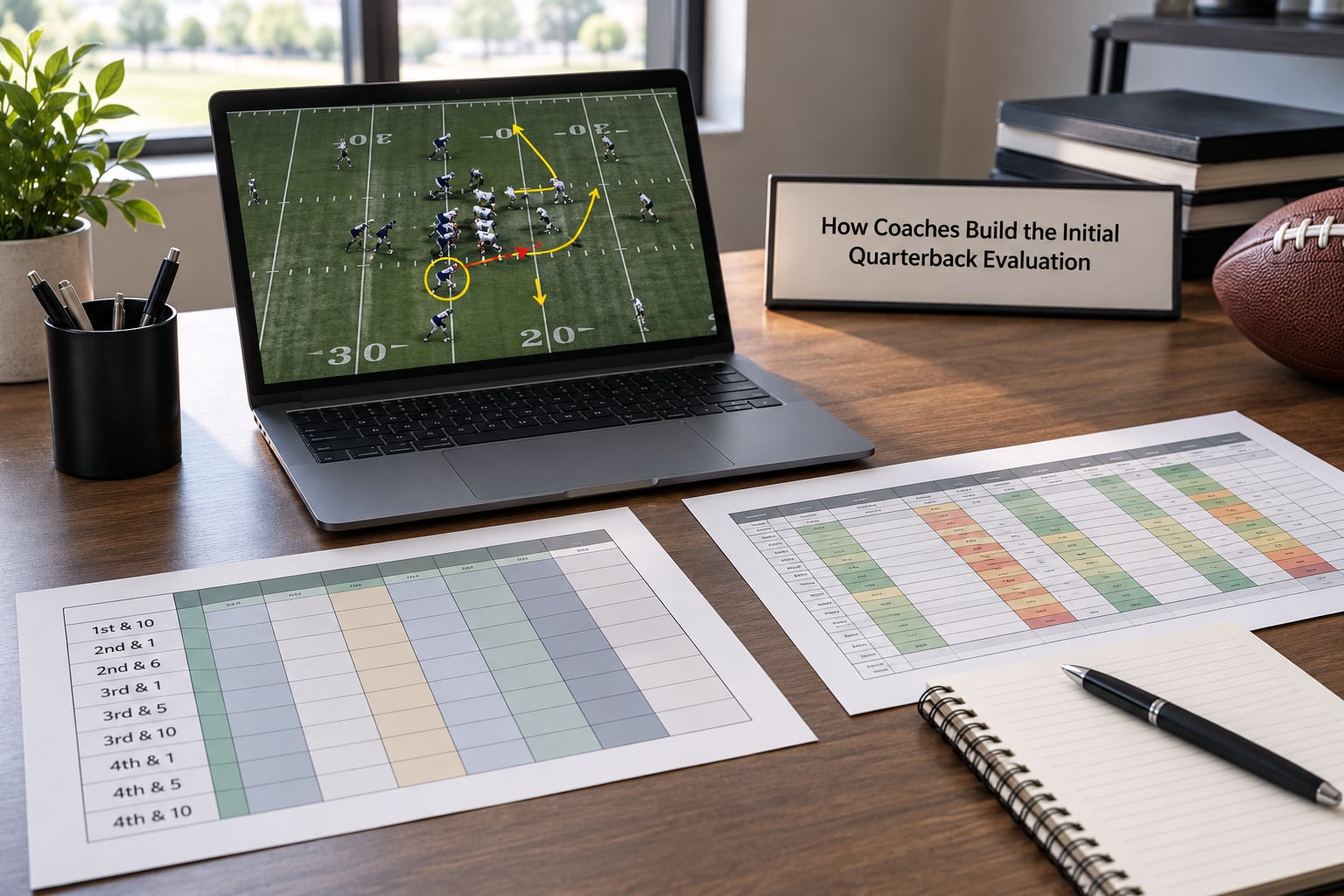
From there the process usually runs in this order:
- The initial screen. Rank, film volume, position depth chart at the target school, and whether the program is even recruiting a quarterback this cycle.
- The film cut. A coordinator pulls full games, not a reel, and grades mechanics, reads and accuracy.
- Measurables. A verified testing session, usually at a combine or a campus showcase.
- Live reps. A throwing session in front of coaches with a defense present, which is where the character read happens.
- The interview. Questions about preparation, mistakes, and how he learned the offense.
- The staff decision. Scheme fit, depth chart math, and whether the projection holds up against the roster they have.
Timing matters here, and it is the one part of the process that changes every year. The NCAA calendar opens junior year contact in the spring, runs through an evaluation period, and then a dead period when coaches cannot have contact with prospects at all. Dates shift annually, so anyone quoting a specific window should be checked against the current calendar before you plan a showcase trip around it.
How Film Reveals Quarterback Mechanics and Processing
Film is the highest-weight input, and the difference between a highlight reel and full game film is the difference between a sales document and an evaluation. A reel is cut to show completed throws. A full game is where a coach sees everything else.
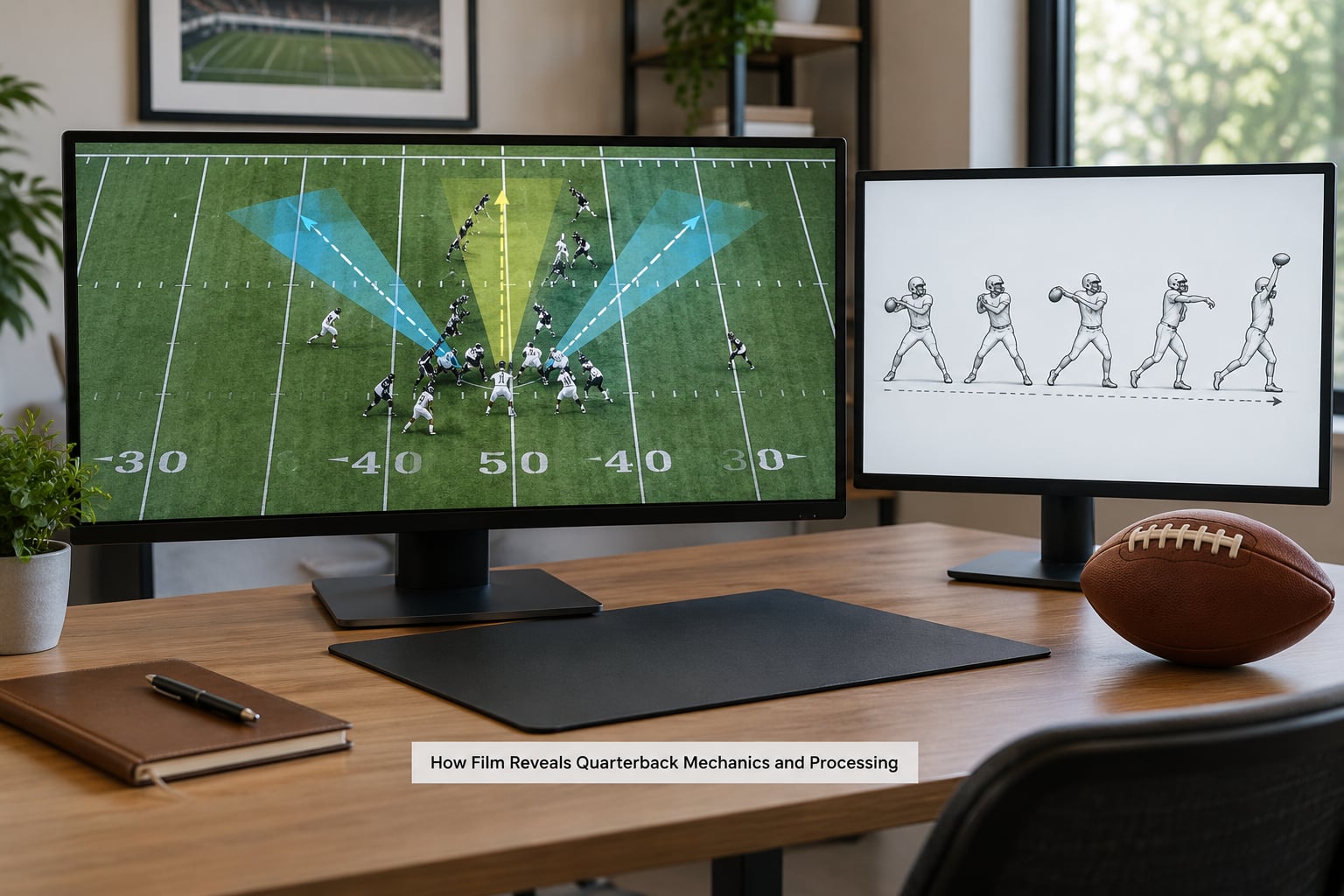
On a full-game cut, a coordinator is looking for specific things in this order:
- Footwork and platform. Does the base stay stable under pressure, and does the release point move as the pocket shrinks.
- Pocket awareness. Whether the quarterback feels pressure from the blind side and steps away from it, or stands flat and eats a hit.
- Timing. Throws that arrive on schedule with a receiver’s route, not throws that need a receiver to adjust to the ball.
- Progression reads. Whether the quarterback goes through receivers in order, or teleports downfield when the first read is covered.
- Pressure response. What happens on the roughly one in three dropbacks where nobody blocks the rusher.
- Turnover context. Interceptions that a coach can attribute to a bad read versus ones caused by a broken protection.
Coaches watch volume. One game is an anecdote, and a senior who played behind a weak line or a conservative coordinator tells you very little about his processing. Forum veterans on r/NFL_Draft and the CanesInSight recruiting board keep coming back to the same test, phrased as a question: is the game slow for them? A quarterback who sees the throw before it opens, at every level, is the ceiling projection every staff is hunting.
What a reel structurally cannot show is the other side of the ball. Effort without the football, body language after a mistake, and the way a quarterback responds when a play is called that does not fit the situation. Those are exactly the traits that get screens, so a reel that only contains successes can quietly make a prospect look like a different player.
What Statistics Help Coaches Evaluate Quarterbacks?
Statistics help a coach mostly by telling him what to look for on film, and help a player or a parent mostly by telling them what to brag about. That gap is the source of most miscommunication in this process.
Completion percentage is the most quoted number and one of the least informative in isolation. It is a volume statistic, so it rewards a quarterback who throws a lot of short passes to a reliable target. Contextual measures carry more signal: completion percentage by field zone, air yards per attempt, and the rate of throwaway attempts on third down. A coach reading a stat sheet wants to know how often the quarterback was forced into a bad throw, because that number predicts the interception rate he will see at the next level.
Rushing value is a real category, not a consolation prize. It depends entirely on the offense. In a spread or RPO system, a quarterback who can make a defender account for him changes the coverage on every pass. In a pro-style system, the running back carries most of that value, and quarterback rushing matters mainly as a pressure-release valve.
The one stat line a coach tends to trust more than a percentage is sacks taken and pressures absorbed, because it is a count of situations the quarterback did not control. A prospect who has never been hit in three years has not been evaluated under the condition that matters most.
How Does the Recruiting Combine Change the Evaluation?
A combine adds verified numbers and a controlled throwing environment. It confirms what film suggested about athleticism, and it does one thing film cannot do, which is put a repeatable measurement on record with a name attached to the stopwatch.
That verification detail matters more than most families realize. Hand-held stopwatches run roughly 0.2 to 0.4 seconds fast, and a coaching staff knows it. A hand-timed 40 is treated as an estimate. An electronic or laser-timed 40 is treated as data, and it is the only way the number carries weight.
The typical quarterback battery includes the 40-yard dash, the pro agility shuttle and 5-10-5, a vertical and broad jump, a functional movement screen, and a session of throwing where velocity is measured and accuracy is tested on a defined set of targets. What coaches read from it:
- 40-yard dash for open-field speed, with a large caveat that raw speed and football speed are not the same thing.
- Pro agility shuttle for change-of-direction ability, which correlates with escaping a pass rusher far better than a straight-line time.
- Throwing velocity as a floor check on whether the quarterback can make the throws the scheme requires.
- Accuracy reps against moving targets, usually the part of the session coaches weight most.
What a combine cannot establish is the part that actually decides the offer. It cannot show whether a quarterback sees a coverage rotation before the snap, or how he handles a mistake after the third interception, or whether his production holds up when the supporting cast is average. Those come from film, from the interview, and from watching a prospect operate inside a team setting for a full day.
One rule of thumb from the CanesInSight recruiting board is worth repeating because it explains why mobility shows up in combine scoring at all: a quarterback needs to be either a multisport athlete or a legitimate dual threat with major running ability. Multisport background matters to coaches partly as an endurance signal for a position that takes constant hits, and partly because it indicates competitive reps against a different kind of athlete.
How Coaches Account for Scheme and Opponent Quality
Quarterback evaluation is comparative, and the comparison is against the next level, not the last one. A staff has to answer one question: will this production repeat when the receivers are slower, the defensive front is faster, and the line does not dominate?
Scheme changes what the traits even mean. In a spread offense with run-pass options, the quarterback is asked to throw on the move, make reads in space, and decide quickly at the mesh point. In a pro-style system, the quarterback lives in the pocket, reads a longer progression, and takes a hit on every third-down conversion. The same athletic prospect reads completely differently to the two staffs, and neither staff is wrong.
That is also why opponents and supporting talent get discounted. A quarterback behind an elite offensive line with two future Division I receivers is running a different test than one throwing to a rotating cast of seniors. Coaches look for the quarterback who produced on plays that did not require help, then ask whether those plays exist in the college offense they run.
How Do Coaches Compare a Quarterback’s Ceiling and Floor?
Every staff is running two projections at once: how good this player can get, and how bad he can get when the novelty wears off. The floor is the part families underrate.
Ceiling questions come down to physical tools and learning response. Does the arm have room to grow, is the athlete still getting faster, and does the quarterback pick up a new concept in one practice or three? A staff that sees a fast learner with unfinished tools will take a risk on him, because the tools are the part a program can develop.
Floor questions come down to habits. Does he default to the same bad read under pressure? Does his accuracy hold when the pocket is messy? Does he disappear after a turnover, or respond? A quarterback whose floor is high is easier to coach and far less likely to become the reason a season falls apart.
The best way to test both at once is to watch how he handles defensive looks he has never seen. A spread-trained quarterback thrown into a simulated blitz may be at his best or his worst, and the answer tells a staff a great deal about the translation gap between high school and college football.
What Do Coaches Ask During Recruiting Interviews?
The interview is not a formality. Coaches on these boards describe it as the part where they find out whether a player is coachable, and they use questions the same way a test uses a wrong answer to reveal a wrong model.
- Walk me through a game where you lost. Looking for accountability and specificity, not blame for a teammate.
- What have you been taught this year that changed how you play? Evidence of coaching response rather than talent that arrived finished.
- What are you bad at? Almost every candidate claims self-awareness. The ones who can name a real flaw and describe the fix are the ones worth coaching.
- Describe your offensive concepts. Understanding of spread, run-pass option or protection schemes, in his own words.
- How do you handle a bad week? Practice habits and response to criticism, which is the closest thing to a preview of a college season.
- What questions do you have for us? Preparation and genuine interest, both of which show up in how the room feels afterward.
Families often ask what not to say. The useful version of that question is simpler: do not say anything you have not earned. Talking up a school you have not visited, guessing at a coach’s scheme, or implying an offer is coming tends to close doors quietly rather than loudly.
What Common Quarterback Prospect Mistakes Can Mislead Coaches?
Most evaluation mistakes run in the direction of overvaluing measurable, visible things. That is convenient for coaches, since it lets them sort a large pool quickly, and inconvenient for families who have no way to know which signals were discounted.
Judging a highlight reel. The reel is a curated document. It tells you the quarterback can complete passes, which was never in question.
Quoting season totals without context. Yards and touchdowns depend on volume of drives, offensive scheme and opponent quality. A parent presenting raw totals to a coach signals that they have not thought about the game.
Overvaluing combine numbers. A verified 40 gets a quarterback onto a watch list. It does not get him an offer, and recruiting services rank heavily on speed and size for reasons that have more to do with their model than with a coach’s judgment.
Ignoring mechanics under pressure. A quarterback can have textbook mechanics in a quiet pocket and lose all of them when a defender shows up. Coaches watch for exactly this, and it does not appear on a reel.
Assuming one scheme fits everyone. A prospect who has only been coached one way can be genuinely excellent and still be a poor fit for a specific staff. This is the translation gap, and it is why the same quarterback gets an offer from some programs and shrugs from others.
None of this makes the process unfair. It makes it a projection, and projections have error bars. Forum consensus on quarterback evaluation is blunt about this: the position is the least predictable in sports, and no single data point separates the good ones from the failures.
Frequently Asked Questions
What do college coaches look for first in a high school quarterback?
Decision-making on full game film, ahead of everything else. A coordinator wants to see how the quarterback reads a defense before the snap and what he does when a plan fails, because those habits repeat at every level. Arm talent gets measured second, and combine numbers come later still, once film has decided whether the prospect is worth the coaching attention.
Are combine numbers more important than game film for quarterbacks?
No. Film is the higher-weight input, and combine testing mostly confirms what film already suggested about athleticism. The numbers do one thing film cannot: they put a repeatable, verified measurement on record with a named timing system. A coaching staff treats a hand-timed 40 as an estimate and an electronic one as data, which is why verification matters more than the number itself.
How do college coaches evaluate a quarterback’s decision-making?
By watching every snap of full game film rather than a highlight cut, then sorting the throws into reads that were available, reads that were forced, and reads that were simply missed. Turnover context matters as much as the count, because an interception caused by a broken protection says something different about a quarterback than one caused by a bad read. The same drop looks different on third down in a low-scoring game than on a routine first down.
What throwing stats should a high school quarterback focus on?
Contextual accuracy rather than completion percentage alone. Completion percentage rewards volume of short throws, so chart accuracy by field zone, air yards per attempt, and the rate of throwaway attempts on third down. Sacks taken and pressures absorbed are also worth tracking, since a quarterback who has never been hit has not been evaluated under the condition that matters most in college football.
Can a quarterback recruit well without elite physical measurements?
Yes, and it happens more often than the recruiting services suggest. A pro-style offense puts most of its value on accuracy, timing and command of the offense, so a quarterback without elite speed can be a strong fit and a weak fit elsewhere. The filter that does survive is mobility of some kind, either real dual-threat running ability or multisport background, because a quarterback who cannot extend a play limits the offense’s options.
What to Fix First
If you are a quarterback or a parent trying to move this evaluation, start with the two things a coach can verify on film and that you control in practice: accuracy when the pocket is messy, and how fast you make a pre-snap call. Those two show up in a full game cut, they hold up against a faster defense, and they are worth more to a coaching staff than any verified time on a stopwatch.