An unofficial visit is a trip to a college campus that your family pays for, arranged so you can meet the coaches, see the facilities and watch the team practice. It happens during that sport’s open recruiting contact window, and it differs from an official visit in exactly one way: who picks up the bill.
That single distinction drives everything else, including how unofficial visits work in recruiting. Coaches treat a recruit who flies in on their own dime very differently from a prospect on a school-funded itinerary, and the NCAA rules read differently the moment an institution pays for anything.
Quick answer: an unofficial visit has no NCAA cap, can begin as early as your class’s contact rules allow, and is arranged almost entirely by you. The school may hand you complimentary tickets to up to three home athletic events, but if the institution covers travel, lodging or meals, the trip is reclassified as an official visit. Confirm current limits at NCAA.org, because visit rules have been rewritten more than once in recent years.
Table of Contents
- What Is an Unofficial Recruiting Visit?
- Who Pays for an Unofficial Visit?
- How Unofficial Visits Work in Recruiting: From Contact to Evaluation
- What Can College Coaches Do During an Unofficial Visit?
- What Is Not Allowed During an Unofficial Visit?
- How to Compare Schools After an Unofficial Visit
- What Happens After an Unofficial Visit?
- Frequently Asked Questions
- Conclusion
What Is an Unofficial Recruiting Visit?
An unofficial recruiting visit is a campus trip the recruit and their family pay for themselves, during which they may tour facilities, watch practice, meet the coaching staff and see campus life, subject to the recruiting calendar for that sport.
The word unofficial is doing real work. It signals that no institution money is involved, that the visit is not one of the limited official recruiting visits a prospect may receive, and that no offer can be handed over in person while you are there.
A recruit-initiated trip, where you email a coach and set the date yourself, is an unofficial visit. A trip the program schedules and hosts is usually an official visit. And a walk onto campus with no appointment at all is a campus tour, not a recruiting visit, though a coach who takes time with you there treats it much the same way.
Who Pays for an Unofficial Visit?
Your family pays. That is the whole rule, and it is enforced with a conversion trigger: if the institution pays any part of your trip, even indirectly, the visit is treated as an official one.
Plenty of families assume a coach can reimburse gas or buy lunch. That assumption is the single most expensive mistake out there, because a paid meal, a covered hotel room or a reimbursed flight turns the whole trip into an official visit with all the limits and paperwork that come with it.
What a school can usually still hand over:
- Complimentary admissions to up to three home athletic events, which is commonly the only thing provided.
- A scheduled meeting with the coaching staff during a permitted contact window.
- A normal campus tour conducted by the admissions office, on the same terms any visitor gets.
- Printed recruiting materials, since coaches hand these out to visiting families anyway.
What your family covers: airfare or fuel, lodging, meals, rental car, game tickets beyond the three allowed, and any travel for relatives who tag along.
Cost is the reason families stagger visits geographically. Rather than three separate trips, many families plan one driving loop that hits several schools inside a single weekend, and treat nearby campuses as the realistic budget option. Athletes on r/CFB describe out-of-state trips paid entirely by the family as one of the clearest seriousness signals a coach can receive.
How Unofficial Visits Work in Recruiting: From Contact to Evaluation
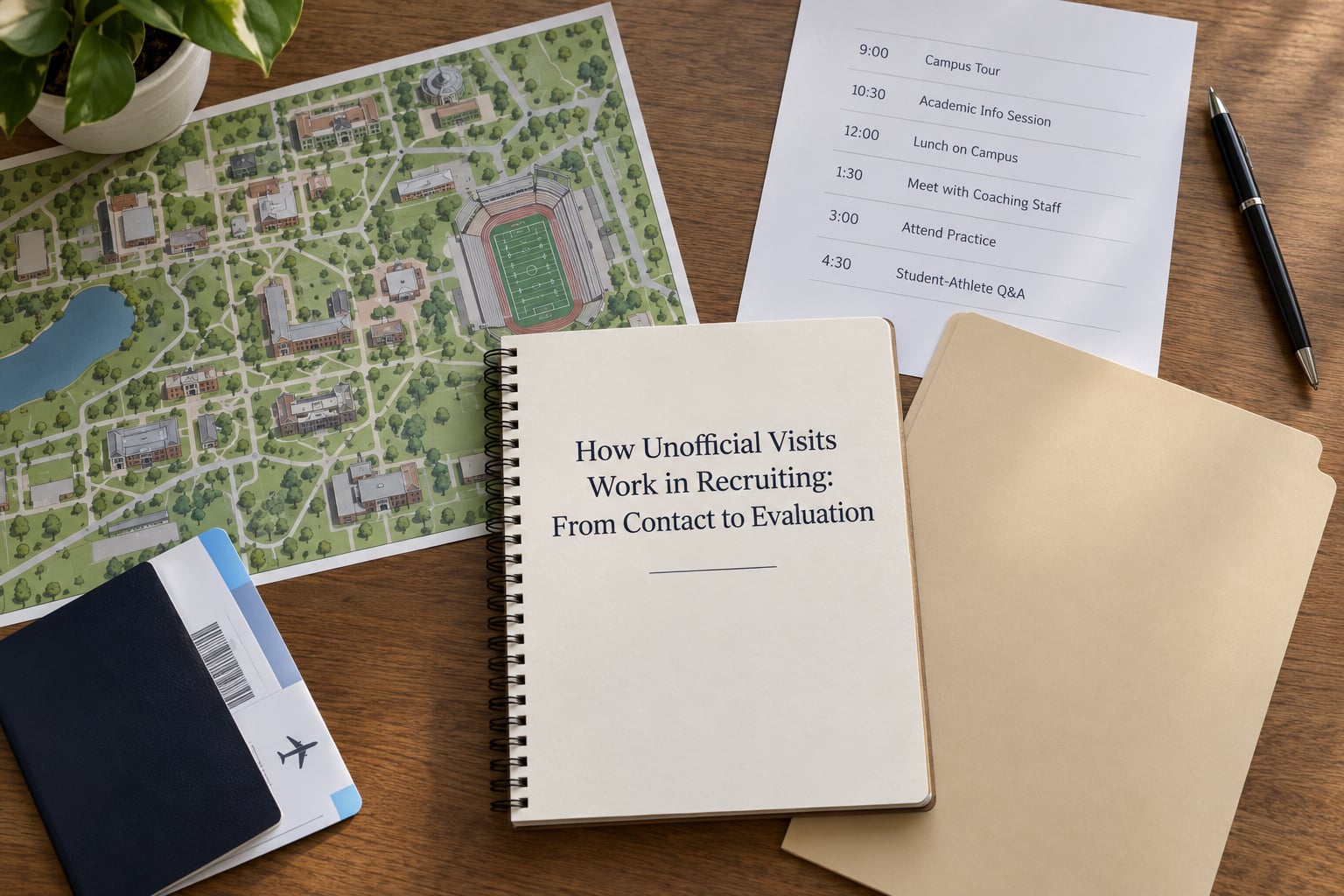
Step 1: Ask the coach, do not assume you are invited
Email or text the coach directly, reference a specific conversation you have already had, and propose two dates. Families on baseball recruiting boards describe this as ordinary: the recruit arranges the visit, prints a transcript and athletic resume, and brings them to the meeting.
Step 2: Check the recruiting calendar for your sport
Before you book anything, confirm the visit sits inside a contact period. During a dead period, college coaches may not have in-person contact with you at all, and a well-intentioned visit can force a coach into a rules problem they did not create.
Step 3: Let the program build the day if they offer to
Some coaches will construct a full day around your visit, practice viewing included. Parents on recruiting forums note that coaches frequently want to meet the entire family, which is normal behavior rather than a pressure tactic.
Step 4: Ask the questions you actually care about
Coaching staff know you are evaluating them, and a good coach will answer directly. Ask where you fit in the depth chart, what the staff does when a player is buried, and how the program handles multi-year scholarships and roster attrition.
Step 5: Write everything down within 48 hours
Details blur fast. The scoreboard style answer you liked, the assistant coach who explained the strength program, the number of seniors on the roster, all of it goes into a note the same night while it is still accurate.
A worked example: a junior football recruit emails a mid-major head coach after a Friday practice in June, the only window when college coaches may have contact with high school players. The coach replies with a Saturday morning meeting and an invitation to watch the afternoon practice. The family drives over the night before, pays for two rooms, and eats breakfast before arriving. Nothing is reimbursed. Two weeks later the recruit sends a short follow-up email referencing one specific thing the coach said about the offensive line rotation, and that email is what turns the visit into an ongoing conversation.
What Can College Coaches Do During an Unofficial Visit?
A coach may evaluate you in person, and a good visit is the only place where that happens face to face. Academics, athletic skill, character, work ethic and how you carry yourself around a staff all count, because coaches are watching how you handle an unstructured day rather than a game.
Coaches can also instruct during a permitted practice viewing. They can explain schemes, walk you through a position and let you watch a full practice, and they can bring you into meetings or a facility tour. Some programs run a team meal, which is standard activity rather than a recruiting perk.
What a coach generally cannot do is extend an offer in person. Verbal scholarship offers and other agreements are handled through official channels, and the coach who offers on the spot is generally doing it in conversation rather than as a binding commitment. Coaches also cannot promise playing time, a starting job or scholarship renewal, because none of those are theirs to promise alone.
What an unofficial visit invitation actually signals
It is a courtesy plus a read, not a commitment. A coach inviting you is usually telling you they want to see whether you are serious, and that the visit would help them decide where you sit on the recruiting board. Recruits report the confusion here: a warm invitation is easy to read as an offer, and it is not one.
What Is Not Allowed During an Unofficial Visit?
The rules are narrower than most families expect, and the penalties sit on the program’s compliance office, not on you. Four situations cause real trouble.
- Institution-paid anything. A staff member paying a meal tab, covering a hotel or buying a ride home converts the trip into an official visit. Even small tab errors have been treated as violations.
- Boosters buying perks. An alum or donor treating the family to dinner, or providing tickets, creates a reporting obligation the moment staff learns about it.
- Any agreement on the spot. No offer, no roster spot, no scholarship promise while you are standing in the office.
- Steering. Anyone affiliated with the school pressuring you toward a choice, rather than presenting what the program offers and letting you decide.
Division III programs generally do not fund official recruiting visits at all, so their unofficial visits look quite different. NAIA programs run their own framework through NAIA.org, and the contact calendar differs by sport and by division, so the same trip can be fine for one recruit and impossible for another.
Rules on unofficial visits get rewritten, sometimes mid-cycle. Verify current limits directly at NCAA.org or NAIA.org before you spend money, and ask the compliance officer what your program’s specific interpretation is. That conversation costs nothing and it protects your recruiting relationship.
How to Compare Schools After an Unofficial Visit
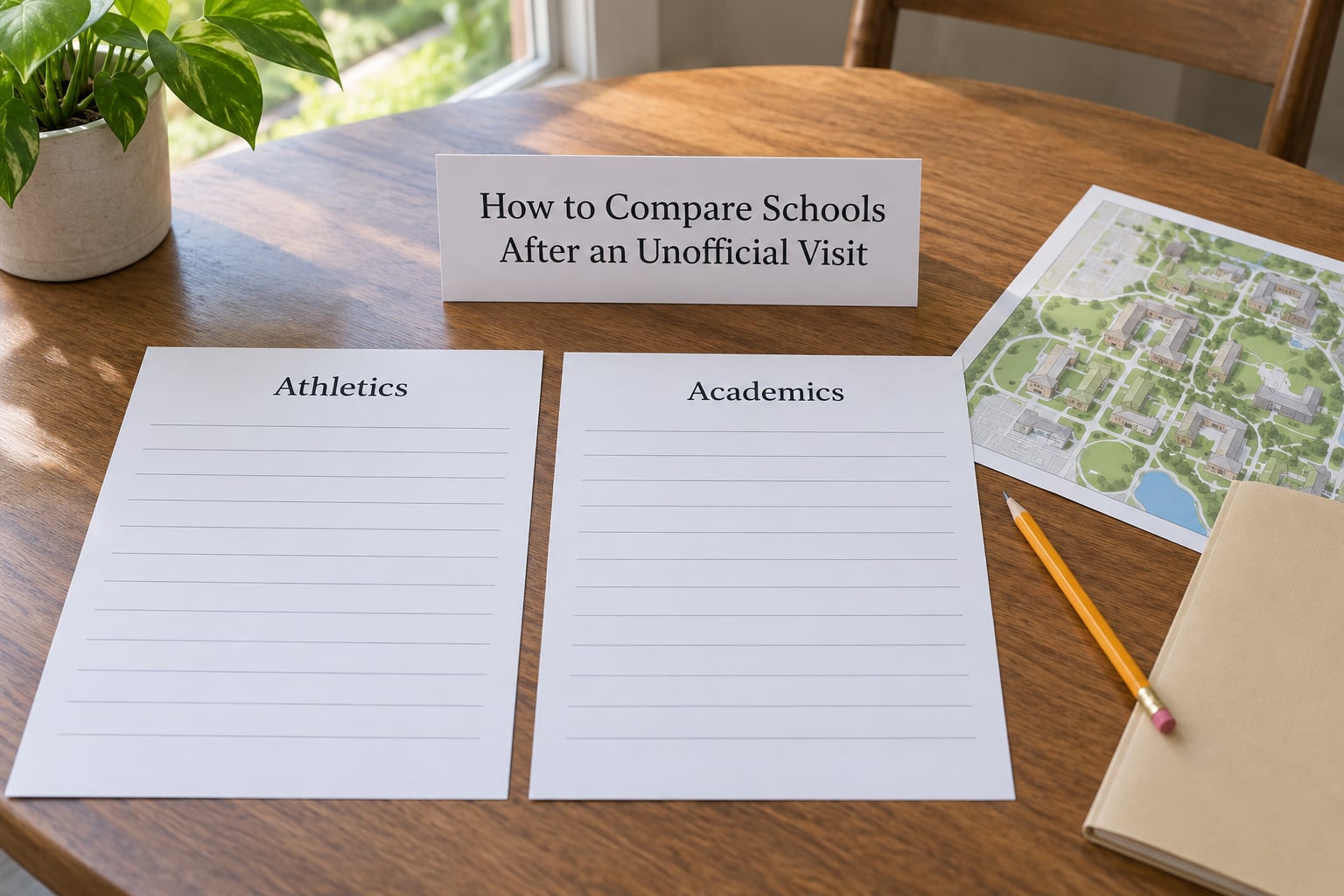
One visit produces a lot of impressions and almost no structure. Give yourself a framework and the differences separate cleanly. Score each school out of ten the night you get home, while the details are still sharp.
- Coaching. Does the head coach explain what they are building, or only describe the last season? Check staff stability and how much the recent graduate transfer rate says about playing time.
- Academics. What is the graduation rate for athletes in your sport, and who is your academic advisor? Ask who actually monitors your progress.
- Culture. How do current players talk about the staff when the staff is not in the room? Talk to at least one athlete who is not a star.
- Facilities. Weight room, practice space, medical support and recovery, since a program that cuts corners there usually cuts them everywhere.
- Cost. Total family outlay per visit, plus the aid package. Unofficial visits are never reimbursable, so build the budget honestly.
- Roster need. How many seniors are leaving your position, and how many underclassmen are already committed there? The answer predicts your minutes better than any coach’s promise.
- Trajectory. Conference membership, facility plans, and whether the program is building or maintaining.
Take the same notes on every trip, in the same order. Comparing five schools from memory is how families end up impressed by the most confident voice rather than the best fit.
What Happens After an Unofficial Visit?
Most trips end quietly, which is why the follow-up matters more than people expect. A short email within a day or two, referencing something specific the coach said, does more for a recruiting board than another month of highlight reels.
The typical sequence runs like this. The coach updates his internal ranking based on what he saw, and that movement is invisible to you unless you ask about it. Some programs follow up with a campus visit invitation or a chance to attend a game. Others move to scholarship discussions, which happen through official channels rather than in a parking lot afterward.
Be honest about your own read. Families describe athletes who left a great visit with no idea where they stood, and that ambiguity is avoidable. Ask directly where you are on the board and what would move you up. A coach who will not answer plainly has already answered.
And do not commit during the visit itself, however certain you feel. Recruiting is a decision made with the full picture, and schools you visit later may change what you think is possible.
Frequently Asked Questions
Can a coach make an offer during an unofficial visit?
No. An in-person offer during an unofficial visit is not permitted, because the visit is by definition a trip with no institutional money attached. Verbal scholarship offers and other agreements move through official channels. What a coach can do is describe the program honestly, explain where you fit and keep recruiting you. Treat enthusiastic conversation during the visit as evaluation, never as a commitment.
Does an unofficial visit guarantee a scholarship or roster spot?
No visit guarantees anything, and coaches cannot promise playing time, a starting role or scholarship renewal since none of those belong to them alone. What an unofficial visit does is move you up a coach’s internal list by proving seriousness. Roster spots are decided by the staff and the depth chart, and aid is handled through the proper process, not on a campus visit.
Can a student-athlete take an unofficial visit without a coach’s invitation?
You can travel to campus any time, but an uninvited trip is a campus tour rather than a recruiting visit, and coaches are far more receptive when you contact them first. Families who simply show up describe mixed results. Email the coach, reference a real conversation, and propose dates, because a scheduled appointment demonstrates planning that a surprise appearance does not.
How long is an unofficial visit?
There is no NCAA duration limit on an unofficial visit, since the limits apply to official visits, which carry a clock and a set number per recruiting cycle. In practice most run a few hours to a full day, and a visit arranged around a practice, a game or a tournament weekend can stretch further. Check your sport’s recruiting calendar, because a dead period rules out recruiting contact regardless of trip length.
Can a parent or family member attend an unofficial visit?
Yes, and most families go together. Coaches expect to meet the parents, and many will spend real time answering their questions about academics, aid and life away from home. Because your family is paying, treat the parents as active participants rather than luggage. Let the coach know in advance who is coming so nobody is caught off guard on a tight schedule.
Conclusion
An unofficial visit is how recruiting actually works day to day: you pay, you ask, you show up, and a coach decides in person whether you are serious. That is why how unofficial visits work in recruiting comes down to preparation rather than perks.
Before the next trip, write down your specific questions, confirm which expenses the program will cover so nobody crosses a line by accident, take organized notes using the same framework for every school, and treat the visit as one part of a wider recruiting decision rather than a verdict. Recruit in 2026, and go look before you commit.