College football TV windows are chosen by the television networks, not the schools or the conferences. Networks hold contractual rights to a conference’s games, and they use that right each week to pick which matchup fills which Saturday slot based on expected audience and advertising revenue. The conference controls who plays whom and the schedule order. The network controls the window.
That split explains almost everything fans complain about. A ranked matchup lands at noon not because noon is better for you, but because a different network already has the night. And a time that looked firm three weeks ago can still change on a Sunday night.
Here is how the process actually works, which slots exist, and what to watch when your game is still listed as tentative. Everything below reflects the conference media landscape as it stands in 2026, after several rounds of conference realignment and rights consolidation.
Table of Contents
- How College Football TV Windows Are Chosen at a Glance
- Who Chooses College Football TV Windows?
- How Conferences Balance Control, Revenue, and Competitive Balance
- Why Teams, Games, and Time Zones Matter
- What Is a Flex Week in College Football?
- How Do TV Windows Affect the College Football Playoff Race?
- How the Major College Football TV Windows Work
- How Can Fans Follow Late TV Announcements?
- Frequently Asked Questions
- Why do some college football games have late or undecided start times?
- Are college football TV windows based only on team ranking?
- Does playing in a later TV window help a team reach the College Football Playoff?
- Why does a network change a game’s time shortly before kickoff?
- Which source should fans trust when a college football TV assignment changes?
- Conclusion
How College Football TV Windows Are Chosen at a Glance
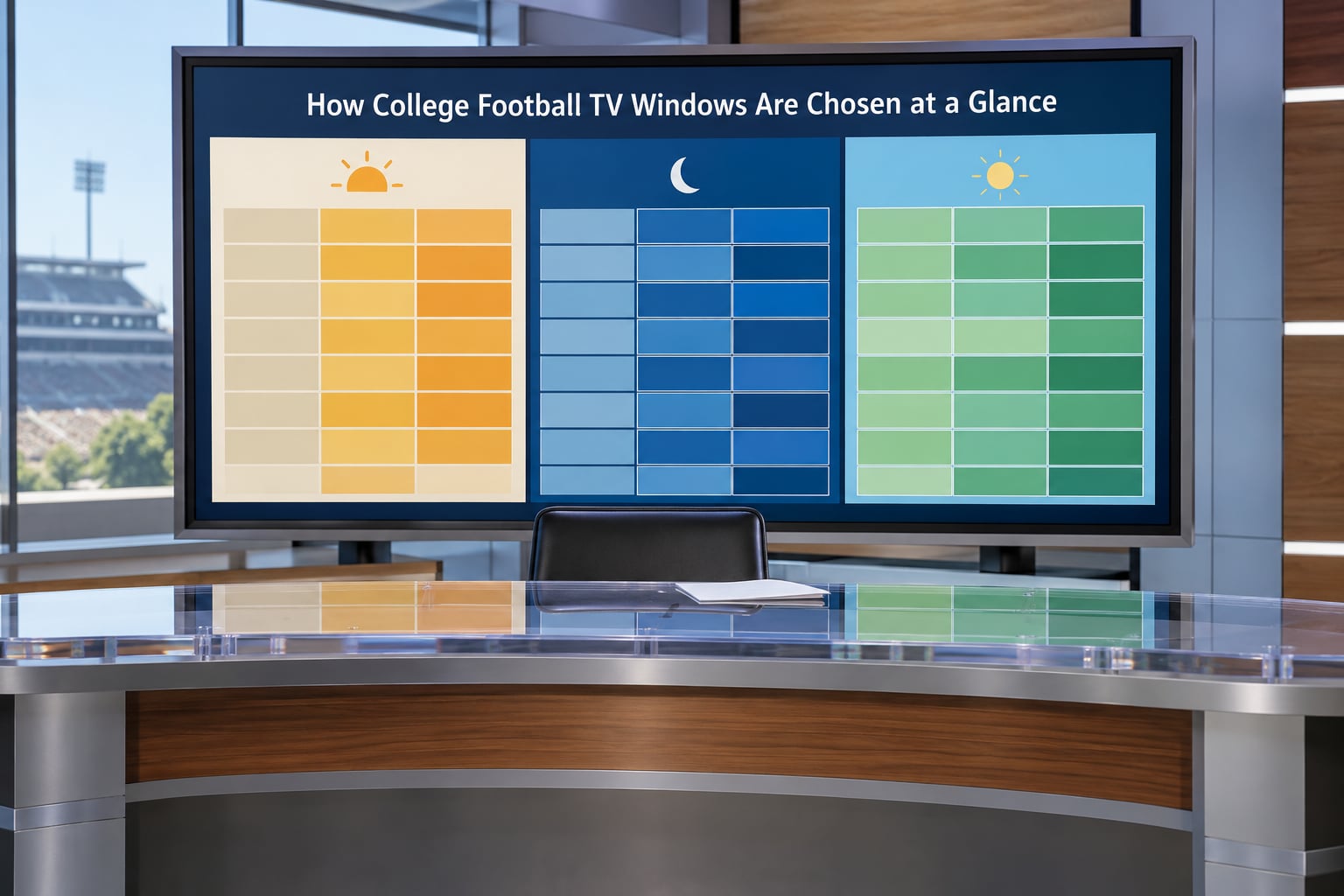
Six factors decide most Saturday assignments: the network’s selection order, the expected size of the audience, contractual minimums, the value of the matchup itself, time-zone and daylight constraints, and conflicts with other programming the network already owns.
| Factor | Who it serves | What it produces on the schedule |
|---|---|---|
| Selection order | The network holding that week’s top pick | The most-watched slot goes to the game that network chooses, not the best game available |
| Expected audience | Advertisers buying commercial time | Rivalries and high-profile programs land in prime time; regional favorites go early |
| Contractual minimums | Networks that owe appearances to sponsors or conferences | Guaranteed games are protected even in weeks with better options |
| Matchup value | Networks chasing a rivalry or a ranked pairing | A head-to-head game between two ranked teams gets a prime slot on a regional basis |
| Time zone and daylight | Host schools in the West | Late afternoon start times or a home date that was written in months earlier |
| Programming conflicts | Networks juggling tennis, racing, or postseason events | Usual slots get shifted or skipped entirely on those weekends |
Read that table as a priority list. Selection order comes first and cannot be argued with, and everything after it is a negotiation the other networks are having among themselves.
Who Chooses College Football TV Windows?
Television networks choose the week-to-week start times, conferences decide the opponents and the order of the schedule, and the media contract between the two is the rulebook everyone operates under. The conference builds the slate in the spring and sets selection order for the network partners. Each Saturday, the networks take turns picking games into the windows, and the results are usually published about 12 days ahead.
Each side guards something. Conferences want inventory protected for their postseason arrangements and want no single team owning every attractive slot. Networks want the highest-rated game in the most valuable window they can legally reach.
Who sets the kickoff time for a streaming-only game?
Streaming-only games work differently. When a game is exclusive to a platform like ESPN+, Peacock, or TNT Sports rather than a linear broadcast, the network usually has a much wider range of open start times because it is not fighting for the same audience slot. In many cases the host school sets or confirms the kickoff, within limits the rights agreement allows. A stream-only game can land at an hour that no broadcast window would tolerate, like 6:30 p.m. Pacific on a school night.
What a published kickoff time does and does not tell you
A time on a public schedule means the decision has been made by that network for that week. It does not tell you the order of consideration, whether another network asked for it, or whether a change is still possible. Most season schedules are published with approximate times early, then firm times in August, then revised again in the Monday release and again, for a small number of games, on the Sunday before kickoff.
How far in advance are college football TV windows chosen?
The pattern is consistent: dates and opponents come out with the schedule in the spring, general windows for many weeks get defined in the summer, and firm kickoff times for the next slate drop on the Monday that sits 12 days ahead of kickoff. A small number of games stay open past that point.
How Conferences Balance Control, Revenue, and Competitive Balance
Conferences do not hand over a finished Saturday and walk away. They negotiate minimum game guarantees for each partner, write rules about how many appearances a school owes a given network, and decide how many weeks a single program can own the top pick. Those terms are what keep a network picking a lesser game instead of the one its audience wants.
Inside those rules, the trade-press shorthand is that a conference is trying to protect marquee games, spread attractive matchups across its partners, avoid overloading a single team, and preserve inventory for the postseason. In practice that means two protections matter most: a cap on how many times one program can be featured, and a guarantee that lower-tier partners still get their required games.
| Conference | Media partners | Who picks first | How selection works |
|---|---|---|---|
| SEC | ESPN and ABC under a consolidated deal | One rights holder, so fewer competing picks | The conference pre-announces general windows for most weeks, leaving ESPN room to adjust kickoff times inside them |
| Big Ten | FOX, CBS, NBC, Peacock, and Big Ten Network | Rotates by week among the top partners | Multiple networks compete for the top Saturday choice, with minimum appearance counts written into the deal |
| Big 12 | FOX and ESPN-family outlets | Alternates between networks across the season | Fewer marquee brands means the value of the matchup carries more weight in each pick |
| ACC | The CW, ESPN, and ABC | Varies by week and by contract tier | Conference schedules some windows itself and lets partners pick from the remainder |
| Group of 5 | Mainly ESPN-family and Fox Sports outlets | Often no separate top pick | Games are chosen to fill whatever inventory the partner has open, so a good matchup alone rarely drives a prime slot |
How the SEC picks its windows
The SEC’s structure changed when its media rights consolidated under ESPN. Instead of discovering each week’s assignment weeks ahead, the conference now defines general windows far in advance, with an early slot, an afternoon slot, and a night slot, and the network retains flexibility on exact kickoff times inside them. Fans on conference message boards generally welcomed the move, and the reasoning holds up. Fewer competing networks means fewer games dragged into unwanted hours, even if the individual times land later than some fans would like.
How the Big Ten rotates first pick
The Big Ten splits rights across several networks, so the top Saturday choice rotates week to week. Fans in the subreddit for the conference track which network holds the first pick each week, and one of the recurring wrinkles they point to is that certain rivalry weeks come with a built-in priority for the incumbent partner. The important caveat is that conferences rarely publish the full order, so any fan chart of first picks is an informed read of the past rather than an official list.
How the Big 12 and the ACC handle selection
Both conferences spread games across a mix of broadcast and cable partners, which means value judgments carry more weight. When a league has one flagship network rather than three competing ones, the best available matchup tends to win the top slot. When a league has several, each network is sometimes choosing a game it likes over a game that is objectively better for viewers, and that is the single biggest reason a great pairing can be left for the afternoon.
How the Group of 5 fills leftover slots
Programs outside the Power Five rarely control their own Saturday. Their games are selected primarily to fill inventory the partner has not filled, which is why a conference game can appear at odd hours on a Friday or early on a Sunday morning. Program appeal still matters, but it operates as a tiebreaker rather than a driver.
Why Teams, Games, and Time Zones Matter
Once a network has the top pick, it evaluates the candidate games on a short list. National brand and recent performance usually lead, followed by the strength of the matchup itself.
Rivalries get treated differently from ranked games. A rivalry does not need two ranked teams to be worth prime time, because the audience is there for the history. A ranked-versus-ranked game is evaluated more on the size of the potential audience and whether the two fan bases overlap enough to keep both regions watching.
Local television demand shapes regional picks. Networks that air a lot of home-market games use strong local following as a reason to take a game that a national network would not touch, because the inventory is valuable even if the national audience is thin.
Then there are the hard constraints. A West Coast school can rarely be asked for a night kickoff, and daylight saving time in the fall has historically made late starts unwelcome in a handful of regions, which is why so many afternoon windows exist at all. Weather and stadium limitations factor in too, and specific date carve-outs mean a homecoming or a rivalry game can carry a locked-in time from months earlier. Users of the main college football subreddit generally get this part right: some games are written into the schedule long before any network sees them, and the rest are decided a couple of weeks out.
What Is a Flex Week in College Football?
A flex week is a stretch of the schedule where the network holding the top pick has not committed to a game yet, so the kickoff time for one or more games in the group remains undetermined until close to kickoff. Flex options are written into media contracts, which is why they exist in some conferences and effectively not at all in others.
When a game is flexible, the network waits because how that TV window is chosen depends on information it will not have until later. A late Saturday injury report can change which matchup draws an audience. A prior game’s outcome can elevate an opponent. Once a network knows more, it assigns the slot.
That is the part that confuses fans. A listing that says the time is to be determined at a specific later date looks temporary, but the arrangement was planned months earlier. The hold itself is contractual.
The practical part is knowing when a listing is genuinely open. A Saturday game with a firm time in the Monday release is settled. A game marked as flexible into the week of kickoff may still move Sunday or Monday. Non-conference games and lower-profile conference matchups are the usual candidates for a hold, since they carry the least inventory risk either way.
How Do TV Windows Affect the College Football Playoff Race?
A team’s window does not determine its playoff position, and any suggestion otherwise is wrong. Selection committees weigh win-loss record, strength of schedule, head-to-head results, division rivals, and conference championships. The television slot is a consequence of those results, not a cause.
There is an indirect effect people argue about. A team playing at 3:30 p.m. produces a full game, wins, and moves up in the rankings by Sunday. A team playing at 8 p.m. in the West may kick off as some selectors are already asleep, and the result can land in fewer feeds by the time the committee’s Sunday meetings begin. Another argument runs the other way: a late game creates a fresher rivalry result than an early one, because fewer teams have finished playing by selection time.
Head-to-head scheduling shapes the argument too. Committees reward direct wins against ranked opponents, and networks want those games in front of an audience, so a conference is more likely to build a ranked-versus-ranked pairing for a strong window. Divisions where teams play each other late in the year give committees fresher evidence, and conferences know that when they set the order.
How the Major College Football TV Windows Work
Weekend windows are consistent enough across leagues to describe as a schedule, and each carries a different tradeoff for fans, networks, and schools.
| Window | Typical start | Main outlets | Tradeoff |
|---|---|---|---|
| Early window | Noon to 1 p.m. ET | Regional broadcast and sports networks | Cheap inventory for the network, comfortable for students and a good travel day, but a top matchup here draws the most complaints |
| Afternoon window | 3:30 to 4:30 p.m. ET | Regional broadcast, sports networks, and some cable partners | The largest single block of games, which means more competition for the regional picks and more out-of-market access on a national feed |
| Night window | 7 to 8 p.m. ET | National broadcast networks and their cable sports siblings | The highest value and the most restricted. A West Coast host usually cannot take it, and the owning network rarely gives it up |
| Friday window | 7 to 8 p.m. ET, sometimes earlier | Cable sports networks and some broadcast partners | Often a reserved package slot, which is why several non-conference games cluster on Friday regardless of opponent |
| Streaming-only | Wide range, set near kickoff | Streaming platforms | Fewer scheduling conflicts and looser start times, but the game can be hard for casual viewers to find and may need a paid subscription |
Regionalization is the part most people miss. The same 3:30 p.m. game may be a national broadcast in one market and regional in another, which is why two fans can look at the same listing and see different channels.
How Can Fans Follow Late TV Announcements?
Check four sources in this order, and you will rarely be surprised by a change.
First, the conference or the network. Network posts are the authoritative word on which games landed where, and they usually appear in the same Monday window as the rest of the slate. Conference sites matter most in leagues where the conference pre-defines its own windows.
Second, the athletic department. Team sites post travel information, fan gameday guides, and parking details once a time firms up, and those are what you need for an away trip.
Third, a schedule aggregator. Aggregators are convenient, but they refresh on their own schedule, so a time showing there may lag the official announcement by a few hours.
Fourth, social accounts, with a caveat. Staff and insiders post time changes early, and those posts are usually right, but they are not the official record.
For travel, the useful rule is to book refundable fares and rooms for a home game and confirm closer to kickoff. A noon start on a Saturday is very unlikely to become a night game once the Monday release lands, so the riskiest booking decision is a long drive or a flight timed to an early afternoon start, since a hold can push that game later rather than earlier.
For fantasy players, note that flexed games usually resolve before the Sunday morning deadline, and streaming-only games carry the same roster rules as broadcast games.
Frequently Asked Questions
Why do some college football games have late or undecided start times?
A network is waiting on information that only arrives close to kickoff, such as an injury report or the result of an earlier game that changes which matchup draws an audience. When a contract allows a flex option, the network can hold the assignment open. That is why some listings show a time as to be determined for part of the week before kickoff.
Are college football TV windows based only on team ranking?
No. Ranking is one input, alongside rivalry history, national brand, recent performance, expected audience, contractual minimums, time zone, and conflicts with other programming. A lower-ranked rivalry game can beat a ranked non-rivalry pairing to a prime window, and a ranked matchup can sit in the afternoon when a different network controls the top pick that week.
Does playing in a later TV window help a team reach the College Football Playoff?
It does not help directly. Selection committees weigh record, strength of schedule, head-to-head results, division rivals, and championships. A late game may finish closer to selection time with fresher results, but that is a scheduling artifact, not an advantage. No committee ranks a team based on the window it played in.
Why does a network change a game’s time shortly before kickoff?
Usually because a flex option allowed it and the information that mattered arrived late. A better game became available, an injury report changed a matchup’s appeal, or a program clash opened a slot. Games without flex options, such as most non-conference and rivalry dates, are far less likely to move once announced.
Which source should fans trust when a college football TV assignment changes?
The network’s own announcement is the official record, and the conference site is equally authoritative in leagues where it defines the windows. Team athletic department pages are best for gameday and travel details. Aggregators and social posts are useful early signals but can lag or be unofficial, so check them against the network before you change plans.
Conclusion
The conference builds the schedule and writes the rules. The network picks the games and sets the times, working down a contractual list of assignments it cannot skip and a priority list of games it prefers. Everything fans find strange about kickoff times traces back to that division of control.
When a time is still tentative, look at three things in order: whether the game is conference-controlled or a network’s own selection, whether that league uses flex options, and whether the matchup is a rivalry or a ranked pairing. A game holding that combination is the one most likely to move. Everything else, a Monday release usually settles.