ESPN does not choose college football games one at a time on its own. Games are assigned almost entirely by conference media rights contracts and a recurring weekly selection process among the networks that share those rights, and kickoff times plus final network calls are locked roughly 6 to 12 days before each game.
That answer hides more than it gives away, so the rest of this piece walks through the actual process: what the contracts decide, how the annual draft works, what makes a game attractive to a network, and how you can tell a real assignment from a rumor.
Updated for 2026. College football schedules move often, so treat anything you read about a slate in September as a snapshot rather than a final map.
Table of Contents
- How ESPN Picks College Football Games to Broadcast
- What Makes a College Football Game Attractive to ESPN?
- How conference and television contracts affect the slate
- Why ESPN changes games before they are played
- A Week-by-Week Guide to ESPN’s College Football Slate
- How to Tell a Confirmed ESPN Game From a Projection
- Frequently Asked Questions
- Does ESPN choose its college football games based only on team rankings?
- Why can an attractive nonconference matchup move to a different television window?
- What does flex scheduling mean on an ESPN college football schedule?
- Are games listed on ESPN’s website always confirmed for that channel?
- How can fans watch an ESPN college football game away from home?
- Conclusion: What to Watch First
How ESPN Picks College Football Games to Broadcast
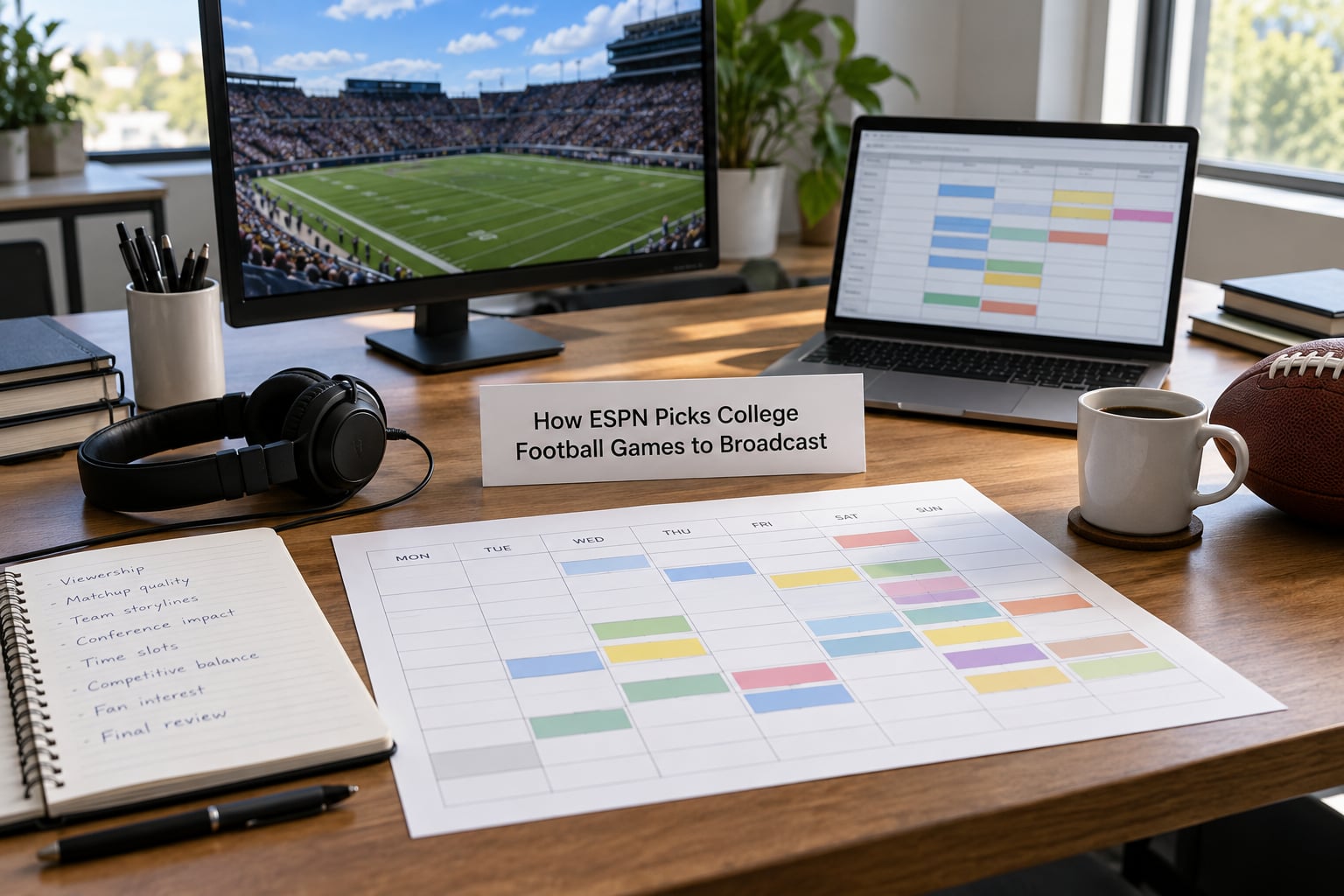
Eight things drive nearly every decision about which network shows a college football game.
- Which contract the conference signed, and which network holds the rights.
- How many games the network is guaranteed each week.
- Expected ratings and the size of the audience.
- Rivalry value and whether both teams have national profiles.
- The conference’s own ranking and television footprint.
- Which window fits: noon, afternoon, prime time or late.
- Who the in-market home team is for a regional broadcast.
- Whether the game already exists on another network or streaming service.
Rights come first. Everything after that is a negotiation inside the boundaries a contract draws.
How the College Football Selection Process Works
The cycle starts long before kickoff. Conferences negotiate multi-year media rights agreements years ahead, and those deals decide the number of games a network carries, the channels it can use, and how much inventory it holds each week.
Inside that framework, the networks holding overlapping rights meet in a scheduling draft. It typically starts in early February and runs into mid-May, according to industry reporting on the annual ESPN and FOX process. During those calls, the sides take turns selecting weeks rather than individual games, and each week is debated on the basis of expected audience size and advertising revenue.
Only a slice of the schedule is public in advance. The first few weeks are usually revealed before the season begins, and later weeks tend to be released somewhere between 6 and 12 days before kickoff. Some slots stay listed as time TBD, which is the schedule’s way of saying a window exists but the kickoff hour has not been fixed.
Networks do not publish the ratings model behind those choices, and conferences rarely publish how much say they have in a given week. Transparency is limited on purpose.
What Makes a College Football Game Attractive to ESPN?
Matchup quality is the first filter. Two ranked teams with a history of close games pull a bigger audience than two programs nobody outside their fanbases follow, and networks build their weekly picks around the games most likely to hold an audience.
Rivalry games carry extra weight because the audience is guaranteed rather than projected. A regional rivalry draws viewers in two time zones who will not tune in for an unknown opponent, and a historic series such as a Michigan and Indiana game gets argued over in the draft calls precisely because both sides can project a number.
Team profile matters just as much as record. Programs with recent national playoff runs, long-running television relationships and large alumni bases in a particular market are easier to sell to advertisers, and a network treats that sellability as part of the value.
Conference standing and window fit do the deciding work. A game that fits a prime time slot has a different commercial profile than one buried at noon, so the same matchup can be worth more at 8 p.m. than at 12:05 p.m. Projections are estimates, though. A slate built on expected audiences can disappoint once actual games start trending.
How conference and television contracts affect the slate
A conference media rights agreement is the single most important input. It fixes which network holds the games, how many, on which channels, and for how long. It also determines whether a conference keeps any games for itself.
Exclusivity is the part fans notice most. When a conference sells its inventory to a national network, that network typically controls every televised game in the conference, which means the league’s own channel carries fewer and less prominent matchups. It is also why you may see a conference network airing a conference’s games while its biggest Saturday game sits on a national network hours later.
Independents and religious schools complicate the grid because they have no conference contract. A school that does not belong to a conference negotiates its own deal, which is why a program with a national audience can land on a network that carries no other games from its region.
| Outlet | Typical role in the college football schedule |
|---|---|
| ESPN | Flagship channel for the highest-drawing national selections |
| ESPN on ABC | Major Saturday afternoon games with wider reach |
| ESPN2 and ESPNU | Secondary national windows and lower-tier selections |
| ACC Network, SEC Network, Big Ten Network | Conference-specific programming built around their own leagues |
| FOX, CBS, The CW | Rights held by other conferences and conferences in overlap |
| ESPN streaming tiers | Games that are not part of the linear national windows |
The rights map changes constantly, and conference realignment is the fastest-moving piece. When a league lands a new deal or a program changes conferences, the network that used to carry a fan’s team may not be the network that carries it now. Nothing in the new deal signals that change more clearly than an autumn schedule full of unfamiliar channel names.
Why ESPN changes games before they are played
Late changes happen more often than the planning process makes it look, and most of them trace back to a game that did not behave as expected.
The most common cause is an overflow. When one game runs past its scheduled window because of a tie, a long weather delay or a rivalry that keeps going, the next game’s kickoff moves. If the moved game was assigned to a different network, that network inherits the change too, and an assignment announced days earlier can flip hours before kickoff.
Program-level changes come next. A team that has to play a conference game instead of an originally planned nonconference matchup alters the competitive picture, and a late decision about a starting quarterback or a postseason berth can push a network to revalue the week.
Weather and safety decisions can force a move that nobody in the scheduling process chose. Postseason changes work the other way, since playoff field and seeding talk reshapes the last weeks of a regular season the conference already sold.
When a change is real, the network and the schedule page both reflect it. Rumors rarely do, which is the subject of the next section.
A Week-by-Week Guide to ESPN’s College Football Slate
Saturday’s slate reads like a grid only once you know the windows. A typical national schedule runs a noon ET game, an early afternoon window, a 3:30 p.m. block, a 7:30 p.m. slot, a prime time game at 8 p.m. and one late window afterward.
Flex scheduling is the mechanism that keeps those windows honest. A game listed with a start time subject to change, or paired with another game in the same window, is a placeholder. The actual assignment can shift by several hours depending on what needs to fill.
Regional games follow in-market logic. When two teams play in the same broad market, the regional network serves that market and the national network takes the rest. In-market games can also replace an announced selection, which is why a network may drop a nationally interesting game in favor of two regional draws if the schedule math requires it.
Weekly planning has its own rhythm. Early weeks are locked long in advance because teams need travel and ticket notice. Later weeks are less settled because the competitive picture changes as the season develops and because conferences want the option to schedule their strongest remaining matchups in better windows.
Streaming tiers add a final wrinkle. Some games exist only in a streaming package and never appear on a linear channel, which is a distribution decision rather than a selection decision but reads to fans like a demotion.
How to Tell a Confirmed ESPN Game From a Projection
Start with the label, not the screenshot. A confirmed assignment appears in the official weekly schedule release from the network or the conference, usually with a network, a date and a kickoff time all filled in.
Anything labeled time TBD has a window but not a fixed hour. That means the game exists in the schedule and the channel is settled, while the start time can still move inside a range.
Projections look different. Media guides, aggregators and unofficial schedule trackers publish early-season guesses built from the draft, and they routinely carry plausible but unconfirmed network assignments. If a listing has no date-specific release behind it, treat it as a guess.
When something looks wrong, check three places in order: the network’s official college football schedule page, the conference’s release, and the date-and-time listing attached to the game. Announcer assignments come after the network decision, so a broadcast team listed on a game is strong confirmation that the network itself is settled.
Frequently Asked Questions
Does ESPN choose its college football games based only on team rankings?
No. Rankings are one input, but the conference media rights agreement decides which network is even allowed to carry the games, and the weekly selection process weighs expected ratings, rivalry value, window fit and in-market logic on top of that. A highly ranked team can land on a secondary channel when a rival game needs a stronger window.
Why can an attractive nonconference matchup move to a different television window?
Nonconference games are usually the easiest to relocate because they carry less conference obligation than a league game. Once a season develops, networks and conferences may shift a nonconference matchup to a later window to protect a more valuable rivalry in prime time, or out of a window where two similar draws are competing for the same audience.
What does flex scheduling mean on an ESPN college football schedule?
Flex scheduling means a game has a window but not a fixed start time, and it can move within that window depending on what the rest of the day requires. A listing marked time TBD is the clearest sign of a flex assignment. The window usually does not change, but the kickoff hour can slide by an hour or more as the schedule is finalized.
Are games listed on ESPN’s website always confirmed for that channel?
Not always. Early in the season, schedule pages can include projected entries built from the planning draft rather than final assignments. A confirmed game appears in an official weekly schedule release with a date, a network and a kickoff time. If a listing shows time TBD, the channel is settled but the hour is not, which is a different kind of provisional than a projection.
How can fans watch an ESPN college football game away from home?
Three routes cover most cases: the network’s linear channel through a TV provider login, the ESPN streaming tiers for games that are not part of a linear window, and the conference network that carries many of a league’s other games. Because streaming tiers replace the older standalone add-on in the current lineup, check which package the specific game belongs to before assuming a login will cover it.
Conclusion: What to Watch First
Three things explain nearly every assignment. The conference media rights agreement decides who is allowed to carry the game, the weekly selection process decides which of the available windows it takes, and late changes adjust the result right up to kickoff.
Start with the current weekly slate release from the network or your conference, then check whether any listing is marked time TBD before you plan a watch party. If you want to predict rather than react, learn to read which networks share rights in your conference, because that overlap is exactly where the picks move first.