Keeping a basketball scorebook is straightforward once you follow the same order every time: fill in the game details and rosters before tipoff, mark each possession and scoring play as it happens, track fouls, timeouts and substitutions, then tally and verify the totals at every break and after the final horn. Most beginners lose games not because the notation is hard, but because they record a play a beat late and then have to reconstruct it from memory.
Budget 15 minutes of setup before the game and a few focused minutes at each period break. I have watched enough scorers fumble a fourth-quarter scoreboard to know the difference is almost never talent — it is a repeatable routine and the confidence to say a number out loud so the coaches and officials hear it too.
This guide covers how to keep a basketball scorebook for youth, recreational and school games using paper, which is still what most scorer’s tables run on. We will walk the whole thing in order: what to bring, what to write in each phase, and what to do when you miss something.
What You Need
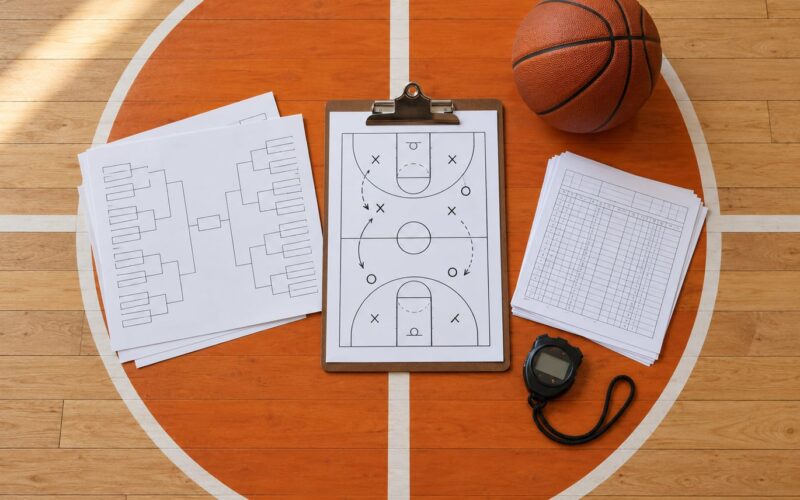
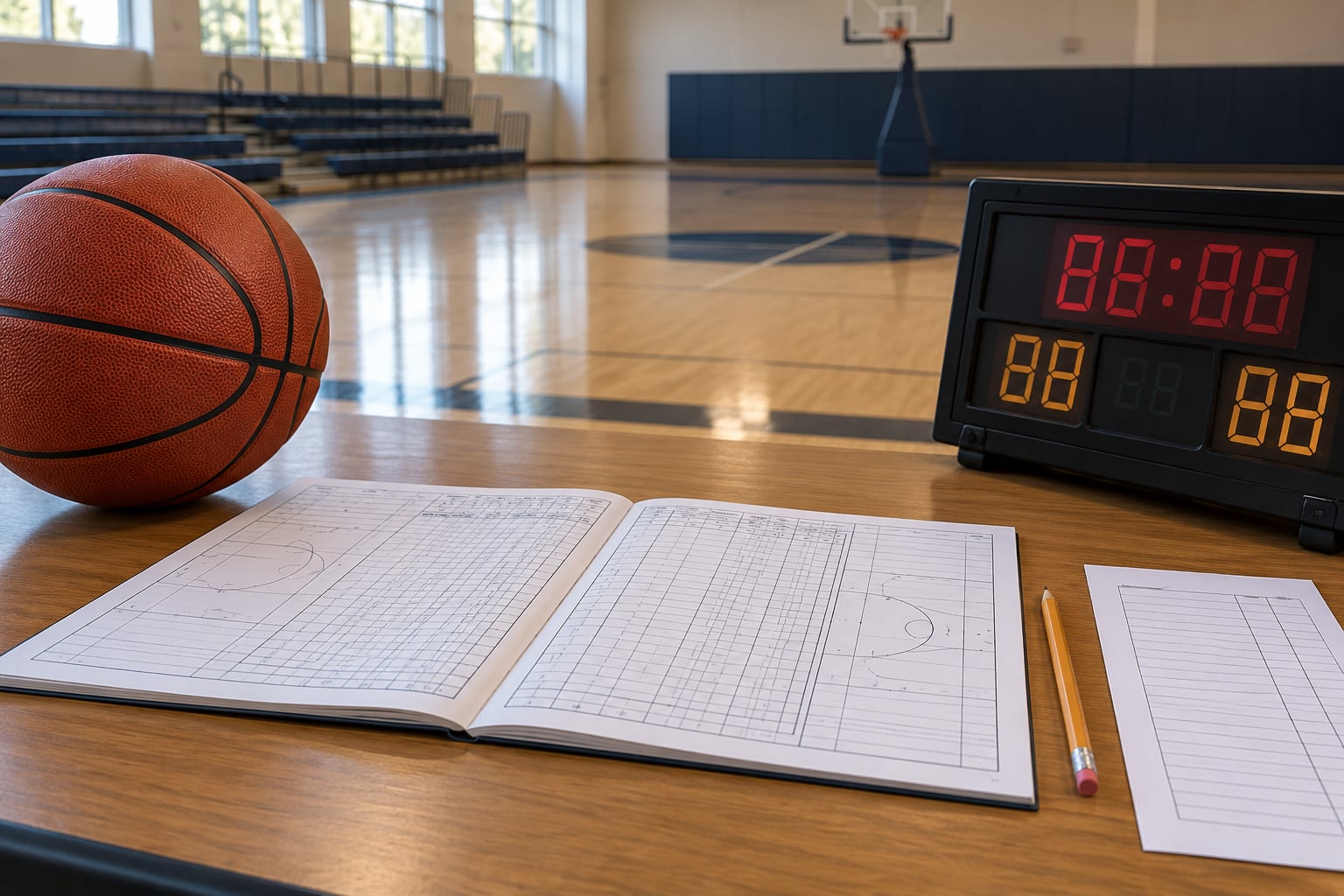
You need a game scorebook, a pencil or pen, the team roster for both sides, the game rules for your league, and a way to mark period and timeout information. That is the whole kit. A clipboard, a spare roster sheet and an eraser for a dry-erase board cover the things that go wrong at least once a season.
Use a pencil rather than a pen if your scorebook is paper. Officials may need you to correct a mark, and a pencil lets you do that cleanly under your league’s correction rules instead of crossing the whole sheet out.
The exact columns will vary by scorebook format. A two-page-per-game commercial book, a one-page sheet with both teams, and a FIBA-style scoresheet all hold the same information in different layouts. What should not vary is which information you record, and using the same notation for the same event every single game so you build muscle memory.
- Scorebook or scoresheet: a bound book keeps every game’s result together, which coaches tend to prefer, while a single printed sheet works fine for a rec league with one table.
- Roster sheets: one per team, with jersey numbers matched to player names before you sit down.
- League rules or rulebook: bonus thresholds, period length and overtime differ enough that guessing causes real problems.
- A clock you can run: the game clock at the table is your timing reference for period length and timeouts.
Step-by-Step
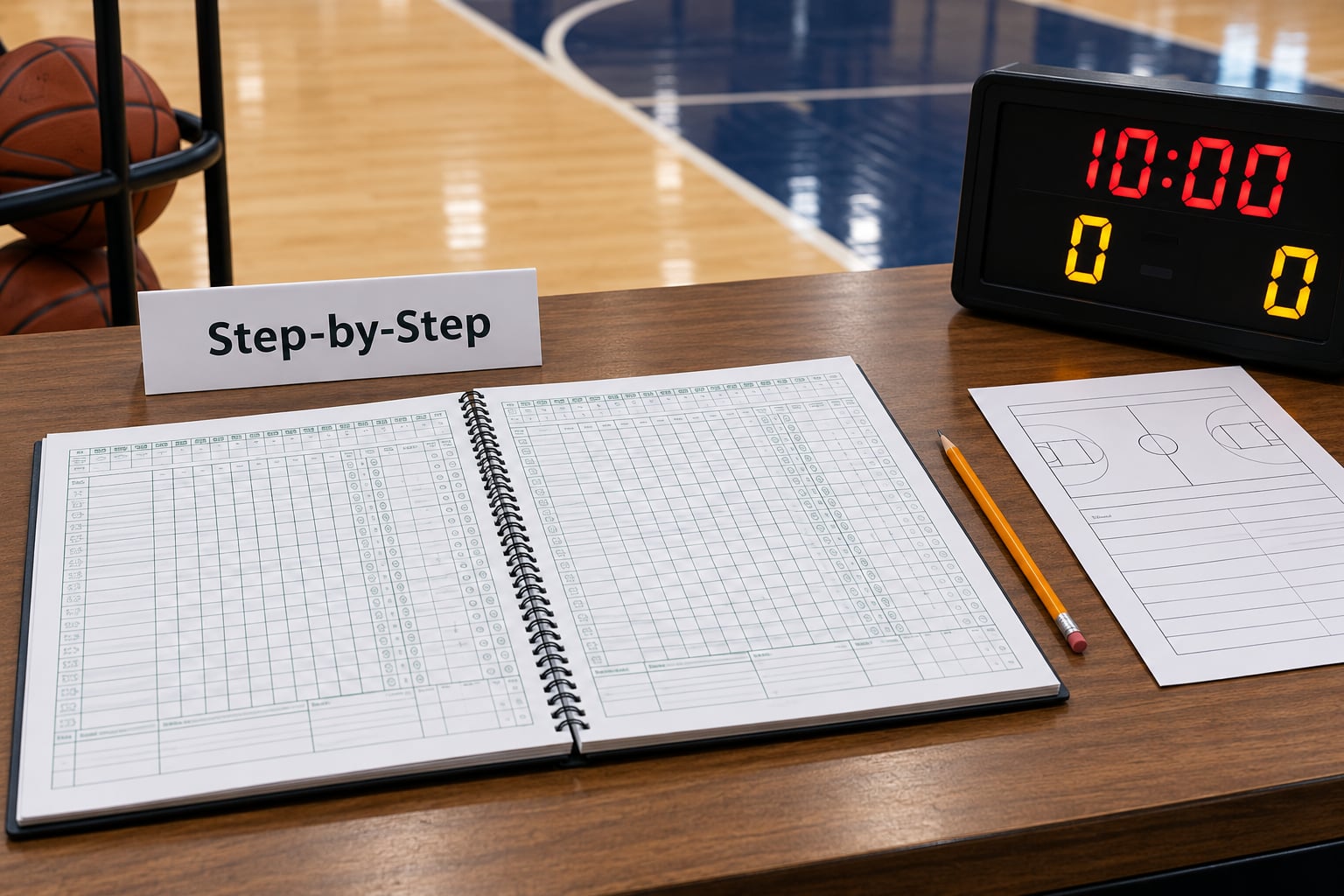
The sequence below runs from the opening tip to the final horn in the order the plays actually happen. Announce changes aloud as you make them, so the scorer, the coaches and the nearest official all hear the same number at the same time. Out loud is the part people skip, and it is the part that catches mistakes while they are still fixable.
1. Set Up the Game Before Tipoff
Fill in the date, teams, starting players and game details while the teams are still warming up. Identify which side is home and which is visiting, and enter each roster in numerical order rather than by who walked in first. Numerical order saves you a search every time the ball changes hands.
Mark the five starters clearly, either with an X beside the number or a star in the margin, because starting lineups are what coaches check first and what broadcasters read off the sheet. Then confirm which team receives the opening possession and note the direction of play.
Take a minute to locate the columns you will use most: foul circles, the team foul row, timeout boxes, the running score track and the period totals. Knowing where each field sits before the game is the difference between watching the floor and hunting for a column mid-possession.
2. Record Every Possession
Mark the team with possession, keep the direction of the arrow or possession indicator current, and record the result of the attempt in the scoring player’s row. Do it at the moment the ball goes through the net or the whistle sounds, not after the next two possessions have already started.
Notation usually follows one simple pattern: 1 for a free throw, 2 for a field goal, 3 for a three-pointer. Many books use a slash for a field goal and a small circle for a free throw, filled in if made and left open if missed. Whatever your book uses, use it consistently — a mixed notation is impossible to total at the end of the quarter.
A few events come up constantly, so it helps to have their handling memorised:
- Missed shot: mark the attempt for the shooter and note the rebound under the rebounder’s row.
- Made basket: add the point value in the shooter’s row and cross off the next box on the running score.
- Offensive rebound: keep possession with the same team and let the shooter try again from a new spot.
- Turnover: mark it in the column your format uses and note who gained possession.
- Defensive rebound: credit the rebounder and flip the possession arrow.
Say the score out loud as you update it. “It’s 14 to 11” takes a second and settles any argument before it starts.
3. Track Fouls, Timeouts, and Substitutions
Record player fouls in the row for that player, usually in a small circle or square numbered 1 through 5. Record team fouls in the team foul row, which runs across the page for that period, so both the individual and the team totals stay visible at the same time.
Know where your league draws the bonus line and say it out loud when the team reaches it, because the officials need to hear it too. Most leagues go to bonus on the fifth team foul of a period or half, and double bonus adds two free throws instead of one in the second half of the period. Check your rulebook, because college, high school, international and youth leagues genuinely differ here.
When a player picks up their fifth foul, tell the nearest official and mark the fouled-out column in the same breath. Missing a foul-out can cost a team a rotation, and correcting it later is painful.
Timeouts get a single mark per period, and a note for any unusual situation your league requires. Substitution entries go in the section your book provides, typically near the player rows, with the incoming player’s number and the clock or score.
4. Keep the Clock and Period Totals Accurate
Mark the period clearly and update the running score and team totals after every scoring change, without waiting for a natural pause. Free throws are the usual culprit: a two-shot trip that gets logged as one basket leaves the board a point out and nobody notices until halftime.
At each break, add the period, cross it off the period list, and check that the period total matches the sum of the boxes you just filled. A quick recount at the break takes 30 seconds; a recount at the end of the game with coaches arguing takes much longer.
If your table operates the game clock, keep one hand on the controls and one on the scorebook, start and stop on the official’s signal, and never let the two tasks happen at the same moment. Working the clock and writing the score simultaneously is how possession arrows end up backwards.
5. Check the Final Score and Correct Errors
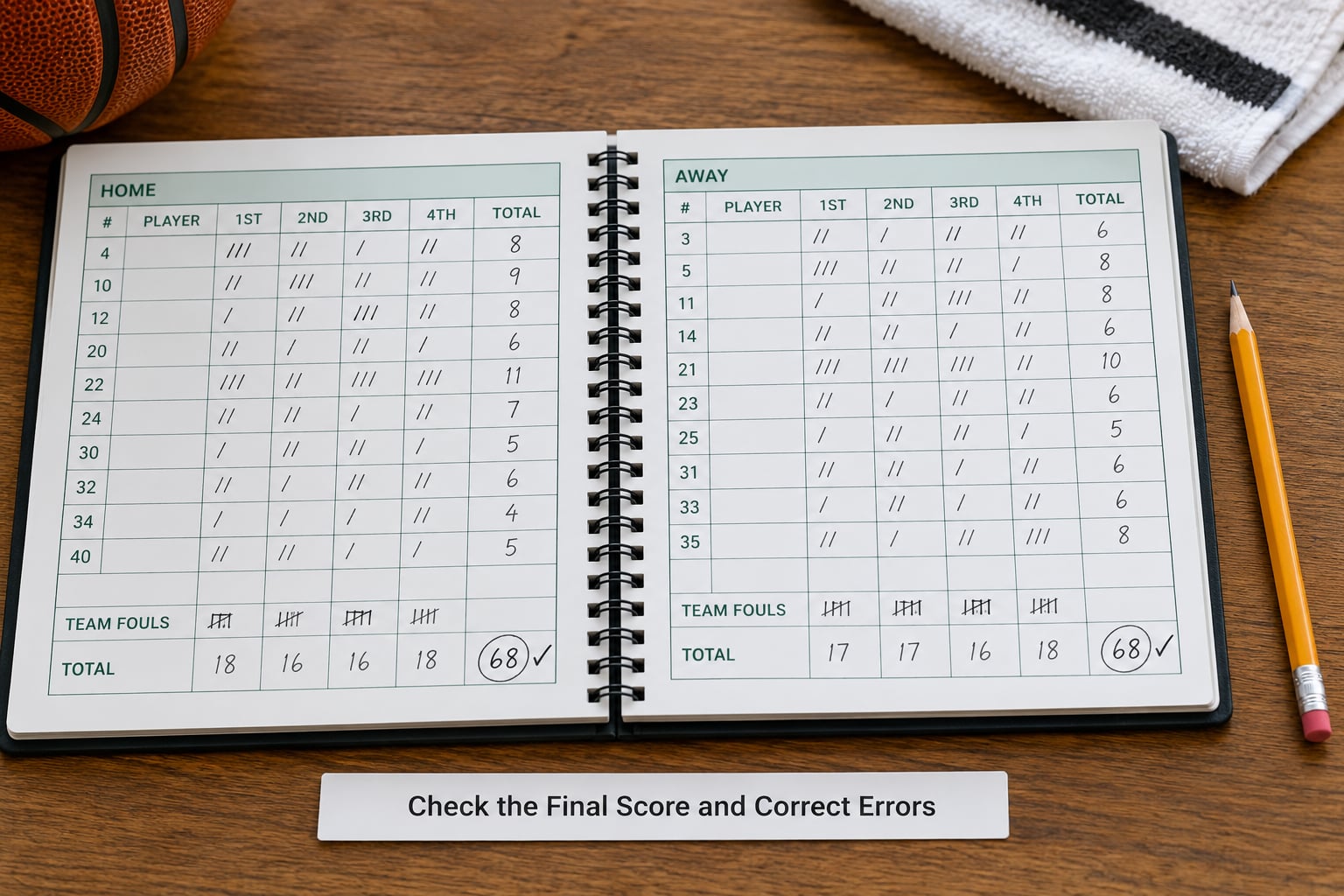
After the last horn, total the scoring marks and confirm the team foul and timeout records where the result depends on them. Compare the two totals against the numbers you called out during the game — if they disagree, the error is usually in the free throws or the running score, not in the field goals.
Make corrections the way your league requires, usually a single thin line through the error with the correct value beside it, and get the official or table manager to initial anything that changes the score. Never erase a whole section or rewrite a page; a rewritten page is what causes a protest.
Then announce the final score before anyone leaves the table. A verified, spoken final number ends the game cleanly.
Common Mistakes
These are the errors that show up in almost every first season of scorekeeping, and each one has a simple fix:
- Recording a possession under the wrong team. The arrow gets flipped but the box does not. Fix: update the arrow and the running score in the same motion.
- Forgetting to update the running total. Individual points are right, the board is wrong. Fix: cross off a box every single time, no batching.
- Confusing player fouls with team fouls. One gets personal, the other triggers bonus. Fix: mark both in the same breath when a whistle sounds.
- Skipping rebounds and turnovers. Fix: give each event its own column and fill it even when the possession does not change.
- Using the wrong period notation. Logging an overtime period as a regular quarter changes the margin. Fix: label every period explicitly, including OT.
- Missing a foul-out. Fix: call the fifth foul out loud to the nearest official.
- Logging two free throws as one basket. Fix: mark each attempt separately.
- Correcting the sheet the wrong way. Fix: one thin line through the error, correct value beside it, official initials.
A few habits keep a scorer calm. Sit where you can see both benches and the shot clock without turning your head, keep the roster sheet beside the book so names resolve instantly, and decide beforehand that you will call the score out loud every time it changes.
Frequently Asked Questions
What is the easiest way to keep a basketball scorebook?
The easiest method is a fixed order you never deviate from: game details and rosters before tipoff, then every scoring play in the shooter’s row as it happens, then a tally and check at each break. Keep a minimal stat set if it is your first game, points, personal fouls and team fouls only. Write each play the moment the whistle sounds rather than reconstructing it later, and say the score out loud.
Do I need to record rebounds and turnovers?
Not at the start. Most beginner scorers do better tracking points, personal fouls, team fouls and timeouts accurately than tracking everything poorly. Add rebounds and turnovers once those four are automatic. If you want fuller numbers, use a format with a dedicated column for each and fill it in as you record the possession, rather than trying to add columns for players you barely see.
What should I do if I miss a play?
Ask the nearest official or a coach what happened before you write anything. Officials will give you the shooter and the point value for most plays, and coaches usually know the rebound or turnover. Then record it in the correct row and update the running score. If nobody can confirm it, write down your best information and flag the play for review instead of guessing silently.
How do I correct a mistake in a basketball scorebook?
Use one thin line through the incorrect entry and write the correct value next to it, then have the nearest official initial the change. Most leagues also want you to note the game time of the correction. Never erase a section, use correction fluid, or rewrite a page, because those marks are what officials use to decide whether the record can still be trusted.
Can I keep a basketball scorebook on a phone?
Apps work for simple scoring at a casual level, and they give you a visible scoreboard to show fans. The trade-off is speed: entering plays on a screen during a fast sequence takes longer than a pencil mark, and you spend more time looking down. Paper remains faster and easier to correct under time pressure, so most competitive tables still run it. Whichever you choose, keep the same notation habits.
How do I know the game is over and which score is final?
The game is over when the final horn sounds and, in most leagues, the ball is dead after the last free throw or inbound. Verify the score by adding your period totals one more time, confirm nothing changed on the last possession or free throw, then announce the final score before anyone leaves the table. Once an official or table manager has initialled the sheet, the score is the official record.
Conclusion
If you remember one thing about how to keep a basketball scorebook, make it the order of operations: set the sheet up early, record each possession as it happens, update the running total immediately, and verify the totals at every break and after the final horn. Everything else, notation quirks, format differences and bonus thresholds, sits on top of those four habits.
Take a blank book home before your next game and work through one full quarter on paper with no crowd. Do it twice and the table will feel boring, which is exactly the point. Updated for 2026.